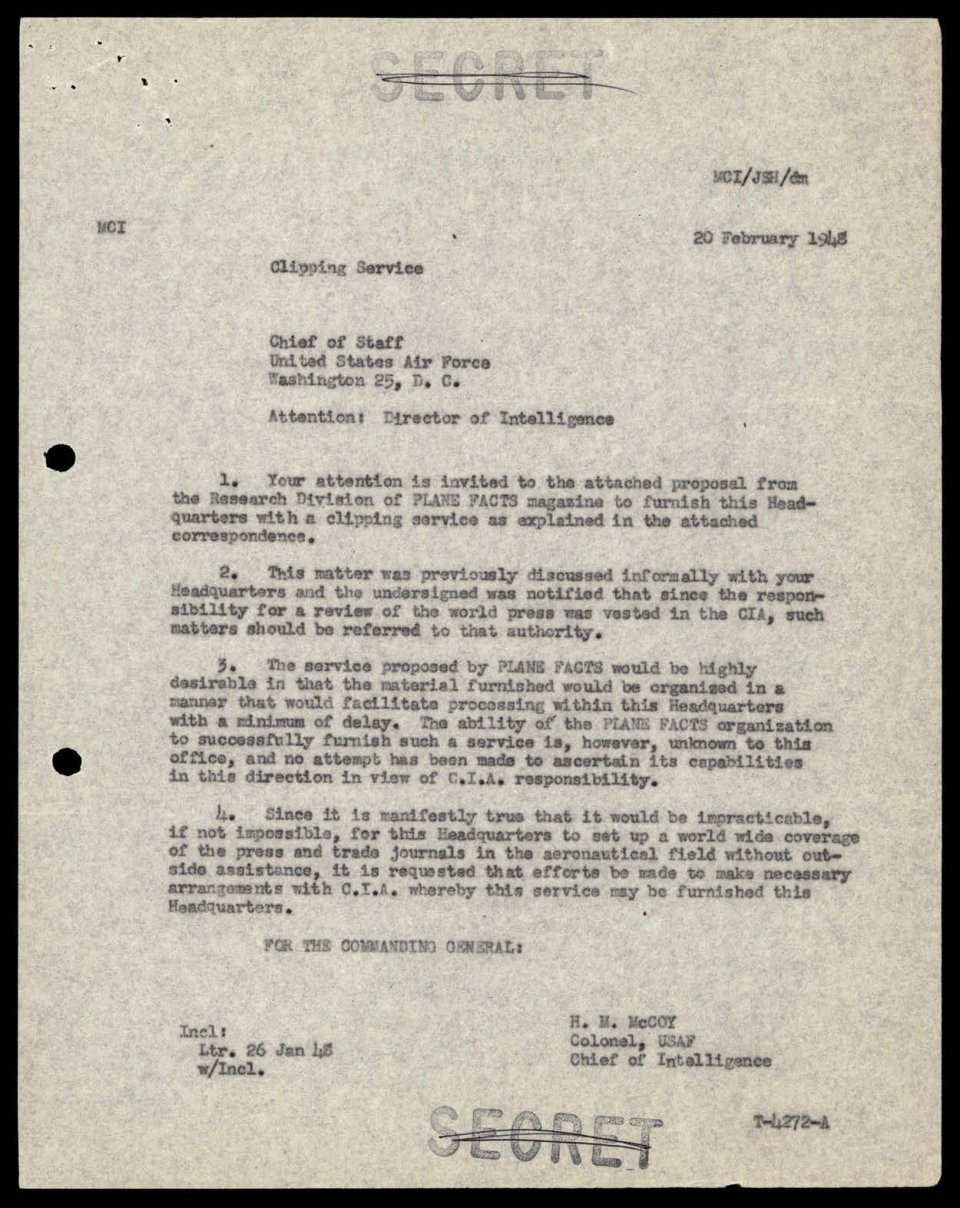
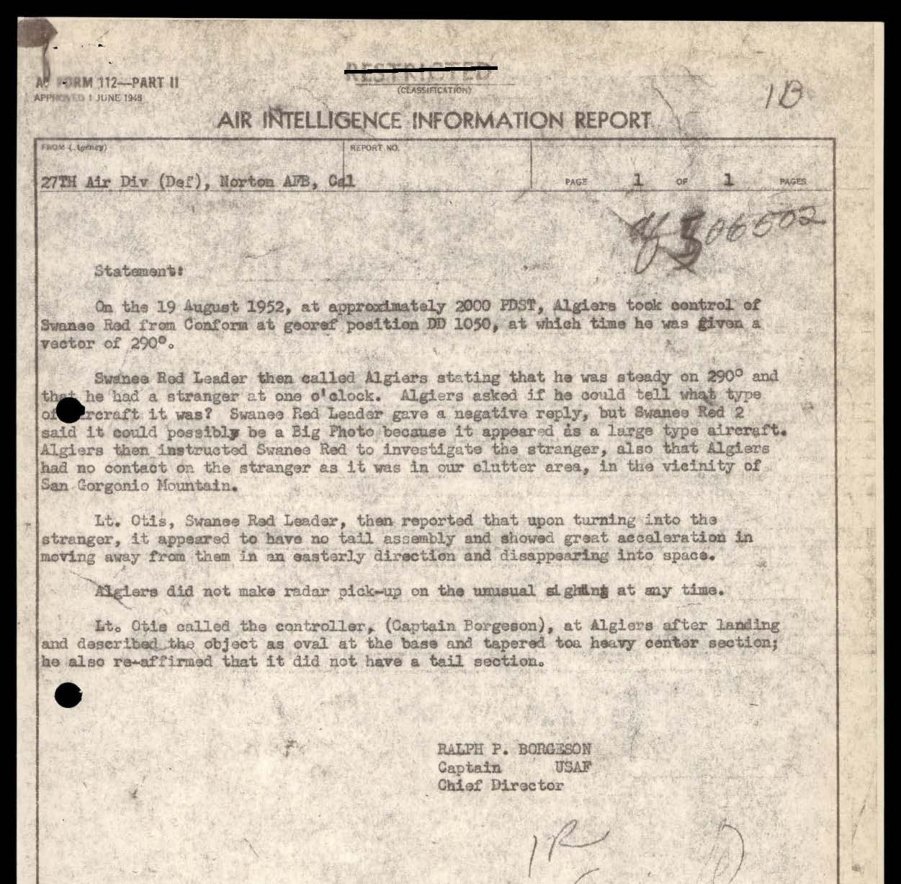
Data: Março de 1952, segundo a nota do Departamento de GuerraLocal: Local da palestra não identificado na transcrição
Palestra de 1952: Ruppelt diz que um em cada cinco relatos “não permite conclusão”
A transcrição de uma palestra do capitão Edward J. Ruppelt mostra como a Força Aérea reorganizou a investigação de OVNIs no início de 1952. Ele conta cerca de 800 casos, dos quais uns 20% seriam bons relatos sem explicação, e descreve câmeras e radares que pretendia usar para obter dados físicos.
- Data do evento
- Março de 1952, segundo a nota do Departamento de Guerra
- Local
- Local da palestra não identificado na transcrição
- Tema
- História da investigação
- Órgãos das fontes
- DOW
- Documentos
- 1 documento · 19 páginas
- Leitura
- 63 min
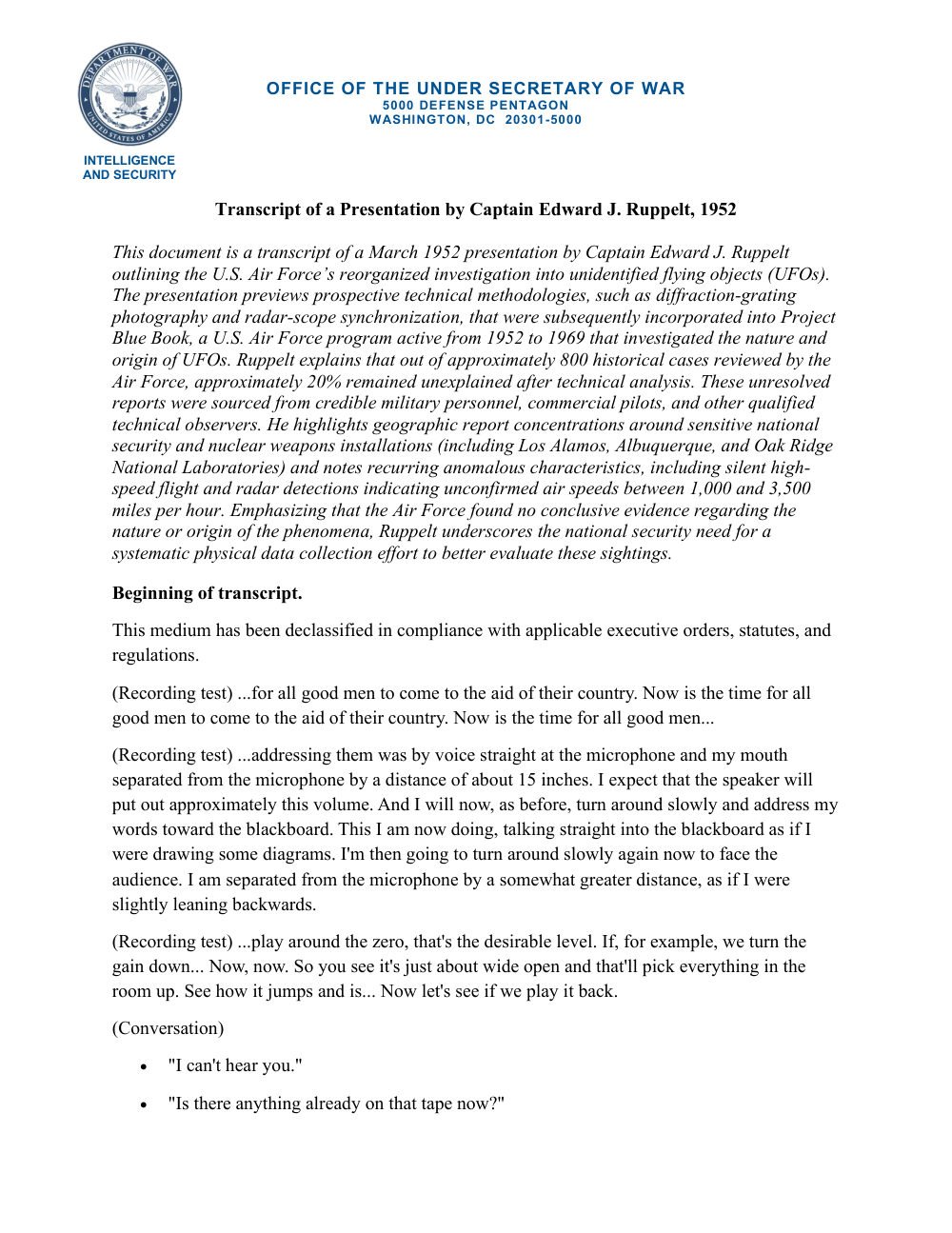 Primeira página de transcriçãoPágina física 1
FONTES DOCUMENTAIS · DOW
O que os registros contam
O documento é a transcrição de uma gravação em que o capitão Edward J. Ruppelt, engenheiro responsável pelo projeto de objetos voadores não identificados da Força Aérea, fala a uma plateia que faz perguntas. Uma nota do Departamento de Guerra, no alto da primeira página, data a palestra de março de 1952 e a relaciona ao Projeto Blue Book; essa nota é um resumo moderno, não fala de Ruppelt. A transcrição começa com testes de microfone e conversas, e não identifica o local nem o público. O áudio correspondente foi divulgado como DOW-UAP-PR160.
Ruppelt conta a história do projeto do ponto de vista da Força Aérea. Os relatos começaram em 1947 com Kenneth Arnold, que ele situa “em Idaho”, onde Arnold morava. Um relatório de agosto de 1949, com cerca de 300 casos e consultores como o astrônomo J. A. Hynek, concluiu por histeria coletiva, pessoas perturbadas ou em busca de publicidade e confusão com objetos comuns. Segundo ele, das três explicações só a última se sustentava. De cerca de 800 casos, uns 2% eram fraudes, e uns 20% eram bons relatos de pessoas muito confiáveis dos quais nenhuma conclusão podia ser tirada. O caso foi reaberto “por volta de outubro passado”, com um engenheiro permanente.
Ele descreve mapas e gráficos que a plateia mal conseguia ver. Havia concentrações em Dayton e Columbus, que descartou por causa dos voos experimentais de Wright Field e da proximidade do projeto, nos portos, em Los Alamos e Albuquerque, em White Sands e em Camp Hood; as de Oak Ridge e Albuquerque “talvez signifiquem algo”, disse, sem saber o quê. Os relatos tinham pico em junho e julho. Grupos de luzes eram 0,6% do total; objetos parecidos com aviões, 2,5%. Formas de charuto podiam ser efeito da persistência da imagem no olho. Os discos eram sempre silenciosos, e ele dizia não conhecer motor que funcionasse sem ruído.
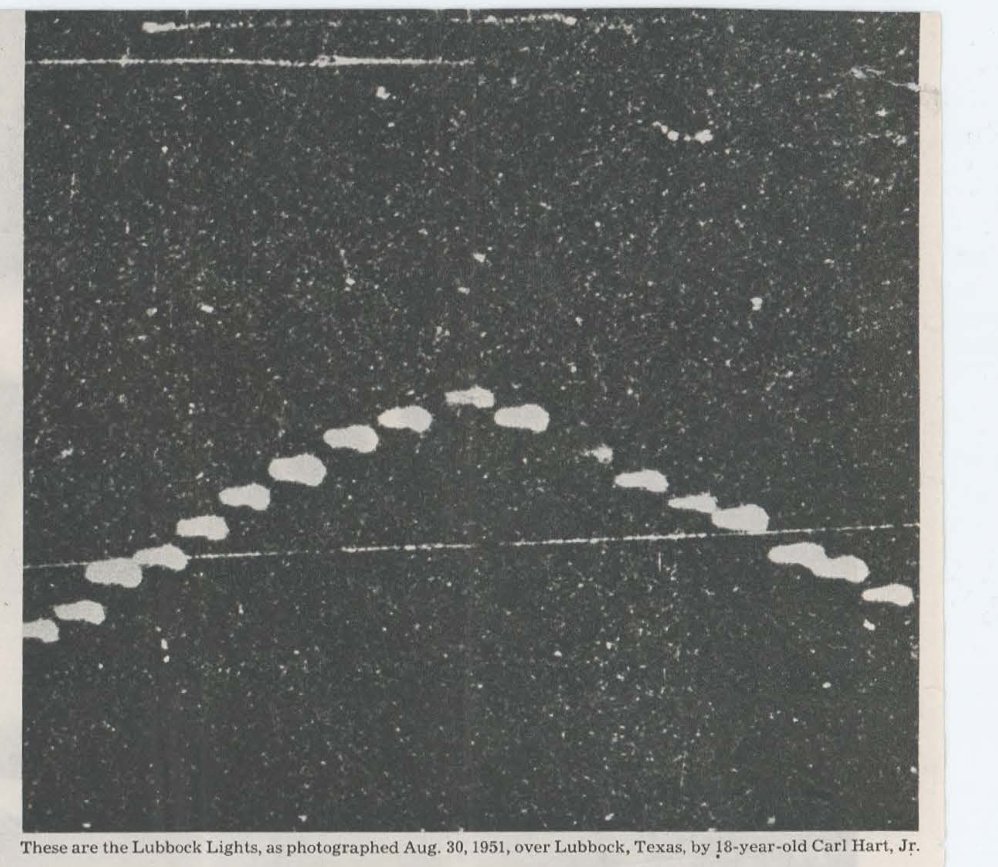
Sobre os pilotos, Ruppelt diz que os de linhas aéreas eram confiáveis, mas evitavam relatar por medo de ridículo, e que histórias ouvidas de pilotos sobre o Oriente Médio eram só boato. Explica que pilotos militares confundiam balões com objetos grandes e rápidos, e que não bastava haver um balão lançado a 100 milhas para encerrar um caso: era preciso reconstruir a trajetória com os ventos. Cita fotografias, entre elas as de Phoenix em 1947 e as de Lubbock em 1951, um rastreamento em Holloman a uns 150 mil pés e 3.500 milhas por hora que os próprios operadores não garantiam e que podia ser um meteoro diurno, e as bolas verdes do Novo México, estudadas sem conclusão.
Os planos eram obter dados físicos. Ruppelt descreve câmeras baratas com rede de difração, ideia de um certo Dr. Kaplan, da Universidade da Califórnia, para guardas de Sandia e White Sands fotografarem luzes e permitir análise do espectro; câmeras nas telas de radar do Comando de Defesa Aérea, cujos radares tinham registrado alvos de 1.000 a 3.500 milhas por hora sem que se pudesse descartar defeito ou efeito atmosférico; e, ainda só em conversa, uma câmera de longo alcance apontada junto com a antena do radar. “Até agora, não temos nenhuma prova real de que algo sequer exista”, resumiu, acrescentando que os bons relatos bastavam para manter o interesse.
A transcrição tem valor como registro de como o chefe da investigação apresentava o problema em 1952, com estimativas faladas e sem documentos de apoio. Os percentuais são dele e não vêm acompanhados de tabelas nestas páginas. A nota moderna do Departamento de Guerra diz que 20% dos casos “permaneceram sem explicação após análise técnica”; na fala, Ruppelt diz que eram bons relatos sobre os quais não se podia concluir nada, e admite que a confusão com objetos conhecidos poderia, em tese, explicar todos. O trecho sobre Lubbock tem dossiê próprio.
No fim da exposição, Ruppelt conta dois relatos da mesma época das fotografias de Lubbock. Duas mulheres que dirigiam pelas planícies do Texas disseram ter visto um objeto prateado em forma de pião pairando sobre a pradaria, que decolou quando o carro se aproximou. Na mesma noite das fotos, cerca de duas horas antes, um guarda da base de Sandia, em Albuquerque, e a esposa viram passar uma grande forma escura parecida com uma asa voadora, a uns 150 pés de altura, com pequenas chamas de escapamento. O guarda, ao ver as fotos de Lubbock, disse que os pontos de luz eram os escapamentos que tinha visto. Ruppelt chamou a ligação de provável coincidência, mas disse que não havia fatos para fechar a questão.
Nas perguntas sobre radar, Ruppelt diz que os ecos inexplicados costumavam indicar mais de 1.000 milhas por hora e conta, em tom de piada, o caso de dois ecos que mudaram de rumo logo depois de a torre avisar "às cegas" que estavam em rota de colisão com um C-47. Em seguida descreve o episódio de Fort Monmouth e Sandy Hook, em Nova Jersey, como um bom avistamento que desmoronou: segundo ele, os pilotos do T-33 tinham visto um balão grande lançado em Fort Monmouth, a primeira equipe de radar não conseguiu travar o rastreamento automático durante uma demonstração para coronéis e supôs 3.500 milhas por hora, e operadores estudantes passaram a captar balões meteorológicos com refletores.
Outros oficiais da equipe, não identificados na transcrição, completam a palestra. Um deles conta, como algo ouvido de pessoal do Comando Aéreo Estratégico, que um operador de radar acompanhava um B-29 a 25.000 pés perto de St. Louis quando viu um eco a 48.000 pés descer em rota de colisão a cerca de 1.000 milhas por hora, fazer duas curvas e sumir. O mesmo oficial diz que o instituto Battelle Memorial, contratado da Força Aérea, poria especialistas à disposição do projeto e talvez um serviço de recortes de jornais. Em seguida dá a divisão aproximada dos casos: uns 60% explicados com certeza, uns 20% que talvez fossem avião, balão ou meteoro, e uns 20%, como as bolas de fogo verdes, sem resposta.
O fim da gravação trata da relação com o público. Os oficiais falam de uma nova diretriz de relato em preparação, discutem se valia alertar os 100 mil voluntários do Corpo de Observadores de Solo e dizem temer que o país inteiro voltasse a ficar agitado. Anunciam que a revista Life publicaria em duas semanas uma reportagem feita com a colaboração da equipe e preveem reportagens mais sensacionalistas da True e da Look. Sobre o caso Mantell, o oficial que responde repete a versão oficial de falta de oxigênio e diz que o alvo provavelmente era Vênus ou um balão Skyhook. O projeto, dizem, era classificado como confidencial, e a ideia era baixar os detalhes dos avistamentos para restrito, porque a recusa em falar alimentava manchetes sobre naves capturadas.
MÍDIA OFICIAL
Vídeo oficial deste caso
Arquivos publicados pelo Governo dos Estados Unidos na DVIDS. O título de cada um é o da publicação oficial, traduzido; a descrição do que se vê está no texto do dossiê.

Gravação de áudio histórica · 1 h 05 min · o vídeo só é carregado quando você inicia a reprodução, direto do servidor oficial.
Ficha oficial ↗Mais imagens do documento
LEITURA DIRETA DO ARQUIVO
O documento, em português
Transcrição da palestra traduzida na íntegra, página por página.
TRECHO 1 · PÁGINA FÍSICA 1
Página física 1: nota introdutória do Departamento de Guerra e início da transcrição (íntegra)
ESCRITÓRIO DO SUBSECRETÁRIO DE GUERRA, 5000 DEFENSE PENTAGON, WASHINGTON, DC 20301-5000. INTELIGÊNCIA E SEGURANÇA. Transcrição de uma apresentação do capitão Edward J. Ruppelt, 1952. Este documento é a transcrição de uma apresentação de março de 1952 do capitão Edward J. Ruppelt sobre a investigação reorganizada da Força Aérea dos EUA sobre objetos voadores não identificados (UFOs). A apresentação antecipa métodos técnicos prospectivos, como a fotografia com rede de difração e a sincronização com telas de radar, que foram depois incorporados ao Projeto Blue Book, programa da Força Aérea dos EUA ativo de 1952 a 1969 que investigava a natureza e a origem dos UFOs. Ruppelt explica que, de cerca de 800 casos históricos examinados pela Força Aérea, cerca de 20% continuaram sem explicação após a análise técnica. Esses relatos sem solução vieram de militares confiáveis, pilotos comerciais e outros observadores técnicos qualificados. Ele destaca concentrações geográficas de relatos em torno de instalações sensíveis de segurança nacional e de armas nucleares (entre elas Los Alamos, Albuquerque e os laboratórios nacionais de Oak Ridge) e observa características anômalas recorrentes, como voo silencioso em alta velocidade e detecções de radar que indicavam velocidades não confirmadas entre 1.000 e 3.500 milhas por hora. Ao enfatizar que a Força Aérea não encontrou prova conclusiva sobre a natureza ou a origem dos fenômenos, Ruppelt ressalta a necessidade, para a segurança nacional, de um esforço sistemático de coleta de dados físicos para avaliar melhor esses avistamentos. Início da transcrição. Este meio foi desclassificado em conformidade com as ordens executivas, leis e regulamentos aplicáveis. (Teste de gravação) ...para todos os bons homens virem em auxílio de seu país. Agora é a hora de todos os bons homens virem em auxílio de seu país. Agora é a hora de todos os bons homens... (Teste de gravação) ...dirigindo-me a eles com a voz diretamente para o microfone e a boca separada do microfone por uma distância de cerca de 15 polegadas. Espero que o alto-falante produza mais ou menos este volume. E agora, como antes, vou me virar devagar e dirigir minhas palavras ao quadro-negro. É o que faço agora, falando diretamente para o quadro-negro, como se estivesse desenhando alguns diagramas. Depois vou me virar de novo, devagar, para ficar de frente para a plateia. Estou separado do microfone por uma distância um pouco maior, como se me inclinasse um pouco para trás. (Teste de gravação) ...oscile em torno do zero, que é o nível desejável. Se, por exemplo, baixarmos o ganho... Agora, agora. Então vocês veem que está quase todo aberto e vai captar tudo o que há na sala. Vejam como pula e... Agora vamos ver se tocamos de volta. (Conversa) • 'Não consigo ouvir você.' • 'Já há alguma coisa nessa fita?'Nota editorial: A nota do alto é um resumo moderno do Departamento de Guerra, não faz parte da fala de Ruppelt; é ela que data a palestra de março de 1952. A transcrição não identifica o local nem o público. As unidades são as do original (1 polegada = 2,5 cm; 1 milha = 1,6 km). O resumo fala em 20% de casos 'sem explicação após análise técnica'; na fala, Ruppelt diz que são bons relatos sobre os quais 'nenhuma conclusão pode ser tirada'.
Conferir original em inglês
OFFICE OF THE UNDER SECRETARY OF WAR 5000 DEFENSE PENTAGON WASHINGTON, DC 20301 -5000 INTELLIGENCE AND SECURITY Transcript of a Presentation by Captain Edward J. Ruppelt, 1952 This document is a transcript of a March 1952 presentation by Captain Edward J. Ruppelt outlining the U.S. Air Force’s reorganized investigation into unidentified flying objects (UFOs). The presentation previews prospective technical methodologies, such as diffraction-grating photography and radar-scope synchronization, that were subsequently incorporated into Project Blue Book, a U.S. Air Force program active from 1952 to 1969 that investigated the nature and origin of UFOs. Ruppelt explains that out of approximately 800 historical cases reviewed by the Air Force, approximately 20% remained unexplained after technical analysis. These unresolved reports were sourced from credible military personnel, commercial pilots, and other qualified technical observers. He highlights geographic report concentrations around sensitive national security and nuclear weapons installations (including Los Alamos, Albuquerque, and Oak Ridge National Laboratories) and notes recurring anomalous characteristics, including silent high- speed flight and radar detections indicating unconfirmed air speeds between 1,000 and 3,500 miles per hour. Emphasizing that the Air Force found no conclusive evidence regarding the nature or origin of the phenomena, Ruppelt underscores the national security need for a systematic physical data collection effort to better evaluate these sightings. Beginning of transcript. This medium has been declassified in compliance with applicable executive orders, statutes, and regulations. (Recording test) ...for all good men to come to the aid of their country. Now is the time for all good men to come to the aid of their country. Now is the time for all good men... (Recording test) ...addressing them was by voice straight at the microphone and my mouth separated from the microphone by a distance of about 15 inches. I expect that the speaker will put out approximately this volume. And I will now, as before, turn around slowly and address my words toward the blackboard. This I am now doing, talking straight into the blackboard as if I were drawing some diagrams. I'm then going to turn around slowly again now to face the audience. I am separated from the microphone by a somewhat greater distance, as if I were slightly leaning backwards. (Recording test) ...play around the zero, that's the desirable level. If, for example, we turn the gain down... Now, now. So you see it's just about wide open and that'll pick everything in the room up. See how it jumps and is... Now let's see if we play it back. (Conversation) • "I can't hear you." • "Is there anything already on that tape now?"Consultar a ficha do documento ↗ · Página física 1, contando a capa.
TRECHO 2 · PÁGINA FÍSICA 2
Página física 2: a história do projeto até 1951 (íntegra)
• 'Sim, há algumas coisas na fita.' • 'Por que você não diz alguma coisa?' • '...começaram a aparecer por volta de 1947. Os senhores provavelmente os conhecem até certo ponto pelas notícias de jornal. Os primeiros foram vistos por um Kenneth Arnold em junho de 1947, lá em Idaho. Vou chamá-los de "essas coisas", porque não temos ideia do que estamos tratando. Os jornais e o rádio exploraram muito o assunto na época e, por isso, introduziram talvez um pouco de histeria coletiva ou algo assim no problema. A coisa se acendeu, de forma espasmódica, por uns dois anos, e depois diminuiu até certo ponto. A Força Aérea assumiu este projeto logo depois do primeiro avistamento, porque o público exigia uma explicação desses objetos. Em 19... agosto de 1949, a Força Aérea publicou um relatório, supostamente final, em que chegou a algumas conclusões. Havia especialistas de certas áreas trabalhando no problema, e talvez os senhores queiram saber quem eram. Havia um dr. J. A. Hynek, astrônomo da Universidade Estadual de Ohio; o dr. G. Valley, do Conselho Consultivo Científico; um dr. Fitz, da Aeromédica, que acho que era psicólogo; a RAND Corporation; o Serviço Meteorológico da Força Aérea; a Estação de Campo de Cambridge; e o Serviço Meteorológico do Departamento de Comércio dos EUA. Todos eles pegaram os relatos — havia uns 300 relatos na época —, leram e chegaram às suas conclusões. Embora as conclusões variassem em certa medida, todos concordaram que não sabiam exatamente o que eram. No entanto, evidentemente não representavam ameaça direta aos Estados Unidos, e por isso não deram muito mais atenção. A Força Aérea chegou a várias conclusões nesse relatório. Uma delas era que se tratava de um caso leve de histeria coletiva, por assim dizer, devido aos nervos da guerra; a guerra tinha acabado de terminar. Alguns casos se deviam a pessoas psicopatológicas, ou malucos, algo assim, tentando criar agitação ou conseguir publicidade, ou pura e simplesmente uma farsa. E a outra era que se deviam a má interpretação de objetos convencionais. Bem, desde então passaram-se vários anos e pudemos voltar e rever um pouco essas conclusões. Pudemos descartar todas, menos a má interpretação de objetos convencionais. Voltando atrás, temos agora cerca de 800 casos registrados, e só cerca de 2% deles são farsas de verdade ou pessoas psicopatológicas que simplesmente não sabem o que veem. A má interpretação de objetos conhecidos continua sendo, é claro, um fator grande. Quer dizer, isso poderia talvez explicar todos eles. Mas é um pouco duvidoso. Examinamos esses relatos e chegamos ao fato de que cerca de 20% são relatos muito bons, feitos por pessoas muito confiáveis, e simplesmente nenhuma conclusão pode ser tirada. O fator histeria coletiva saiu de cena porque os jornais não exploram o assunto há cerca de três anos. Há surtos ocasionais, mas nada que mereça agitação, e mesmo assim os relatos continuam chegando. Abandonamos este projeto em 1949, como disse, como projeto especial, e desde então tratamos essas informações como material de inteligência comum.Nota editorial: As perguntas e falas da plateia aparecem como no original. 'Aeromédica' é o laboratório aeromédico da Força Aérea. Ruppelt situa Kenneth Arnold 'em Idaho', onde ele morava; o avistamento ocorreu sobre o Estado de Washington. Nesta página está também o trecho sobre os 800 casos, a fração de 2% de farsas e os 20% de relatos 'sem conclusão possível'.
Conferir original em inglês
• "Yeah, there are a few things on the tape." • "Why don't you say something?" • "...begin to appear in about 1947. You're possibly familiar with them to a certain extent following the newspaper reports. The first ones were sighted by a Kenneth Arnold in June of 1947 out in Idaho. Now, I'll refer to them as 'these things' because we have no idea what we're dealing with. The newspapers and radio played them up to a great degree at that time and consequently introduced a little bit of, probably a little bit of mass hysteria or something like that into the problem. They flared up for about, oh, spasmodically for about two years and then the things died down to a certain extent. The Air Force took over this project soon after the first sighting because the public demanded an explanation of these objects. In 19... August of 1949, the Air Force came out with a report, supposedly a final report on this, where they reached a few conclusions. Now they had some specialists in certain fields working on this problem, and you might be interested in knowing who they were. There's a Dr. J. A. Hynek, an astronomer at Ohio State, Dr. G. Valley of the Scientific Advisory Board, a Dr. Fitz of the Aeromedical, I believe he was a psychologist, the RAND Corporation, Air Weather Service, Cambridge Field Station, and the U.S. Department of Commerce Weather Bureau. All those people took the reports— they had about 300 reports at that time—they took the reports, read them over, came up with their conclusions. Although their conclusions varied to a certain extent, they all agreed that they didn't know exactly what they were. However, there were obviously no direct threat to the United States, so they didn't pay too much more attention to them. The Air Force came up with several conclusions in that report. One of them was it was a mild case of mass hysteria due to, we might say, war nerves; the war had just been over. Some of them were due to psychopathological people, or nuts, something like that trying to create an excitement or get publicity or pure do a pure hoax. And the other one was that they were due to misinterpretation of conventional objects. Well, since that time, several years has passed, and we've been able to go back and review these conclusions a little bit. We've been able to drop out all except the misinterpretation of conventional objects. Going back, we have approximately 800 cases now on record, and only about 2% of those are actual hoaxes or psychopathological people who just don't know what they see. The misinterpretation of known objects is still, of course, a large factor. I mean, that could possibly account for all of them. However, it's a little bit doubtful. We've gone through these reports and come up with the fact that about 20% are very good reports offered by very reliable people and are just absolutely no conclusions can be drawn. The mass hysteria factor has gone out because the newspapers haven't played this up for the last approximately three years. There's occasional flurries, but nothing to get excited about at all, and still the reports continue to come in. We dropped this project in 1949, as I said, as a special project and have been handling this information as regular intelligence material since that time.Consultar a ficha do documento ↗ · Página física 2, contando a capa.
TRECHO 3 · PÁGINA FÍSICA 3
Página física 3: reabertura do projeto, mapa de concentrações e cronologia dos relatos (íntegra)
Decidimos, por volta de outubro passado, que possivelmente já havia material suficiente para reabrir este caso. Então o centro nomeou um engenheiro de projeto permanente, que sou eu, e revimos todo esse material. Pegamos todos os casos que tínhamos, retrabalhamos, arquivamos tudo em um arquivo organizado para saber o que tínhamos. Examinamos e indexamos tudo de forma cruzada para ter uma ideia dos diferentes fatores envolvidos nesses relatos. Chegamos a alguns resultados. Não direi que são resultados notáveis, não... não sabemos o que os resultados significam. Mas, infelizmente, eu não imaginava que teríamos uma plateia tão grande, e por isso trouxemos estes slides. Não sei se os da sala dos fundos conseguem ver esta impressão. Vou passá-la para que tenham uma ideia. Este é um mapa dos avistamentos nos Estados Unidos. Ele não inclui os avistamentos fora dos Estados Unidos; temos avistamentos fora do país, mas por ora não nos preocupam muito. Interessam-nos mais os Estados Unidos. Vou explicar um pouco, já que não dá para ver. Há certas áreas nos Estados Unidos onde há concentrações. Em Dayton e Columbus, em Ohio, há concentrações. Isso talvez se deva a duas coisas. Uma é o fato de que as pessoas dessa área sabiam que toda a atividade deste projeto se passava ali e, por isso, relatavam um pouco mais. Outra é que todo o voo experimental era feito em torno de Wright Field, e ainda temos muito problema com isso. As pessoas ligam e dizem: 'Acabei de ver uma luz enorme passar a 5.000 milhas por hora', e acaba sendo um avião levando um sinalizador ou algo assim. Então descartamos essa concentração. Mas em torno de todos os portos dos Estados Unidos — São Francisco, Los Angeles, a região costeira em volta da cidade de Nova York e Nova Orleans — há concentrações. Em torno de Los Alamos e da área de Albuquerque há concentrações. Em torno de White Sands há concentrações, e aqui embaixo, em Camp Hood, no Texas. Ora, essa concentração de Camp Hood, no Texas, se deveu a um surto de luzes estranhas há uns dois anos. Nunca se determinou exatamente o que eram as luzes. Foi um tipo de relato especial, por assim dizer, que não ocorreu de novo, e não demos muita atenção a isso. Mas as de Oak Ridge e as de Albuquerque talvez signifiquem alguma coisa, não sabemos. O resto dos relatos está bem espalhado pelos Estados Unidos. Se marcamos esses relatos por ano, eles começaram na Costa Oeste, no Noroeste, em torno de Washington, Oregon e Idaho, em 1947. No ano seguinte, tenderam a aparecer um pouco na Costa Leste e, daí em diante, se espalharam por todos os Estados Unidos. Não havia nenhum padrão. Marcamos de novo a frequência desses relatos. Os senhores veem que não varia muito de um ano para outro. Este pico grande aqui ocorreu logo depois do primeiro avistamento desse Arnold lá em Idaho, e sem dúvida boa parte se deveu a histeria coletiva ou a gente querendo ver o nome no jornal. Mas veem que diminuiu e chega a um pico aqui, vejamos, este é junho e julho, e quase todo ano chega a um pico aí. Há também um pico até certo ponto em janeiro e depois, de novo, um pico em dezembro.Nota editorial: Ruppelt descreve gráficos e mapas que a plateia não conseguia ver bem. A 'concentração' de Dayton e Columbus ele atribui à proximidade do projeto e aos voos experimentais, e a de Camp Hood a um surto de luzes de cerca de dois anos antes. O comentário sobre Oak Ridge e Albuquerque 'talvez signifiquem alguma coisa' é dele e não é explicado. Mapas e gráficos de contagem semelhantes, de 1955, estão nos dossiês sobre o Relatório Especial 14.
Conferir original em inglês
We've decided, about last October, we decided there possibly was enough material now to reopen this case. So we, the center, appointed a permanent project engineer, which I'm the project engineer, and we reviewed all this stuff. We took all the cases that we had, reworked them, filed them all in a neat file so we could tell what we had. We went through and cross-indexed all the material so that we could get an idea of the different factors that were involved in these reports. We came up with some results. I won't say they're outstanding results, I don't... we don't know what the results mean. But, uh, unfortunately, I didn't realize we were going to have such a large audience here, so we did bring these slides along. I don't know whether you can... any of you in the back room see this print? I'll pass it around and you can get an idea. This is a plot of the sightings in the United States. Now, this does not include the... we have sightings outside of the United States, but we're not too worried about those at the present time. We're more interested in the United States. I'll explain this a little bit to you since you can't see it. We have certain areas in the United States where there are concentrations. In Dayton and Columbus, Ohio, there are concentrations. Now, this is possibly due to two things. One of them is the fact that the people in that area knew that all the activity in this project was taking place in that area, and consequently, they were doing a little bit more reporting. Another thing is that all the experimental flying was being done around Wright Field, and we still have a lot of trouble with that. People call in and say, "I just saw a great big light go over at 5,000 miles an hour," it turns over... it turns out it's an airplane carrying a flare or something like that. So we've disregarded that concentration. However, around all the ports in the United States—San Francisco, Los Angeles, the coastal area around New York City, and New Orleans—there's concentrations. Around Los Alamos and the Albuquerque area, there's concentrations. Around White Sands, there's concentrations, and down here at Camp Hood, Texas. Now, this Camp Hood, Texas concentration was due to an outbreak of odd lights about two years ago. They never did determine exactly what the lights were. They were a special, we might say, a special type of report that haven't occurred again, and we haven't paid too much attention to that. But the ones around Oak Ridge and the ones around Albuquerque may possibly mean something, we don't know. The rest of the reports are pretty well scattered out around the United States. If you plot these reports up by years, they started in the West Coast, up around in the Northwest, around Washington, Oregon, and Idaho in 1947. The next year, they were... they tended to be on the East Coast to a certain extent, and from then on, they were just spread out all over the United States. There was no, no pattern. We've plotted the frequency of these reports again. You'll see that it doesn't vary too much year from, uh, from year to year. This large peak down here occurred right after the first sighting by this Arnold out in Idaho, and it was undoubtedly, a lot of it was due to mass hysteria or people wanting to get their names in the paper. However, you can see it tapered off, and it reaches a peak right in, let's see, this is June and July, and every year, almost, it reaches a peak in there. It's also peaked to a certain extent here in January and then again, there's a peak here in December.Consultar a ficha do documento ↗ · Página física 3, contando a capa.
TRECHO 4 · PÁGINA FÍSICA 4
Página física 4: formas relatadas e fontes dos relatos (íntegra)
Ora, na verdade não há um padrão direto nisso, mas há padrão suficiente para plantar uma semente de dúvida na cabeça. Dá para se perguntar por que isso deveria seguir um ciclo desses. Nestes dois anos, '47 e '48, houve muita publicidade de jornal. Em '49, '50 e '51, porém, houve muito pouca publicidade de jornal, e os relatos de '49, '50 e '51 vêm sobretudo de fontes militares. Os civis saíram de cena, talvez porque não soubessem aonde relatar essas coisas ou não tivessem interesse. A Força Aérea veio a público dizer que não havia nada ali, e então eles simplesmente pararam de fazer relatos. Os militares, porém, continuaram a relatar. Devo dizer que, nesses dois anos, estão incluídos militares e alguns pilotos de linhas aéreas. Pegamos as formas relatadas. Temos muitas perguntas. As pessoas dizem: 'Bem, o que as pessoas estão relatando?' Então separamos por formas. Neste segmento aqui não se relatou forma nenhuma. Alguém simplesmente ligou ou escreveu uma carta e disse: 'Vi alguma coisa', e tivemos de descartar. Este segmento aqui representa algum tipo de corpo astronômico. Quer dizer, pode ser uma luz brilhante no céu ou um risco de luz que poderia ter sido um meteoro. Juntamos tudo isso. Nesta seção estão os objetos em forma de disco ou esféricos. Juntamos esses porque não acreditamos que as pessoas consigam dizer se estão vendo um disco ou uma esfera, a menos que por acaso vejam tanto por baixo quanto de lado, para determinar que é um disco. Então juntamos todos. Alguns podem ser balões. Quer dizer, não há dúvida de que podem ser balões meteorológicos. Mas, contrariando a opinião popular, essas coisas definitivamente não são todas balões. Estas são formas que foram relatadas simplesmente como ovais. É difícil dizer o que são. Diversos é quase qualquer coisa. Rastros de vapor provavelmente eram mesmo rastros de vapor de aeronaves. Há um segmento pequeno aqui, que é só 6/10 de 1% de todos os 800 relatos, e é o de relatos de grupos de luzes cruzando o céu. Tivemos bastante dificuldade com esses, porque os relatos costumam vir de fontes bem boas, e eles veem, digamos, de 6 a 20 luzes em formação riscando o céu. Ora, é quase impossível que se encontrassem seis meteoros juntos. Entendo que é possível ver dois deles juntos que pareceriam estar em formação, mas não mais que isso. Uma certa porcentagem, 1%, é relatada como balões. São balões cuja origem não conseguimos estabelecer. Quer dizer, são simplesmente balões flutuando sobre os Estados Unidos, provavelmente balões meteorológicos que se soltaram de alguma estação e não estouraram quando deviam. Cerca de dois e meio por cento se parecem com aeronaves de verdade. Tivemos bastante discussão sobre se esses objetos poderiam ser algum tipo de aeronave muito desenvolvida que os soviéticos tenham. Conseguimos quase descartar isso, por causa da pequena porcentagem de relatos que mencionam sequer alguma forma que se pareça com aeronave. Esta porcentagem aqui é relatada como foguetes ou objetos em forma de charuto. Mais uma vez, examinamos isso a fundo e constatamos o que é de conhecimento comum: qualquer luz brilhante que atravesse o ar queima uma imagem no olho e deixa certa persistência, e parece alongada quando na verdade é só uma fonte de luz redonda.Nota editorial: Os percentuais (6/10 de 1% de grupos de luzes, 1% de balões sem origem conhecida, cerca de 2,5% de aeronaves) são estimativas faladas por Ruppelt sobre uns 800 casos, sem tabela. A tradução mantém a oscilação de oralidade do original; 'diversos' traduz 'miscellaneous'.
Conferir original em inglês
Now there's actually no direct pattern to that, but there's enough of a pattern that it plants a seed of doubt in your mind. You sort of wonder why this thing should run a cycle like that. In these two years, '47 and '48, there was a lot of newspaper publicity. However, in '49, '50, and '51, there was very little newspaper publicity, and the reports from '49, '50, and '51 are mostly from military sources. The civilians have dropped out because possibly they didn't know where to report this stuff or they weren't interested in it. The Air Force came out and said there was nothing to it, so they just quit making reports. However, military has continued to make reports. I should say military and a few airline pilots are covered in these two years. We've taken the reported shapes. We have a lot of questions. People say, "Well, what are people reporting?" So we've broken it down into shapes. In this segment here, there were no shapes reported. Somebody just called in or wrote a letter and said, "I saw something," so we've had to disregard it. This segment right here represents some type of an astronomical body. I mean, you could say it was either a bright light in the sky or a streak of light that could have been a meteor. We've lumped all those together. In this section are disc or spherical shaped objects. We've lumped those together because it's... we don't believe that people can tell if they're seeing a disc or a sphere unless they should happen to see it both on the bottom view and edgewise to determine it's a disc. So we've lumped those all together. Some of these could be balloons. I mean, there's no doubt about that, that they could be weather balloons. However, due to, or contrary to popular opinion, these things are not, are definitely not all balloons. These are shapes that are just reported as oval shapes. It's difficult to tell what they are. Miscellaneous is almost anything. Vapor trails probably actually were vapor trails of aircraft. There's one small segment in here, which is only 6/10 of 1% of all 800 reports, and that is reports of groups of lights going through the sky. Now we've had quite a bit of difficulty with those because the reports are usually from pretty good sources, and they'll see, oh, anywhere from 6 to 20 lights in a formation going streaking across the sky. Well, it's almost impossible that that would, that you would find six meteors together. I understand it's possible to see two of them together that would appear to be in formation, but no more than that. A certain percentage, 1%, are reported to be balloons. Now, these are balloons that we've not been able to establish the origin of. In other words, we don't, they're just balloons floating over the United States, and they're probably meteorological balloons that have gotten loose from some station and haven't burst when they were supposed to. About two and a half percent resemble actual aircraft. We've had quite a bit of discussion as to whether or not these objects could possibly be some highly developed aircraft type that the Soviets have. We've almost been able to throw that out because of the small percentage of reports that even mention any shape due to aircraft, that would resemble aircraft. This percentage here are reported to be rockets or cigar-shaped objects. Now, once again, we've gone into that quite thoroughly and have found that, and it's common knowledge, that any bright light traveling through the air will burn an image in your eye and will, you'll have some persistence there, and it will appear to be elongated when actually it's just a round source of light.Consultar a ficha do documento ↗ · Página física 4, contando a capa.
TRECHO 5 · PÁGINA FÍSICA 5
Página física 5: sons, tipos de observadores e pilotos de linhas aéreas (íntegra)
Essas são algumas das formas que tivemos. Agora, voltando a esses objetos em forma de disco ou esféricos, essas coisas são sempre silenciosas. Quer dizer, se quisermos supor que o objeto de que tratamos é uma coisa em forma de disco, eles são sempre silenciosos e costumam ser muito manobráveis. Embora, ultimamente, os relatos que vêm chegando tenham deixado de pôr essa história da curva de 90 graus; apenas passam a grande velocidade. Mas o fato de serem silenciosos é bastante interessante, porque não conhecemos nenhum tipo de motor que seja completamente silencioso. Estes são os tipos de pessoas que nos mandam relatos. Este segmento aqui são civis, e a maior parte desses relatos chegou quando o projeto foi iniciado, lá em 1947 e '48. Este segmento preto aqui são relatos de fontes militares, que classificamos como apenas oficiais de terra, em geral não oficiais de voo, ou pelo menos relatos não feitos do ar. Temos um pequeno segmento aqui de retornos de radar que não conseguimos explicar. Esta seção aqui são relatos de pilotos civis que estavam no ar na hora do avistamento. Este segmento aqui, em especial, é o que nos interessa muito. São relatos de pilotos de linhas aéreas, de operadores de torre e de observadores de balão. Esses observadores de balão são normalmente pessoas como as equipes da General Mills, que lançam esses balões de grande altitude. E aqui temos pessoal tecnicamente treinado, como cientistas, engenheiros e assim por diante. Este segmento, como eu disse, é o que nos interessa muito. Ora, consideramos os pilotos de linhas aéreas muito confiáveis porque eles não gostam de se expor e fazer um desses relatos a menos que estejam absolutamente seguros de que viram alguma coisa. Receberam publicidade muito desfavorável durante este último surto de relatos, ou o primeiro, devo dizer, em '47 e '48, e se recusam absolutamente a nos dar relatos a menos que estejam completamente convencidos de que viram algo. Conversei com bastante pilotos, e um deles disse que, se olhasse pela janela e visse um foguete V-2 ou coisa parecida voando ponta de asa com ponta de asa com ele sobre Spokane, não contaria a ninguém. Quer dizer, nunca relataria à Força Aérea, nem a ninguém, porque diriam que ele estava louco e provavelmente o tirariam de voo. Essa é a grande dificuldade que temos para obter relatos de pilotos de linhas aéreas. Ouvimos por vias informais que eles veem muitas coisas estranhas que não relatam, sobretudo no Oriente Próximo, no Irã, e no Oriente Médio, devo dizer, Irã, Palestina, Egito, nessas rotas. Mas não conseguimos confirmar isso como fato. É só um boato que ouvimos conversando com outros pilotos de linhas aéreas que ouviram outros pilotos de linhas aéreas dizerem isso, mas nunca conseguimos confirmar. No entanto, seria muito interessante descobrir, e estamos tentando, embora tenhamos esbarrado em muitas dificuldades porque, como eu disse, os pilotos não querem publicidade e não fazem esses relatos. Este segmento aqui foi relatado por pilotos da Força Aérea, e são avistamentos aéreos. Muitos desses foram balões. Tivemos muito problema com os balões porque um piloto que encontra um balão no ar não sabe o que esse balão vai fazer. Quer dizer, ele está acostumado a encontrar outro avião e já formou na cabeça qual deve ser a taxa de aproximação e outras coisas. Costuma supor que, quando encontra um balão, em vez de um balão é algum objeto de uns 30 ou 40 pés deNota editorial: Os rótulos 'este segmento' referem-se a gráficos de pizza mostrados à plateia, que não aparecem na transcrição. 'V-2' é o míssil alemão. O boato sobre pilotos no Oriente Médio é apresentado por Ruppelt como não confirmado. 1 pé = 0,3 m.
Conferir original em inglês
So that's some of the shapes that we've had. Now, getting back to this disc or spherical shaped objects, these things are always silent. I mean, if we want to assume that this object we're dealing with is a disc-shaped thing, these are always silent, and they're usually highly maneuverable. Although lately, the reports that have been coming in have neglected to put this 90-degree turn business in; they just go over at a great rate of speed. But the fact that they're silent is quite interesting because we, we have no knowledge of any type of power plant that would be completely silent. These are the types of people that send in our reports. This segment here are civilians, and most of these reports came in when the project was first initiated back in 1947 and '48. This black segment here are reports from military sources, and they are, we've put them in as just ground officers, not usually not flying officers, or at least the reports are not made from the air. We have a small segment here of radar returns that we've been unable to explain. This section right here are reports from civilian pilots who were airborne at the time of the sighting. This segment in here especially is the one that we're very interested in. They're reports from airline pilots, from tower operators, and balloon observers. Now, these balloon observers are normally people like the General Mills crews that launch these high-altitude balloons. And here we have technically trained personnel such as scientists, engineers, and so forth. This segment, as I said, are the ones that we're very much interested in. Now, airline pilots are, we consider very reliable because they're very, well, they don't like to stick their neck out and make one of these reports unless they're absolutely sure they saw something. They received some very unfavorable publicity during this last rash of reports, or the first one, I should say in '47 and '48, and they absolutely refuse to give us reports unless they're completely sold that they saw something. I've talked to quite a few of the pilots, and one of them made the statement if he looked out his window and saw a V-2 rocket or something like that flying wingtip to wingtip with him over Spokane, he wouldn't tell anybody about it. I mean, he'd never report it to the Air Force because or to anybody because they just say he was crazy and probably ground him. So that's the big difficulty we have in getting reports from airline pilots. We do hear through the grapevine that they see an awful lot of odd things that they don't report, especially over in the Near East, Iran, and the Middle East, I should say, Iran, Palestine, Egypt, in those runs. Now, we haven't been able to pin that down as fact. That's just a rumor that we've picked up in talking to other airline pilots who've heard other airline pilots say that, but we've never been able to pin it down. However, it would be very interesting to find out, and we're making attempts, although we've run up against a lot of trouble because, as I said, the pilots just don't want publicity and they won't make those reports. This segment in here have been reported by Air Force pilots, and they're aerial sightings. A lot of these have been balloons. We've had a lot of trouble with the balloons in that a pilot meeting a balloon in the air isn't familiar with what that balloon's going to do. I mean, he's familiar with meeting another airplane, and he's already made up his mind as to what the rate of closure should be and different things like that. He'll usually assume that the, when he meets a balloon, that it's instead of a balloon, it's some object about 30 or 40 feet inConsultar a ficha do documento ↗ · Página física 5, contando a capa.
TRECHO 6 · PÁGINA FÍSICA 6
Página física 6: balões, fotografias de Phoenix e o caso de Lubbock (íntegra)
diâmetro e, julgando a taxa de aproximação, supõe que ele vai a uma velocidade tremenda. Mas conseguimos, em alguns casos, mostrar de fato como o piloto foi enganado e que era na verdade um balão. No entanto, não tentamos dizer que tudo era balão. Quer dizer, se um balão foi lançado na área, tentamos de fato confirmar isso. Conseguimos o horário de lançamento do balão, a taxa de subida e os ventos em altitude, podemos traçar o caminho desse balão e o caminho do piloto e mostrar, por várias linhas de visada, como ele realmente viu o balão. No passado, era prática dizer: 'Bem, havia um balão lançado num raio de 100 milhas; portanto, o piloto deve ter visto o balão.' Não queremos fazer isso porque, bem, queremos ter mais provas antes de dizer que é um balão. E a Força Aérea se meteu em muita encrenca no passado por ligar com muita leviandade esses balões aos avistamentos. Temos algumas fotografias desses objetos; temos bastante fotografias, devo dizer. Muitas delas são com certeza farsas ou então defeitos no negativo, e as pessoas que encontraram essa imagem olharam e disseram: 'Ah, tirei uma foto do céu e não vi esse disco voador, mas aqui está a foto dele', e mandam para nós. Não é muito difícil examinar essas imagens ao microscópio e descobrir que a imagem se deve a uma imperfeição do negativo. Mas temos algumas fotografias muito difíceis de avaliar. Esta é uma delas aqui. Foi tirada em Phoenix, no Arizona, em 7 de julho de 1947. Isso foi muito discutido, e há um pouco de dúvida sobre se foi ou não forjada de propósito, mas nunca conseguimos provar. Esta fotografia é provavelmente a mais interessante que já recebemos, principalmente porque investigamos muito mais o contexto dela. Foi tirada em Lubbock, no Texas, em setembro passado. Ora, esse caso de Lubbock é provavelmente o mais interessante; o caso inteiro é o mais interessante que já tivemos. Esses cinco professores universitários da Texas Tech estavam sentados no quintal, uma noite, em que foi, agosto, sim, 25 de agosto, e por acaso discutiam meteoros e estavam ali olhando para o céu, e de repente passou esse grupo de luzes. Então um deles, olharam um para o outro e disseram: 'O que foi aquilo?' Ninguém parecia saber. E, cerca de meia hora depois, ainda discutiam as luzes e disseram que gostariam que algo assim passasse de novo, e passou. Então, no total, num período de, creio que foram cinco ou seis noites, eles observaram 12 dessas coisas que passaram. Bem, supuseram que fosse algum tipo de míssil que a Força Aérea estava desenvolvendo e, por serem curiosos, resolveram descobrir o que eram esses mísseis; chegaram a essa conclusão depois de ver os dois primeiros. Então montaram os seus próprios sistemas de medição, rudimentares. Conseguiram montar um, ou medir os ângulos nas casas e coisas assim nos quintais, para saber o ângulo que essa coisa percorria, e cronometraram com cronômetro. Também montaram uma linha de base a 90 graus do trajeto — e, aliás, essas coisas sempre vinham pelo mesmo caminho e mais ou menos na mesma hora todas as noites, de modo que eles sabiam mais ou menos o que estava acontecendo. Montaram essa linha de base e se posicionaram em cada ponta com rádios de duas vias e uns, bem, dá para chamar de teodolitos caseiros, ou dispositivos de medir ângulos, e tentaram obter uma altitude. Bem, não tiveram sucesso nisso.Nota editorial: A foto de Phoenix de 1947 e as de Lubbock de 1951 têm dossiês próprios no site. Ruppelt data o caso de Lubbock de 'setembro passado' (1951) e as luzes de 25 de agosto. A medição de 30 graus por segundo vem na página seguinte.
Conferir original em inglês
diameter, and judging the rate of closure, he assumes it's going at a very terrific speed. But we've been able in some cases to actually show how that pilot was misled and that it was actually a balloon. However, we don't, we don't try to say that everything was a balloon. In other words, if a balloon was launched in the area, we try to definitely pin that down. We can get the time of launch of the balloon, the rate of ascent, the winds aloft, we can plot out the path of that balloon and plot out the pilot's path and show by various lines of sight how he actually did see the balloon. In the past, it's been a practice to say, "Well, there was a balloon launched within 100 miles, consequently the pilot must have seen the balloon." We don't want to try that because it's, well, we just want to have more proof before we say that it's a balloon. And the Air Force has gotten into a lot of trouble in the past by very loosely tying up these balloons with the sightings. We have some photographs of these objects that, we have quite a few photographs, I should say. A lot of them are definitely either hoaxes or else they're flaws in the negative and the people that have found this print have looked at it and said, "Ah, I took a picture of the sky and I didn't see this flying saucer, although here's a picture of it," and they'll send it into us. It's not too difficult to examine those under a microscope and find out that the image is due to an imperfection in the negative. However, we have a few photographs that are very difficult to evaluate. This is one of them right here. It was taken in Phoenix, Arizona, on the 7th of July, 1947. This has been hashed around quite a bit, and there's a little bit of doubt as to the, whether or not this was purposely faked, but we've never been able to prove it. This picture is probably the most interesting one that we've ever received, mainly because we went into the background of this thing a lot more. This was taken in Lubbock, Texas last September. Now, this Lubbock case is probably the most interesting one, the whole case is the most interesting one we've ever had. These five college professors from Texas Tech were sitting out in the backyard one evening, in what was it, August, yes, August 25th, and they happened to be discussing meteors and so they were sitting there looking up in the sky, and all of a sudden this bunch of lights went over. And so one of them, they looked at each other and said, "What was that?" Nobody seemed to know. And so, about a half an hour later, why they were still discussing the lights and they said they wished that something like that would go over again, and it did. So, for, well, altogether in a period of, I believe it was five or six nights, they observed 12 of these things that went over. Well, they assumed that it was some kind of a missile that the Air Force had been developing, and being nosy, they thought they'd find out what this, well, they reached this conclusion after they saw the first two, that they'd find out what these missiles were. So they set up their own measuring, crude measuring systems. They were able to set up a, or measure the angles on the houses and things in their backyards so they could tell the angle this thing went through, and they timed it with a stopwatch. They also set up a baseline 90 degrees to the path—and incidentally, these things always came over the same path and at roughly the same time every night, so they knew about what was going on. They set up this baseline and got at each end with two-way radios and some homemade, well, you might call them theodolites or measuring, angle measuring devices, and tried to get an altitude. Well, they were unsuccessful onConsultar a ficha do documento ↗ · Página física 6, contando a capa.
TRECHO 7 · PÁGINA FÍSICA 7
Página física 7: os cinco professores, as fotografias e a insistência do estudante (íntegra)
nisso. Mas conseguiram a medida angular através do céu, e deu 30 graus por segundo. Ora, essa é a única medição que temos dessas coisas. Só ficamos sabendo cerca de um mês depois de acontecer, e eu fui até lá e passei bastante tempo com essas pessoas. De início, achamos que era só uma grande farsa, que eles estavam atrás de publicidade, mas, ao investigar essas pessoas e conversar com elas, descobrimos que havia o professor de, creio que é o chefe do departamento de física da Texas Tech; um senhor que era chefe do departamento de engenharia de petróleo da Texas Tech; um senhor que passou os últimos cinco anos no Alasca estudando a aurora; e um doutor em matemática; e havia um astrônomo que não viu as luzes, embora tenha participado da investigação. Bem, depois que descobriram que a Força Aérea se interessava, passaram a ver tudo de forma completamente diferente. Quer dizer, quando descobriram que não era um dos nossos mísseis, começaram a se perguntar o que era, mas a coisa já tinha acontecido, acabara, e eles não puderam nos dar mais informação. Ora, essas fotografias, bem, aliás, antes disso, eles publicaram uns textos no jornal local para tentar saber quem mais tinha visto essas coisas, e puseram seus nomes no jornal para que as pessoas pudessem escrever e dizer: 'Eu vi' ou 'Eu não vi', e tiveram muita publicidade. Por consequência, todo mundo em Lubbock, no Texas, ficava sentado à noite esperando essas coisas passarem. E um calouro da Texas Tech estava com a câmera pronta quando elas passaram numa noite, e esta é a foto que ele conseguiu. Esta é uma formação que passou e esta é outra formação. A história dele é que viu uma passar e de repente lhe ocorreu: 'Bem, posso tentar tirar uma foto.' Ele era um fotógrafo amador razoavelmente bom. Tirou estas com uma Kodak 35. Fez com 1/10 de segundo, a F3,5, em filme Plus-X. Ele acompanhou o movimento delas, e por isso não sabemos se este borrão se deve ao movimento do objeto ou ao movimento da câmera, já que fotografou a 1/10 de segundo. Esta é a primeira formação que passou e esta é a segunda formação. Ora, tentamos de todas as maneiras que conhecemos provar que essas fotos são forjadas. Conversei com o rapaz, na verdade, conversei duas vezes. O OSI conversou com ele umas três vezes e, na última, ficaram a sós com ele e disseram: 'Olha, nós deixamos você sair dessa se quiser. Nunca contaremos a ninguém. Quanto ao jornal e a todos a quem você vendeu essas fotos, elas são realmente boas fotos, mas, se você simplesmente confessar ao OSI, deixamos para lá.' Mas ele disse: 'Não.' Disse: 'Estas são fotos de uma coisa que sobrevoou Lubbock, no Texas, em...' Bem, estas foram tiradas em 31 de agosto. Disse: 'Não sei o que são, mas', disse, 'eu tirei as fotos e é só isso que sei', e assinou uma declaração sob juramento para nós, e então tivemos de largar o caso ali mesmo. Quer dizer, não temos como... (Pergunta da plateia) • 'Essas fotos conferem com as observações daqueles cinco?' • 'Não, senhor. Eu ia justamente mencionar isso. Os professores universitários dizem que estas fotos são forjadas. Quer dizer, eles não acreditam nelas de modo nenhum. Dizem que as coisas que viram, eles sabem que eram fracas demais para se tirar uma foto. Ora, conferimos isso com o rapaz, e ele disse, ele disse: "É isso mesmo." Disse: "Depois que tirei essas fotos", disse, "eu nãoNota editorial: OSI é o Escritório de Investigações Especiais da Força Aérea. 'Plus-X' é o tipo de filme e 'Kodak 35' o modelo da câmera, como no original. Ruppelt diz, na página 6, que a foto foi tirada 'em setembro passado', mas aqui dá a data de 31 de agosto; a transcrição não resolve a diferença. O dossiê do caso de Lubbock traz as fotografias e o resultado das análises.
Conferir original em inglês
that. However, they did get their angular measurement across the sky, and it came out to be 30 degrees per second. Now, that's the only measurement we've got on these things. We didn't hear about it till about a month after it happened, and I went down and spent quite a bit of time with these people. At first, we thought it was just one big hoax, that they were just out to get some publicity, but on investigating these people and talking to them, we found out that there was, the professor of, I believe he's head of the physics department at Texas Tech, a gentleman who was head of the petroleum engineering department at Texas Tech, a gentleman who'd spent the last five years in Alaska studying the aurora, and a doctor of mathematics, and they had an astronomer who actually who didn't see these, although he was in on the investigation. Well, after they found out the Air Force was interested in it, they took an entirely different view. I mean, when they found out that it wasn't one of our missiles, then they began to wonder what it was, but the thing had happened and it was finished and they couldn't get any more information for us. Now these pictures, well, incidentally, before that, they put a couple of pieces in the local newspaper to try to determine who else had seen these things, and they put their names in the paper so that people could write to them and say, "I saw it" or "I didn't see it," and they got a lot of publicity. Consequently, everybody in Lubbock, Texas was sitting out at night waiting for these things to go over. And a college freshman at Texas Tech had his camera ready when they went over one night, and this is the picture that he got. Now these are, this is one formation that went over and this is another formation. He, his story is that he saw one go over and all of a sudden it dawned on him, "Well, I might try to get a picture." He was a fairly good amateur photographer. He took these with a Kodak 35. He shot them at 1/10th of a second at F3.5 on Plus-X film. He tracked them, and consequently, we don't know whether this blur is due to the movement of the object or the movement of his camera since he shot them at 1/10th of a second. This is the first formation that went over, and this is the second formation. Now, we've tried every way that we know of to prove that these pictures are faked. I've talked to the kid, and in fact, I talked to him twice. We've had OSI talk to him about three times, and the final, last time, they got him alone and they said, "Now look, we'll let you back out on this if you want to. We'll never tell anybody. As far as the newspaper's concerned and everybody you've sold these pictures to, why they're really good photos, but if you'll just confess to the OSI, why we'll drop it." But he said, "No," he said, "these are pictures of something that flew over Lubbock, Texas on..." Well, this was, these happened to be taken on the 31st of August. He said, "I don't know what they are, but," he said, "I took the pictures and that's all I know," and he signed a sworn statement for us, so we had to drop it right there. I mean, we've got no way to... (Question from audience) • "Do these pictures check with the observations of those five?" • "No, sir. I was going to just mention that. The college professors say that these pictures are faked. I mean, they won't believe them at all. They say the things that they saw, they know were too dim to ever take a picture of. Now, we cross-checked with the kid on that, and he said, he said, 'That's right.' He said, 'After I took these pictures,' he said, 'I didn'tConsultar a ficha do documento ↗ · Página física 7, contando a capa.
TRECHO 8 · PÁGINA FÍSICA 8
Página física 8: exame das fotografias de Lubbock, hipótese dos patos (íntegra)
revelar por dois dias porque", disse ele, "eu só pensava comigo que nem teria imagem, porque o que vi era, pensei, fraco demais para fotografar, mas arrisquei." Então ele tirou essas fotos. Acabou revelando e foi isso que saiu. E ele vendeu essas, creio que recebeu 8 dólares pelo jogo original de cópias, de um jornal. Levamos essas cópias ao laboratório fotográfico e elas foram examinadas. Quer dizer, é uma imagem real, não há dúvida disso. Ele poderia ter pegado uma folha de papel preto e feito furos nela, e forjado com muita facilidade, mas jura de pés juntos que não fez isso. Essas coisas, ao microscópio, mostram que a posição relativa delas varia um pouquinho em cada foto. Bem, é duvidoso que, se tivesse pegado um pedaço de papelão e feito furos, fosse esperto o bastante para variar os furos, a posição do furo em cada exposição. Provavelmente teria tirado quatro fotos da mesma coisa e talvez mexido a câmera para dar uma pequena aparência de movimento. Mas as exposições, ou imagens, de fato se deslocam um pouquinho em cada exposição. Ora, isso também poderia vir de ele ter inclinado o papel ao tirar a foto, mas não sabemos. Nunca conseguimos provar que foram forjadas. A densidade no negativo se compara à densidade de uma estrela brilhante. Quer dizer, usamos a mesma exposição e o mesmo filme e saímos para tirar duas fotos de uns planetas brilhantes, e a densidade do negativo é só um pouco maior que a de um planeta brilhante à noite. Então é só isso que sabemos a respeito. Não conseguimos... (Pergunta da plateia) • 'Em alguns casos, vocês obtiveram dois conjuntos de luzes, em vez de um borrão?' • 'Não, senhor, não obtivemos. Perguntei a ele sobre isso e ele disse que, quando tirou as fotos, parecia uma linha reta. Não notou duas formações diferentes. Ora, eu sempre hesito em contar isso, porque pode ser de novo uma grande coincidência, mas, se marcarmos esses pontos, numa ampliação, numa folha de papel milimetrado, e os marcarmos exatamente, veremos que, nos quadros consecutivos, uma fileira de luzes, a de trás, digamos, sobe até a primeira fileira, e depois segue adiante na terceira foto. Ora, isso não faz sentido nenhum, pelo fato de que são duas formações diferentes que ele fotografou. As únicas duas possibilidades em que conseguimos pensar são: uma é que ainda seja uma grande farsa, que os professores universitários tenham resolvido ver o quanto enganariam o povo de Lubbock, no Texas, e plantaram essas fotos com o rapaz. A outra é que se sabia que havia uma passagem de patos na área na época, que os patos estavam voando sobre Lubbock. Tentamos, e o povo de Lubbock tentou, ver se dava para fotografar patos à noite só pelo reflexo das luzes da cidade, e isso é impossível. Então, se essas fotos não são verdadeiras, ou não são falsas, então essas fotos não são de patos. Vamos dizer assim. Os professores universitários não acreditam de modo nenhum na história dos patos. Quer dizer, dizem que aquilo não eram patos. Se fossem patos, teriam de estar a tal e tal altura para dar esses 30Nota editorial: A hipótese dos patos refletindo as luzes da cidade foi apresentada por Ruppelt como uma entre duas possibilidades, ao lado de uma farsa; ele mesmo diz que as fotos de patos à noite, por reflexo, são impossíveis. A conta da altura dos patos continua na página seguinte.
Conferir original em inglês
develop them for two days because,' he said, 'I just thought in my own mind that I wouldn't even have an image because they were, what I saw was, I thought, was too dim to take a picture of, but I just took a chance.' So he took those pictures. He finally developed them and that's what he came out with. And he sold those, I believe he got $8 for the original set of prints from a newspaper. We had those prints over to the photo lab and they checked them out. I mean, they are an actual image, there's no doubt about that. He could have taken a black sheet of paper and just punched holes in it and faked them very easily, but he swears up and down he didn't do that. These things under a microscope show that the relative position of these things vary just a little bit in each picture. Well, it's doubtful if he took a piece of cardboard and just punched holes in it, if he would be smart enough to vary the holes, the position of the hole in each exposure. He'd probably just taken four shots of the same thing and maybe moved his camera to give him a little appearance of motion there. But the actual exposures or images are moved just a little bit in each exposure. Now again, that could come from the fact that maybe he tipped his paper as he took the picture, but we don't know. We've never been able to prove that they were faked. The density on the negative compares to the density of a bright star. In other words, we used the same exposure and the same film and went out and took a couple pictures of some bright planets, and it's, the density of the negative is just a little bit more than that of a bright planet at night. So, that's all we know about it. We haven't been able to... (Question from audience) • "Did you get two sets of lights in some cases rather than a smear?" • "No, sir, we haven't. I asked him about that and he said when he took the pictures, it looked like a straight line. He didn't notice two different formations. Now, I always hesitate to tell this because it could again be one big coincidence, but if you plot those points on a piece of, on an enlargement on a piece of graph paper and plot them out exactly, you'll see that as the consecutive, in the consecutive frames, one row of lights, the back row, will say, moves up to the first row, and then it moves on ahead in the third picture. Now, that doesn't make sense at all because of the fact that they're two different formations he took. The only two possibilities that we can think of, one of them is that it's still one great big hoax that the college professors just decided to see how much they could fool the people in Lubbock, Texas and they planted these pictures with the kid. The other thing is that there was, it was known that there was a duck flight on in the area at the time, that the ducks were flying across Lubbock. We tried, and the people in Lubbock tried to see whether or not you could take a picture of ducks at night just from the reflection of the city lights, and that's impossible. So if these pictures aren't true, or are not fakes, why then these pictures are not of ducks. We'll put it that way. The college professors won't believe the duck story at all. I mean, they say those were not ducks. We can, if they were ducks, they'd have to be at such and such an height to give that 30Consultar a ficha do documento ↗ · Página física 8, contando a capa.
TRECHO 9 · PÁGINA FÍSICA 9
Página física 9: conclusões gerais, ausência de ruído, radar sem avistamento visual e o rastreamento de Holloman (íntegra)
graus por segundo, e, se estivessem tão baixo, aliás, creio que dá cerca de 75 a 80 pés, os patos teriam de estar a essa altura para voar a 60 milhas por hora e percorrer esse ângulo nesse determinado tempo. E eles dizem que não são patos. Ora, essa é a única possibilidade que temos, ou a única ideia do que poderiam ser. Podem ser patos refletindo as luzes da cidade, embora ainda seja difícil acreditar nisso, porque, só por todas as circunstâncias, não parece que sejam patos. Muita gente em Lubbock que procurava esses objetos nessas noites viu patos. E, quando estávamos lá, ligavam para nós e diziam: 'Eu sei o que são essas luzes, são patos, porque eu vi e dava para ver as asas batendo e ouvir o grasnado e ver os pescoços esticados, e os senhores estão desperdiçando o bom dinheiro dos contribuintes vindo aqui falar disso, porque eram patos.' Mas, de novo, cerca de metade das pessoas que viram esses objetos disseram que não eram patos, porque diziam: 'Vivemos em Lubbock a vida inteira e vemos patos há 30 anos e aquilo não eram patos.' Então estamos diante de um muro neste caso específico. Agora nós, uh, chegamos a várias, ou melhor, não chegamos a conclusão nenhuma. Há dois ou três fatos gerais sobre todos os avistamentos, sobre o conjunto de avistamentos que temos. Um deles é que, nos nossos bons avistamentos, jamais se relata ruído nenhum ligado a esses objetos, por mais baixo que estejam. Podem ser relatados como meros pontinhos no céu ou bem baixos, e não se relata absolutamente nenhum ruído. Mais uma vez, não conhecemos nenhum tipo de sistema de propulsão que faça isso. Quer dizer, tudo o que conhecemos tem algum tipo de ruído ligado. Outra coisa é que tivemos muitos retornos de radar, mas nunca tivemos um avistamento visual ligado a um retorno de radar. Tivemos dois ou três relatos disso, mas nunca conseguimos confirmá-los o bastante, nem obter fatos suficientes, para ter certeza de que ambos olhavam para a mesma coisa. Eles têm um projeto sobre isso lá em Holloman. Estão muito interessados porque têm visto, em termos comparativos, mais dessas coisas em torno de Holloman e White Sands. Eles de fato rastrearam algo lá com seus cinetodolitos. Não sabem o que é, e pode ser possivelmente um meteoro diurno de movimento lento. Ora, não sou astrônomo, mas entendo que essas coisas existem. Eles obtiveram fotos disso e conseguiram rastrear. Mas viram cerca de cinco, creio que foram cinco ou seis dessas coisas de uma vez. Foi logo depois que lançaram um míssil e tinham os seus cinetodolitos Askania apontados para o ar e viram essas quatro ou cinco coisas logo atrás do míssil, e receberam a ordem de girar para elas e esquecer o míssil. E ficaram um pouco em dúvida se todas as estações rastrearam o mesmo objeto. Por isso, as leituras deles estão um pouco imprecisas, mas chegaram a uma leitura de altitude de cerca de 150.000 pés. A velocidade era muito grande. Chegaram a uma velocidade de cerca de 3.500 milhas por hora, mas, de novo, não confirmam isso, porque não têm certeza das condições em que essas leituras foram feitas. Foi a única vez em que chegamos realmente perto de obter dados exatos sobre essas coisas. E quero dizer de novo que pode ter sido um meteoro de dia. Ora, eles têm outro tipo deNota editorial: A velocidade de 3.500 milhas por hora (cerca de 5.600 km/h) e a altitude de 150.000 pés (cerca de 46 km) são as do rastreamento de Holloman que Ruppelt cita; os próprios operadores não as garantiam, e ele sugere um meteoro diurno. A transcrição escreve 'Scania' para os cinetodolitos, que se leem como Askania, a marca; a tradução corrige para o nome da marca.
Conferir original em inglês
degrees per second, and if they were that low, why, in fact, I think it comes out to be about 75 to 80 feet, the ducks would have to be that low to be flying 60 miles an hour and go through that angle at that certain time. And they say they are not ducks. Now that's the only possibility we have, or the only idea of what they could be. They might be ducks reflecting the city lights, although it's still hard to believe that because just of all the circumstances, it just doesn't sound like ducks. A lot of people in Lubbock who were looking for these objects on these nights did see ducks. And when we were down there, they'd call us up and they'd say, 'I know what these lights are, they're ducks because I saw them and I could see the wings flapping and I could hear them honking and I could see their necks sticking out, and you're wasting our good taxpayers' money coming down here talking about it because they were ducks.' Now, but once again, there's about half the people that saw these objects again said they were not ducks because they said, 'We've lived in Lubbock all our life and we've seen ducks for the last 30 years and those were not ducks.' So we're up against a blank wall on this certain, this one case. Now we, uh, we've reached several general, or I shouldn't say reached any conclusions. There's two or three general facts about all of the sightings, the overall, uh, collection of sightings we have. One of them is that on our good sightings, there's absolutely no noise ever reported in connection with these objects, no matter how low they are. They may be, uh, reported as just being specks in the sky or down fairly low and there's absolutely no noise reported. And once again, we, uh, we don't know of any kind of a propulsion system that would, uh, that would do that. I mean, everything that we know of has some type of noise connected with it. Another thing is we've had a lot of radar returns, uh, but we have never had a visual sighting linked up with a radar return. We've had two or three reports of that, but we've never been able to pin them down enough and get enough facts about them to make sure that they were both looking at the same thing. Uh, they have had a project on this down at, uh, Holloman. They've been very much interested in it because they've been seeing, uh, compare on a comparative basis, more of these things around the Holloman and White Sands area. They did track something down there with their cinetheodolites. Uh, they don't know what it is, and it could possibly be a slow-moving daylight meteor. Now, I'm not an astronomer, but I understand such things exist. Uh, they, they got pictures of it and they were able to track it. However, they saw about five, I think it was five or six of these things at once. Uh, it was right after they launched a missile and they had their, uh, Scania, cinetheodolites pointed up in the air and they saw these four or five things right behind the missile and they got the word to swing over on those and forget the missile. And they're a little bit doubtful as to whether or not all stations tracked the same object. So consequently, their readings are a little bit off, but they did come up, uh, with an altitude reading of about 150,000 feet. Uh, the speed was, uh, very great. They, they came up with a speed of about 3,500 miles an hour, but again, they won't back that up because they aren't, they aren't sure of the conditions that these readings were made under. Uh, that's the only time we've ever come really close to getting any, uh, any accurate data on these things. And I want to say again that it could be that there was a, a meteor in the daytime. Now, they have another type of, uh,Consultar a ficha do documento ↗ · Página física 9, contando a capa.
TRECHO 10 · PÁGINA FÍSICA 10
Página física 10: as bolas de fogo verdes e o dr. LaPaz (íntegra)
fenômeno, ou objeto, ou algo flutuando por aquela área, que são essas bolas de fogo verdes. Ora, não sei se os senhores têm lido sobre isso no jornal, mas há um dr. Lincoln LaPaz, lá em Albuquerque, na Universidade do Novo México, que tem feito muito alarde dessas bolas de fogo verdes. Elas parecem semelhantes a um meteoro, exceto que têm uma trajetória nitidamente plana. São relatadas como de um azul-esverdeado brilhante e não explodem. Quer dizer, parecem muito baixas, com cerca de um terço ou um quarto do tamanho da Lua cheia, e simplesmente se apagam assim, não explodem. Ora, a teoria do dr. LaPaz é que, se fosse um meteoro normal, deveria haver uma explosão tremenda, porque o tamanho dessas coisas indica que estão baixas na atmosfera e deveria haver uma explosão tremenda quando descem o bastante para explodir. De novo, não sabemos o que são. Quer dizer, elas existem de fato. Não há dúvida. Não é imaginação de ninguém, porque foram relatadas por, bem, o próprio dr. LaPaz viu uma, e tivemos alguns relatos muito bons e todos seguem o mesmo caminho. Há uma trajetória plana definida, bem, paralela à superfície da Terra. Elas se apagam sem explosão e são de um verde brilhante. Ora, pilotos de linhas aéreas as viram e, se as encontram de frente ou algo assim, empinam o avião de passageiros e quase jogam todos para fora dos assentos, porque acham que vão ter uma colisão frontal com isso, seja o que for. Ora, os laboratórios de Cambridge têm trabalhado nisso há dois anos e não chegaram a nenhuma conclusão sobre o que poderiam ser. Então entendo que vamos reassumir o caso e ver se podemos chegar a alguma ideia. Conversamos com, bem, a ideia do dr. Kaplan, ou a ideia de LaPaz, é que vêm da Rússia. E ele disse que estão usando algum tipo de míssil de autodestruição e que estão mirando em Los Alamos. Ora, essa é uma boa história. Quer dizer, soa muito empolgante e existe uma possibilidade. Não podemos dizer que não, porque não sabemos o que são. Conversamos bastante com o dr. Kaplan sobre o assunto, provavelmente os senhores o conhecem da Universidade da Califórnia. Ele acha que são ou algum tipo de, possivelmente, um meteoro novo que não conhecemos, ou algum fenômeno relacionado à aurora. Ele afirma que consegue reproduzir essa cor em seu laboratório e não tenho certeza de como exatamente ele faz isso. Creio que usa, bem, não sei, não direi. Tenho um relatório, mas não quero citar algo que não conheço. Mas, de qualquer forma, ele consegue reproduzir essa cor e acredita que é isso. Ora, como digo, essa é uma divisão definida dessas coisas. Quer dizer, elas definitivamente existem e o nosso problema é descobrir, realmente descobrir, o que são. Se forem algum tipo de fenômeno, então podemos entregar aos astrônomos e deixar que cuidem. Se por acaso vierem da Rússia, então é melhor começarmos a descobrir o que estão tentando fazer com isso. (Pergunta da plateia) • 'Quantos relatos de luzes verdes vocês têm?' • 'Temos bastantes, senhor. Detesto dizer, quer dizer, não saberia dar o número exato, mas começaram, creio que em '49. Sim, senhor. Houve um surto grande delas em '49, eNota editorial: A hipótese soviética citada é de LaPaz, como Ruppelt a apresenta, e ele a descreve como uma boa história sem prova. Os laboratórios de Cambridge são os do Centro de Pesquisas da Força Aérea em Cambridge (EUA). O dossiê das bolas verdes de Los Alamos reúne os documentos oficiais do caso.
Conferir original em inglês
phenomena or object or something floating around down that area, and that's these green fireballs. Now, I don't know whether you've been reading about that in the paper, but there's a Dr., uh, Lincoln LaPaz down in Albuquerque at the University of New Mexico who's been making a big deal out of these green fireballs. They appear to be, uh, similar to a meteor except that they have a definite flat trajectory. Uh, they're reported to be a brilliant, uh, greenish-blue color, and they, uh, they don't explode. I mean, they appear to be very low at, uh, about a third or a fourth the size of a full moon and they're very low and they just go out like that, they don't explode. Now Dr. LaPaz's theory on this thing is that if it's a normal meteor, there should be a terrific explosion because of the size of these things, uh, indicates that they're down low in the atmosphere and there should be a terrific explosion when they, uh, when they get down low enough to explode. It's, uh, again, we don't know what they are. I mean, they actually exist. There's no doubt about it. I mean, it's not anybody's imagination because they've been reported by, well, Dr. LaPaz himself has seen one, and we've had some very fine reports and they all, uh, follow the same path. There's a definite flat trajectory right across the, uh, well, parallel to the Earth's surface. Uh, they, they go out with no explosion and they're a brilliant bright green. Now, airline pilots have seen them and maybe if they meet them head-on or something like that, they'll rack the airliner up, just about toss everybody out of the seats because they think they're going to have a head-on collision with this, uh, whatever it may be. Now Cambridge, uh, labs have been working on that for two years and they came up with no conclusions whatsoever as to what they might be. So, I understand that we're going to take it over again and see if we can't possibly come up with, uh, some idea. Uh, we've talked to, uh, well, Dr. Kaplan's idea, or, uh, LaPaz's idea is that they come from Russia. And he said that they're using some kind of a self-destruction missile that and they're zeroing in on, uh, Los Alamos. Now that's a good story. I mean, it, it, uh, sounds real exciting and and there's a possibility. I mean, we can't say that it isn't because we don't know what it is. Uh, we've talked to Dr. Kaplan quite a bit on this subject, uh, probably, probably know him from the, uh, University of California. Uh, he thinks that they're either some kind of a, possibly a new meteor that we are not familiar with, or, uh, some phenomena that's related to the aurora. Uh, he, he claims that he can duplicate this color in his lab and I, I'm not, uh, sure of just exactly how he does it. I believe he uses, uh, well, I don't know, I won't say. I've got a report but I don't want to quote something I don't know about. But anyway, he can duplicate this color, and he believes that that's what it is. Now, uh, as I say, that is a definite division of these things. I mean, they, they definitely exist and our problem is to find out, really find out what they are. If they're some kind of phenomena, why then we can turn it over to the astronomers and let them take it. Uh, if they should happen to come from Russia, why then we better start finding out what they're trying to do on it. (Question from audience) • "How many of these green light reports do you have?" • "We have quite a few, sir. I'd hate to say, I mean, I couldn't tell you exactly a number, but they started out in, I believe, '49. Yes, sir. There was a big outbreak of them in '49, andConsultar a ficha do documento ↗ · Página física 10, contando a capa.
TRECHO 11 · PÁGINA FÍSICA 11
Página física 11: fragmentos, câmeras com rede de difração e radar (íntegra)
elas parecem aparecer em janeiro, ou em dezembro e janeiro, nesse período entre os anos. E coincidem com uma chuva de meteoros que ocorre nessa época. Não creio que eu me lembre do nome dela, mas, durante muito tempo, tentaram ligá-las a essa chuva de meteoros, mas só recentemente, no último ano, começaram a ocorrer mais ao longo do ano inteiro, em vez de num só momento. O OSI, o dr. LaPaz trabalhou para o OSI em '49 nelas e tentaram chegar a uma conclusão, não conseguiram. Também gastaram muito tempo tentando achar fragmentos e nunca tiveram sucesso. Quer dizer, conseguiram triangular essas coisas e obter um monte de relatos de pessoas que as viram, ou viram uma delas, e depois fazer a triangulação como fazem com meteoros grandes, mas nunca conseguiram achar nenhum pedaço. Queriam que nós colocássemos um coletor de poeira num B-29 e tentássemos voar pela área logo depois de essas coisas ocorrerem, para tentar colher a poeira que pudessem ter deixado na atmosfera superior, mas não encontraram absolutamente nada que indicasse que algo incomum estava acontecendo. Então estamos diante de um muro de pedra nisso também. Quer dizer, tudo o que temos são ideias das pessoas. Não temos prova do que realmente podem ser. Ora, uma das nossas abordagens nisso será o uso de redes de difração em câmeras. É ideia do dr. Kaplan. Ele diz que podemos, e quer dizer, não devo dizer que ele diz, sabemos que podemos pegar uma câmera muito barata e pôr nela uma rede de difração e dar às guardas de Sandia, de White Sands e de todos esses lugares onde os guardas ficam ao ar livre 24 horas por dia. E toda vez que virem algo incomum, apontam a câmera e tiram uma foto, e ele diz que consegue pegar a leitura e compará-la, seja com objetos conhecidos, seja no laboratório dele, e nos dizer qual é a composição desse objeto que emite essa luz. Ora, ainda não fizemos, isso está estritamente na fase de planejamento; não fizemos muita coisa, exceto que o dr. Kaplan agora está tentando descobrir a câmera mais barata que consegue construir para nós e a mais resistente, para que esses guardas possam jogá-la de um lado para outro e ainda obter fotos decentes desses objetos. Outra coisa que fizemos, recentemente, foi informar o Comando de Defesa Aérea sobre todo este projeto e obter a cooperação deles com as câmeras de tela de radar. Como mencionei antes, tivemos bastantes retornos de radar desconhecidos. Essas coisas, os radares do Comando de Defesa Aérea rastrearam objetos indo de 1.000 até cerca de 3.500 milhas por hora. Nunca conseguimos determinar, porém, que não eram defeitos no equipamento de radar ou devidos a algum tipo de fenômeno atmosférico. Tentamos obter as cartas meteorológicas da época, ou as condições do tempo na época em que esse fenômeno ocorreu, e tentar correlacionar esses dados e mostrar que, por causa de certo tipo de condição de tempo, tivemos esse tipo de retorno. Ora, não tivemos muita sorte nesse ângulo; então agora vamos tentar conseguir câmeras de tela de radar e obter fotos disso, e então saberemos. Antes tínhamos só a interpretação do operador de radar do que viu na tela. Achamos que, com fotos, provavelmente poderemos fazer um pouco mais. Ora, mais um passo além disso, e não fizemos nada a respeito, só falamos, e pode chegar ao ponto em que vamos fazer isso, é tentar pôr uma câmera de longa distância focal;Nota editorial: 'Guardas de Sandia' são os vigias da base de Sandia, em Albuquerque. A ideia da rede de difração (que decompõe a luz em um espectro) era de um dr. Kaplan, da Universidade da Califórnia. Os planos descritos ainda estavam, segundo Ruppelt, em fase de planejamento.
Conferir original em inglês
they seem to appear in January or in December and January, in that period between the years. And they coincide with a meteor shower that occurs at that time. I don't believe I know, remember the name of it is, but for a long time, they tried to tie them in with that meteor shower, but just recently now, within the last year, they've begun to occur more on a, over the whole year instead of coming at at one time. OSI, Dr. LaPaz worked for OSI in '49 on these and they tried to come up with a conclusion, they couldn't. They've also spent a lot of time trying to find any fragments and have never been successful. I mean, they've been able to triangulate these things and get a heck of a lot of reports on people who have seen them or seen one of them and then work their triangulation like they do on large meteors, but they've never been able to find any parts. They wanted us to fire to pick up, put a dust collector on a B-29 and try to fly through the area right after these things occurred, try to pick up any dust that they might have left in the upper atmosphere, but they didn't find anything at all that would indicate that anything unusual was going on. So, we're up against a stone wall on these things too. I mean, all we've got is just people's ideas. We've got no proof as to what they actually may be. Now, we've, one of our approaches on this thing is going to be the use of diffraction gratings on cameras. This is Dr. Kaplan's idea. He says that we can, and I mean, I shouldn't say he says, we know that we can take a very inexpensive camera and put a diffraction grating on it and give them to these guards around Sandia and White Sands and all these places where the guards are outdoors 24 hours a day. And every time they see something that's unusual, just point the camera at it and take a picture, and then he says that he can take the reading and match them up either by known objects or match them up in his lab and tell us what the composition is of this object that's emitting this light. Now, we haven't, that's just strictly in the planning stage now, we haven't done very much except Dr. Kaplan is now trying to figure out the cheapest camera that he can build for us and the most rugged camera so these guards can throw it around and still get some decent pictures of these objects. Another thing that we've done is recently we've briefed the Air Defense Command on this whole project and have got their cooperation in with their radar scope cameras. As I mentioned before, we have had quite a few unknown radar returns. These things have, the Air Defense Command radars tracked objects going anywhere from 1,000 up to about 3,500 miles an hour. We've never been able to determine, however, that these weren't malfunctions in the radar set or due to some type of atmospheric phenomena. We've tried to get the weather charts at the time or weather conditions at the time this phenomena has occurred and try to correlate that data and show that due to a certain type of weather condition that they had this type of return. Now, we haven't had too much luck on that angle, so now we're going to try to get radar scope cameras and get pictures of this stuff, and then we'll know. Before, we just had the radar observer's interpretation of what he saw on the scope. We think that with pictures, probably we can do a little bit more with this. Now, another step further than that, and we haven't done anything on this except talk about it, and it may get into the point where we are going toConsultar a ficha do documento ↗ · Página física 11, contando a capa.
TRECHO 12 · PÁGINA FÍSICA 12
Página física 12: câmera sincronizada com o radar, posição oficial da Força Aérea e 20% sem explicação (íntegra)
tentar combinar uma câmera de longa distância focal com o giro da antena do radar, de modo que, sempre que esse operador de radar tiver um retorno, tudo que ele precise fazer é apertar um botão e essa câmera tire uma foto da área do céu para onde a antena está apontando. E nisso, se chegarmos a tanto, e se obtivermos um retorno ruim ou estranho, digamos, um retorno incomum na tela, e se obtivermos uma imagem, não importa o tamanho dela, na chapa fotográfica ou no filme ao mesmo tempo, então poderemos dizer que esse operador de radar estava de fato captando alguma coisa. Quer dizer, isso seria uma grande ajuda para nós agora, porque não sabemos com certeza se eles estão captando alguma coisa. Mas esse é o passo seguinte e ainda está na fase de planejamento, ou mesmo na fase de conversa, neste momento. Essa é a principal coisa que vamos tentar fazer quanto aos planos futuros. Queremos tentar obter dados concretos para dizer que essas coisas existem. Até o presente, não temos prova real de que sequer algo exista. A única coisa que temos são relatos de pessoas muito confiáveis que trazem muitos detalhes, mas os detalhes não são do tipo que queremos. Quer dizer, não nos dão dados suficientes sobre o possível desempenho ou qualquer outra coisa de que possamos precisar sobre esses objetos. O ponto de vista oficial da Força Aérea é que temos bons relatos suficientes de pessoas confiáveis para nos interessarmos por isso. Não podemos endossar nenhum desses livros de Scully ou Keyhoe e dizer que sabemos que são de Vênus, ou que sabemos que são da Rússia, ou que sabemos sequer que existem. Quer dizer, há a possibilidade de que tudo o que está sendo relatado seja um balão, ou um meteoro, ou patos, ou qualquer coisa em que se possa pensar, que alguém simplesmente viu de um ângulo estranho ou sob condições de luz estranhas e que se pareça com outra coisa. Mas no momento temos fé suficiente nessas pessoas que têm entregado os relatos para dizer que não exatamente acreditamos nelas. Quer dizer, vamos precisar de mais provas antes de dizer que tudo o que está sendo visto é algum objeto conhecido visto sob circunstâncias diferentes. Eu poderia falar por muito tempo sobre os bons relatos que tivemos. Diria que cerca de 20% dos 800 ou 900 relatos que temos agora simplesmente não podem ser explicados. Quer dizer, não se pode dizer que aquilo parece um meteoro. Não se pode dizer que poderia ser um balão, se há um balão na área, porque simplesmente não bate. E a maior parte dessas pessoas que fizeram esses relatos são pilotos de linhas aéreas bem estabelecidos, quer dizer, pilotos velhos com muitas horas de voo; as pessoas que lançaram esses balões da General Mills viram algo; as pessoas de White Sands viram coisas muito estranhas; este próprio dr. LaPaz viu duas coisas flutuando sobre as montanhas lá no Novo México que ele não conseguiu explicar. E temos cerca de 20% dos nossos relatos assim, que simplesmente não podemos ir até eles e dizer: 'Agora não pode ser, você está maluco.' Quer dizer, essa seria a nossa única resposta nesses: 'Vocês estão loucos.' Mas não se pode ir até alguém e dizer isso. Quer dizer, eles viram alguma coisa e não sabemos o que é. Ora, algumas das grandes perguntas que nos ocorrem sobre isso são: uma, a história de não haver som. Se existe de fato, e não há, há algum tipo de propulsão mas não há som, o que poderia ser? Outra grande pergunta, e isso entra na linha da psicologia, é por que ou como uma pessoa poderia olhar para cima à noite, ou ao crepúsculo, digamos, ou mesmo de dia, e ver algumas dessasNota editorial: Cumpre notar o que o próprio Ruppelt diz: 'até o presente, não temos prova real de que sequer algo exista', e, ao mesmo tempo, que cerca de 20% dos relatos não podem ser explicados. 'Scully' é Frank Scully, autor do livro 'Behind the Flying Saucers'; 'Keyhoe' é Donald Keyhoe. A nota moderna do Departamento de Guerra resume essa fala como 20% 'sem explicação após análise técnica'; na fala, são 'bons relatos', sobre os quais ele diz que nada pode ser concluído.
Conferir original em inglês
do this, and that is try to put in a long focal length camera, try to match this, a long focal length camera with the radar spinner, so that whenever this radar operator gets a return, all he has to do is poke a button and this camera will take a picture of the area of the sky that the radar spinner is pointing at. And in that, if we get that far, and if we get a bad or funny return, we'll say, an unusual return on a scope, and if we get an image, no matter how big the image is, on the photographic plate or on the film at the same time, why then we can say that this radar operator was actually picking up something. I mean, that would be a great help to us now because we don't know for sure if they're even picking anything up. But that's the next step and it's still in the planning or even it's in the talking stage right now. That's about the main thing we're going to try to do as far as future plans are concerned. We want to get, try to get some concrete data to say that these things exist. Up till the present time, we've got no real proof that anything even exists. The only thing we've got are reports from very reliable people that do have a lot of details in them, but the details aren't the kind that we want. I mean, they don't give us enough data as to the possible performance or anything else that we might need on these objects. The official Air Force viewpoint is that we've got enough good reports from reliable people to be interested in this. We can't back up any of these books by Scully or Keyhoe and say that we know that they're from Venus or that we know they're from Russia or that we even know they exist. I mean, there's a possibility that everything that's being reported is some, is a balloon or is a meteor or ducks or anything you can think of that somebody just saw them from an odd angle or under odd lighting conditions and they look like something else. But it's at the present time, we have enough faith in these people that have been turning in the reports to say that we don't exactly believe them. I mean, we're going to have to get more proof before we can say that everything that's being seen is some known object just viewed under different circumstances. I could go on for a long time telling you about the good reports we've had. I'd say about 20% of the 800 or 900 reports that we now have just cannot be explained. I mean, you can't say that looks like a meteor. You can't say that that could be a balloon if there's a balloon in the area because it just doesn't tie up. And most of these people that have made these reports are well- established airline pilots, I mean, old pilots who've had a lot of flying time, the people that released these General Mills balloons have seen something, the people at White Sands have seen very odd things, this Dr. LaPaz himself has seen a couple things floating over the mountains down in New Mexico that he didn't, he couldn't explain. And we've got about 20% of our reports are like that, that we just, we can't go up to them and say, 'Now you can't, this can't be, you're nuts.' I mean, that would be our only answer on those. 'You're just crazy.' But you can't go up to anybody and tell them that. I mean, they're, they've seen something and we don't know what it is. Now, some of the big questions that enter our mind on this is one, the no sound business. If it actually exists and there's no, there's some type of propulsion but there's no sound, what could it possibly be? Another big question is, and it's getting into the lines of psychology, why or how could a person look up at night or in the dusk, we'll say, or even in the daytime and see some ofConsultar a ficha do documento ↗ · Página física 12, contando a capa.
TRECHO 13 · PÁGINA FÍSICA 13
Página física 13: casos de Texas e Sandia na mesma noite de Lubbock e perguntas sobre radar (íntegra)
coisas que relatam? Ora, justamente nessa linha, tivemos, na mesma época em que essas fotos foram tiradas lá em Lubbock, dentro de dois ou três dias dessa data, duas mulheres dirigiam um carro e, de repente, olharam para as planícies do Texas e viram esse objeto que descreveram como em forma de pião, como um desses piões antigos em que se enrola um barbante e se puxa, e era prateado e pairava sobre a pradaria. E elas se aproximaram, e, ao se aproximarem, a coisa começou a decolar assim. Bem, conferimos essas mulheres e descobrimos que eram tão confiáveis quanto as suas esposas ou quaisquer outras. Quer dizer, não tinham fama de mentirosas habituais nem de exagerar histórias nem nada assim. Eram só boas e velhas esposas de fazendeiros do Texas. E as interrogamos, mas essa é a história delas. Quer dizer, disseram: 'Foi isso que vimos. Não sabemos o que era. Deixamos a cargo da Força Aérea nos dizer o que vimos.' Bem, Thunder, não podemos dizer a elas. E, mais uma vez, volta-se à questão: quanto as pessoas podem imaginar? Na mesma época em que essas fotos de Lubbock foram tiradas, na verdade na mesma noite, um guarda e a esposa da base de Sandia, em Albuquerque, estavam sentados no quintal e, de repente, olharam para cima e viram essa grande forma escura passar. E disseram que era, parecia muito com uma aeronave do tipo asa voadora, e estava a uns 150 pés e os assustou demais, porque estava muito baixa. E dava para ver pequenas chamas de escapamento na traseira do avião. Bem, conferimos de novo e, mais uma vez, descobrimos que são pessoas boas e normais. Quer dizer, o homem é guarda em Sandia há um bom número de anos, então é confiável até esse ponto. Quer dizer, em geral não contratam casos psicopáticos para vigiar lugares como Sandia. E, só por curiosidade, mandamos essas fotos para esse homem, e o OSI as mostrou a ele e ele disse: 'Sim', disse, 'foi isso que vi, mas', disse, 'esses pontinhos de luz são as chaminés de escapamento que eu vi.' E aconteceu na mesma noite em que essas fotos foram tiradas, cerca de duas horas antes de essas pessoas verem essa coisa em Lubbock. Quer dizer, provavelmente é coincidência, mas, de novo, não se pode dizer que seja coincidência. Quer dizer, não conseguimos obter fatos suficientes para nunca fechar isso, mas é uma dessas coisas muito interessantes de trabalhar. Quer dizer, enlouquece depois de certo tempo, mas tentamos continuar. Isso é tudo o que eu tinha. Se os senhores têm perguntas, ficaremos muito felizes em discutir qualquer aspecto de toda esta questão com os senhores. (Pergunta da plateia) • 'Que tipo de dados de desempenho vocês obtêm desses retornos de radar?' • 'Bem, varia. Varia bastante. Em geral alta velocidade. Quando digo alta velocidade, quero dizer qualquer coisa acima de 1.000 milhas por hora. Durante um tempo, achamos que tínhamos descoberto, ou o pessoal de radar achou, porque o retorno sempre passava sobre a estação. Entrava, atravessava o ruído de solo, praticamente diretamente sobre a estação e saía do outro lado. Ora, eles alegam que isso era indício de algo, não tenho certeza, interferência na estação deles ou algo assim. Mas ultimamente não fazem mais isso. Quer dizer, entram no alcance, talvez façam uma curva e saem. Ora, tivemos um caso interessante de New Spay Library e, esseNota editorial: 'Thunder' é o que o texto traz depois de 'Bem,'; parece uma palavra mal transcrita e foi mantida. 'New Spay Library' também parece nome mal transcrito de um lugar e não foi identificado. As duas mulheres do carro e o casal de Sandia são testemunhas anônimas, sem nome na transcrição.
Conferir original em inglês
these things that they report? Now, right along those lines, we had, the same time these pictures were taken down in Lubbock, within two or three days of that time, two women were driving along in a car, and all of a sudden they looked out over the Texas plains and they saw this object that they described as being top-shaped, like one of these old-fashioned tops you put a string around and pull, and it was silver and it was hovering along over the prairie. And they drove up, well, they approached it, and as they approached it, why the thing began to take off like that. Well, now we checked on these women and found out that they were just as reliable as your wives or anybody else. I mean, they didn't have any reputation of being habitual liars or stretching stories or anything like that. They were just good old Texas farm wives is all they were. And we questioned them, but that's their story. I mean, they said, 'That's what we saw. We don't know what it was. We're leaving it up to the Air Force to tell us what we saw.' Well, Thunder, we can't tell them. And once again, it goes down back to the point, how much can people imagine? At the same time these Lubbock pictures were taken, in fact, it's the same night, a guard and his wife from the Sandia base in Albuquerque were sitting out in their backyard, and all of a sudden they looked up and they saw this big dark shape go over. And they said that it was, it looked a lot like a flying wing type aircraft, and it was down about 150 feet and it just scared the dickens out of them because it was so low. And they could see little exhaust flames on the back of the airplane. Well, we checked them again and once again, we found out that they're just good, normal people. I mean, the guy's been a guard at Sandia for a good number of years, so he's reliable to that extent. I mean, they don't usually hire psychopathic cases to guard places like Sandia. And just out of curiosity, we sent these pictures down to that guy, and the OSI showed them to him and he said, 'Yeah,' he said, 'that's what I saw, but,' he said, 'it was, these little lights are the exhaust stacks that I saw.' And it happened on the same night that these pictures were taken, just about two hours before these people saw this thing at Lubbock. So, I mean it, it's probably a coincidence, but again, you can't say it's a coincidence. I mean, we can't get enough facts to ever pin it down, but it's one of those things that's just very interesting to work on. I mean, it'll drive you nuts after a certain amount of time, but then we try to keep going on it. That's about all that I had. If you've got any questions, well, we'd be very happy to discuss any aspect of this whole thing with you folks. (Question from audience) • "What sort of performance data do you get out of these radar returns?" • "Uh, it varies. It varies quite a bit. Usually high speed. When I say high speed, I mean anything over 1,000 miles an hour. Uh, they, for a while, we we thought we had it pinned down or our radar people did because the return always went over the station. It came in, went through the ground clutter, practically directly over the station and went out the other side. Now they claim that that was an indication of, uh, something, I'm not sure, uh, interference in their station or something like that. But lately, we, they haven't been doing that. I mean, they'll, they'll come in to the, uh, into the range and they'll maybe make a turn and go out. Now we had one interesting case from New Spay Library and, uh, thisConsultar a ficha do documento ↗ · Página física 13, contando a capa.
TRECHO 14 · PÁGINA FÍSICA 14
Página física 14: o caso do GCA e do C-47, e o caso de Fort Monmouth (íntegra)
operador de GCA estava sentado olhando para sua tela e, de repente, viu esses dois objetos entrarem. Vinham a uns 400 ou 500 milhas por hora. E, ao mesmo tempo, um C-47 estava chegando, ia pousar o seu 47. Bem, ele notou que estavam em rota de colisão e chamou a torre e disse: 'Digam àqueles dois aviões não identificados que estão em rota de colisão com este 47.' Então a torre simplesmente chamou às cegas... A torre disse que não havia outros aviões lá fora. O homem do radar disse: 'Sim, há.' A torre simplesmente chamou às cegas e disse: 'Vocês dois, aviões não identificados, estão em rota de colisão com um 47.' E justamente quando disseram isso, esses dois retornos fizeram uma curva. Ora, mais uma vez, temos uma coincidência ou temos de fato alguma coisa? Quer dizer, é que... Eles falam inglês? ... Então, essa é a única conclusão que podemos tirar: devem falar inglês. Mas essas são algumas das coisas com que nos deparamos. Deparamo-nos com muito desse tipo de coisa, em que temos muitas pequenas situações que se acumulam numa grande. E pode ser só coincidência. Pode ser que coloquemos a nossa imaginação nisso sem querer. Só que nós tentamos evitar isso. Tentamos ficar bem no estreito e reto. Quer dizer, não queremos ser influenciados para nenhum lado nisso. Podem ser de Marte, mas, se forem, não queremos pensar que são. Não queremos pensar que são todos balões. Quer dizer, tentamos ficar bem no meio do caminho. Ora, tivemos um muito interessante de Nova Jersey, em torno de Sandy Hook e Fort Monmouth, não faz muito tempo. Esses pilotos de um T-33 perseguiram algo e, uns 10 minutos depois, todas as nossas estações de radar naquela área começaram a captar esses objetos indo e vindo por todo o céu. E pensamos: 'Rapaz, é isso.' Então corremos para lá para descobrir e, rapaz, a história parecia muito boa. Esses pilotos do T-33 viram essa coisa enorme em forma de disco ali e foram atrás dela e não conseguiram alcançar. E então as estações de radar começaram a captar esses sinais e cronometravam velocidades de até 3.500 milhas por hora e tudo mais. Bem, descobriu-se que os pilotos tinham visto um balão grande. Era maior que um balão meteorológico normal e tinha sido lançado em Fort Monmouth. E eles se confundiram um pouco com a taxa de aproximação e coisas assim e viram um balão. E as equipes de radar, a primeira equipe de radar tinha captado provavelmente apenas uma aeronave comum, mas estavam fazendo uma demonstração para um grupo de coronéis e os operadores ficaram um pouco nervosos com tudo e não conseguiram travar o rastreamento automático, e então supuseram que a coisa devia estar a cerca de 3.500 milhas por hora. E descobriu-se que a razão de não conseguirem travar era que estavam simplesmente excitados demais e se atrapalharam um pouco com os procedimentos. E dali em diante captavam balões meteorológicos, com esses refletores de radar pendurados neles e tudo mais, e os estudantes, aliás, descobriu-se que eram principalmente operadores de radar estudantes que captavam essas coisas. O quartel-general tinha ligado e não tinha explicado nada. Só disseram: 'Liguem as telas de radar e procurem esses objetos misteriosos que flutuam por aí.' Bem, foi tudo o que bastou para esses rapazes, porque, rapaz, eles viram tudo. Bem, o que a princípio parecia um avistamento muito bom desmoronou todo quando obtivemos fatos suficientes. Ora,Nota editorial: GCA é o radar de aproximação controlada do solo ('ground-controlled approach'). A história do C-47 e do 'inglês' é uma piada de Ruppelt. O episódio de Fort Monmouth, em setembro de 1951, é o dos ecos de radar e do T-33; o dossiê próprio do site reúne os documentos oficiais.
Conferir original em inglês
GCA operator was, uh, sitting there looking in his scope and all of a sudden he saw these two objects come in. They were coming in about 4 or 500 miles an hour. And at the same time a C-47 was coming in, he was going to land his 47. Well, he noticed they were on a collision course, so he called the tower and said, 'Tell those two unidentified airplanes they're on a collision course with this 47.' So the tower just called in the blind... The tower said there's no other airplanes out there. The radar man said, 'Yes, there is.' The tower just called in the blind and said, 'Uh, you two unidentified airplanes, you're on a collision course with a 47.' And just as they said that, these two returns made a turn. Now, once again, have we got coincidence or have we actually got something? See, I mean it, uh... Do they speak English? ... So, that's about the only conclusion we can draw, they must speak English. But, uh, that's some of the things we run into. We run into a lot of that kind of stuff where we'll have a lot of small situations that all build up into a big one. And it might be just a coincidence. It might be, we may put our imagination into it unconsciously. Only we, we try to keep away from that. We try to stay right in the straight and narrow. I mean, we don't want to, uh, be influenced either way on this thing. They may be from Mars, but if they are, we don't want to think they are. We don't want to think they're all balloons. I mean, we try to stay right in the middle of the road. Now, we had a real interesting one from, uh, New Jersey, uh, around Sandy Hook and Fort Monmouth here not too long ago. These pilots in a T-33 chased something, and about 10 minutes later, all our radar stations in that area begin to pick these objects up going back and forth all over the skies. And we thought, 'Boy, this is it.' So we tore up there to find out, and boy, the story sounded real fine. These T-33 pilots saw this great big disc-shaped thing over there and he took out after it and he couldn't catch it. And then the radar stations begin to pick up these signals and they were clocking speeds up to 3,500 miles an hour and everything else. Well, it turned out that the pilots had seen a big balloon. It was larger than a normal weather balloon, had been launched at Fort Monmouth. And they were a little bit mixed up with their rate of closure and stuff like that and had seen a balloon. And the radar crews, the first radar crew had picked up a, probably just an ordinary aircraft, but they were giving a demonstration to a bunch of colonels and the operators got a little bit flustered on the whole thing and they couldn't lock in this automatic tracking, so they assumed the thing must be going about 3,500 miles an hour. And it turned out the reason they couldn't lock it in is they were just too excited and got a little bit fouled up on their procedures. And from then on, why they were picking up weather balloons, uh, with these radar reflectors hanging on them and everything else, and the students, incidentally, it turned out they were mostly student radar operators picking this stuff up. The, uh, headquarters had called in and hadn't explained anything. They just said, 'Get on your radar scopes and look for these mysterious objects floating around.' Well, that's all it took for these kids because, boy, they saw everything. Well, what at first appeared to be a very good sighting just all broke down when we get enough facts. NowConsultar a ficha do documento ↗ · Página física 14, contando a capa.
TRECHO 15 · PÁGINA FÍSICA 15
Página física 15: relato de outro oficial sobre um B-29, a relação com o Battelle e as proporções de casos conhecidos (íntegra)
talvez todos acabem assim, mas até agora temos muitos que nem chegamos perto de explicar.' • 'Eu gostaria de, correndo o risco de repetir, resumir alguns desses pontos. Um é que o tenente Ruppelt mencionou cerca de 800 casos que temos em nossos arquivos. Sabemos que isso é só uma parte dos avistamentos que foram feitos. São os que conseguiram ser relatados a alguma base militar e depois chegar a nós pelos canais. Pode-se ler jornais locais em quase qualquer lugar do país e, se os lermos ao longo do tempo, encontraremos histórias sobre essas coisas que não chegaram ao nosso conhecimento. Ouvimos falar delas até em organizações militares que não foram relatadas, porque acho que é quase o caso dos pilotos de linhas aéreas que se perguntam se não há algo estranho. Por exemplo, eu conversava com algumas pessoas do SAC outro dia e elas me contavam sobre uma corrida de pontuação de bombardeio por radar de um B-29 em St. Louis. E estavam acompanhando o B-29 até o ponto inicial. O operador notou esse avião voando, ou um objeto, a 48.000 pés. O B-29 estava a 25.000 pés. Ele pensou imediatamente: "Bem, isso é possível." Quer dizer, harmônicas duplas ou algo assim, e de qualquer forma explicou aquilo para si mesmo. Bem, então o ponto começou a descer em rota de colisão, e uma verificação rápida revelou que descia a uma taxa de algo como 1.000 milhas por hora. Ele ficou um pouco mais preocupado e ainda pensou: "Bem, possivelmente isso está no radar ou em alguma condição atmosférica." Bem, então, quando a coisa se separou e fez uma curva, e depois outra curva, e tomou rumo e desapareceu, simplesmente não sabem o que é. Constatamos, nesses avistamentos de radar, que ficamos praticamente do lado de fora. Quer dizer, não dá para escavar de fato. Não se tem nada, porque há tantos que podem ser explicados, e existe a possibilidade de que seja algo na atmosfera ou no equipamento. Tivemos um bom caso não faz muito tempo, e um dos nossos especialistas em eletrônica tirou um livro-texto e, puxa, havia um caso descrito no livro-texto exatamente como o que nos foi relatado. Um objeto pairando que subiu rapidamente e depois tomou um rumo. Bem, tal coisa aparentemente ocorreu por causa de fenômenos meteorológicos, foi relatada e bastante bem descrita. Então constatamos que toda essa área de avistamentos, quer dizer, ficamos simplesmente sem respostas. Um ponto que não foi mencionado é a nossa relação com o Battelle.' • 'Ah, sim, esqueci de mencionar... o Battelle Memorial Institute. É um dos contratados que fazem trabalhos para nós e... (inaudível) ...Eles são sempre silenciosos. Interessaram-se por isso quando apontamos a eles, um dia, que aqui há uma área em que tivemos muitos problemas e procuramos ajuda. Não sabemos as respostas. Então, uma das coisas que eles esperam fazer por nós é pôr à nossa disposição pessoas que são especialistas em várias áreas. Assim, se tivermos um caso que exige um astrônomo, podemos rapidamente conseguir um astrônomo para trabalhar nele. Outra coisa é possivelmente um serviço de recortes de jornais que traga uma massa de relatos que não temos e, se algum valer a pena acompanhar, podemos fazê-lo. Mas o nosso problema é simplesmente obter fatos. Não temos fatos suficientes para fazer qualquer coisa além de explicar que 80% desses, aproximadamente, são objetos conhecidos, ou possivelmente. Na verdade,Nota editorial: A partir daqui falam outros oficiais da equipe de Ruppelt, que a transcrição não identifica; mais adiante, um deles se refere a um 'coronel Kirkland'. Esta é a página em que o instituto Battelle Memorial, de Columbus, Ohio, é mencionado como contratado da Força Aérea para o estudo; o Relatório Especial 14 não nomeia a instituição que fez a análise. 'SAC' é o Comando Aéreo Estratégico; 1 pé = 0,3 m.
Conferir original em inglês
maybe they'll all turn out to do that, but so far, we've got an awful lot of them that we can't even come close to explaining." • "I'd like to, at the risk of repeating, just sum up some of these points. One is, Lieutenant Ruppelt mentioned around 800 cases that we have in our files. We know that that's only a portion of the sightings that have been made. Those are the ones that have managed to be reported to some military base and then through channels get to us. You can read local newspapers almost anywhere in the country, and if you read them over a period of time, you'll find stories on these things that we have not heard of. We've even heard of them in military organizations that have not been reported because I think it's almost a case of the airline pilots that wonder if there isn't something peculiar. For example, I was talking to some people from SAC the other day, and they were telling me about a radar bomb scoring run of a B-29 out at St. Louis. And they were following the B-29 in to the initial point. The operator noticed this plane flying or an object at 48,000 feet. The B-29 was at 25,000 feet. He immediately thought, 'Well, that's possible.' I mean, double harmonics or something, and anyway, he explained it away in his own mind. Well, then the blip started descending on a collision course, and a quick check revealed that it was descending at a rate of something like 1,000 miles an hour. He got a little more concerned, still thought, 'Well, possibly this is either in the radar or in some atmospheric condition.' Well then when the thing broke off and made a turn and then another turn and took the course and disappeared, they just don't know what it is. We find on these radar sightings that you're just left pretty much outside. I mean, you can't really dig in. You haven't got anything because there's so many of them that can be explained as there's a possibility that it is something either in the atmosphere or in the set. We had one good one not too long ago, and one of our electronics people pulled out a textbook and, gee, there was a case written up in the textbook exactly what had been reported to us. A hovering object that made a rapid rate of ascent and then took off on a course. Well, such a thing has occurred apparently because of weather phenomena, been reported and pretty thoroughly written up. So we find that whole area of sightings, I mean we're just left without any answers. One point that was not brought out is our relationship with Battelle." • "Oh, yes, I forgot to mention... Battelle Memorial Institute. They're one of the contractors who do work for us and... (inaudible) ...They're always silent. They became interested in this when we pointed out to them one day that here's an area in which we've had a lot of problems, and we're looking for help. We don't know the answers. So, one of the things that they hope to do for us is make available to us people who are specialists in various areas. So if we get a case that calls for an astronomer, we can quickly get an astronomer to work on it. Another thing is possibly a clipping service that will bring in a mass of reports we don't have, and if any of them are worth following up, we can. But our problem is just getting facts. We don't have enough facts to do anything other than explain that 80% of these, roughly, are known objects, or possibly. As a matter of fact,Consultar a ficha do documento ↗ · Página física 15, contando a capa.
TRECHO 16 · PÁGINA FÍSICA 16
Página física 16: 80% conhecidos, 20% sem resposta, diretrizes de relato, Observer Corps e a reportagem da Life (íntegra)
não é que 80% estejam definitivamente provados, mas digamos 60 definitivamente. Quer dizer, não há dúvida na nossa cabeça de que era um avião ou outra coisa. E depois, esses são números aproximados, digamos 20% que talvez pudessem ter sido um avião, um balão ou um meteoro. E depois há aqueles 20%, como as bolas de fogo verdes e as luzes, para os quais simplesmente não temos resposta. Ora, uma coisa que as pessoas sugeriram: "Bem, e um estudo de viabilidade?" Bem, uma viabilidade de quê? Do desconhecido. Ficamos emperrados aí.' (Pergunta da plateia) • 'Todos os oficiais de inteligência das bases e unidades foram alertados sobre isso e relatam tudo, ou os militares em geral foram alertados?' • 'Sim, nós, deveríamos ter dito isso antes. Há uma diretriz do Quartel-General da Força Aérea que estabelece um procedimento de relato. Ora, sentimos durante muito tempo que, como a maioria das diretrizes, sobretudo se não há atividade nisso, as pessoas esquecem. Quer dizer, ela vai parar no arquivo. Também sentimos que não era muito boa. Tinha muitos pontos fracos. Então preparamos uma nova diretriz e, enquanto isso, sugerimos que se lembrasse a todas essas pessoas que existe um procedimento de relato montado, para trazer relatos. E a nova diretriz foi coordenada há pouco, creio, não foi? Está voltando para a DOI agora.' • 'E deve sair. Ora, o tenente Ruppelt, ao rodar por esses casos, claro, faz muito trabalho missionário, porque, quando chega a uma base, informa-os de forma bem completa sobre o nosso problema. E os lugares por onde passou, tenho certeza, estão bem cientes de como se faz. Tenho igual certeza de que há vários desses lugares que simplesmente não sabem. Provavelmente têm uma diretriz em algum lugar.' • 'Eu estava pensando no meu próprio caso. Sabia que os senhores tinham interesse por esta associação ou outras, mas ainda nenhum canal eficiente, que nunca ouviu dizer que há interesse de...' • 'E o Corpo de Observadores de Solo? Eles têm 100.000 pessoas, não têm? E estão bem ativos agora, mas eu não...' • 'Eles estão até certo ponto, senhor. Falamos bastante sobre isso e não sabemos se vale a pena alertar essas pessoas. Ora, eles não estão agora em regime de 24 horas. Esperam pôr em regime de 24 horas em breve. Mas não sabemos exatamente até onde ir. Quer dizer, temos medo de que, se alertarmos esse número de pessoas, todo mundo nos Estados Unidos fique agitado de novo. É o que estamos tentando evitar nisso: essa história de agitação. Ora, daqui a duas semanas, na sexta-feira da semana que vem, a Life vai publicar uma reportagem sobre esses objetos, e temos trabalhado de perto com a Life, e supostamente eles vão imprimir o que dissemos a eles. Espero que sim. Vão pôr o assunto em bases factuais. Quer dizer, mais ou menos como este briefing. Em outras palavras, pode haver algo nisso, mas não sabemos. E achamos que essa reportagemNota editorial: As proporções (80% conhecidos, 60% 'definitivamente', 20% talvez e 20% sem resposta) são estimativas faladas e aproximadas por um oficial, não resultado de um estudo; elas não coincidem com as do Relatório Especial 14 de 1955 (19,7% de desconhecidos entre 2.199 fenômenos). A reportagem da Life citada é a de abril de 1952, 'Have We Visitors from Space?'; o ano não está na transcrição.
Conferir original em inglês
they're not 80% definitely proved, but say 60 definitely. I mean, there's no question in our mind it was a plane or something else. And then, these are rough figures, say 20% that maybe could have been a plane, a balloon, or a meteor. And then there's that 20% like the green fireballs and the lights that we just do not have an answer for. Now, one thing that people have suggested, 'Well, how about a feasibility study?' Well, you, a feasibility of what? The unknown. We're stuck there." (Question from audience) • "Have all the intelligence officers of the bases and units been alerted on this and they report everything, or is the military generally alerted to this?" • "Yes, we, we should have brought that out early. There is a directive from Headquarters, USAF, that establishes a reporting procedure. Now, we felt for a long time, like most directives, particularly if there's no activity on it, people forget about it. I mean, it gets stuck off in the file. We've also felt that it was not a very good one. It had a lot of weak points in it. So we prepared a new directive, and in the meantime suggested that they go ahead and remind all of these people that there is a reporting procedure set up so that it would bring reports in. And the new directive has just recently been coordinated, I believe, hasn't it? It's going back to DOI right now." • "And it should be out. Now, Lieutenant Ruppelt, in getting around on these cases, of course, does a lot of missionary work because when he hits a base, I mean, he briefs them pretty thoroughly on our problem. And the places he's hit, I'm sure, are well aware of how it's done. I'm equally sure there are a number of these places that just don't know. They probably have a directive somewhere." • "I was just thinking of my own case. I knew you folks were interested from this association or others, but no still any efficient channel that never heard that there's any interest from..." • "How about the ground observer corps? They have 100,000 people, don't they? And they're quite active now, but I haven't..." • "We, they are to a certain extent, sir. We've talked about that quite a bit, and we don't know whether it's worth alerting those people. Now, they're not now on a 24-hour basis. They will, they hope to get them on a 24-hour basis soon. But, we don't know exactly how far to go. I mean, we're afraid maybe if we alert that number of people, then everybody in the United States will get excited again. That's the thing we're trying to keep out of this thing is this excitement business. Now, in two weeks, a week from this coming Friday, Life is coming out with an article on these objects, and we've been working closely with Life, and they're supposedly are going to print what we told them to. I hope they do. They're going to put it on a factual basis. I mean, just about like this briefing. In other words, there may be something to it, but we don't know. And we feel that that reportConsultar a ficha do documento ↗ · Página física 16, contando a capa.
TRECHO 17 · PÁGINA FÍSICA 17
Página física 17: a imprensa, True, Look e o caso Mantell (íntegra)
possa tirar o mistério e a histeria do assunto e levar as pessoas a nos darem alguns relatos, sabem, pessoas de bom senso, em vez de todas essas cartas de malucos que recebemos de vez em quando. Outra coisa: o coronel Kirkland se referiu a esse serviço de recortes de jornais; esperamos pô-lo em andamento antes que esta reportagem da Life saia e mantê-lo por, digamos, um ano, para ver como os picos de publicidade nos jornais correspondem aos picos nos relatos que recebemos. Achamos que, depois que a Life sair, várias outras revistas sem dúvida vão pegar o assunto. A revista True deve sair com uma reportagem em algum momento dentro dos próximos dois meses. Vai ter outra inclinação. Vai ser escrita por um desses escritores de ficção científica e deve nos dar problema sem fim. Não conseguimos fazer a True cooperar conosco de modo nenhum. Quer dizer, não devo dizer isso, provavelmente cooperariam, mas o tipo de revista deles, quer dizer, vendem um item sensacional e não querem, querem explorar. E depois creio que a Look também está pensando em sair com uma reportagem. Então as revistas vão seguir a Life e provavelmente vamos tomar mais um pouco de rajada nisso de novo. (Pergunta da plateia) • 'É improvável, ou melhor, é provável que alguma dessas revistas tenha fatos ou dados que guardaria só por ser sensacional?' • 'A revista Life tem muita informação que nós não temos sobre diferentes avistamentos. Eles também têm alguns avistamentos muito bons. Quer dizer, chamaram algumas pessoas bem importantes pelos Estados Unidos. Eles não querem, hesitam muito em dizer quem trabalha para eles como consultores. Mas têm alguns avistamentos muito bons de que nunca ouvimos falar, e vão usá-los na reportagem, embora os tenham conferido conosco. Os dois ou três casos de sempre, que todo mundo sempre explora, como este caso Mantell, lá em Kentucky, em que o sujeito morreu perseguindo um deles, supostamente; o de Sioux Falls, em Dakota do Sul, em que o piloto do F-51 lutou com essa coisa por 15 minutos; e alguns daqueles que são marcantes para os escritores de ficção científica, a Life vai deixar de fora. Eles não vão desenterrar de novo e requentar.' (Pergunta da plateia) • 'Chegou-se a estabelecer o que causou a morte e a desintegração de Mantell?' • 'Bem, acham, quer dizer, o relatório oficial é, e tendo a acreditar nele, que ele não tinha oxigênio nenhum, e simplesmente subiu até desmaiar e então o avião entrou em mergulho e se despedaçou. Acho que isso provavelmente, o que ele perseguia, ainda está em discussão. Era ou provavelmente Vênus ou um desses grandes balões Skyhook que a General Mills lança, porque havia um perdido na área na época, embora nunca tenham conseguido dizer onde estava, exceto que estavaNota editorial: A morte de Mantell (1948) tem dossiê no site; o duelo de um piloto de F-51 com um objeto durante 15 minutos, que o orador situa em Sioux Falls, Dakota do Sul, lembra o caso do piloto Gorman, que o site trata em Fargo, Dakota do Norte, e pode ser uma troca de lugar do orador. A explicação de Ruppelt para Mantell (falta de oxigênio, e alvo provavelmente Vênus ou um balão Skyhook) é a posição oficial de 1952 e foi depois muito discutida; aqui está só traduzida.
Conferir original em inglês
may tend to take the mysteriousness and hysteria out of the thing and just get people to give us a few reports, you know, people with good common sense instead of all these nut letters that we get occasionally. Another thing, Colonel Kirkland referred to this newspaper clipping service, we hope to get that started before this Life magazine article comes out and keep it going over say a period of a year and see how the peaks in the newspaper publicity correspond with the peaks in this, in the reports that we get. We feel that after Life comes out, why then several other magazines will undoubtedly pick this stuff up. A True magazine is supposed to be coming out with an article sometime within the next couple months. It will be slanted the other way. It's going to be written by one of these science fiction writers, and it should give us no end of trouble. We haven't been able to get True to cooperate with us at all. I mean, I shouldn't say that, they probably would, but their type of magazine, I mean, they sell a sensational item, and they don't, they want to play it up. And then, I believe Look is also thinking about coming out with an article. So, magazines are going to follow Life and we'll probably run into a little bit of flak again on this thing. (Question from audience) • "Is it unlikely, or rather, is it likely that any of these magazines have facts or data which they would withhold just for the sake of being sensational?" • "Life magazine has a lot of information that we do not have on different sightings. They have some very good sightings too. I mean, they've called in some pretty important people around the United States. They won't, they're very hesitant to tell you who works for them as their consultants. But they have got some pretty good sightings that we have never heard of, and they're going to use those in their article, although they have checked those with us. The two or three old standbys that everybody always plays up, such as this Mantell case down in Kentucky where this guy got killed chasing one of them, supposedly, the one up in Sioux Falls, South Dakota where the F-51 pilot fought with this thing for 15 minutes, and a few of those that are outstanding as far as the science fiction writers are concerned, Life is going to leave out. They're not going to dig those up again and rehash them again." (Question from audience) • "Was it ever established what caused Mantell's death and disintegration?" • "Well, they think, I mean, the official report is, and I tend to believe it, is that he didn't have any oxygen at all, and he just climbed up until he passed out and then the airplane went into a dive and just tore itself to pieces. I think that that probably, what he was chasing is still open to discussion. It was either, probably either Venus or one of these great big Skyhook balloons that General Mills puts up, because there was one lost in the area at the time, although they were never able to say where it was, except that it wasConsultar a ficha do documento ↗ · Página física 17, contando a capa.
TRECHO 18 · PÁGINA FÍSICA 18
Página física 18: classificação do projeto, imprensa e canais de relato (íntegra)
sobre Kentucky ou Tennessee. Isso é tudo que conseguiram confirmar, e acham que pode ter sido isso. Mas...' (Pergunta da plateia) • 'Isto ainda é classificado como ultrassecreto, já que a Life vai publicar?' • 'Não, nós, na verdade, mantemos como confidencial, o projeto no geral. Estamos tentando fazer baixar para restrito agora, porque a Life vai publicar muito material que demos a eles que é classificado, ou foi classificado em algum momento. A única vez em que isto foi classificado como ultrassecreto foi logo depois que saiu. Mantemos como confidencial. Há alguns aspectos que teremos de manter classificados como secretos ou talvez mais, quando começarmos a listar estações de radar de Defesa Aérea, possível ligação com alguns de nossos mais recentes desenvolvimentos e coisas assim. Teremos de manter isso classificado. Mas apenas, ou só os detalhes de um avistamento, vamos tentar desclassificar para restrito, porque tivemos problemas no passado com isso. Algum jornal liga e diz: "Grande avistamento em tal lugar", e dizemos: "Sim, ouvimos falar." E eles dizem: "Qual é o resultado?" Dizemos: "Não podemos contar sobre isso, é classificado." Então imediatamente saem com uma grande matéria sobre: "A Força Aérea acabou de recolher uma nave espacial em algum lugar e não quer nos contar." E é disso que estamos tentando nos afastar. Quer dizer, não queremos agitar ninguém com o projeto.' • 'Há outra área classificada, que é onde temos relatos sobre pessoas. Sim, sabem, o histórico delas, para tentar determinar se são confiáveis ou não. Deparamo-nos com uma discussão interessante sobre essa classificação, porque algumas pessoas dizem: "Bem, essas coisas poderiam ser da Rússia", o que é verdade, poderiam. "Portanto, estamos prestando um grande serviço a eles ao relatá-las em nossos documentos com muito cuidado, onde obtêm os pontos de plotagem", o que é verdade. Mas achamos que os jornais, quer dizer, quando recebem uma, vão relatá-la e depois vêm a nós para saber o que sabemos. E é inevitável se os jornais pegarem. Então essa é uma razão pela qual gostamos desse canal de relato que foi estabelecido: se alguém avistar uma delas, não é muito ilógico que, se vir algo no ar, ligue para a base da Força Aérea mais próxima. Quer dizer, é uma das primeiras coisas em que pensaria: "Talvez tenham algo no ar." E constatamos, porém, só como exemplo desse caso do T-33 que o senhor mencionou, que os repórteres estavam de plantão para discutir isso com os pilotos quando pousaram, e tiraram fotos deles.' • 'Descobrimos que, na área de Nova York, algum jornal, não saberia dizer qual, monitora o VHF, monitora todo o tráfego aéreo da área. E não sei por que fazem isso, mas fazem. E foi assim que pegaram esse incidente do T-33, monitorando o tráfego aéreo. Ora, ouvi duas histórias diferentes. Uma, que o jornal tem de fato uma instalação própria para monitorar. Outra, que têm dois ou três radioamadores na área alertados para ligar se algo acontecer. Mas esse piloto do T-33 ligou para a torre e contou, e os jornais estavam lá em cima. Então descobrimos uma coisa: é que osNota editorial: A palavra 'plotagem' traduz 'plots' (pontos marcados em mapa). Os níveis de classificação são os da época: 'ultrassecreto' (top secret), 'secreto' (secret), 'confidencial' e 'restrito' (restricted). O oficial diz que o projeto é 'confidencial' e que tentam baixar a classificação dos detalhes de cada avistamento.
Conferir original em inglês
either over Kentucky or Tennessee. That's all they've been able to pin down, and they think that that might have been it. But..." (Question from audience) • "Is this still classified top secret, since Life is coming out with it?" • "No, uh, we've, we actually, we carry it as confidential, the overall project. We're trying to get it dropped down to restricted now because Life is going to come out with a lot of material we've given them that is classified, or was classified at one time. The only time this was classified top secret was right after it came out. We've been carrying this confidential. There are some aspects of it we'll have to keep classified as secret or maybe higher when we start listing Air Defense radar stations, possible tie-in with some of our latest developments and things like that. We'll have to keep that classified. But just, or just the details of a sighting, we're going to try to declassify to restricted because we've had trouble in the past on that. Some newspaper will call up and say, 'Big sighting up somewhere,' and we'll say, 'Yes, we've heard about it.' And they'll say, 'What's the results?' We'll say, 'We can't tell you about that, it's classified.' So immediately they come out with a big story about, 'The Air Force just picked up a spaceship somewhere and they won't tell us about it.' And that's the thing we're trying to get away from. I mean, we don't want to excite anybody on the project." • "There is one other area that's classified, and that's where we have reports on people. Yes, you know, their background to try to determine whether they're reliable or not. We run into one interesting bit of discussion on this classification because some people who say, 'Well, now, these could be from Russia,' which is true, they could be. 'Therefore, we're doing them a great service reporting them in our papers very carefully where they get plots,' which is true. But we feel that the papers, I mean, when they get one, are going to report it, and then they're going to come to us for what we know on it. And it's inevitable if the papers pick it up. So that's one reason we like this reporting channel that's established, that if anybody sights one of them, it's not too illogical for somebody if he sees something in the air to call the nearest Air Force base. I mean, it's one of the first things he would think of, 'Maybe they've got something in the air.' And we have found, though, just as an example of this T-33 case you mentioned, the reporters are right on hand to discuss this thing with the pilots when they landed, and took pictures of them." • "We found out that in the New York area, some paper, I couldn't tell you which one it is, monitors VHF, monitors all the air traffic in the area. And I don't know why they do it, but they do. And that's where they picked up that T-33 incident, was monitoring the air traffic. Now, I heard two different stories. One that the newspaper actually has a setup themselves to monitor it. Another one that they have two or three hams in the area alerted to call them if anything happens. But this T-33 pilot did call the tower and told them about it, and the newspapers were right on it. So, we found out one thing, and that is theConsultar a ficha do documento ↗ · Página física 18, contando a capa.
TRECHO 19 · PÁGINA FÍSICA 19
Página física 19: a imprensa como canal de informação, o grupo da Costa Oeste e fim da gravação (íntegra)
jornais superam a Força Aérea em seus canais de informação. São bons. Quer dizer, não há como contornar isso. (Fala inaudível sobre o sr. Davis e o presidente) • 'Bem, na verdade vai um pouco além disso. Quer dizer, é um aliado maravilhoso. Acho que o projeto variou muito no tratamento, apenas por diferença de opinião ou, sabem, mudanças de opinião. Houve grande interesse nele e depois caía, pouco interesse, e depois grande interesse. E isso oficialmente também, assim como no público. Achamos que, seguindo em frente e pegando cada caso que recebemos e tentando obter fatos adicionais e incentivando qualquer pessoa a nos dar informações, há muitos grupos interessados nisso. Há, não sei se algum dos senhores leu a reportagem da Time de algumas semanas atrás sobre os discos, bem, há um grupo na Costa Oeste que, em seu tempo livre, tenta obter todos os casos que pode para trabalhar. Achamos que esse grupo, se formos bem francos com ele, seria muito cooperativo e nos ajudaria. Quer dizer, não estamos tentando esconder nada, estamos tentando obter ajuda. Existe um problema, e até onde se vai publicamente, mas acho que possivelmente uma reportagem do tipo da Life ajudará, se publicarem o que esperamos.' Fim da gravação; nada mais segue.Nota editorial: A última intervenção é de um oficial não identificado; ela diz que a Força Aérea não quer esconder nada e procura ajuda de grupos civis. A reportagem da Time e o grupo da Costa Oeste não são identificados na transcrição. Esta é a última página do documento, que termina com a nota 'Fim da gravação'.
Conferir original em inglês
newspapers surpass the Air Force in their intelligence channels. They're good. I mean, there's just no getting around it." (Inaudible talk about Mr. Davis and the President) • "Well, I actually, it goes a little further than that. I mean, it's a wonderful ally. I think the project has varied in its handling a lot just through a difference of opinion or, you know, changes in opinion. There's been great interest in it and then it would fall away, not too much interest, and then great interest. And that's officially too, as well as the public. We feel that by going right down the line and taking every case we get and trying to get additional facts and encouraging anybody and everybody to give us information, there are a lot of groups that are interested in this. There's a, I don't know whether any of you read the Time article a few weeks ago on the saucers. Well, there's a group out on the West Coast that's in their spare time trying to get all of these cases they can to work on. We feel that that group, if we're quite frank with them, would be very cooperative and help us. I mean, we're not trying to hide anything, we're trying to get help. You do have a problem and how far you go publicly, but I think possibly this Life type article will help if they, if they publish what we expect." End of recording; nothing follows.Consultar a ficha do documento ↗ · Página física 19, contando a capa.
Datas e contexto documental
- Acontecimento
- 03/1952 — Data dada pela nota introdutória do Departamento de Guerra; a fala não menciona a data. Ruppelt se refere à reabertura do projeto “por volta de outubro passado”.
- Documento
- Não estabelecida — Transcrição moderna, sem data própria nas páginas.
- Publicação
- 18/09/2026 — Divulgação do áudio DOW-UAP-PR160 e da transcrição no lote de 18/09/2026, conforme o catálogo de vídeos oficiais.
Origem e divulgação
Força Aérea dos EUA (fala do capitão Edward J. Ruppelt); transcrição e nota introdutória do Departamento de Guerra, Subsecretaria de Inteligência e Segurança · DOW-UAP-D154_Transcript-of-a-Presentation-by-Captain-Edward-J-Ruppelt-1952.pdf
Transcrição digitada moderna.
Relatos relacionados e suas diferenças
- Lubbock, 1951: as luzes dos professores
- Kenneth Arnold, 1947
- Phoenix, 1947: fotografias de Rhodes
- As bolas verdes de Los Alamos
- Os ecos de Fort Monmouth
Perguntas para continuar a investigação
- Onde e para qual plateia a palestra foi feita?
- As tabelas de 800 casos que Ruppelt mostrou em lâminas foram preservadas?
- O programa de câmeras com rede de difração chegou a produzir fotografias analisadas?
GEOGRAFIA DO CASO
Local da palestra não identificado
A transcrição não informa onde a palestra ocorreu.
RASTRO DOCUMENTAL
Volte às fontes
As referências usam páginas físicas do PDF, contando a capa. Os resumos são apresentados em português; os documentos preservam seu idioma original.
- DOW-UAP-D154_Transcript-of-a-Presentation-by-Captain-Edward-J-Ruppelt-1952.pdf
Página física 1: nota introdutória do Departamento de Guerra e início da gravação · Páginas físicas 2 a 12: exposição do capitão Edward J. Ruppelt sobre o histórico, as estatísticas e os planos do projeto
DOW · 19 páginas
Síntese editorial baseada no fichamento do acervo. Como lemos os documentos.