Data: 03/10/1962, cerca de 5 h 20 min de voo segundo o registro citadoLocal: Sobre o oceano Índico, depois de passar pelo sul da África, segundo a reconstrução de Schirra
Sigma 7, 1962: a “faixa de smog” marrom que Schirra viu no horizonte depois de cruzar a África
Schirra chamou de sua maior surpresa uma camada marrom-acinzentada, “cor de smog”, que ocupava todo o horizonte e escurecia as estrelas vistas através dela. Os cientistas estimaram que ela seria centenas de vezes mais brilhante que o brilho noturno comum, e a questão ficou sem resposta no documento.
- Data do evento
- 03/10/1962, cerca de 5 h 20 min de voo segundo o registro citado
- Local
- Sobre o oceano Índico, depois de passar pelo sul da África, segundo a reconstrução de Schirra
- Tema
- Relatos de astronautas
- Órgãos das fontes
- NASA
- Documentos
- 1 documento · 216 páginas
- Leitura
- 78 min
 Transcrição de debriefingPágina física 139
FONTES DOCUMENTAIS · NASA
O que os registros contam
No mesmo debriefing de março de 1963, o presidente da sessão pediu a Schirra que falasse da “coisa peculiar” vista sobre a África. Ele disse que foi sua maior surpresa, algo de que não tinha nenhum conhecimento prévio, e que no voo chamou aquilo de brilho atmosférico por falta de nome melhor. O episódio estaria no registro por volta de 5 horas e 20 minutos de voo, e os cientistas contaram que tiveram de achá-lo no relato gravado que o próprio astronauta fez depois.
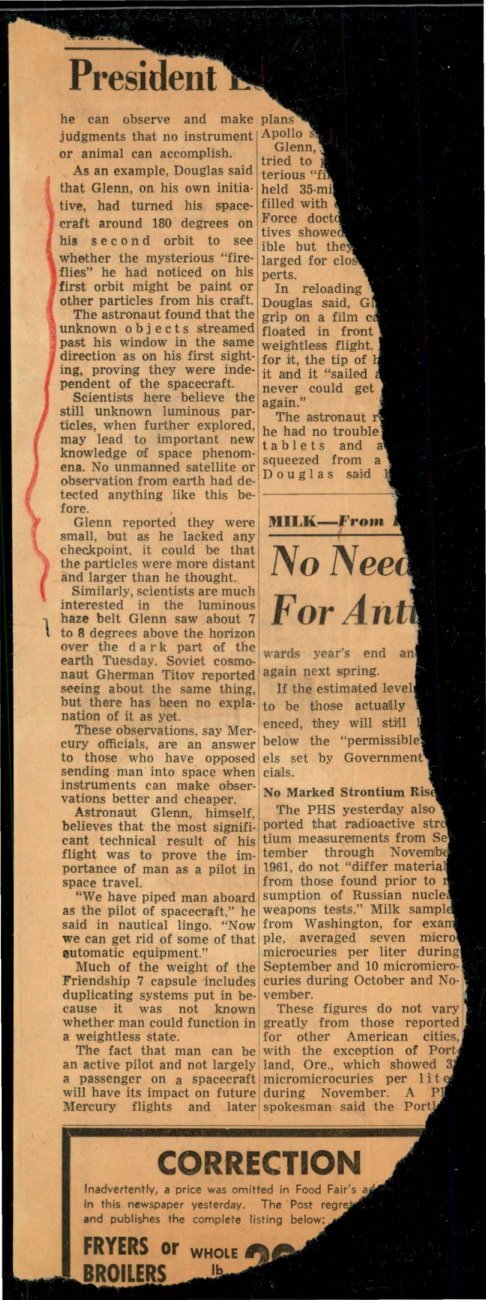
A descrição é de uma camada que cobria todo o horizonte visível, e não de uma mancha. Tinha cerca de um quarto da largura da janela, ficava mais densa no meio e tinha cor marrom-acinzentada, “cor de smog”, como a poluição de Los Angeles vista do alto ao descer de avião. Schirra evitou chamá-la de nuvem de poeira, porque isso sugeriria algo sólido: era um efeito de névoa, sem partículas visíveis. Disse tê-la visto uma única vez e que era diferente da faixa branca e suave do brilho noturno comum, que também observou.
Ao reconstruir a cena, contou que tinha passado pela costa sudeste da África, com a cabine escura e a nave à deriva, sem atitude definida. Achou ter visto luzes de cidades abaixo da camada, mas percebeu que eram constelações: estrelas abaixo da faixa. Acima dela havia mais estrelas, e através dela as estrelas apareciam, mas bem enfraquecidas. Como a nave girava livremente, não conseguiu identificar as estrelas nem confirmar a direção; achava que olhava para o norte.
Os cientistas tentaram situar o fenômeno. Winifred Cameron calculou a nave a cerca de 280 quilômetros de altura e a camada a cerca de 66, com a ressalva de que não se sabia se estava à frente ou atrás do plano da órbita. John O'Keefe contou que David Stern, do Centro Goddard, tinha previsto antes do voo que Schirra veria algo muito incomum por causa de uma forte anomalia magnética na região, e situou a observação no Atlântico Sul. A reconstrução de Schirra fala do oceano Índico, e a transcrição insere entre parênteses “Madagascar”. O local não foi resolvido.
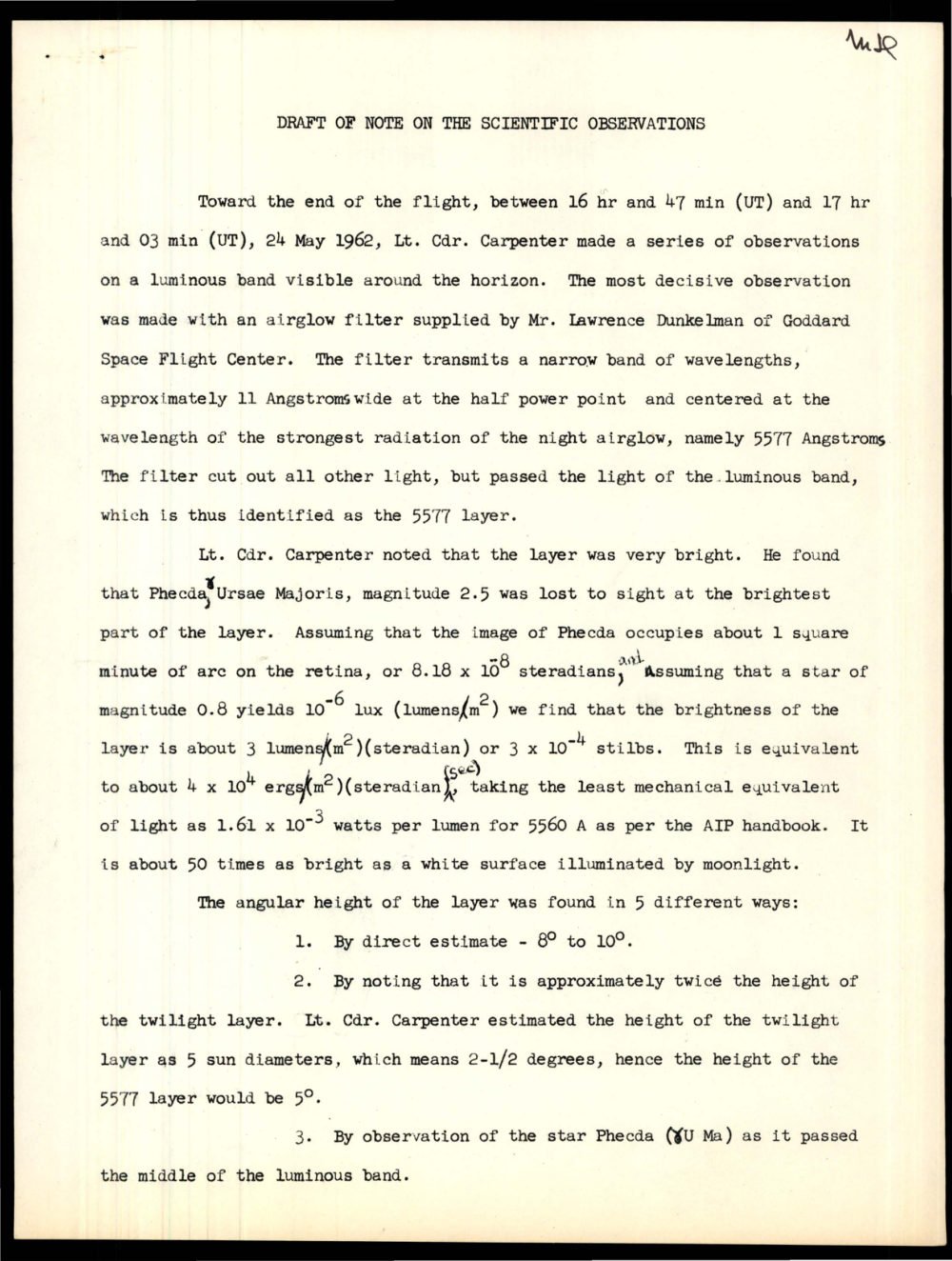
Lawrence Dunkelman estimou que, se as estrelas apareciam enfraquecidas através da faixa, ela teria cerca de 3 ergs por centímetro quadrado por segundo, umas trezentas vezes mais brilhante que o brilho noturno comum visto de lado, e que perceber cor já exigiria de 50 a 100 vezes mais. Schirra respondeu que queria “resolver isso de vez” porque o assunto o incomodava havia muito tempo. A equipe combinou ouvir a gravação original em abril. As páginas consultadas não trazem o resultado.
A transcrição completa corrige a cronologia da conversa. Os números de 280 e 66 quilômetros, que o dossiê atribuía à faixa marrom, foram dados antes do intervalo para o café e se referem a outra observação: as camadas coloridas do horizonte que Schirra viu ao acompanhar o pôr do planeta Mercúrio. Nordberg perguntou pela altura do “topo turbulento” dessas camadas, e Cameron respondeu com a altura da nave e a das camadas. A ressalva de Dunkelman, de que o fenômeno poderia estar à frente ou atrás do plano da órbita, também vale para essas camadas. A faixa marrom só entra na conversa depois da pausa.
Sobre a faixa, a transcrição registra que nem o próprio Schirra a achava facilmente na gravação do voo. Os cientistas tiveram de “garimpá-la” no relato gravado que ele fez depois. Schirra contou que, ainda em voo, Glenn lhe perguntara pelo rádio, quando passava sobre a Califórnia, se tinha visto o que era o “airglow”, e que ele respondera estar surpreso com a altura daquilo. Também admitiu que chamou a faixa de airglow “só como uma saída”, por falta de nome melhor, e que pediu uma correção nunca feita sobre uma troca de Vênus por Mercúrio no seu relato.
Quando lhe perguntaram que estrelas apareciam abaixo da faixa, Schirra se lembrou de ter mencionado as Plêiades e Aldebarã. Os cientistas concluíram, com ele, que isso era impossível: Órion, as Plêiades e Aldebarã estavam do lado iluminado da Terra naquele momento. Nancy Roman sugeriu que Arcturo ou Antares poderiam ter sido confundidas com Aldebarã, e Schirra mencionou Antares ou Alfeca. Disse que a faixa e as estrelas pareciam fixas juntas, como na Via Láctea, mas negou que fosse a Via Láctea. A visão durou “um, dois ou três minutos” e acabou mais pela deriva da nave do que pelo avanço na órbita.
Para resolver a identificação, o grupo combinou reconstituir o céu daquele momento no Planetário Morehead, em Chapel Hill, com o diretor Tony Jenzano, no começo de abril de 1963. Jocelyn Gill ficou encarregada de organizar a sessão e de redigir com Schirra uma conclusão. O astronauta lamentou ter levado o periscópio em vez de um espectrógrafo ultravioleta, com o qual teria fotografado a faixa. Winifred Cameron chegou a mostrar um desenho da carta celeste com a janela posicionada às 5 horas e 20 minutos de voo. Nem o desenho, nem a conclusão, nem o resultado da sessão no planetário estão no arquivo.
Mais imagens do documento
LEITURA DIRETA DO ARQUIVO
O documento, em português
Transcrição da NASA, obra do governo dos EUA: descrição e comentários traduzidos após conferência no fac-símile. Valores de altura e brilho são estimativas feitas na sessão, não medições do voo.
TRECHO 1 · PÁGINA FÍSICA 128
Página física 128 (página 14 da transcrição), quatro primeiras falas: menção à "área brilhante" sobre Madagascar
Shoemaker - Mais algum item sobre o brilho atmosférico que devamos tratar?
Schirra - Vamos falar daquela outra coisa que eu vi, imagino?
Shoemaker - A nuvem (área brilhante) que você viu sobre Madagascar?
Schirra - Sim.Nota editorial: É a primeira menção ao episódio no debriefing; a conversa, porém, segue para as cores do horizonte no pôr do Mercúrio (pp. 128 a 135, fora do caso) e só volta à faixa na página física 143. Transcrição literal datilografada do debriefing científico de 12/03/1963, com os nomes dos participantes sublinhados no original. Participantes citados nesta página: Eugene Shoemaker (presidente da sessão), John O'Keefe, Winifred Cameron, Larry Dunkelman, John Nordberg e George Tennyson, do Centro Goddard; Maurice Dubin, Jocelyn Gill, Nancy Roman e Oran Nicks, da sede da NASA.
Conferir original em inglês
Shoemaker - Any other items on airglow we should take up?
Schirra - We will bring up this other thing I saw - I guess?
Shoemaker - The cloud (bright area) you saw over Madagascar?
Schirra - Yes.Consultar a ficha do documento ↗ · Página física 128, contando a capa.
TRECHO 2 · PÁGINA FÍSICA 139
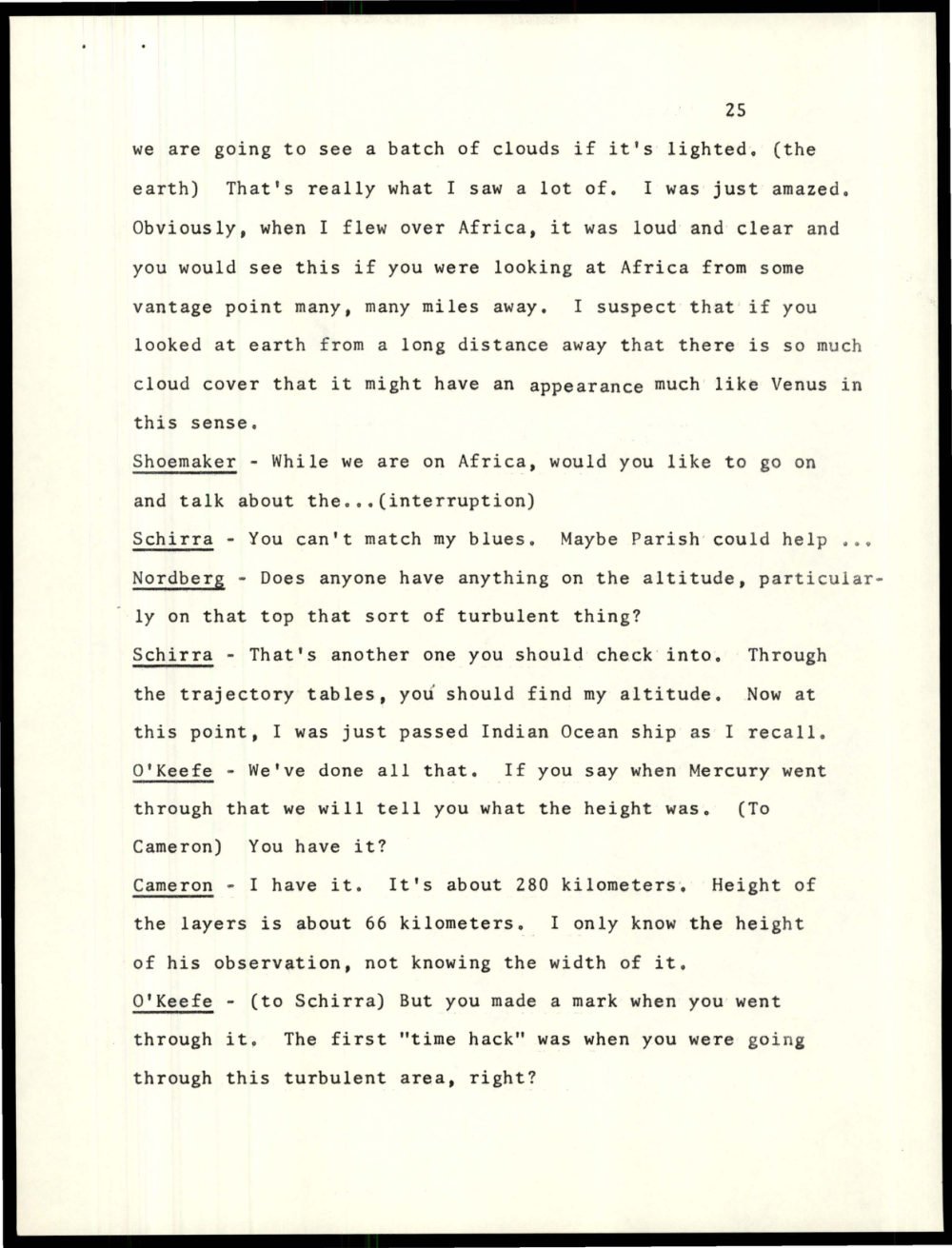
Página física 139 (página 25 da transcrição), íntegra
vamos ver um monte de nuvens, se estiver iluminada. (a Terra) Foi isso que vi muito. Fiquei simplesmente impressionado. Claro, quando passei sobre a África, estava tudo bem nítido, e veríamos isso se olhássemos para a África de algum ponto de observação a muitas, muitas milhas. Suspeito que, se alguém olhasse a Terra de muito longe, há tanta cobertura de nuvens que ela poderia ter uma aparência bem parecida com a de Vênus, nesse sentido.
Shoemaker - Já que estamos na África, você gostaria de continuar e falar sobre o... (interrupção)
Schirra - Vocês não conseguem igualar os meus azuis. Talvez o Parrish pudesse ajudar...
Nordberg - Alguém tem algo sobre a altitude, em especial sobre aquele topo, aquela coisa meio turbulenta?
Schirra - Isso é outra coisa que vocês deveriam verificar. Pelas tabelas de trajetória, vocês devem achar minha altitude. Naquele momento, eu tinha acabado de passar pelo navio do oceano Índico, pelo que me lembro.
O'Keefe - Já fizemos tudo isso. Se você disser quando o Mercúrio passou por aquilo, diremos qual era a altura. (Para Cameron) Você tem isso?
Cameron - Tenho. São cerca de 280 quilômetros. A altura das camadas é de cerca de 66 quilômetros. Só sei a altura da observação dele, não sua largura.
O'Keefe - (Para Schirra) Mas você fez uma marca quando passou por ela. A primeira "marcação de tempo" foi quando você estava passando por essa área turbulenta, certo?Nota editorial: O "topo meio turbulento" e as "camadas" de 66 km referem-se às faixas coloridas do horizonte no pôr do planeta Mercúrio, descritas por Schirra nas pp. 128 a 135, e não à faixa marrom, de que o grupo só passa a tratar na página física 143. "Parish" é o pintor Maxfield Parrish, citado antes por causa dos tons de azul. O "navio do oceano Índico" era a estação de rastreamento embarcada do programa Mercury. Transcrição literal datilografada do debriefing científico de 12/03/1963, com os nomes dos participantes sublinhados no original. Participantes citados nesta página: Eugene Shoemaker (presidente da sessão), John O'Keefe, Winifred Cameron, Larry Dunkelman, John Nordberg e George Tennyson, do Centro Goddard; Maurice Dubin, Jocelyn Gill, Nancy Roman e Oran Nicks, da sede da NASA.
Conferir original em inglês
we are going to see a batch of clouds if it's lighted. (the earth) That's really what I saw a lot of. I was just amazed. Obviously, when I flew over Africa, it was loud and clear and you would see this if you were looking at Africa from some vantage point many, many miles away. I suspect that if you looked at earth from a long distance away that there is so much cloud cover that it might have an appearance much like Venus in this sense.
Shoemaker - While we are on Africa, would you like to go on and talk about the...(interruption)
Schirra - You can't match my blues. Maybe Parish could help...
Nordberg - Does anyone have anything on the altitude, particularly on that top that sort of turbulent thing?
Schirra - That's another one you should check into. Through the trajectory tables, you should find my altitude. Now at this point, I was just passed Indian Ocean ship as I recall.
O'Keefe - We've done all that. If you say when Mercury went through that we will tell you what the height was. (To Cameron) You have it?
Cameron - I have it. It's about 280 kilometers. Height of the layers is about 66 kilometers. I only know the height of his observation, not knowing the width of it.
O'Keefe - (to Schirra) But you made a mark when you went through it. The first "time hack" was when you were going through this turbulent area, right?Consultar a ficha do documento ↗ · Página física 139, contando a capa.
TRECHO 3 · PÁGINA FÍSICA 140
Página física 140 (página 26 da transcrição), íntegra
Schirra - Correto, foi quando entrei nela.
O'Keefe - Qual era a altura das camadas naquele momento, 66 quilômetros, é isso?
Schirra - Isso, era o que eu estava dizendo. "Espero que possamos segurar o Mercúrio", querendo dizer que eu gostaria de vê-lo atravessar aquilo, e eu não sabia que conseguiria, mas evidentemente provei que conseguia; consegui. Foi uma bela surpresa. Você não disse, Jocelyn, que não há muita gente que viu o pôr do Mercúrio?
Gill - É verdade. Mercúrio (o planeta), ponto. Muito pouca gente sabe que ele existe.
O'Keefe - Posso observar que você usou a palavra brilho atmosférico (airglow) em termos gerais, uma luz fraca e brilhante vista a partir da atmosfera, sem o seu... O que você chamou de airglow não é o que tecnicamente se conhece como airglow.
Schirra - Sim, sempre que usamos airglow, eu não o uso no sentido profissional. Eu o usava só como uma saída.
Dunkelman - Há outro ponto aí. Não se tem certeza de em que plano esses fenômenos ocorreram. Podem ter estado à frente ou atrás deste plano (o da nave). Temos de pensar nisso... Os 66 quilômetros podem de fato corresponder a algo que estava antes deste ponto, entende?
Nordberg - (Comentário inaudível.)
Schirra - Minha vertical local seria esta mão, como mostro, e, claro, 40 graus à esquerda, onde o Sol eNota editorial: A conversa continua sobre as camadas do pôr do planeta Mercúrio, não sobre a faixa marrom. "Know" está assim no original (por "known"). Transcrição literal datilografada do debriefing científico de 12/03/1963, com os nomes dos participantes sublinhados no original. Participantes citados nesta página: Eugene Shoemaker (presidente da sessão), John O'Keefe, Winifred Cameron, Larry Dunkelman, John Nordberg e George Tennyson, do Centro Goddard; Maurice Dubin, Jocelyn Gill, Nancy Roman e Oran Nicks, da sede da NASA.
Conferir original em inglês
Schirra - Correct, that's when I came into it.
O'Keefe - What was the height of the layers at this time - 66 kilometers, is that right?
Schirra - Right, that's what I was saying. I hope we can hold Mercury meaning that I'd like to see it go through this and I did not know that I could, but obviously I proved that I could; I did. This was quite a surprise. Didn't you say, Jocelyn, that there aren't many people that have seen Mercury sets?
Gill - Very true. Mercury, (the planet) period. Very few people know that it exists.
O'Keefe - Can I point out that you used the word airglow just in general terms, a faint, glowing light seen from the atmosphere without your - What you called the airglow is not what is technically know as the airglow.
Schirra - Yes, any time we use airglow I don't use it as we professionally talk about airglow. I was using it merely as an escape clause.
Dunkelman - There is one other point there. One isn't sure just in what plane these phenomena took place. They may have been ahead or behind this plane (of the spacecraft). We have to think of this... The 66 kilometers might indeed be reflected as something that had been before this point, you see.
Nordberg - (Comment inaudible).
Schirra - My local vertical would be this hand as I show it and, of course, 40 degrees to the left where the sun andConsultar a ficha do documento ↗ · Página física 140, contando a capa.
TRECHO 4 · PÁGINA FÍSICA 141
Página física 141 (página 27 da transcrição), íntegra
o Mercúrio atravessavam, estava num plano mais ou menos assim. É esse o seu ponto, acho, Larry, não é?
Dunkelman - É um deles...
Schirra - Então eles descem deste jeito, o que matematicamente não é difícil de resolver, mas vocês devem levar isso em conta.
Dubin - Esse plano pode variar um pouco, e é muito difícil saber para que lado.
Schirra - A nave, nesse momento, estava sob controle de atitude, bem firme, de certo modo.
Roman - Acho que o ponto do Larry é que, embora não saibamos de fato se estamos... se estamos realmente fazendo uma travessia direta pela atmosfera, pode ser algo à frente, uma linha tangente, ou atrás.
Dunkelman - A primeira ideia é passar uma linha bem ali, e neste ponto ela pode estar no plano, mas pode não estar. Algumas podem estar à frente ou atrás, ou as duas coisas...
Schirra - Em outras palavras, essas camadas, nesse sentido, poderiam estar todas escalonadas, e esta empilhada como uma série de degraus, de certo modo.
Dubin - E poderiam estar a uma altitude maior que uma simples projeção em ângulo reto.
O'Keefe - Isso é bem seguro.
Schirra - Eu estava olhando em duas dimensões, de certo modo.
Cameron - Os ângulos retos de projeção, e esta é a zona crepuscular do espectro.Nota editorial: Ainda sobre as camadas do pôr do planeta Mercúrio. Transcrição literal datilografada do debriefing científico de 12/03/1963, com os nomes dos participantes sublinhados no original. Participantes citados nesta página: Eugene Shoemaker (presidente da sessão), John O'Keefe, Winifred Cameron, Larry Dunkelman, John Nordberg e George Tennyson, do Centro Goddard; Maurice Dubin, Jocelyn Gill, Nancy Roman e Oran Nicks, da sede da NASA.
Conferir original em inglês
Mercury were traversing was in a plane something like this. This is your point I think, Larry, Isn't it?
Dunkelman - That's one ...
Schirra - So they come down this way which mathematically isn't hard to solve, but you should consider this.
Dubin - This plane may vary a certain amount and it is very difficult to know which way.
Schirra - The spacecraft at this point was under attitude control and was fairly tight in a sense.
Roman - I think Larry's point is that though we don't really know if we are ... if we are actually taking a traverse straight through the atmosphere, it may be something in front, a tangent line, or behind it.
Dunkelman - The first thought is to put a line right through there, and at this point this may be on the plane but it may not be that. Some may be ahead or behind, or both. ...
Schirra - In other words, these layers in this sense could be all staggered out and this one stacked like a bunch of steps in a sense.
Dubin - And they could be higher in altitude than a simple right angle projection.
O'Keefe - It's quite safe.
Schirra - I was looking at two dimensions in a sense.
Cameron - The right angles of projection and this is the twilight zone of the spectrum.Consultar a ficha do documento ↗ · Página física 141, contando a capa.
TRECHO 5 · PÁGINA FÍSICA 142
Página física 142 (página 28 da transcrição), íntegra
Schirra - Se houver mais um daqueles cafés, troco este. Não me importo que esteja frio.
Intervalo (conversa geral)Nota editorial: A página tem só essas duas linhas; marca o intervalo antes da parte sobre a faixa marrom. Transcrição literal datilografada do debriefing científico de 12/03/1963, com os nomes dos participantes sublinhados no original. Participantes citados nesta página: Eugene Shoemaker (presidente da sessão), John O'Keefe, Winifred Cameron, Larry Dunkelman, John Nordberg e George Tennyson, do Centro Goddard; Maurice Dubin, Jocelyn Gill, Nancy Roman e Oran Nicks, da sede da NASA.
Conferir original em inglês
Schirra - If there is another one of those coffees, I'll trade this one in. I don't mind it cool.
Break (General conversation)Consultar a ficha do documento ↗ · Página física 142, contando a capa.
TRECHO 6 · PÁGINA FÍSICA 143
Página física 143 (página 29 da transcrição), íntegra
Schirra - E as raras ocasiões em que tive o momento certo para isso.
O'Keefe - Há um belo voo da Delta de Washington para Houston. O avião vai exatamente na direção do Sol; não tem como errar.
Cameron - Você vai ter de ir à cabine de comando.
Schirra - Hum. É preciso pegar o voo da Delta, neste caso específico, de Dallas para Los Angeles. Passei por Albuquerque.
Shoemaker - Aquela coisa peculiar que você viu sobre a África, talvez você pudesse nos contar.
Schirra - Aquilo, como já disse, foi minha maior surpresa. Conversei com a maioria de vocês longamente sobre coisas que esperávamos ou contávamos ver. Disso eu não tinha nenhum conhecimento prévio, e basicamente posso dizer que fui "enganado" e chamei aquilo, de início, de airglow, se vocês se lembram. Acho melhor recorrer de novo ao registro. Foi às 5 horas e 20 minutos.
Cameron - É o horário que tenho de você. A única coisa que notei no roteiro foi que você disse que Glenn lhe perguntou, quando passava sobre a Califórnia, se você tinha visto o que era o airglow. Aí você disse algo sobre ter ficado surpreso com a altura dele.
Schirra - Era o mesmo fenômeno. Eu tinha voltado de lá, acho; não é isso? Vejamos.
Dubin - O oceano Índico.
O'Keefe - David Stern, de Goddard, previu antes do voo que você veria algo muito incomum nesta missão...
Schirra - É mesmo?Nota editorial: As quatro primeiras falas, logo depois do intervalo, retomam a conversa sobre a luz zodiacal vista de avião (páginas físicas 136 a 138); o trecho é traduzido também no dossiê sobre o brilho do foguete visto do avião. "5 hours and 20 minutes" é tempo decorrido de voo, não hora do dia. "Script" é a transcrição do voo. Transcrição literal datilografada do debriefing científico de 12/03/1963, com os nomes dos participantes sublinhados no original. Participantes citados nesta página: Eugene Shoemaker (presidente da sessão), John O'Keefe, Winifred Cameron, Larry Dunkelman, John Nordberg e George Tennyson, do Centro Goddard; Maurice Dubin, Jocelyn Gill, Nancy Roman e Oran Nicks, da sede da NASA.
Conferir original em inglês
Schirra - And the rare occasions that I've had the timing for this.
O'Keefe - There is a nice Delta Flight from Washington down to Houston. The thing goes exactly toward the sun - you can't miss it.
Cameron - You'll have to go to the cockpit.
Schirra - Hmm - You have to make the Delta Flight, in this particular case, from Dallas to Los Angeles. I passed Albuquerque.
Shoemaker - This peculiar thing you saw over Africa - maybe you could tell us about it.
Schirra - That, as I have said, was my biggest surprise. I talked to most of you at great length about things we would hope to see or expect to see. This I had no prior knowledge of and I basically can say that I was "sucked" in and originally called this airglow, if you recall. I guess it is best to refer back to the record again. This was 5 hours and 20 minutes.
Cameron - That's the time I got from you. The only thing I notice from the script was that you said Glenn was asking you when you were passing over California if you had seen what the airglow was. Then you said something about you were surprised at how high it was.
Schirra - This was the same phenomena. I had come back from there, I think, isn't that correct? Let's see.
Dubin - The Indian Ocean.
O'Keefe - David Stern at Goddard predicted that you would see something very unusual in this flight before you went up. ...
Schirra - Really?Consultar a ficha do documento ↗ · Página física 143, contando a capa.
TRECHO 7 · PÁGINA FÍSICA 144
Página física 144 (página 30 da transcrição), íntegra
O'Keefe - Sim, ele me deu um bilhete. Eu deveria passá-lo ao Centro de Naves Tripuladas; acho que não passei. Acho que a culpa é minha. (Nota do editor: cópias foram enviadas ao MSC.)
Roman - De que você está falando?
O'Keefe - Há uma anomalia magnética muito forte nessa região, e é aí que...
Dunkelman - Acho que o fato de Schirra não ter ouvido falar disso torna a observação ainda melhor do ponto de vista científico.
Schirra - Hum.
O'Keefe - Muito empolgante isso, mas de que região exatamente o comandante Schirra está falando? ...Ele fala do Atlântico Sul, e o Atlântico Sul estava sob a luz do Sol. Isto é provavelmente o mais perto que poderíamos chegar dele estando no escuro.
Schirra - Acho que o que aconteceu foi que olhei para fora enquanto derivava, e por acaso estava na atitude certa para ver isso, o que provavelmente significa que eu olhava para o norte, embora não possa confirmar.
Cameron - Você disse algo sobre julgar que a largura era de cerca de um quarto da sua janela.
Schirra - Sim.
Cameron - Pode dizer a que distância, alguma coisa sobre a altura em relação ao horizonte?
Schirra - Fiquei surpreso quando vi o que pensei serem luzes de cidades e que se revelaram estrelas abaixo daquela coisa. Por isso, fiquei confuso, no sentido de que não estava então procurando referências de medida.Nota editorial: A nota "Ed." foi acrescentada por quem editou a transcrição. O Centro de Naves Tripuladas (MSC) ficava em Houston. A anomalia magnética da região é hoje conhecida como Anomalia Magnética do Atlântico Sul; a página não usa esse nome. A frase de O'Keefe sobre o Atlântico Sul estar sob luz do Sol é ambígua no original. Transcrição literal datilografada do debriefing científico de 12/03/1963, com os nomes dos participantes sublinhados no original. Participantes citados nesta página: Eugene Shoemaker (presidente da sessão), John O'Keefe, Winifred Cameron, Larry Dunkelman, John Nordberg e George Tennyson, do Centro Goddard; Maurice Dubin, Jocelyn Gill, Nancy Roman e Oran Nicks, da sede da NASA.
Conferir original em inglês
O'Keefe - Yes, he gave me a note. I was supposed to pass that note down to the Manned Spacecraft Center; I don't think I did. I think it's my fault. (Ed. copies were forwarded to MSC.)
Roman - What is this you are referring to?
O'Keefe - There is a very strong magnetic anomaly in this region, and this is where ...
Dunkelman - I think the fact that Schirra had not heard of this makes the observation even better scientifically.
Schirra - Hmm.
O'Keefe - Quite exciting about this thing, but exactly what region is Cdr. Schirra talking about? ...He's talking about the South Atlantic - and the South Atlantic was in sunlight. This is probably as close to it as we could get to be in darkness.
Schirra - I think what happened is I looked out as I was drifting and this happened to be in the right attitude to see this, which probably meant that I was looking toward the North although I can't confirm this.
Cameron - You said something about you would judge that the width was about a fourth of your window.
Schirra - Yes.
Cameron - Can you say how far - anything about how high it was from the horizon?
Schirra - I was surprised when I saw what I thought were city lights and they turned out to be stars below this thing. As a result, I was confused in the sense that I wasn't then looking for yardsticks.Consultar a ficha do documento ↗ · Página física 144, contando a capa.
TRECHO 8 · PÁGINA FÍSICA 145
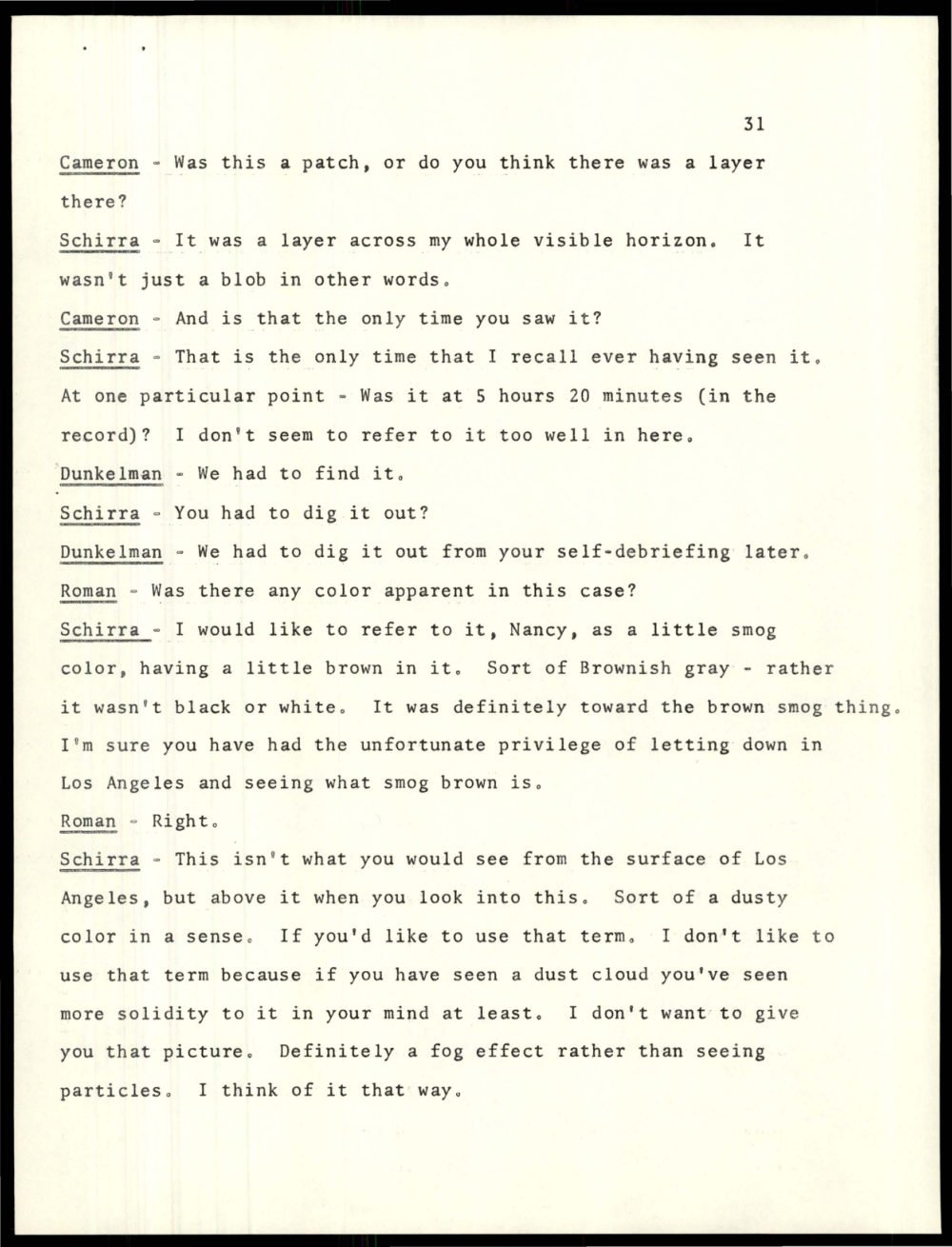
Página física 145 (página 31 da transcrição), íntegra
Cameron - Era uma mancha, ou você acha que havia uma camada ali?
Schirra - Era uma camada atravessando todo o meu horizonte visível. Não era só uma bolha, em outras palavras.
Cameron - E foi a única vez que você a viu?
Schirra - É a única vez de que me lembro de tê-la visto. Num ponto específico. Foi às 5 horas e 20 minutos (no registro)? Parece que não me refiro muito bem a ela aqui.
Dunkelman - Tivemos de procurá-la.
Schirra - Vocês tiveram de garimpá-la?
Dunkelman - Tivemos de garimpá-la do seu autodebriefing posterior.
Roman - Havia alguma cor visível nesse caso?
Schirra - Eu gostaria de chamá-la, Nancy, de uma leve cor de smog, com um pouco de marrom. Uma espécie de cinza amarronzado; quer dizer, não era preta nem branca. Era decididamente para o lado do marrom do smog. Tenho certeza de que você já teve o infeliz privilégio de descer em Los Angeles e ver o que é o marrom do smog.
Roman - Certo.
Schirra - Não é o que se veria da superfície de Los Angeles, mas de cima, quando se olha para dentro dele. Uma espécie de cor de poeira, de certo modo, se quiser usar esse termo. Não gosto de usá-lo, porque, se você já viu uma nuvem de poeira, já viu mais solidez nela, pelo menos na sua cabeça. Não quero lhes dar essa imagem. Decididamente um efeito de névoa, mais do que ver partículas. É assim que penso nisso.Nota editorial: "Smog" é a névoa de poluição urbana. O trecho sobre a descrição da camada já estava traduzido no site; a redação foi mantida. O "autodebriefing" é o relato gravado pelo próprio astronauta depois do voo. Transcrição literal datilografada do debriefing científico de 12/03/1963, com os nomes dos participantes sublinhados no original. Participantes citados nesta página: Eugene Shoemaker (presidente da sessão), John O'Keefe, Winifred Cameron, Larry Dunkelman, John Nordberg e George Tennyson, do Centro Goddard; Maurice Dubin, Jocelyn Gill, Nancy Roman e Oran Nicks, da sede da NASA.
Conferir original em inglês
Cameron - Was this a patch, or do you think there was a layer there?
Schirra - It was a layer across my whole visible horizon. It wasn't just a blob in other words.
Cameron - And is that the only time you saw it?
Schirra - That is the only time that I recall ever having seen it. At one particular point - Was it at 5 hours 20 minutes (in the record)? I don't seem to refer to it too well in here.
Dunkelman - We had to find it.
Schirra - You had to dig it out?
Dunkelman - We had to dig it out from your self-debriefing later.
Roman - Was there any color apparent in this case?
Schirra - I would like to refer to it, Nancy, as a little smog color, having a little brown in it. Sort of Brownish gray - rather it wasn't black or white. It was definitely toward the brown smog thing. I'm sure you have had the unfortunate privilege of letting down in Los Angeles and seeing what smog brown is.
Roman - Right.
Schirra - This isn't what you would see from the surface of Los Angeles, but above it when you look into this. Sort of a dusty color in a sense. If you'd like to use that term. I don't like to use that term because if you have seen a dust cloud you've seen more solidity to it in your mind at least. I don't want to give you that picture. Definitely a fog effect rather than seeing particles. I think of it that way.Consultar a ficha do documento ↗ · Página física 145, contando a capa.
TRECHO 9 · PÁGINA FÍSICA 146
Página física 146 (página 32 da transcrição), íntegra
Dunkelman - Estamos aqui para ouvir a sua versão, e acho que devemos entender melhor isso. Não quero pôr minhas ideias nisso, mas estava tentando citá-lo, dizendo que são camadas de smog amarronzadas, e não tinha certeza de como defini-las.
Schirra - Sim. É um marrom sujo, não um marrom agradável, não um que se goste de ver. Algo como um "marrom encardido" em vez de um "cinza encardido".
Cameron - Vênus estava logo fora da borda dela. Tenho o relato disso.
Schirra - Vejamos, onde estamos aí?
Cameron - Acho que você não diz nada sobre isso. Queria saber se você notou Vênus naquele momento.
Schirra - Houve um ponto aqui em que troquei Vênus por Mercúrio, esqueci qual, mas isso está errado. Pedi que corrigissem e nunca corrigiram. Mas, de todo modo, foi isso que eu disse. Acho que vocês poderiam me desmentir com muita facilidade, porque simplesmente não podia estar lá. Esqueci a qual dos dois me referi. Vênus e a Lua estavam sempre juntas, é esse o ponto, e para mim estavam numa linha horizontal, o que me dava uma boa referência.
O'Keefe - Comandante Schirra, há alguns pontos importantes aqui. Em primeiro lugar, claro, tanto Glenn quanto Carpenter viram estrelas por baixo da camada comum de brilho atmosférico.
Schirra - Sim, eu me lembro.
O'Keefe - Então, claramente, ela não pode ser vista, e isso já era de esperar.
Schirra - Eu diria que isso é confirmado pelo meu relato de ter visto Mercúrio atravessando essas camadas no pôr do Mercúrio, o queNota editorial: "Tattle tale gray" era expressão de propaganda de sabão em pó para roupa branca encardida; Schirra faz um trocadilho com "brown". A frase "So it clearly can't be seen" está assim no original; o sentido parece ser que a camada comum não impede ver as estrelas. Transcrição literal datilografada do debriefing científico de 12/03/1963, com os nomes dos participantes sublinhados no original. Participantes citados nesta página: Eugene Shoemaker (presidente da sessão), John O'Keefe, Winifred Cameron, Larry Dunkelman, John Nordberg e George Tennyson, do Centro Goddard; Maurice Dubin, Jocelyn Gill, Nancy Roman e Oran Nicks, da sede da NASA.
Conferir original em inglês
Dunkelman - We are here to hear yours and I think we should figure out some more of this. I don't want to inject my thought into this, but I was trying to quote you in saying that it is brownish smog layers and wasn't sure how to define it.
Schirra - Yes. This is dirty brown, not a pleasant brown, not one you would like to see. Sort of like a tattle tale brown instead of a tattle tale gray.
Cameron - Venus was just off the edge of it. I have the report of it.
Schirra - Let's see, where are we there?
Cameron - I don't think you are saying anything about that. I was wondering if you noticed Venus at that time?
Schirra - There was some point in here where I miscalled Venus or Mercury, I forget which, but this is wrong. I told them to correct it and they never did. But anyway this is what I did say. I think you could disprove me very easily, because it just couldn't be there. I forgot which one it was I referred to. Venus and the moon were always together is the whole point, and they were to me in a horizontal line which gave me a good reference.
O'Keefe - Cdr. Schirra, there are some important points here. First of all, of course, both Glenn and Carpenter saw stars underneath the ordinary airglow layer.
Schirra - Yes, I remember.
O'Keefe - So it clearly can't be seen and one would expect that anyway.
Schirra - I would say that this is substantiated by my report of seeing Mercury as it passed through these layers as Mercury set whichConsultar a ficha do documento ↗ · Página física 146, contando a capa.
TRECHO 10 · PÁGINA FÍSICA 147
Página física 147 (página 33 da transcrição), íntegra
provaria que as estrelas podiam muito bem ser vistas fazendo a mesma travessia. Aquela coisa que vi (vamos chamá-la simplesmente de cinturão de smog) nessa passagem pelo sul, para voltar e recapitular a sensação que me trouxe isso à mente, o que não aparece aqui, a não ser pelo fato de que consigo identificar o que vi. Eu vinha passando sobre uma área de terra. (Acho melhor parar um segundo e pegar meu mapa orbital, que tenho aqui.)
O'Keefe - Se você tiver a fita, podemos tocá-la de novo.
Schirra - Seria melhor, porque parte daquelas nove horas eu não identifiquei com cuidado suficiente, e deveria ter feito isso, revendo a fita e essas áreas de interesse. Acho que deveríamos ouvir a fita original de novo. Vamos voltar ao ponto em que estávamos.
Cameron - O Larry (Dunkelman) a ouviu no Cabo, acho.
Dunkelman - Você viu o que chamo de brilho atmosférico normal à noite? Aquela faixa branca suave.
Schirra - Sim, vi.
Dunkelman - Muito bem, sim, isso é importante, porque acho que mais adiante vai ajudar.
Cameron - Era aquilo que você viu?
Schirra - Isto é nitidamente diferente, e acho que identificamos isso na discussão anterior (sobre o uso do termo airglow).
Dunkelman - Ótimo.
Schirra - Eu tinha luar também, mas conseguia ver claramente esse efeito branco fraco.Nota editorial: As "nove horas" são a duração aproximada do voo da Sigma 7. Transcrição literal datilografada do debriefing científico de 12/03/1963, com os nomes dos participantes sublinhados no original. Participantes citados nesta página: Eugene Shoemaker (presidente da sessão), John O'Keefe, Winifred Cameron, Larry Dunkelman, John Nordberg e George Tennyson, do Centro Goddard; Maurice Dubin, Jocelyn Gill, Nancy Roman e Oran Nicks, da sede da NASA.
Conferir original em inglês
would prove that the stars well could be seen going through the same traverse. This thing I saw - let's just call it the smog belt - on this southern pass, to go back and recap the sensation that brought this to mind which is not brought out here other than the fact that I can identify what I saw. I was coming over a land area. (I think I better take a second and break out my orbital map which I have here.)
O'Keefe - If you have the tape, we might replay that.
Schirra - This would be better because some of the nine hours there, I have not identified carefully enough, and I should have, by going back over the tape and these areas of interest - I think we should listen to the original tape again. Let's get down to where we were.
Cameron - Larry (Dunkelman) has listened to it at the Cape, I think.
Dunkelman - Did you see what I call normal airglow at night? That is the soft white band.
Schirra - Yes, I did.
Dunkelman - All right, yes, that's important because I think later it will help.
Cameron - Was that the thing you saw?
Schirra - This is distinctly different and this, I think, we identified in our earlier discussion (speaking of the use of the term airglow).
Dunkelman - Fine.
Schirra - I had moonlight as well, but I could definitely see this faint white effect.Consultar a ficha do documento ↗ · Página física 147, contando a capa.
TRECHO 11 · PÁGINA FÍSICA 148
Página física 148 (página 34 da transcrição), íntegra
Dubin - Havia alguma cor nele?
Schirra - No brilho atmosférico que vi? Não, a não ser nos momentos de pôr do sol, quando se tem a própria luz do Sol.
Dubin - Nenhuma cor?
Schirra - Penso no branco como todas as cores, e vocês percebem que já me enredei com pintura algumas vezes. Esta mancha era mais densa à medida que se chegava ao meio do cinturão. Ela decididamente tinha de ter um estímulo luminoso, senão eu não a teria visto. Eu tinha plena consciência disso e pensei nisso quando a vi. A impressão inicial que me chamou a atenção é, antes de tudo, e essa é a desvantagem que temos: queremos ver algo que precisa ser visto a olho nu quando o interior do veículo está escuro.
Cameron - Na mancha, você notou alguma variação de cor, na horizontal ou na vertical? Ou era toda igual?
Schirra - O brilho atmosférico de que estamos falando agora?
Cameron - A mancha sobre (Madagascar).
Schirra - Ah, esta mancha, parecia... Não dá para acompanhar o tempo todo se você está sobre terra ou água, e o tempo passa bem depressa; por exemplo, neste período específico de que falamos, de 5 horas e 20 minutos, voltando só alguns minutos, estou sobre a África, porque tinha deixado a costa sudeste da África, ou seja, Durban, que é o lugar onde uma vez pensei em ver um sinalizador luminoso, e vi cidades, e sei que vi a Cidade do Cabo, que estava com tempo limpo. Conversei com o embaixador daquela parte da África quando estávamos em Goddard, na comemoração dos 5 anos dos satélites, e ele disse: "Ah, quem dera tivéssemos sabido disso, porqueNota editorial: "Madagascar" aparece entre parênteses no original, como acréscimo de quem editou a transcrição. A comemoração dos "5 anos dos satélites" em Goddard é citada sem data. Transcrição literal datilografada do debriefing científico de 12/03/1963, com os nomes dos participantes sublinhados no original. Participantes citados nesta página: Eugene Shoemaker (presidente da sessão), John O'Keefe, Winifred Cameron, Larry Dunkelman, John Nordberg e George Tennyson, do Centro Goddard; Maurice Dubin, Jocelyn Gill, Nancy Roman e Oran Nicks, da sede da NASA.
Conferir original em inglês
Dubin - Was there any color whatever in it?
Schirra - In the airglow that I saw? No, other than during sunset times where you would have sunlight itself.
Dubin - No color whatever?
Schirra - I think of white as being all colors and you can see I've been trapped with painting a few times. This patch was denser as you came into the middle of this belt. It definitely had to have a light stimulus to it or I wouldn't have seen it. I was well aware of this and thought this as I saw it. The initial impression that brought to my attention is, first off, and this is the liability we have; we're wanting to see something that needs to be seen with the naked eye when the inside of the vehicle is dark.
Cameron - In the patch did you notice any variation in color either horizontal or vertical? - Or was it all one?
Schirra - The airglow now we are discussing?
Cameron - The patch over (Madagascar).
Schirra - Oh, this patch, it seemed ... You can't keep track of whether you are over land or water continually and time is progressing fairly rapidly; for example, on this particular period where we are talking in terms of 5 hours and 20 minutes, going back just a few minutes, I am over Africa because I had left the southeast coast of Africa, in other words, Durban and this is the place I had one time in my mind wanted to see a flare and I did see cities and I know I saw Capetown which was in the clear. I talked to the Ambassador from that section of Africa when we were at Goddard for the 5th year celebration of satellites, and he said, "Oh, I wish we had known that, becauseConsultar a ficha do documento ↗ · Página física 148, contando a capa.
TRECHO 12 · PÁGINA FÍSICA 149
Página física 149 (página 35 da transcrição), íntegra
todo mundo pensa que a única coisa que vocês veem é Perth!" (risos) Bem, vemos muitos outros lugares também. Voltando: eu tentava reconstituir esse fenômeno na minha cabeça. Eu tinha passado sobre a África e estava com a cabine escura. Estava à deriva. Enquanto derivava (gostamos de dizer que conseguimos ver uma cidade, porque o povo da cidade fica bem empolgado com isso, como sabemos que Perth ficou), e eu seguia através do oceano Índico, à deriva, de modo que minha atitude não pode ser definida, quis dizer a mim mesmo: ah, estou vendo mais cidades abaixo de mim. Bem, eu não estava convencido de que estava sobre o oceano Índico, mas, com a atitude não bem definida, eu bem poderia ter visto cidades. Dessas eu disse: ah, essas cidades parecem arranjos de constelações. Pareciam constelações. Aí eu disse: meu Deus! São constelações. São estrelas, e isso estava abaixo do que eu então, pelo menos na minha cabeça, tinha fixado como airglow. De novo, um termo genérico, significando um horizonte iluminado; e olhei acima desse efeito de smog marrom e vi mais estrelas. Depois consegui ver estrelas através desse efeito marrom, mas bem enfraquecidas por ele. Bem, como a atitude estava mudando, não tive oportunidade de acompanhar uma estrela ou um planeta individual atravessando essa área. Naquele momento, eu não estava muito interessado em saber que constelações estava vendo. Em voo à deriva, não há de fato necessidade de navegar, isto é, de saber onde se está em relação a um campo de estrelas ou à superfície.
Roman - Então você não sabe o que estava vendo?
Schirra - Então eu não conseguia identificar nenhuma estrela ou constelação específica naquele momento. Se precisasse, teria de destruirNota editorial: Perth, na Austrália, acendeu as luzes da cidade para Glenn em fevereiro de 1962; Schirra alude a isso. O trecho sobre as luzes de cidade que eram estrelas já estava traduzido no site; a redação foi mantida. Transcrição literal datilografada do debriefing científico de 12/03/1963, com os nomes dos participantes sublinhados no original. Participantes citados nesta página: Eugene Shoemaker (presidente da sessão), John O'Keefe, Winifred Cameron, Larry Dunkelman, John Nordberg e George Tennyson, do Centro Goddard; Maurice Dubin, Jocelyn Gill, Nancy Roman e Oran Nicks, da sede da NASA.
Conferir original em inglês
everybody thinks that all you see is Perth! (laughter) Well, we see a lot of other places as well." To go back, I was trying to re-establish this phenomenon in my mind so I had passed over Africa and I was darkened within the vehicle. I was drifting. As I was drifting - we like to say that we can see a city because the people of the city get quite excited about it as we know Perth did - and I was proceeding across the Indian Ocean drifting, so my attitudes cannot be defined, I wanted to say to myself, oh, I see some more cities below me. Now I wasn't convinced in my mind that I was over the Indian Ocean, yet with the attitudes not carefully defined, I might well have seen cities. These I said, ah, those cities are quite constellation setups. They looked like constellations. Then I said, my gosh! they are constellations. They are stars and this was below what I then, in my mind at least, had planted as airglow. Again, a lump term, meaning a lighted horizon, and I looked above this brown smog effect and saw more stars again. Then I could see through this brown effect, stars, but they were dimmed considerably by it. Now, I did not have the opportunity in that the attitudes were dynamic to trace an individual star or planet through this particular area. I wasn't at this point too interested in knowing what constellations I was looking at. In drifting flight, you don't really have a requirement to navigate, that is, to know where you are in relation to a star field or surface.
Roman - So you don't know what you were looking at?
Schirra - So any particular star or constellation, I could not identify at this time. If I needed to, I would then have to destroyConsultar a ficha do documento ↗ · Página física 149, contando a capa.
TRECHO 13 · PÁGINA FÍSICA 150
Página física 150 (página 36 da transcrição), íntegra
minha adaptação ao escuro, acender a luz da minha carta celeste e então identificar essas coisas. Esse é o problema que temos.
O'Keefe - Um dos problemas clássicos da astronomia; uma das soluções é iluminar com luz vermelha, porque assim não se destrói tão depressa a adaptação ao escuro.
Schirra - É por isso que adotamos essas luzes nas pontas dos dedos, que são vermelhas. Comecei, e isso pode interessar a vocês, indo ao planetário de Chapel Hill com as duas luvas. Uma tinha luzes brancas e a outra, luzes vermelhas. Foi o meu teste dessas luzes. Usamos as luvas trabalhando no planetário. Acendemos as luzes brancas, e a cúpula inteira ficou de um branco brilhante. São lampadazinhas minúsculas, de verdade. Foi a última vez que usei aquelas luzes brancas. No mesmo dia, foram pintadas de vermelho por causa disso. É preciso uma quantidade de luz muito, muito pequena para...
Dunkelman - Tive a impressão, na primeira vez que falamos disso, de que você não tinha visto nenhuma estrela através da mancha, essa mancha amarronzada, mas você acha que viu...
Schirra - Sim, senhor, é isso que estou tentando fazer: recriar a cena. Por isso voltei à saída da África. Tendo procurado as luzes e visto a Cidade do Cabo, achei que estava vendo mais luzes de cidades, e então fiquei muito surpreso ao perceber que eram estrelas. Isso só significa que eu não estava inclinado para baixo o suficiente para ver a própria Terra. Então isso significa que ela estava bem alta.
Roman - Você acha que estava olhando para as camadas de brilho atmosférico no pôr do sol, ou pode ter estado olhando para baixo, de modo meio tangencial, já que você está num certo ângulo?Nota editorial: O planetário de Chapel Hill é o Planetário Morehead, da Universidade da Carolina do Norte, onde os astronautas do Mercury treinavam o reconhecimento de estrelas. Transcrição literal datilografada do debriefing científico de 12/03/1963, com os nomes dos participantes sublinhados no original. Participantes citados nesta página: Eugene Shoemaker (presidente da sessão), John O'Keefe, Winifred Cameron, Larry Dunkelman, John Nordberg e George Tennyson, do Centro Goddard; Maurice Dubin, Jocelyn Gill, Nancy Roman e Oran Nicks, da sede da NASA.
Conferir original em inglês
my dark adaptation and light up my star chart and then identify these things. This is the problem we have.
O'Keefe - One of the classic problems in astronomy - one of the solutions for it is to illuminate with a red light, because you don't destroy the dark adaptation so quickly.
Schirra - This is why we went to these fingertip lights which are red. I started out, and this might interest you, I went to the planetarium in Chapel Hill and took both gloves with me. One had white lights and one had the red lights. This was my test of these lights. We used them while working in the planetarium. We lit up the white lights and the whole dome was just brilliant white. These are tiny little peanut bulbs, really minute. This was the last time I used those white lights. That very day - they were painted red as a result of this. You need very, very low orders of light to -
Dunkelman - I had the impression the first time we talked about this that you had not seen any stars through the patch, this brownish patch, but you feel that you had seen -
Schirra - Yes sir, this is what I am trying to do; recreate the scene. That is why I went back to coming off Africa. Having looked for the lights, and having seen Capetown, I then felt that I was seeing more city lights and then I was so surprised to realize that these were stars. Now this only means that I was not pitched down enough to really see the earth itself. So this means that it was quite high.
Roman - Do you feel that you were looking at the airglow layers at sunset or might you have been looking down at this sort of tangentially as you are at some angle?Consultar a ficha do documento ↗ · Página física 150, contando a capa.
TRECHO 14 · PÁGINA FÍSICA 151
Página física 151 (página 37 da transcrição), íntegra
Schirra - Acho que eu olhava para cima, para ela, em relação ao meu horizonte local.
Roman - Você olhava mesmo para cima? Tem ideia de quão alta ela estava acima do horizonte aparente naquele momento?
Schirra - É aí que me complico, Nancy, porque não há conhecimento direto e repetido de qual era a atitude.
Roman - Bem, a outra pergunta é...
Schirra - Mas vi um bom punhado de estrelas abaixo dela, o que significa que meu eixo tinha de estar bem acima do horizonte.
Roman - Alguma estrutura, turbulenta ou em ondas?
Schirra - Não, era muito suave. Em termos de nuvens, a melhor descrição seria uma camada de cirros, e não de cúmulos; estratos seria um termo melhor, acho.
Nordberg - Meio difusa?
Roman - Ainda não estou bem certa de ter a resposta à minha pergunta. Não sou meteorologista.
Schirra - Se eu fosse fazê-la, pegaria um apagador de giz e faria uma faixa no quadro-negro: seria mais intensa no centro do apagador e depois difusa à medida que eu...
Roman - Mas nenhuma outra estrutura?
Schirra - Nenhuma outra estrutura.
Roman - Pergunto isso porque parece que poderia estar relacionado a algum outro brilho atmosférico vermelho equatorial que já foi observado do solo. Esse tem uma estrutura de ondas nítida.
Schirra - Entendo. Não, não vi o efeito de ondas permanentes nem oNota editorial: Transcrição literal datilografada do debriefing científico de 12/03/1963, com os nomes dos participantes sublinhados no original. Participantes citados nesta página: Eugene Shoemaker (presidente da sessão), John O'Keefe, Winifred Cameron, Larry Dunkelman, John Nordberg e George Tennyson, do Centro Goddard; Maurice Dubin, Jocelyn Gill, Nancy Roman e Oran Nicks, da sede da NASA.
Conferir original em inglês
Schirra - I feel that I was looking up at it now in relation to my local horizon.
Roman - You were actually looking up at it? Have you any idea how high it was above the apparent horizon at that time?
Schirra - That is where I am in trouble, Nancy, because there is no direct repeated knowledge of what this attitude is.
Roman - Well, the other question is ...
Schirra - But I saw a good batch of stars below it which meant that my axis had to be fairly well above the horizon.
Roman - Any structure either turbulent or wave-like?
Schirra - No, this was a very soft - we best describe this in clouds as being a cirrus layer rather than a cumulus layer; a stratus would be a better term, I think.
Nordberg - Sort of diffuse?
Roman - I am still not quite sure I have the answer to my question then. I'm not a meteorologist.
Schirra - If I were to do it, I'd take a chalk eraser and just make a streak across the blackboard, it would be more intense in the center of the eraser and then diffused as I got -
Roman - But no other structure?
Schirra - No other structure.
Roman - The reason I am asking this is that it sounds as if it might be related to some other equatorial red airglow which has been observed from the ground. This has a distinct wave structure.
Schirra - I see. No, I did not see the permanent wave effect or theConsultar a ficha do documento ↗ · Página física 151, contando a capa.
TRECHO 15 · PÁGINA FÍSICA 152
Página física 152 (página 38 da transcrição), íntegra
efeito "escama de peixe" que se vê nas nuvens. É muito mais um... bem, eu diria que, se quiser mesmo fazê-la, faça com aquarela, e não com giz.
Nordberg - Ela cobria todo o seu campo de visão?
Schirra - Cobria todo o meu campo de visão, sim. Foi aí que "caí", pensando que estava vendo "airglow" (no sentido que usamos agora; acho que vocês entendem como usei airglow) e que havia cidades abaixo dela e estrelas acima. Então essas cidades se definiram rapidamente como estrelas, e então eu...
Dubin - Então você não viu horizonte nenhum? E não viu nada do brilho atmosférico comum?
Schirra - Não, não consegui ver nenhum vestígio da superfície da Terra, ou seja, do verdadeiro airglow, nesse sentido.
Dubin - O que você viu, então, foram algumas das faixas, com estrelas acima e abaixo. Lembra-se de quão alto estava olhando?
Schirra - Não. Se eu não tivesse a mania de economizar combustível nesse período de deriva, o que era muito importante, não só para economizar combustível, mas para ver que efeitos o veículo sofreria derivando por um período, em outras palavras, o que essa atmosfera mínima poderia fazer com o veículo, se o faria girar mais depressa ou mais devagar, ou seja lá o que for... Eu poderia ter descoberto minha atitude simplesmente inclinando a nave para baixo e localizando a superfície da Terra. Mas aí teria estragado o período de deriva que vínhamos fazendo para ver se a atitude do veículo tinha sido afetada pelo período orbital.
Roman - Para uma coisa dessas, seria desejável levar um espelhinho, como um espelho de bolsa de mulher, com o qual vocêNota editorial: "Mackerel effect" refere-se ao céu "escamado" de cirrocúmulos, que lembra o padrão da cavala. Transcrição literal datilografada do debriefing científico de 12/03/1963, com os nomes dos participantes sublinhados no original. Participantes citados nesta página: Eugene Shoemaker (presidente da sessão), John O'Keefe, Winifred Cameron, Larry Dunkelman, John Nordberg e George Tennyson, do Centro Goddard; Maurice Dubin, Jocelyn Gill, Nancy Roman e Oran Nicks, da sede da NASA.
Conferir original em inglês
mackerel effect that you see in clouds. This is very much a - well, I would say if you really wanted to do it - well, do it in water colors rather than chalk.
Nordberg - Did it cover your entire field of view?
Schirra - It covered my whole field of view, yes. That's where I "suckered-in" thinking that I was looking at "airglow-" what we have used now - I think you understand how I have used airglow and that there were cities below it and stars above it. Then, these cities were defined rapidly as stars and then I -
Dubin - You actually saw no horizon then? And you saw none of the regular airglow?
Schirra - No, I could not see any vestige of the surface of the earth, meaning the true airglow in this sense.
Dubin - What you saw then were some of the bands with stars above and below - you remember how high up you were looking?
Schirra - No. If I had not had the fetish of conserving fuel in this drifting period - was most important - not only conserving fuel, but to see what effects the vehicle would get while it drifted over a period of time; in other words, what this minute atmosphere might do to the vehicle, whether it would spin it up or slow it down or what have you. I could have picked up my attitude just by pitching down and picking up the surface of the earth. But then I would have destroyed the period of time that we had been drifting to see if the vehicle attitude had been affected by the orbital period.
Roman - For something like that, would it be desirable to carry a small mirror, something like a woman's pocketbook mirror, which youConsultar a ficha do documento ↗ · Página física 152, contando a capa.
TRECHO 16 · PÁGINA FÍSICA 153
Página física 153 (página 39 da transcrição), íntegra
pudesse olhar para baixo em diferentes ângulos?
Schirra - Tínhamos um espelho lá. Ele me permitia basicamente olhar para o escudo térmico. Algo como um retrovisor, só que no Mercury era um espelho de visão para a frente. Mas, de todo modo, quase seria preciso... precisamos de algo como um espelho de dentista, para mover em volta. Acho que, de novo, um espelho complica; pensei nisso. Aliás, eu tinha um espelho na mão, uma placa plana muito parecida com o espelho de maquiagem de mulher. Era mais ou menos do mesmo tamanho, e, quando se usa um espelho, perde-se muito só pelo fato de mudar as distâncias. A imagem fica a outra distância. Então descobri que não tive sorte nenhuma.
Tennyson - Era só a sua desorientação.
Schirra - Isso em si era outro problema. (Cameron mostra um desenho a Schirra.)
Cameron - Tenho aqui um desenho do que acho que você viu pela janela às 5 horas e 20 minutos.
Schirra - Ah, é mesmo? Gostaria de ver, sim...
Cameron - É só a carta celeste. Tentei... Acho que é aqui que você estava; bem, fiz um decalque da coisa e o deslizei (a lâmina de plástico que representa a janela da cápsula) para cima (na carta celeste), aqui; aqui está o horizonte, e tentei adivinhar onde você poderia ter estado, e pus a largura em cerca de... (mostrando a Schirra) você achou que era...
Schirra - Muito bom. Mas a questão é que eu podia estar inclinado também em rolagem, e isso moveria este campo; entende o que quero dizer?Nota editorial: O desenho de Cameron, sobre a carta celeste, não está no arquivo. Transcrição literal datilografada do debriefing científico de 12/03/1963, com os nomes dos participantes sublinhados no original. Participantes citados nesta página: Eugene Shoemaker (presidente da sessão), John O'Keefe, Winifred Cameron, Larry Dunkelman, John Nordberg e George Tennyson, do Centro Goddard; Maurice Dubin, Jocelyn Gill, Nancy Roman e Oran Nicks, da sede da NASA.
Conferir original em inglês
could look down at the different angles.
Schirra - We had a mirror on there. This permitted me basically to look toward the heat shield. Something like a rear view mirror, except it was a front view mirror in Mercury. But in any case, you almost need - we need something like a dental mirror to move around. I think again you get in trouble with a mirror; I considered this. In fact, I had a mirror on my hand which was a flat plate much like the woman's cosmetic mirror. It was about the same size, and when you use a mirror you lose so much just by the fact that you change distances. Your image has been ranged differently. So I found that I didn't have any luck at all.
Tennyson - It was just your disorientation.
Schirra - That itself was another problem. (Cameron showing Schirra a drawing)
Cameron - I have a drawing here of what I think you saw out your window at 5 hours 20 minutes.
Schirra - Oh, really, I'd like to see that, yes. ...
Cameron - It's just the star chart. I tried. ... I think this is where you were, well, I made a tracing of the thing and slid it (the plastic slide which represents the capsule window) up (on the star chart) here - here's the horizon and I tried to guess where you might have been, and I put the width about ... (showing Schirra) you thought it was -
Schirra - Very good. But the thing is you see I could be tilted as well in roll and it would move this field--see what I mean?Consultar a ficha do documento ↗ · Página física 153, contando a capa.
TRECHO 17 · PÁGINA FÍSICA 154
Página física 154 (página 40 da transcrição), íntegra
Cameron - Eu queria saber se você reconheceu este padrão aqui, que viu abaixo dela.
Schirra - O que mais me desconcertou (foi aí que me compliquei) é que eu disse algo sobre as Plêiades, e sei que não podia vê-las.
Cameron - Veja, segundo isto, a Lua estava no alto (da janela) e Vênus estava à esquerda. Você as viu?
Schirra - Não as vi nesse período, não.
O'Keefe - Onde está o Delfim? O Delfim está em algum lugar.
Roman - Eu estava justamente pensando nisso...
Cameron - Bem, ele está em Ofiúco e Hércules e...
(Discussão geral inaudível)
Schirra - O Delfim parece um pouco com as Plêiades, de certo modo, sim.
Roman - É um pouco maior, mas tenho certeza de que...
Schirra - Uma vez tentei rastrear isso e ver o que realmente estava vendo, e francamente não fiz. Isso é típico de tudo o que fazemos; sempre corremos para outra coisa.
O'Keefe - (Para Cameron) Você acha o Delfim? Fica bem ao lado da Cruz (do Norte).
Cameron - Não o vejo. Acho que não está aqui...
Schirra - Será que identifiquei... quando eu disse Aldebarã, posso muito bem ter estado falando de...
Cameron - Há um Norton (atlas celeste) na minha bolsa; talvez eu esteja... se você puder me passar... talvez eu esteja na página errada, não sei... não sei por quê... ele o tem ali com toda a clareza.
O'Keefe - Você tem Ofiúco, Hércules?Nota editorial: Delfim, Ofiúco, Hércules e Cruz do Norte (Cisne) são constelações; Aldebarã é a estrela principal do Touro, perto das Plêiades. Norton é o Norton's Star Atlas. Transcrição literal datilografada do debriefing científico de 12/03/1963, com os nomes dos participantes sublinhados no original. Participantes citados nesta página: Eugene Shoemaker (presidente da sessão), John O'Keefe, Winifred Cameron, Larry Dunkelman, John Nordberg e George Tennyson, do Centro Goddard; Maurice Dubin, Jocelyn Gill, Nancy Roman e Oran Nicks, da sede da NASA.
Conferir original em inglês
Cameron - I was wondering if you recognized this pattern here that you saw below it?
Schirra - What really flipped me--this is where I got in trouble-- I said something about the Pleiades and I know I could not see those.
Cameron - You see according to this the Moon was up at the top (of the window) and Venus was off to the left. Did you see them?
Schirra - I did not see them during this period, no.
O'Keefe - Where is Delphinus? Delphinus is somewhere.
Roman - I was just thinking about that. ...
Cameron - Well, he's in Ophiuchus and Hercules and --
(General discussion which is inaudible)
Schirra - Delphinus does look something like the Pleiades in a sense, yes.
Roman - It's a little larger, but I'm sure that...
Schirra - At one time I tried to trace this down and see what I really was looking at and I frankly have not done it. This is typical of everything we do, we always rushed into something else.
O'Keefe - (to Cameron) Can you find Delphinus? It's right next to the (Northern) Cross.
Cameron - I don't see it. I don't think it's on here. ...
Schirra - Did I identify - when I said Aldebaran, I may well have been talking about...
Cameron - There's a Norton (Star Atlas) in my bag - maybe I'm - if you'd hand it to me - maybe I've got the wrong page--I don't know - I don't know why - he's got it there very clearly.
O'Keefe - You have Ophiuchus, Hercules?Consultar a ficha do documento ↗ · Página física 154, contando a capa.
TRECHO 18 · PÁGINA FÍSICA 155
Página física 155 (página 41 da transcrição), íntegra
(Conversa inaudível)
Schirra - Eu costumava levar comigo minha pequena carta celeste do tipo régua de cálculo.
Roman - Ou então há alguns aglomerados (de estrelas); bem, se fossem as Plêiades, seriam bem definidas e você não as confundiria; há alguns aglomerados num campo de estrelas que à primeira vista dão a mesma aparência enevoada de um aglomerado como as Plêiades.
Cameron - É a direção errada, claro.
Roman - Bem, mas ele está lá embaixo, na região do Escorpião, se você pensar bem.
Schirra - Uma das coisas de que me lembro com muita nitidez é que falei de Aldebarã, e ela simplesmente não podia estar lá no momento em que eu...
Gill - Ah, então talvez você não tivesse as Plêiades.
Schirra - Sei que não. Não eram as Plêiades.
Gill - Porque aqui você tem Órion. Órion, as Plêiades e Aldebarã combinam muito bem.
Schirra - Combinam mesmo, mas não deveriam estar lá.
Gill - Mas eram as erradas. (Risos) Não podem estar lá.
Dunkelman - Acho que o Voas corrigiu isso daquela vez. Veja, Aldebarã não estava lá.
Schirra - Sim, essa é a desvantagem quando não se sabe de fato a atitude; com esta carta celeste dá para varrer todo um novo segmento do céu.
O'Keefe - Por que você não pode ter visto Aldebarã e essas outras coisas? Estavam acima do horizonte?Nota editorial: Robert Voas era o psicólogo responsável pelo treinamento dos astronautas do Mercury; a página só traz o sobrenome. "O" no início da fala de Gill está assim no original ("Oh"). Transcrição literal datilografada do debriefing científico de 12/03/1963, com os nomes dos participantes sublinhados no original. Participantes citados nesta página: Eugene Shoemaker (presidente da sessão), John O'Keefe, Winifred Cameron, Larry Dunkelman, John Nordberg e George Tennyson, do Centro Goddard; Maurice Dubin, Jocelyn Gill, Nancy Roman e Oran Nicks, da sede da NASA.
Conferir original em inglês
(Conversation inaudible)
Schirra - I used to carry my little star chart slide rule thing around with me.
Roman - Alternatively, there are some (star) clusters - well, if it's the Pleiades, it would be well enough defined and you wouldn't confuse it - there are some clusters in a star field which at first glance give you the same haziness that you get from a cluster like the Pleiades.
Cameron - It's the wrong direction, of course.
Roman - Well, but he is down in the Scorpio region if you think of it.
Schirra - One of those things I do recall very vividly was that I talked about Aldebaran and it just couldn't have been there at the time I. ...
Gill - O, well maybe you didn't have the Pleiades then.
Schirra - I know it wasn't. It wasn't the Pleiades.
Gill - Because you've got Orion here. Orion, the Pleiades and Aldebaran go nicely together.
Schirra - They sure do, but they shouldn't be there.
Gill - But those were the wrong ones. (Laughter) They can't be there.
Dunkelman - I think Voas corrected that at that one time. You see Aldebaran wasn't there.
Schirra - Yes, this is the liability you get into if you don't really know your attitude; with this star chart you can sweep out a whole new segment of the sky.
O'Keefe - Why can't you have seen Aldebaran and these other things? Were they above the horizon?Consultar a ficha do documento ↗ · Página física 155, contando a capa.
TRECHO 19 · PÁGINA FÍSICA 156
Página física 156 (página 42 da transcrição), íntegra
Schirra - Não acho que estejam nesta área. Temos de ampliar esta carta celeste. Se eu estivesse guinado uns 90 graus, esta carta seria absolutamente inútil, porque só cobre mais ou menos 60 graus.
O'Keefe - Eu sei, eu sei...
Schirra - Talvez eu pudesse ter...
O'Keefe - Mas sua trajetória passou de fato sobre Aldebarã, Órion, o plano da órbita.
Schirra - Pelo que me lembro (e minha memória, claro, sofre com o tempo que passou desde o voo, em 3 de outubro de 1962), Órion estava no lado diurno, veja, está...
Roman - Como eu disse, ia dizer que Órion estava, na verdade, muito tarde, pouco antes do amanhecer, se é que estava no céu.
Schirra - Era fisicamente impossível ver; aqui está a constelação de Órion, bem aqui embaixo; no tempo, isto está no meu lado diurno.
Roman - Eu acho que Aldebarã teria quase o mesmo problema.
Cameron - Exatamente a mesma coisa.
Schirra - Está na mesma família, claro.
Roman - Que hora da noite era? Pode me dar alguma ideia da distância entre a luz do dia e o pôr do sol?
Schirra - É por isso que estou perfeitamente convencido de que não poderia ver nada ligado à constelação de Órion ou a Aldebarã. Com esta carta celeste, Nancy, o que fazemos é ter uma margem de tempo. (Olhando a carta.) Órion, aqui embaixo, está na verdade na minha luz do dia local. Era simplesmente impossível para mim vê-la neste ponto, bem aqui atrás. Estava encoberta, francamente, pelaNota editorial: O dia da data do voo, entre parênteses, foi retocado à mão na cópia; o voo foi em 3 de outubro de 1962. Transcrição literal datilografada do debriefing científico de 12/03/1963, com os nomes dos participantes sublinhados no original. Participantes citados nesta página: Eugene Shoemaker (presidente da sessão), John O'Keefe, Winifred Cameron, Larry Dunkelman, John Nordberg e George Tennyson, do Centro Goddard; Maurice Dubin, Jocelyn Gill, Nancy Roman e Oran Nicks, da sede da NASA.
Conferir original em inglês
Schirra - I don't think they are in this area. We have to expand this star chart. Now if I were yawed around 90 degrees, this star chart is absolutely worthless because this only goes a plus or minus 60 degrees.
O'Keefe - I know, I know ...
Schirra - Maybe I could have ...
O'Keefe - But, your flight path did go over Aldebaran, Orion - the plane of the orbit.
Schirra - As I recall, and my memory of course, is suffering from the time span (which has elapsed since the flight on October 3, 1962.) As I recall, Orion was on the daylight side, you see it's...
Roman - As I say, I was going to say that Orion was actually very late - just before dawn - if it were up at all.
Schirra - Physically it was impossible to see - here is the constellation Orion way down here - in time, this is on my daylight side.
Roman - I would think that Aldebaran would be much the same problem.
Cameron - Just the same thing.
Schirra - It is right in this same family, of course.
Roman - What time of night was this? Can you give me any idea of the distance between sunlight and sunset?
Schirra - That's why I am perfectly convinced that I could not possibly see anything associated with the constellation Orion or Aldebaran. With this star chart, Nancy, what we do is have a time margin. (Looking at the chart.) Now Orion down here is actually in my local daylight. It just was impossible for me to see it at this point way back here. It was occluded frankly by theConsultar a ficha do documento ↗ · Página física 156, contando a capa.
TRECHO 20 · PÁGINA FÍSICA 157
Página física 157 (página 43 da transcrição), íntegra
superfície da Terra; fisicamente, eu simplesmente não podia vê-la.
Roman - Foi o que eu quis dizer: no máximo, você as veria pouco antes do nascer do sol, se tanto, nesta época do ano.
Schirra - Certo. Era simplesmente impossível para mim vê-la neste ponto, bem aqui atrás; estava encoberta pela superfície da Terra; francamente, eu simplesmente não podia, fisicamente não podia vê-la. O que seria divertido mesmo, puxa, seria voltar lá e pedir ao Tony Jenzano (diretor do Planetário Morehead) que montasse isso no planetário.
Gill - Sim, sim, você deveria conseguir resolver isso.
Schirra - Eu conseguiria dizer exatamente o que vi. Vou fazer isso. É assim que se resolve, porque aí terei todo o campo de estrelas, o céu completo naquele momento e lugar. E então poderemos tirar algumas conclusões. Acho que um de vocês deveria ir comigo, para fixarmos isso. Acho que devemos montar isso. Ele (Jenzano) pode montar todo o plano de voo.
Gill - Para fixar isso.
Roman - Eu diria aqui que Arcturo ou Antares podem ter sido confundidas com Aldebarã.
Gill - Com certeza. Seriam boas candidatas.
O'Keefe - Não vamos deixar esse ponto de lado. Quem deve ir?
Shoemaker - Acho que devemos planejar isso.
Schirra - Acho que é assim que se responde a isso, em vez de discutir até cansar. Aposto que vou conseguir dar a vocês um monte de informações lá (no planetário).
O'Keefe - Deve ser você ou a Jocelyn?
Gill - Depende de quando acontecer, em que horário acontecer.Nota editorial: Transcrição literal datilografada do debriefing científico de 12/03/1963, com os nomes dos participantes sublinhados no original. Participantes citados nesta página: Eugene Shoemaker (presidente da sessão), John O'Keefe, Winifred Cameron, Larry Dunkelman, John Nordberg e George Tennyson, do Centro Goddard; Maurice Dubin, Jocelyn Gill, Nancy Roman e Oran Nicks, da sede da NASA.
Conferir original em inglês
surface of the earth; physically, I just couldn't see it.
Roman - That's what I meant when I said at best you'd see those just before sunrise--if at all at this time of year.
Schirra - Right. It was just impossible for me to see it at this point way back here, so it was occluded by the surface of the earth, frankly, I just couldn't - physically I couldn't see it. What really would be fun, by gosh, would be to go back up and have Tony Jenzano (Director, Morehead Planetarium) lay this out in the planetarium.
Gill - Yes, yes, you ought to be able to solve that.
Schirra - I would be able to tell exactly what I saw. I'll do it - That's the way to solve this because then I can get the whole star field, the complete celestial heaven at this time and space. And then we can make some points. I think one of you should go there with me so we can have this pinned down. I think we should lay this out. He (Jenzano) can lay out the whole flight plan.
Gill - To get it pinned down.
Roman - I would say here that Arcturus or Antares could have been confused for Aldebaran here.
Gill - Absolutely. Those would be good candidates.
O'Keefe - Let's not let this point go. Who should go?
Shoemaker - I think we should plan to do this.
Schirra - I think this is the way to answer this rather than trying to beat it to death. I'll bet I'll be able to give you a whole bunch of information in there (at the planetarium).
O'Keefe - Should it be you, or Jocelyn?
Gill - It depends on when it comes off - what time it comes off.Consultar a ficha do documento ↗ · Página física 157, contando a capa.
TRECHO 21 · PÁGINA FÍSICA 158
Página física 158 (página 44 da transcrição), íntegra
Shoemaker - Por que não dizemos que vamos planejar isso, e depois tomamos as providências...
Schirra - Receio que não possa fazer isso rapidamente, mas eu diria que o começo de abril estaria bem.
Shoemaker - Jocelyn, você gostaria de se encarregar de organizar isso e acompanhar até o fim?
Gill - Claro.
Schirra - Eu gostaria de resolver isso de vez. Isso vem me incomodando há muito tempo, e não pareço estar recebendo as respostas que gostaria de ter.
Gill - É possível ter uma visão retrospectiva aqui. Em outras palavras, podemos reconstituir o crime, e acho que vale a pena.
Dunkelman - Fico contente que você tenha mencionado que conseguia ver algumas estrelas enfraquecidas através da mancha, porque, se não visse nenhuma, a mancha seria extremamente brilhante.
Dunkelman - É cerca de 300 vezes mais alto do que o brilho atmosférico normal (visto) de lado.
Schirra - Bem, não era fraca de jeito nenhum.
Dunkelman - Não era fraca; o resultado que obtenho é de cerca de 3 ergs/cm2/s, o que é extremamente brilhante, e sua estrutura é extremamente alta. É cerca de trezentas vezes mais brilhante que o brilho atmosférico normal. Acho que podemos chegar a esse brilho com bastante precisão, porque, se você viu cor, sabe que é um marrom sujo, mas, se havia cor, isso exige pelo menos 50 a 100 vezes mais que o brilho atmosférico noturno normal.
Schirra - É por isso que você me perguntou antes se havia corNota editorial: "Its structure is extremely high" está assim no original. O trecho de Dunkelman sobre o brilho e o pedido de Schirra já estava traduzido no site; a redação foi mantida. Transcrição literal datilografada do debriefing científico de 12/03/1963, com os nomes dos participantes sublinhados no original. Participantes citados nesta página: Eugene Shoemaker (presidente da sessão), John O'Keefe, Winifred Cameron, Larry Dunkelman, John Nordberg e George Tennyson, do Centro Goddard; Maurice Dubin, Jocelyn Gill, Nancy Roman e Oran Nicks, da sede da NASA.
Conferir original em inglês
Shoemaker - Why don't we say we'll plan on this and then we can make the arrangements --
Schirra - I am afraid that I can't do it rapidly, but I'd say the first part of April would be okay.
Shoemaker - Jocelyn, would you like to take this on to set it up and follow it through?
Gill - Certainly.
Schirra - I would like to nail this one down. It has been bothering me for a long time and I just don't seem to be getting any answers that I would like to have as well.
Gill - It is possible to have hindsight here. In other words, we can reconstruct the crime and it is worth doing, I think.
Dunkelman - I am glad you mentioned that you could see some stars dimmed through this patch because if you don't see any, the patch turns out to be extremely bright.
Dunkelman - It's about 300 times higher than what the normal airglow (seen) edge-on is.
Schirra - Well, it wasn't dim by any means.
Dunkelman - It wasn't dim - the answer I get is that it is about 3 ergs/cm2/sec which is extremely bright and its structure is extremely high. It is about three hundred times brighter than the normal airglow. I think we can "home-in" on this brightness rather nicely because, if you saw color, you know it is a dirty brown, but if it was color, that does require at least 50 to 100 times more than the normal night airglow.
Schirra - That's why you were asking me earlier was there a colorConsultar a ficha do documento ↗ · Página física 158, contando a capa.
TRECHO 22 · PÁGINA FÍSICA 159
Página física 159 (página 45 da transcrição), íntegra
no brilho atmosférico, e eu não vi?
Dunkelman - Estamos tentando não (influenciar sua resposta).
Schirra - Pôr uma (resposta) contra a outra é mesmo um bom jeito de fazer isso.
Dunkelman - Outra coisa é que isso era de fato mais brilhante.
Schirra - Mas bem abaixo...
Dunkelman - É possível que o brilho atmosférico normal estivesse lá, mas você não o viu?
Schirra - Mas estava bem abaixo do meu campo de visão.
Dunkelman - Mas temos certeza? Eu também supus que estava bem abaixo, mas...
Schirra - Sim. Vi o que era um campo de estrelas limpo abaixo disso...
Dunkelman - Mas quantos graus, mais ou menos?
Schirra - Estava tentando pensar. Bem, a própria janela... estou só tentando pensar quanto consigo ver, em graus; isto é...
Cameron - Trinta graus.
Schirra - Eram uns trinta graus.
O'Keefe - Mas há uma armadilha aqui, porque aquela janela se abre num ângulo tão acentuado que, se você tentar estimar a altura estimando partes da janela...
Schirra - Ah, não, eu não fazia isso. Só estou tentando dizer que na janela, dentro da janela (esqueçamos essa faixa de smog), eram só estrelas; abaixo da janela é que ficaria a Terra. Não havia horizonte, e mesmo que eu pudesse estar invertido, podemos dizer que a janela estaria assim. Mesmo assim, não havia visão da Terra, nada da Terra que eu pudesse ver, incluindo o brilho atmosférico ouNota editorial: "Another think" está assim no original (por "another thing"). Transcrição literal datilografada do debriefing científico de 12/03/1963, com os nomes dos participantes sublinhados no original. Participantes citados nesta página: Eugene Shoemaker (presidente da sessão), John O'Keefe, Winifred Cameron, Larry Dunkelman, John Nordberg e George Tennyson, do Centro Goddard; Maurice Dubin, Jocelyn Gill, Nancy Roman e Oran Nicks, da sede da NASA.
Conferir original em inglês
in the airglow and I did not see it?
Dunkelman - We are trying not to - (influence your reply).
Schirra - Playing one (response) against the other is indeed a good way of doing it.
Dunkelman - Another think is that this was indeed brighter.
Schirra - But, well below. ...
Dunkelman - It is possible that the normal airglow was there - but you didn't see it?
Schirra - It was well below my field of view though.
Dunkelman - But are we sure? I assumed that it was well below, too, but...
Schirra - Yes. I saw what amounted to a clear starfield below this...
Dunkelman - About how many degrees worth though?
Schirra - I was just trying to think - Well, the window itself - I'm just trying to think what I can see degrees-wise-this is -
Cameron - Thirty degrees.
Schirra - It was roughly thirty degrees.
O'Keefe - But there is a trap here because that window shapes out at such a steep angle - that if you attempt to estimate height by estimating portions of the window--
Schirra - Oh, no, I wasn't doing that. All I am trying to say is that in the window - included in the window - let's forget this smog band, it were stars only, it was below the window which would be the earth. There was no horizon and even if I could have been inverted, we could just say that the window would be this way. There was still no earth vision, nothing of earth I could see, including airglow orConsultar a ficha do documento ↗ · Página física 159, contando a capa.
TRECHO 23 · PÁGINA FÍSICA 160
Página física 160 (página 46 da transcrição), íntegra
mais nada. Então eu estava olhando estritamente... quase se poderia dizer que eu podia até estar olhando direto para cima, o que sei que não estava. As estrelas eram igualmente brilhantes e quase em igual número dos dois lados dessa faixa.
Dubin - Ela passava mais ou menos pelo meio da janela?
Schirra - Correto. Cheguei a dizer que não ocupava um terço da janela e depois reduzi isso para um quarto, mas era mais de um quarto e menos de um terço. Isso significa, de todo modo, que tem cerca de dez graus de espessura, e é uma estimativa bem grosseira.
O'Keefe - Não era a Via Láctea?
Schirra - Não. Não, gosto de olhar a Via Láctea, então já a vi o bastante para dizer "não".
O'Keefe - Porque você estava voltado, segundo o seu desenho, para... bem... não... Escultor, Fornalha... não...
Roman - A Via Láctea, naquela parte do céu, deveria ter uma fenda bem nítida no meio; não seria mais brilhante no centro e esmaecida para os lados.
Schirra - Sim; aliás, se me lembro de como fizemos no planetário, a Via Láctea estava quase no meu horizonte.
Dubin - Por quanto tempo dá para ver isso, aliás?
Schirra - Podemos fazer isso também, John. Eles têm a Via Láctea projetada nesta carta. É um instrumento muito bom, aliás, sobretudo quando se quer reconstituir o crime.
Gill - Talvez fosse muito boa prática, depois, o piloto voltarNota editorial: Há um "x" à mão na margem esquerda, junto à pergunta de Dubin. Na resposta, Schirra chama Dubin de "John" (Maurice Dubin); está assim no original. Escultor e Fornalha são constelações do hemisfério sul. Transcrição literal datilografada do debriefing científico de 12/03/1963, com os nomes dos participantes sublinhados no original. Participantes citados nesta página: Eugene Shoemaker (presidente da sessão), John O'Keefe, Winifred Cameron, Larry Dunkelman, John Nordberg e George Tennyson, do Centro Goddard; Maurice Dubin, Jocelyn Gill, Nancy Roman e Oran Nicks, da sede da NASA.
Conferir original em inglês
anything else. So I was strictly looking, if you could almost say, I could even be looking straight up, which I know I wasn't. The stars were equally bright and equally in number almost on either side of this band.
Dubin - It was about through the middle of the window?
Schirra - That is correct. I went even as far as to say that it wasn't a third of the window and then I modified this down to a fourth, but it was more than a fourth and less than a third. This means, in any case, that it's approximately ten degrees thick and this is a very rough estimate.
O'Keefe - It wasn't the Milky Way?
Schirra - No. No, I like to look at the Milky Way so I've seen it enough to say "no."
O'Keefe - Because you were facing according to your picture to - well - no - Sculptor, Fornax - no -
Roman - The Milky Way in that part of the sky, should have a very distinct rift down the middle, it wouldn't be brightest to the center and shading off.
Schirra - Yes, in fact, if I recall from the way we ran the planetarium, the Milky Way was almost on my horizon.
Dubin - How long can you see this by the way?
Schirra - We can do this too, John. They have the Milky Way projected on this chart. It is a very fine tool, I might add, particularly when you want to reconstruct the crime.
Gill - Might be very good practice afterwards for the pilot to goConsultar a ficha do documento ↗ · Página física 160, contando a capa.
TRECHO 24 · PÁGINA FÍSICA 161
Página física 161 (página 47 da transcrição), íntegra
ao planetário (para reconstituir sua trajetória de voo)...
Schirra - Eu bem queria ter pensado nisso há muito tempo, quando tinha isso mais fresco na memória.
Gill - Também fixaria as coisas na sua cabeça; você conseguiria vê-las de novo imediatamente, para fixá-las.
Dubin - Por quanto tempo você viu isso?
Schirra - Eu não diria segundos; diria minutos.
Nordberg - Isso sumiu simplesmente pelo seu avanço na órbita ou por causa da sua deriva?
Schirra - Acho que mais por causa da deriva, talvez.
Dubin - Você viu as estrelas através dela?
Schirra - De novo, não tive tempo de acompanhar estrelas através dela. Quando digo minutos, não quero dizer um monte de minutos; quero dizer um, dois ou três minutos.
Dubin - Sim, mas você sabe se viu estrelas se movendo em relação à faixa?
Schirra - Não, não se moviam. Não era em relação à faixa. Boa pergunta, agora que você a faz.
Dubin - Em outras palavras, as estrelas pareciam paradas.
Schirra - A faixa e as estrelas estavam fixas juntas, de modo muito parecido com o que se vê na Via Láctea, de certo modo. É um ponto muito bom.
O'Keefe - Você viu um monte de coisas ali. Pode ter sido Aldebarã ou pode ter sido Antares.
Schirra - Suspeito que foi isso que vi, em Antares ou Alfeca, e acho que está naquela mesma faixa do céu. Acho que, em vezNota editorial: "Alpheca" (Alfeca, da Coroa Boreal) está assim no original. "Spectrum" foi traduzido pelo sentido (região do céu). Transcrição literal datilografada do debriefing científico de 12/03/1963, com os nomes dos participantes sublinhados no original. Participantes citados nesta página: Eugene Shoemaker (presidente da sessão), John O'Keefe, Winifred Cameron, Larry Dunkelman, John Nordberg e George Tennyson, do Centro Goddard; Maurice Dubin, Jocelyn Gill, Nancy Roman e Oran Nicks, da sede da NASA.
Conferir original em inglês
back to the planetarium (to reconstruct his flight path.)...
Schirra - I sure wish I had thought of this a long time ago when I was fresher on this.
Gill - It would fix things in your mind too - you'd be able to see them again right away to pin them down.
Dubin - How long did you see this?
Schirra - I would not say seconds, I would say minutes.
Nordberg - Did this go away simply because of your progression in orbit or because of your drifting?
Schirra - I think more because of the drifting, perhaps.
Dubin - Did you see the stars through it?
Schirra - There again, I didn't have time to track stars through it. When I say minutes, I don't mean a whole bunch of minutes, I mean one or two or three minutes.
Dubin - Yes, but do you know whether you saw stars moving relative to the band?
Schirra - No, they weren't. It wasn't relative to the band. That's a good question, now that you bring it up.
Dubin - In other words, the stars seemed to stand still.
Schirra - The band and the stars were planted together, much the same way as you would see the Milky Way in a sense. That's a very good point.
O'Keefe - You saw a bunch of things there. It might have been Aldebaran or it might have been Antares.
Schirra - I suspect that is what I did see at Antares or Alpheca, and I think that is in that same spectrum there. I think ratherConsultar a ficha do documento ↗ · Página física 161, contando a capa.
TRECHO 25 · PÁGINA FÍSICA 162
Página física 162 (página 48 da transcrição), trecho sobre a faixa (até a mudança de assunto para a adaptação ao escuro)
de discutir isso ainda mais, cabe a nós ir ao planetário e resolver isso de vez. Só preciso pegar esta caixa de janela que temos, movê-la um pouco e... arrá... lá está.
Dunkelman - Uma coisa que gostaríamos de saber é o efeito de enfraquecimento.
Schirra - Hum-hum.
Dunkelman - Você diz que essa mancha era bem brilhante, é uma coisa; e então: era bem brilhante porque parecia brilhante ou porque há muito, muito menos estrelas? É essa a pergunta que temos de responder.
Schirra - Certo. Sabe o que me passou pela cabeça quando finalmente percebi o que estava vendo? Fiquei furioso por ter o periscópio. Absolutamente furioso, porque eu teria gastado um rolo inteiro de filme bem naquilo (com o espectrógrafo ultravioleta). (Risos) Eu brigava por aquela coisa, e é por isso que vocês podem ver, ao longo do texto, que faço "periscópio" soar como palavrão. Por todo o texto, a palavra periscópio fica praticamente reduzida a quatro letras. (Risos)
Shoemaker - Vamos em frente. Jocelyn, por que você não se reúne com o comandante Schirra e redige uma conclusão sobre isso?
Schirra - Vamos marcar um encontro aqui.Nota editorial: O resto da página passa à adaptação ao escuro, fora do episódio. "Circumbent" e "perisocpe" estão assim no original (por "incumbent" e "periscope"). A piada das "quatro letras" alude a palavrões de quatro letras em inglês. A conclusão que Shoemaker pede a Gill e Schirra não está no arquivo. Transcrição literal datilografada do debriefing científico de 12/03/1963, com os nomes dos participantes sublinhados no original. Participantes citados nesta página: Eugene Shoemaker (presidente da sessão), John O'Keefe, Winifred Cameron, Larry Dunkelman, John Nordberg e George Tennyson, do Centro Goddard; Maurice Dubin, Jocelyn Gill, Nancy Roman e Oran Nicks, da sede da NASA.
Conferir original em inglês
than beat this any further, it's circumbent on us to go to the planetarium and really nail this down. All I have to do is just take this window box we have and just move it around and - ah ha - there it is.
Dunkelman - Something we would like to know is the dimming effect.
Schirra - Uh huh.
Dunkelman - You say that this patch was quite bright, that's one thing, and then was it quite bright because it appeared bright or because there are many, many fewer stars. This is the question we have to answer.
Schirra - Right. You know what went through my mind when I finally realized what I was looking at? I was livid about the fact that I had the periscope. Absolutely livid, because I would have shot up a whole roll of film right on that (using uv spectrograph). (Laughter) I was fighting for that thing and that's why you can look through and I make perisocpe sound like a dirty word. All through here the word periscope is shortened to four letters practically. (Laughter)
Shoemaker - Why don't we go on. Jocelyn, why don't you get together with Cdr. Schirra and write a conclusion on this.
Schirra - We'll set up a rendezvous here.Consultar a ficha do documento ↗ · Página física 162, contando a capa.
TRECHO 26 · PÁGINA FÍSICA 169
Página física 169 (página 55 da transcrição), íntegra
Nordberg - Tenho curiosidade em saber se o senhor teve a chance de observar variações de brilho ao redor do horizonte, o mais longe possível, tanto de dia quanto de noite.
Schirra - Mais uma vez, o campo de visão não é tão grande. Sei exatamente o que o senhor pergunta. Eu não me dei a liberdade de fazer o que equivaleria a grandes mudanças de guinada (yaw). Não tive a oportunidade de observar essa transição. O campo de visão que eu tinha não mostrava essas variações.
O'Keefe - Veja bem, isso é cerca de 30 graus, que é metade de um raio. Não creio que ele pudesse ver muito mais do que se veria diretamente acima, à noite.
Schirra - Sim.
O'Keefe - Isso significa que, se ele não vê padrões no brilho do ar (airglow) a partir de um único ponto à noite, a menos que tenha liberdade para girar em guinada em todas as direções, não tem como traçar os padrões bastante grandes que devem existir no brilho do ar. Eles têm a ordem de mil milhas de diâmetro.
Nordberg - Eu também tinha curiosidade sobre o dia, por causa do espalhamento para a frente e para trás e dos 90 graus em relação ao Sol. De dia, as suas manobras de giro não se fazem, digamos, num plano tangente à superfície da Terra? Elas se fazem num plano radial, não?
Schirra - Bem, essa é a parte horrível da nossa nave. Os propulsores não estão todos alinhados com o eixo do corpo; por isso, quando você pede um eixo, recebe dois ou três. Se você tentasse acompanhar o horizonte usando o comando de guinada, digamos, com o horizonte sendo um arco como este aqui, você vai assim. Depois tem que rolar,Nota editorial: Continuação do debriefing científico de Walter Schirra (Sigma 7, outubro de 1962): variações de brilho no horizonte e a dificuldade de girar a cápsula para acompanhá-lo. Participantes citados nesta sessão: Eugene Shoemaker (presidente), John O'Keefe, Winifred Cameron, Larry Dunkelman, John Nordberg e George Tennyson, do Centro Goddard; Maurice Dubin, Jocelyn Gill e Nancy Roman, da sede da NASA.
Conferir original em inglês
55
Nordberg - I am curious if you ha<l a chance to observe variations
of brightness around the horizon; around as far as possible
(during) both in day and nighto
Schirra - Again, the field of view isn't that big o I know just
what you are asking faro I didn ' t take the liberty of making
these, what would amount toi large yaw changes. I did no t have
the opportunity to observe that transition. The field of view I
had did not show these various changes .
O'Keefe - You see, this is like 30 degrees, that's half a radius. I don't
t hink he could see much more than you could see overhe ad at ni ght.
Schirra - Yes.
ovKeefe - It means that if he doesn't see patterns in the airglow
from a single place at night, unless he has the freedom to yaw al l
around, he doesn't have the opportunity of tracing out the rather
large patterns which must be in the airglow. They are of the orde r of
a thousand miles in diameter .
Nordberg - I was also curious about daytime, because of the
forward scattering and backscattering and 90° to the sun and
actually, in daytime if your turnaround maneuvers arep s ay , t hey
don 9 t go around in a plane tangential to the surface of the earth ?
They go around in a radial plane, don 9 t they?
Schirra - Well, this is the awful thing about our vehicle. All
the thrusters are not aligned through the body axis, thereforep
you get two and three axes when you ask for one. If you were
trying to track the horizon, using the yaw input, say the horizon
being like an arc here, you go like this. Then you ' ve got to roll pConsultar a ficha do documento ↗ · Página física 169, contando a capa.
TRECHO 27 · PÁGINA FÍSICA 170
Página física 170 (página 56 da transcrição), íntegra
arfar, assim, rolar, arfar. Em outras palavras, você vai avançando por degraus. Não é uma manobra suave como a que você esperaria num avião, onde basta rolar e fazer a volta, traçando uma faixa sem mudar de atitude.
Nordberg - De dia, deve ser realmente algo impressionante: o horizonte olhando em direção ao Sol, de um lado e do outro do Sol, e também olhando para o lado oposto ao Sol; poderia ser extremamente brilhante, e a 90 graus...
Schirra - Sabe onde vamos nos divertir mais? Com o módulo lunar, o LEM, ou "Bug", em órbita da Terra. Meu Deus, vai ser ótimo, porque na prática você tem um observatório nas mãos. Muita área de painel aberta, que não precisa ser protegida para a reentrada nem para a saída. Isso nos dará a primeira oportunidade real de olhar em quase qualquer direção a qualquer momento. O senhor devia ter visto a briga que tivemos para manter uma quinta janela no módulo de comando do Apollo. Estavam prestes a arrancá-la para economizar 16 libras. Ela ficava no assento da direita, onde se passa 90% do tempo numa viagem translunar. (suspiro) Negativo. (Risos) Dissemos não e fizemos uma sessão espírita (seance); é como chamamos isso. É quando reunimos a maioria dos astronautas e chegamos a um acordo. Se houver dissidentes, é pena. Se estiverem em minoria, bem, saímos com uma opinião unida. Foi assim que conseguimos a nossa janela no Mercury. Foi resultado de uma "sessão espírita": custou 500 mil dólares e acho que o senhor sabe que valeu a pena. Era para observação, não apenas para obter atitudes.Nota editorial: Schirra defende o módulo lunar em órbita como observatório e conta a disputa por janelas nas cápsulas Mercury e Apollo.
Conferir original em inglês
56
pitchJ like this, rollj pitch o In other words ~ you step your way
around o It is not a smooth maneuver as you would anticipate
in an airplane where you just roll and come around and cut a
swathe without changing attitudeo
Nordberg - In daytime, it should be really a striking thing,
the horizon looking toward the sun and, on either side of the
sun , and also looking straight away from the sun it could be
extremely bright ooo and at 90° 0
Schirra = You know where we are going to have the most fun?
It 0 s with the lunar module - the LEM or the Bug in earth orbito
By gosh, that's going to be great , because you practical ly have
an observatory on your hands o A lot of open panel area that doesn't
have to be protected for re - entry or exito That will give us our
first real opportunity to look in almost any direction at any timeo
You should see the fight we had 9 to keep a 5th window in the
Apollo command module o They were about to rip it up and save
16 lbso It was in the right seat where you spend 90% of the time
on a trans - lunar tripo (gasp) Negative o (Laughter) We said no
so we had a seancej that 0 s what we call ito This is when we get ·a
majority of the astro~auts together and we agree o If there are any
dissenters it is just too bad o If they are in the minority~ wel l,
we come out with a united opinion. This is how we got our window in
Mercuryo It was the result of a seance == it cost $500;000 and I think
you know its worth it o It was for observation not only getting
attitudes oConsultar a ficha do documento ↗ · Página física 170, contando a capa.
TRECHO 28 · PÁGINA FÍSICA 171
Página física 171 (página 57 da transcrição), íntegra
Schirra - Essas coisas não se definem por números. Apesar da minha filosofia para este voo, não dá para resistir a fazer observações científicas. Isso está sendo gravado? Acho que é legal.
Gill - Foi o que pensei. O senhor não seria humano se não fizesse.
Nordberg - Gostaria de deixar o horizonte por um momento. Vamos às nuvens. Os cinco senhores relataram ter visto padrões de nuvens e coisas assim; há alguma boa indicação, quando se olha para baixo, de profundidade nas nuvens?
Schirra - Muitíssimo. O senhor pode pedir a Paul Backer (melhor tentar Charles Coler, do MSC) as fotos do Serviço Meteorológico que tirei. É fantástico o que se vê. É o sonho do meteorologista ver essa profundidade, o efeito de cúmulos, cúmulos altos etc. Por exemplo, vi as Sierras e pude ver muito claramente o terreno subindo. Fiquei muito satisfeito. O melhor jeito de dizer isso é: se o senhor já voou a 30 ou 40 mil pés, o que deve ter feito, num jato de transporte, vê isso, claro. Agora, se o próprio horizonte não está visível quando se olha mais em direção à superfície da Terra, se a curvatura da Terra não está visível, tem-se a sensação de estar a uns 50 mil pés.
Nordberg - E isso é por algum tipo de visão estereoscópica, por ainda se verem sombras e brilho?
Schirra - Acho que se aproveita toda pista disponível, e se diferenciam cores por cinzas, pretos e brancos, mas não há dúvida na sua mente de que se vê profundidade; e há uma foto marcante, essa foto do Serviço Meteorológico, que mostra dez tipos diferentes de estrutura de nuvens. Uma é um grande cúmulo em torre, quase um cúmulo-Nota editorial: Percepção de profundidade nas nuvens e no relevo vistos da órbita, com referência às fotos do Serviço Meteorológico.
Conferir original em inglês
57
Schirra - These things you canvt define by numbers. In spite of
what my philosophy was for this flight you can't resist making
scientific observations . That's taped? I think it's legal.
Gill = That ' s what I. thought--You wouldn't be human if you didn't .
Norqberg = I would like to get away from the horizon now for a
moment. This is going to clouds . There have bee n reports by
aJ:.1 .f:i ve of you on seeing cloud patterns and the like; is there
any good indication when you look down of on de pth cloud?
Schj.. r f~ - Very much so . You can get Paul Backer (try Charles
Coler, MSC, better) to give you the Weat her Bureau photos I too~ .
It 's fantastic what you can see . It is the meteorologist's dream ,~t;,
to see this depth, cumulus effect , high cumulus, etc. As an
example, I SqW the Sierras, I could very definitely see the rising
terrain . I was very much pleased. I can best say this by s~ying,
if you ' ve flown at 30 thousand or 40 thousand feetp which you must
have , in a jet transport, you see this of course . Now, if the
horizon itself is not visible to you when you are looking more
towards the surface of the earth, if the curvature of the earth is
not visible , you feel that you are at about 50 thousand feet .
Nordberg - And is this because of some sort of stereoscopic view
that you can still see shadows and brightness?
Schirra = I think you take every cue that you 've got and you
d~fferentiate colors by grays, blacks, whites, but there is
no doubt in your mind tha~ you see depth and there is one striking
picture, this Weather Bureau picture~ that shows ten different types
of cloud structure . One is a big towering cumulus, almost a cumulus
·•·Consultar a ficha do documento ↗ · Página física 171, contando a capa.
TRECHO 29 · PÁGINA FÍSICA 172
Página física 172 (página 58 da transcrição), íntegra
nimbo, que se destaca como uma régua em relação ao plano vertical. Acho que pode estar aqui (no registro).
Nordberg - Vi alguns dos filmes. Não sei se eram do seu voo ou de anteriores. Tenho curiosidade se o olho vê algo melhor do que aparece no filme colorido.
Schirra - Vê, sim. Usa-se toda pista disponível.
O'Keefe - Ele não tem o efeito estereoscópico no sentido comum, mas lembre-se de que ele está em movimento quando vê que o topo da nuvem se move numa velocidade diferente; assim obtém uma espécie de efeito pseudoestereoscópico, como quando se vai de carro: os objetos se movem em relação à cápsula.
Schirra - Pegue a página nove aqui e ponha uma folha de papel por cima, para cortar a curvatura da Terra, e o senhor já viu isso de um avião. Não viu?
Nordberg - Sim.
Schirra - Por isso usei este exemplo, para tentar transmitir a ideia. Nesta faixa amarela aqui dá para ver estruturas de nuvens simplesmente formidáveis.
Nordberg - E à noite? O senhor conseguiu ver alguma nuvem na escuridão total?
Schirra - Sim, consegui, e elas estavam iluminadas por relâmpagos. Na verdade, dei a Woomera um relatório na primeira órbita dizendo que eu não poderia ver o sinalizador (flare) deles porque estava vendo relâmpagos e eles ainda nem tinham saído da sala. Disse que estavam prestes a ter tempestades brutais e, na segunda órbita, concordaram comigo, porque já estavam lá. Isso foi no lado noturno.Nota editorial: Como o olho distingue nuvens melhor que o filme; relâmpagos iluminando nuvens à noite sobre a Austrália (Woomera). Os clarões são descargas de tempestade, não objetos.
Conferir original em inglês
58
nimbus that stands out like a ruler in relation to tpe vertical
plane. I think it might be here (in the record).
Nordberg - I have seen some of the films. I don't know if they
were your flight or previous ones. I am just curious whether the
eye sees something better than what shows up on the color film .
Schirra - Yes, they do . You use every cue availabl1.
• ·o•Keefe = He doesn't have the stereoscopic effect i p the ordinary
I
sense, but you remember that he is in motion when He sees that the
peak of the clous moves at a different rate so he gets a sort of
pseudo -stereoscopic effect like you get when you are dri ving a lon g
in a car-- by the fact that they are moving relative to t he caps ule .
Schirra - Take page nine here, and put a sheet of paper on the top
of it to cut off the curvature of the earth and you've seen this
from an airplane. Haven't you?
_Nordberg - Yes .
Schirra - That is why I've used it in this example that I am trying
to get across . You can see cloud structures in this yellow band
here that are just terrific.
Nordberg - Well, how about at night? Have you been able to see
any clouds in real darkness at all?
Schirra - Yes, I did and they were lighted by lightning. In fa ct
I gave Woomera a report on the first orbit saying I would not
possibly see their flare because I was seeing lightning and they
hadn ' t stepped outside their room . I said that you are about t o have
some real brutal thunder storms and the second orbit they agreed with
me~ because they were there then . This was during the night side.Consultar a ficha do documento ↗ · Página física 172, contando a capa.
TRECHO 30 · PÁGINA FÍSICA 173
Página física 173 (página 59 da transcrição), íntegra
Foi meio interessante, porque descrevi os clarões de descargas das tempestades como manchas (blobs) de relâmpago.Nota editorial: Última fala da página 59 da transcrição: os clarões de tempestade descritos como manchas de relâmpago.
Conferir original em inglês
59
This was sort of interesting because I described the thunderstorm
flashes of discharges as blobs of lightning.Consultar a ficha do documento ↗ · Página física 173, contando a capa.
TRECHO 31 · PÁGINA FÍSICA 174
Página física 174 (página 60 da transcrição), íntegra
COMEÇO DA TERCEIRA FITA
Schirra - Não consegui distinguir a estrutura das nuvens porque estava olhando para baixo e, nesse momento, não se tem tempo, e não se acha que as pistas sejam boas o bastante para separar elevações.
Nordberg - O senhor não se lembra de ter visto nuvens quando não havia relâmpago?
Schirra - Não. Não me lembro disso. Acho que realmente não vi. Eu tentava freneticamente ver aquele tufão, e nós o chamávamos de tufão, onde estava o Navio do Comando do Pacífico. Ficava ao sul dele, e eu não conseguia vê-lo. Ainda estava escuro demais; e acho que a outra razão era que o periscópio (aqui vamos nós) me incomodava: captava o nascer do Sol antes de eu ter o meu nascer do Sol, porque olhava naquela direção, e isso arruinou a minha adaptação. Foi quando joguei o filtro por cima dele, e esse foi o fim do periscópio para sempre. Esqueci de tirar aquele filtro, nem que eu tivesse a intenção. Na descida de paraquedas, de certo modo eu gostaria de ter tido a prerrogativa de olhar pelo periscópio e ver as forças de recuperação posicionadas ao redor. Levei muito tempo para entender por que não conseguia ver as forças de recuperação. (Risos) E por fim se descobriu que eu havia jogado esse filtro por cima dele logo antes da retropropulsão. E esse foi o fim do periscópio (risos), o que também mostrou que, obviamente, eu não precisava dele.
Nordberg - Essa questão da frequência dos relâmpagos é realmente importante. O senhor diria que viu relâmpagos em cada órbita noturna?Nota editorial: Início da terceira fita: nuvens à noite, o tufão que não conseguiu ver e o filtro do periscópio esquecido até a descida. Os relâmpagos citados são fenômeno meteorológico conhecido.
Conferir original em inglês
I
60
BEGINNING OF THIRD TAPE
Schirra - I could not pick up cloud structure because I was
looking down and at this pointp you don't have time, and
don 't think your cues are good enough to separate elevations .
Nordberg ~ You don't recall seeing any clouds when there was
no lightning?
Schirra - No. I don 9 t recall this. I don't think I did really.
I was really frantically trying to see this typhoon, and we cal led
it a typhoon where Pacific Command Ship was. It was down south of
it, and I could not see it. It was still too dark, and I think
the other reason for it was that the periscope - here we go - was
annoying to me, that picked up the sunrise before I had my
sunrise, because it was looking in that direction, and it ruined
my adaptati on . That was when I threw the filter over it, and that
was the end of the periscope forever. I forgot to remove that
filter = not that I even intended to. On descent on the parachute,
and in a way I would like to have had the prerogative of looking
at the periscope and seeing the recovery forces deployed around
there . It took me a long time to realize why I couldn't see the
recovery forces . (Laughter) . And it finally came out that I
threw this filter over it just prior to retrofire . And that was
the end of the periscope (laughter) which also showed that
didn 1 t need it, obviously .
Nordberg - This question of frequency of lightning is a real
importan t one . Would you say that you saw lightning through each
night time orbit?
IConsultar a ficha do documento ↗ · Página física 174, contando a capa.
TRECHO 32 · PÁGINA FÍSICA 175
Página física 175 (página 61 da transcrição), íntegra
Schirra - Não, foi só nesta área. O melhor jeito de descrevê-la seria a metade leste da Austrália.
Dubin - O senhor notou algum relâmpago olhando para baixo? O senhor não podia ver os clarões fora da cápsula?
Schirra - Não, não, não entrou nenhuma luz na cápsula. Foram só os meus olhos que captaram essa luz.
Dubin - De dia, o senhor também viu relâmpagos do mesmo jeito? O seu...
Schirra - Não me lembro de ter visto relâmpagos de dia. É uma boa pergunta, mas não me lembro. Tenho certeza de que teria anotado se tivesse visto.
Nordberg - Uma pergunta que tenho certeza de que o senhor não pode responder, por causa da órbita da sua nave, mas que é de enorme importância para o pessoal dos satélites geológicos: a distinção entre nuvens, gelo e neve. Sei que provavelmente o senhor nunca passou sobre neve ou gelo.
Schirra - Olhei para as Sierras na segunda ou terceira órbita (podemos precisar isso) e eu falava com John Glenn sobre alguém esquiando na água no mar de Salton; nessa hora foi incrível quanto eu consegui ver, porque essa área tem ar praticamente limpo e cristalino, no deserto, e morei lá vários anos, então sei disso. Pude olhar para as Sierras e ver montanhas cobertas de neve lá em cima.
Nordberg - Mas sem nuvens, claro.
Schirra - Não, não... bem, do outro lado das Sierras, a oeste, havia aquele terrível cinturão de nevoeiro, e lembro de ter dito que algum dia talvez eu sobrevoe o Pacífico e veja o Pacífico. AindaNota editorial: Onde ocorreram os relâmpagos (metade leste da Austrália) e a observação de montanhas nevadas nas Sierras, com a discussão sobre separar neve de nuvens.
Conferir original em inglês
61
Schirra - No, that was only during this area. This could best
be described as the eastern half of Australia.
Dubin - Did you notice any lightning while looking down - you
couldn't see the flashes away from the capsule?
Schirra - No, oh no, no, I didn't get any light fed into the capsu le.
It was just my eyes that captured this light.
Dubin - In the daytime did you also see lightning the same way? Di d
your ...
Schirra - I don't recall having seen lightning in the daytime. I t 1 s
a good question, though, and I don't recall it. I'm sure I woul d have
noted it if I had seen it.
Nordberg - One question, that I am sure you can't answer because of
the orbit of your vehicle, but it's of tremendous importance to the
geological satellite people, and this is, the distinction of clouds
and ice and snow. I know, you probably never went over snow or ice.
Schirra - I looked up at the Sierras when I was on the second or
third orbit - we can pin this down - and I was talking to John Glenn
about somebody water skiiing on the Salton Sea, and at this time,
it was amazing how much I could see, because this area is practica l ly
crisp, clear air in . the desert, and I lived there for a number of
years, so I know that. I could look all at the Sierras and I could
see snow- capped mountains up there.
Nordberg - But no clouds of course.
Schirra - Not, not - well - on the other side of the Sierras,
westward there was this terrible fog belt, and I do recall saying
sometime I may fly over the Pacific and see the Pacific. I haveConsultar a ficha do documento ↗ · Página física 175, contando a capa.
TRECHO 33 · PÁGINA FÍSICA 176
Página física 176 (página 62 da transcrição), íntegra
não fiz isso, de avião, em todas as vezes que estive lá: ver todo o Pacífico. Nunca tive essa oportunidade, e não sei se alguém terá.
Tennyson - Acho que o que ele queria dizer é que, no satélite TIROS, quando o aparelho passa e fotografa talvez uma camada de estrato que, em boa parte, vai até as montanhas que sabemos estarem cobertas de neve, onde um termina e o outro começa, a neve e o estrato, é difícil ou impossível distinguir.
Schirra - Não... bem, o meu dia foi, claro, em latitude norte, e era basicamente verão. Eu estava nas Sierras cobertas de neve.
Nordberg - Esta pergunta foi mais para registrar que, se um dia um astronauta for para uma órbita polar...
Schirra - Sim.
Nordberg - ...ou tiver a oportunidade de sobrevoar as calotas de gelo para observar essa distinção, porque é algo com que vamos ter que conviver.
Schirra - Já voei além de uma camada de nuvens em aviões, a 40.000 pés, com neve na superfície, e normalmente aparecem árvores saindo da neve e isso faz você perceber que não está mais olhando para uma superfície de nuvens.
Tennyson - Bem, a nossa definição de um satélite TIROS, por causa da largura do raster de TV, que simplesmente não é boa o bastante para captar árvores com a grande angular e as lentes medíocres que usamos.
Schirra - Bem, sim. Quando se está baixo o bastante, vê-se essas mudanças de terreno, o que também ajuda, acho.Nota editorial: Neve, estrato e árvores como pistas para distinguir o que os satélites TIROS fotografam.
Conferir original em inglês
62
yet to do this - in aircraft - in all the times I've been out
there - see all of the Pacific. I have never had that opportunity,
and I don't know that anybody ever will.
Tennyson - I think what he was getting at is when in the TIROS
satellite ~ the cottonpicker goes over and takes a picture perhaps
of stratus deck which to a continual extent runs right up against
the mountains that we know are snow-covered - wh e re one stops
and the other begins, the snow and the stratus. It is difficu lt
or impossible to tell.
Schirra - No - well, my daytime was, of course, northern latitude,
and this was basically summer. I was in the snow-capped Sierras .
Nordberg - This question was really sort of just to make a po int,
that if ever an astronaut goes into a polar orbit.~.
Schirra - Yes.
Nordberg - ... or has the opportunity to fly over the ice caps
to look for this distinction, because this is something we find
we are going to live with.
Schirra - I have flown beyond a cloud deck in aircraft at 40,000
feet and had snow on the surface, and usually trees will come up out
of the snow and then make you realize that you are no longer looki ng
at a cloud surface.
Tennyson - Well, our definition of a TIROS Satellite - because of
the width of the TV raster - which is just not good enough to pick
up trees with the wide angle and the mediocre lenses we use.
Schirra - Well, yes. When you are low enough, you get these terrain
changes which helps you too, I think.Consultar a ficha do documento ↗ · Página física 176, contando a capa.
TRECHO 34 · PÁGINA FÍSICA 177
Página física 177 (página 63 da transcrição), íntegra
Nordberg - Há quem pense que, pela polarização e assim por diante, se pode distingui-las sobre uma superfície uniforme; claro que o olho não tem isso, mas procuro uma pista que o olho possa ter e que não tínhamos considerado num instrumento, como a profundidade, porque é interessante o senhor dizer que vê toda essa profundidade nas próprias nuvens.
Schirra - Sim.
Nordberg - ...se seria possível ver, por diferença de profundidade e sombras, ou algo assim, essa distinção entre nuvens e neve. No primeiro TIROS (satélite), TIROS I...
Schirra - Este aparelho parou (referindo-se ao gravador). Está certo? Acabou? (Não, não, está andando.)
Nordberg - O primeiro TIROS foi só uma espécie de observação, quando ainda estávamos naquela fase de "nossa, olha só" com os satélites. Puxa, vemos algo...
Schirra - Claro, agora o senhor quer mais? (Risos) Eu também.
Nordberg - As pessoas diziam: olhem essas belas nuvens orográficas sobre o norte da Índia, e havia essa enorme faixa, até que alguém viu vales nessas nuvens e tudo o que havia eram áreas cobertas de neve, com os vales limpos.
Schirra - Muito bom...
Tennyson - John O'Keefe chegou a uma afirmação sobre a qual eu, pelo menos, gostaria de pensar mais, e é o movimento relativo envolvido aqui. O TIROS, o Nimbus etc. ainda são itens do tipo foto parada. Acho que a afirmação dele (de Schirra) de que observar os topos e as bases da Terra movendo-se a velocidades relativas diferentes pode ser, pelo menos, tão importante para determinar a altura quanto qualquer coisa que possamosNota editorial: Profundidade, sombras e movimento relativo como pistas para separar neve de nuvens; o caso das imagens do primeiro TIROS sobre a Índia.
Conferir original em inglês
63
Nordberg - There are some thoughts that by polarization and so,
one can distinguish it over a uniform surface; of course, the
eye doesn't have this, but I'm just looking for a clue that the
eye might have which we hadn't thought of in an instrument such
as depth, because it's interesting when you say you can see all
this depth in the clouds themselves.
Schirra - Yes.
Nordbe.!.,& - ...whether one could see because of depth difference and
shadows, or something, this distinction between clouds and snow. On
the first TI ROS (satellite), TI ROS I , . ~
Schirra - This thing is stalled out (referring to tape recorder). 1
Is that o.k. Is it finished? - No, no that's going.)
Nordberg - The first TIROS was just sort of an observation when we
still were at this "Ge Whiz" stage on satellites. Boy, we see
something
Schirra - Sure, now you want more? (Laughter) - So do I.
Nordberg - People said look at those beautiful orgraphic clouds
over northern India, and there is this huge band, until somebody
saw valleys in these clouds and all there was - was snow~covered
areas and with the valleys being clear.
Schirra - Very good. . ..
Tennyson - John O'Keefe has come up with a statement that I, at least ,
would like to think about some more and that is the relative motion
involved here. TIROS and Nimbus, etc. are still picture - type items.
think his (Schirra's) statement there that watching the tops and
bases and of the earth moving at different relative speeds may be,
at least, as important to height determination as anything we can
IConsultar a ficha do documento ↗ · Página física 177, contando a capa.
TRECHO 35 · PÁGINA FÍSICA 178
Página física 178 (página 64 da transcrição), íntegra
fazer com peças de reposição ou itens assim.
Nordberg - É de novo a profundidade.
Schirra - Bem, nós trabalhamos com uma câmera de filmar, onde o TIROS tira fotos paradas; é o que o senhor está dizendo.
Tennyson - Exatamente, e o senhor sugere uma altura que o olho, por si só, numa foto parada, não vê; mas, conforme se anda, o senhor diz: ah-ha, isto se move a uma velocidade diferente e, portanto, tinha de estar mais alto.
Schirra - Eu aceitaria isso, exceto pela fotografia que tenho aqui, que mostra essa profundidade. Ou ela só me lembra dela? Não sei. O senhor vê a profundidade de que falo naquela foto da página 9?
Tennyson - Em certo grau (talvez), mas não, não tão diretamente. Achei essa foto interessante, mas tão pouco decisiva quanto boa parte dessas cópias.
Schirra - Bem, agora, o senhor tem todas essas fotos do Serviço Meteorológico?
Nordberg - Não vi todas; bem, talvez não as tenhamos. Acho às vezes muito curioso que, como órgão da NASA, como Centro da NASA, muitas vezes tenhamos menos acesso imediato a alguns desses filmes do que o Serviço Meteorológico (Risos).
Schirra - Bem, vamos... acho que isso me incomoda muito, porque quando cedi a levar uma câmera, eu realmente queria levar uma, mas queria fazer as pessoas brigarem para me dar o melhor equipamento possível, em vez de simplesmente levar uma câmera. Queria deixar muito claro que quem pudesse usar esses dados receberiaNota editorial: Imagens paradas do TIROS contra filme em movimento; a dificuldade de acesso às fotografias meteorológicas do voo.
Conferir original em inglês
64
do with spare part items or items like that.
Nordberg - It's again the depth.
Schirra - Well, we are working a movie camera where TIROS is taking
stills, is what you are saying.
Tennyson - Exactly, and you imply a height which the eye in itself
in a still picture mode can't see, but as it goes you say, ah, ha
- this moves at a different speed, and therefore, it had to be
higher.
Schirra - I would accept that, except ~or the photograph I have
here which shows this depth. Or is it reminding me of it? I do
not know. Do you see the depth I talk about in that photograph on
page 9?
Tennyson - To some degree (perhaps), b~t, no, not as directly.
I found that picture interesting, but as indecisive as a good many
of these prints are.
Schirra - Well now, do you have all of the~e Weather Bureau
photographs?
Nordberg - I have not seen all of them - well, we may not have them -
I find that sometimes it is very peculiar that as a NASA outfit -
NASA Center - we often have less immediate access to some of these
• films than the Weather Bureau has - (Laughter).
Schirra - Well, let's -- I find this disturbs me very much in
that when I yielded to taking a camera·, I actually did want to take
one, but I wanted to make people fight to give me the best piece of
equipment they could get rather than fust take a camera. I wanted
it very clear that those people who could use this data would getConsultar a ficha do documento ↗ · Página física 178, contando a capa.
TRECHO 36 · PÁGINA FÍSICA 179
Página física 179 (página 65 da transcrição), íntegra
a melhor cópia disponível, e eu definitivamente tenho este grupo nessa lista. Por exemplo, estou decepcionado porque, na ocasião em que tirei aquele filtro do Serviço Meteorológico da parte de trás para fazer essas duas fotos da Lua, ouvi dizer e ainda não vi os resultados gráficos daqueles dois preto e branco da Lua, que são bem interessantes para muita gente. Ouvi dizer isso. Para onde foram, não sei. Embora eu saiba que podem ser obtidas de novo, achei uma pena.
Tennyson - Acho que nunca vi essas cópias. E estamos no escritório que supostamente reúne os requisitos para satélites meteorológicos e não vi as cópias diretas disso. A única coisa que vi sair...
Schirra - Bem, ouvi dizer que, se o senhor pegar o movimento (e eu também não tive essa prerrogativa) e projetá-lo numa tela muito boa, é realmente algo para se ver, pelo menos nessas duas fotos da Lua. E é por isso que levei o Hasselblad. Para ter essa grande peça de emulsão, o filme de 70 mm em vez de 16 ou 35 mm; e isto eu sei de fotografia: quanto maior a tira de filme, mais se tira dela. Por isso fomos de primeira classe com um Hasselblad (câmera) e por isso sou totalmente contra levar uma câmera de 16 mm, que é o que estamos usando.
Nordberg - Nós tínhamos, nos primeiros tempos, logo depois do MA-6, escrito a Kleinknecht e obtido filme do periscópio, cuja qualidade o senhor conhece, e sempre recebíamos a resposta de que elesNota editorial: Schirra se queixa de não ter recebido cópias das fotos da Lua e defende o filme de 70 mm do Hasselblad.
Conferir original em inglês
65
the best print available, and I definitely have this group on
that list. For one, I am disappointed that this occasion where
I pu~led this Weather Bureau filter out of the back to take
these two pictures of the moon, I have heard and I have yet
to have seen the graphic results of those two black and whites
on the moon, which are quite interesting to a lot of people.
I have heard this. Now where they've gone, I don't know.
Although I know they can be obtained again, I thought this was
a shame.
Tennyson - I don't think that I have ever seen these prints.
And, we are in the office that supposedly collects the requ i rements for meteorological satellites and I have not seen the
direct prints of this. The only thing I have seen come out
Schirra - Well, I have heard that if you take - and I haven't
had the prerogative either - if you take the motion and project
it on a very good s~reen, it is really something to see -- at least
of these two lunar pictures. And that ' s why I took the Hasselblad .
To take this big piece of emulsion - the 70 mm film rather than
a 16 or 35 mm . - and this I do know about photography that the
larger the strip of film, the more you will get out of it. That's
why we went first class with a Hasselblad (camera) and why I am
not at all in favor of taking a 16 mm. c amera along which is wh at
we are using.
Nordberg - We had, in the early days, right after MA-6, we had
written to Kleinknecht and had gotten periscope film, which, you
know what the quality is, and we got always the answer that theyConsultar a ficha do documento ↗ · Página física 179, contando a capa.
TRECHO 37 · PÁGINA FÍSICA 180
Página física 180 (página 66 da transcrição), íntegra
ainda não tinham o de 70 mm, mas que, assim que estivesse disponível, nos enviariam; na verdade, não recebemos mais nada deles desde então, e a única vez em que vi algumas dessas fotos de que o senhor fala...
Schirra - Bem, Kleinknecht não tem controle sobre isso, o MSC não tem controle sobre essas fotos que tirei, obviamente, senão eu teria conseguido vê-las.
Gill - Quem tem?
Tennyson - A pessoa envolvida nisso (pelo menos no passado) é Stanley Soules.
Schirra - Sim; quando se pensa no pequeno número de fotos que tirei e na despesa envolvida em tirá-las, é simplesmente espantoso que reproduções de primeira classe não tenham sido amplamente distribuídas.
Shoemaker - Acho, Jocelyn, que isso é algo que você, eu e John O'Keefe deveríamos levar ao nosso comitê conjunto.
Gill - Vou verificar.
Schirra - Elas deveriam estar por toda parte... é isso que realmente quero dizer.
Shoemaker - Isso é algo que podemos resolver.
Schirra - Claro. Sei que Kleinknecht não pode ajudá-los nisso, porque não tem controle sobre isso.
Shoemaker - Acho que podemos acertar isso.
Cameron - O senhor chegou a pensar que poderia ver estradas?
Schirra - Vi estradas em áreas como o México, onde perturbam o terreno por estarem em linha reta. Nunca tive aNota editorial: Quem controla as fotografias do voo e a possibilidade de ver estradas da órbita.
Conferir original em inglês
66
don't have the 70 mm. yet, but as soon as they become available,
they'd send them to us, but actually we haven't really received
anything from them since and the only time that I have seen
some of these photographs that you are talking about .•.
Schirra - Well, Kleinknecht doesn't have control of this, MSC
doesn't have control of these pictures I took, obviously, . or
actually I would have been able to se e them.
Gill - Who does?
Tennyson - The person involved with this (at least in the past)
is Stanley Soules.
Schirra - Yes, when you think of the small number of pictures I
did take, and the expense that was involved in taking these
pictures, it is just ama zin g that first class reproductions
haven't been disseminated widely.
Shoemaker - I think, Jocelyn, this is something that you and I
an d John O'Keefe should take up with our joint committee.
Gill - rv 11 look into it.
Schirra - They should be all over the place ... is really
what I am really getting at .
Shoemaker - This is something we can do something about.
Schirra - Sure . I know Kleinknecht can't help you with this
because he has no control over this.
Shoemaker - I think we can straighten this out.
Cameron - Did you ever think you could see highways?
Schirra - I saw roads in areas such as Mexico where they disturb
the terrain by being in a straight line. I never did have theConsultar a ficha do documento ↗ · Página física 180, contando a capa.
TRECHO 38 · PÁGINA FÍSICA 181
Página física 181 (página 67 da transcrição), íntegra
oportunidade de ver uma rodovia, por exemplo, e traçá-la, porque não passei sobre áreas povoadas como o sul dos Estados Unidos por tempo suficiente, nem com tempo bom, para simplesmente ficar ali observando. Em contraste, acho que, se o senhor visse algo e quisesse olhar, o que faria seria inclinar a nave mais para baixo, olhando quase diretamente para baixo, e ver; Scott tinha capacidade de fazer isso e podia mesmo dar uma olhada cuidadosa.
O'Keefe - Um fato curioso do qual não vi ninguém tirar proveito é este. Na triangulação é muito comum que duas estações a algumas centenas de milhas, ou a cem milhas uma da outra, e portanto tão distantes quanto o senhor está do solo, e ao longo de um trajeto de luz muito inferior, quase paralelo à Terra, para que uma estação consiga ver a outra e medir sobre ela, deem a uma delas um heliotrópio de 6 polegadas; isso basta. Isso significa que alguém no solo, com um heliotrópio de 6 polegadas e que soubesse apontar, poderia apontar uma luz que o senhor veria até de dia, se houvesse um fundo escuro; e, inversamente, se o senhor tivesse um heliotrópio, também poderia ser visto do solo. Nunca vi essa possibilidade discutida. Claro, isso também combina com o fato de que, em vez desses enormes sinalizadores, se soubessem apontar, poderiam fazer uma luz muito mais forte onde o senhor está com um holofote.
Schirra - Claro...
O'Keefe - O holofote de 5 pés do Exército dá 800 milhões de velasNota editorial: Estradas vistas no México e a ideia de O'Keefe de sinalizar a astronautas com heliotrópios e holofotes dirigidos a partir do solo.
Conferir original em inglês
67
opportunity to see a highway, for example, and trace it,
because I wasn't over those populated areas such as the Southern
United States long enough or had the clear weather to just
sit there and observe them. In contrast, I think what you
would do if you saw something and wanted to look at it, I
think what you would do is that you would pitch down more - to
look almost straight down and see it which Scott had the capability
of doing and he could really take a careful look at it.
O'Keefe - One curious fact that I haven't seen anybody take
advantage of is this. It is quite common in triangulation -
that two stations which are a couple of hundred miles apart, or
a hundred miles apart, and that therefore as far apart as you are
from the ground and along a light path which is much inferior -
it's nearly parallel to the earth. In order for one of those
stations to see the other one - to measure on it - they provide
one of them with a 6-inch heliotrope, that's enough. That means
that somebody on the ground with a six-inch heliotrope who knew
how to point could point a light that you could see even in the
daytime if they had a dark background; and conversely, if you had
a heliotrope, you could also be seen from the ground. I have never
seen this possibility discussed. Of course it also goes with the
fact that instead of these tremendous flares, if they knew how to
point, they could make a much stronger light where you are with a
search light.
Schirra - Sure . . ..
O' Keefe - The army 5- foot searchlight gives 800 million candlesConsultar a ficha do documento ↗ · Página física 181, contando a capa.
TRECHO 39 · PÁGINA FÍSICA 182
Página física 182 (página 68 da transcrição), íntegra
no eixo, o que equivale com facilidade a 800 milhões de velas de potência... um único sinalizador no solo...
Schirra - Uh-huh.
O'Keefe - Bem, acho que 2 ou 3 milhões é o maior que já tentaram usar. Assim, o feixe dirigido tem uma vantagem bem grande sobre o feixe não dirigido, se o trabalho orbital das pessoas for bom o bastante.
Schirra - De acordo. O nosso problema, claro, é que, a menos que tenhamos a janela, isto é, a atitude, razoavelmente vertical em relação à superfície da Terra, não dá para tirar proveito disso. É só a atitude confinada em que temos voado...
Shoemaker - Acho que isso tem a ver com outra pergunta que foi enviada. Posso lê-la e ver o que mais podemos acrescentar. As fotografias de terreno não tiveram êxito. Parte do problema foi obviamente a cobertura de nuvens, e parte do filme ficou superexposto. O senhor pode comentar mais isso e tem sugestões para uma fotografia de terreno bem-sucedida em voos futuros?
Schirra - Sim, tenho. Usei um fotômetro automático BIWI, que ainda é ideal para o serviço, e, de novo, não fomos instruídos com cuidado suficiente sobre o BIWI automático; se eu tivesse que fazer de novo, traria o fabricante da BIWI até aqui. Na verdade, muitas das coisas de que falei sobre equipamento: eu disse isso anos antes deste voo, mas durante o programa... se eu precisasse de alguma informação sobre a cápsula, não hesitaria em chamar o Sr. McDonnell (McDonnell Aircraft), por exemplo. Se eu tivesse um medidor de exposição BIWI, gostaria que o Sr. BIWI, ou quem quer que sejaNota editorial: Comparação entre holofotes e sinalizadores e as razões da superexposição das fotos de terreno, ligadas ao fotômetro BIWI.
Conferir original em inglês
68
on the axis which is easily the equivalent of 800 million candle
poweroo osingle flare on the ground ooo
Schirra - uh - huh --
O'Keefe - Well, I think 2 or 3 million is the biggest thing they
ever tried to use o So the directed beam has quite a big advantage
over the undirected beam, if people ' s orbital work is good enough .
Schirra - Agreedo Our problem of course, is unless we have the win d0w ,
meaning, of course, attitude, fairly vertical in relation to the
surface of the earth, you can ' t take advantage of this. This i s j ust
the confined attitude that we 0 ve been flying ino ••o
Shoemaker - I think this bears on another question that was
submitted. I might read it and find out what else we can add to it.
The ph otographs of terrain were not successful. Some of the trouble
was obviously due to cloud cover, and some of the film was overexposed . Can you comment further on this, and do you have any
suggestions for successful terrain ph6tography on future flights?
Schirra - Yes, I do o I used a BIWI automatic light meter which is
still ideal for the job 9 and again we were not briefed carefully
enough on the BIWI automatic, and if I' had this to do again, I
would get the manufacturer from BIWI to come down. In fact, many
things I 've talked about for equipment, I would not ever -- I said
this years before this flight, but while on the programo.oif I needed
some information on the capsule, I would not feel adverse to calling
Mr. McD onell (McDonnell Aircraft) down, as an exampleo I f I had a
BIWI exposure meter, I would like to have Mr. BIWI or whoe ver isConsultar a ficha do documento ↗ · Página física 182, contando a capa.
TRECHO 40 · PÁGINA FÍSICA 183
Página física 183 (página 69 da transcrição), íntegra
o homem certo, me instruísse; e desde então li um pouco mais sobre esse medidor de exposição, e há uma pequena tampa branca e macia que vai sobre o olho do medidor, que capta luz difusa. Ela não altera a leitura do medidor, mas basicamente faz uma média de toda a luz que ele vê. Pois bem, quando eu o usava, não tinha essa tampa; então captava a luz mais brilhante de alguma área, e foi por isso que superexpusemos o filme.
Nordberg - Sim, sim... é muito simples...
Schirra - É assim tão básico, e é por isso que os valores de luz com que voltei, que foram registrados, não têm grande valor, acho. É um pequeno foco: o medidor de exposição tem mais ou menos esse tamanho cúbico (demonstrando); é um belo equipamento e bastante preciso. Tínhamos um calibrador, mas deveria estar (com a tampa)... Gordon Cooper sabe disso e terá a tampa no dele, devo acrescentar.
Nordberg - Todas as fotos ficaram superexpostas?
Schirra - Não; olhei lá fora algumas vezes para uma área quase uniformemente iluminada, como a superfície da Terra. Quando eu tinha o horizonte na foto, em geral superexpúnhamos, porque eu tinha dois níveis de luz diferentes.
Dunkelman - Bem, o lamentável é que, como se precisa de um medidor de exposição para uma boa foto, e os medidores dão um número, é uma pena que os números não estejam disponíveis.
Schirra - Eu os registrei.
Dunkelman - Mais cedo ou mais tarde, esses números vão dar-lhe muitaNota editorial: A tampa difusora que faltava no fotômetro e o efeito sobre a exposição das fotos.
Conferir original em inglês
69
the man to brief me on it, and I since have read up a little bit further
on this exposure meter and there is a little soft, white cap
that goes over the eye of the exposure meter which takes diffused
light o It doesn ' t change the light meter reading, but it basically
~hen takes an average of all the light it sees o Now when I was
~
using it, I didn °t have this cap on there and I then got the
brightest light of some area and that ' s why we overexposed the film
Nordberg ~ Yes, yes oo o it's very simple ooo
Schirra - It 0 s as basic as that , and that ' s why I over - exposed
these light values that I came back with and which were recorded
are really of no great value because of this, I think. I t's a
small focus - the exposure meter is just about that size cubed
(demonstrating) it 0 s a beautiful little piece of equipment and
quite accurate o We had a calibrator, but it should have been
(capped) ooo Gordon Cooper knows this and will have a cap on his ,
I might add o
Nordberg - Have all pictures been overexposed?
Schirra = No, I looked out on occasion where I would be looking at
an almost uniformly lighted area such as the surface of the earth o
When I had the horizon in the picture, we usually overexposed
because I had two different light levelso
Dunkelman - Well, the pity of it all is, since you do need an
exposure meter to get a good picture, and exposure meters give you
a number, it's too bad the numbers isn ' t available.
Schirra - I did record these .
Dunkelman - Sooner or later these numbers are going to give you aConsultar a ficha do documento ↗ · Página física 183, contando a capa.
TRECHO 41 · PÁGINA FÍSICA 184
Página física 184 (página 70 da transcrição), íntegra
informação sobre esses voos.
Schirra - Essa era a minha intenção ao levar o medidor de exposição e o Hasselblad: o senhor registrava valores de luz em vez de aberturas (F-stops) e velocidades de obturador, que não significam nada... esses números. Os valores de luz dizem exatamente o que se quer saber.
Dunkelman - E com alguns deles, o senhor tem tudo definido e conhece todas as circunstâncias.
Schirra - Cooper terá exatamente o mesmo tipo de medidor de luz.
Nordberg - Sabe por que fiz esta pergunta, Larry? Porque estamos medindo radiação visível em um canal do satélite TIROS, que é essencialmente a mesma coisa que um medidor de luz incidente medindo numa direção, e quando calculamos a energia refletida da Terra, ela sempre sai pouca demais, o que é a mesma coisa que fotos superexpostas.
Schirra - Claro, claro. Depende só de quanto ele vê. Se vê o horizonte, vai ter algum preto, em relação à superfície brilhante da Terra, então faz a média.
Shoemaker - Gostaria de acrescentar algumas perguntas minhas. O senhor esteve sobre a África de dia numa parte do voo, não foi?
Schirra - Ah, sim.
Shoemaker - E a Austrália? O senhor esteve lá de dia, em algum momento?
Schirra - Não, nunca com luz do dia sobre a Austrália.
Shoemaker - Tenho curiosidade sobre quanto detalhe o senhor pôde ver doNota editorial: Valores de luz como dados científicos, comparados à radiação medida pelo TIROS; Schirra não sobrevoou a Austrália de dia.
Conferir original em inglês
70
lot of information about these flights.
Schirra = That was my intent in taking the exposure meter and the
Hasselblad because you took light values rather than F-stops
and shutter speeds and this means nothing ... those numbers. The
light values connote exactly what you want to know.
Dunkelman - And a few of those and you've got it all made and
you know all the circumstances.
Schirra - Cooper will have this very same type of light meter.
Nordberg - You know why I asked this question, Larry, because
we are measuring visible radiation in one channel of the TIROS
satellite which is essentially the same thing as an incident
light meter measuring in one direction and when we compute the
reflected energy from the earth, it always comes out too little
which is the same thing as overexposed pictures .
Schirra = Sure, Sure. It just depends on how much it sees. I f it
sees the horizon, it's going to have some black in there relative
to the bright surface of the earth, so it averages it out.
Shoemaker = I ' d like to add some questions of my own to this.
You were over Africa during daylight on part of your flight,
were you not?
Schirra - Oh yes .
Shoemaker - And how about Australia? Were you over there during
daytime at all?
Schirra - No, never having daylight over Australia.
Shoemaker - I am curious as to how much detail you could see on theConsultar a ficha do documento ↗ · Página física 184, contando a capa.
TRECHO 42 · PÁGINA FÍSICA 185
Página física 185 (página 71 da transcrição), íntegra
solo, quanto à estrutura. O senhor poderia inferir algo sobre ela?
Schirra - Por incrível que pareça, senti que vi tudo o que vejo aqui. As mudanças de terreno, os rios; uma das melhores tomadas, esta é claro a América do Sul, é a que eu gostaria de usar, aliás. Quando cruzei a América do Sul, aqui estamos, na sexta órbita, nesta área estava tudo nublado, e finalmente entrei no claro, neste sentido, pouco antes de chegar ao Rio de Janeiro, e pude ver, acho que era o rio Corono, não tenho certeza. Foi mais ou menos aqui que voltou a ficar claro. Pude traçar esse rio com muita facilidade. Bastava segui-lo por todo o trajeto.
Roman - Até o oceano?
Schirra - Não, isso não consegui. Achei que conseguiria, mas nesse ponto é uma espécie de nascer do Sol local, então não se tem boa iluminação vertical sobre ele. Já na África, eu tinha iluminação quase vertical. Era quase o meio-dia local quando a cruzei. Eu teria gostado de ver este grande lago bem aqui, quase no centro da massa da África, e não me lembro de tê-lo visto.
O'Keefe - Chade, Chade.
Schirra - Sim, acho que provavelmente foi quando eu conversava com Conno e tivemos um bocado de discussão sobre o circuito do traje.
O'Keefe - O Chade é um lago muito traiçoeiro, de qualquer modo. Muito junco, e é muito raso; acho que às vezes simplesmente não está lá, então...
Schirra - Acho que se obtém simplesmente um reflexo de luz dele, possivelmente. Parecia tão pronunciado aqui que eu quis vê-lo como ponto de referência e o tinha em mente, e esqueci...Nota editorial: Rios e relevo vistos na América do Sul e na África e o lago Chade, que Schirra não lembra de ter visto. "Corono" e "Conno" estão assim no original.
Conferir original em inglês
71
ground as to structure. Could you infer anything about it?
Schirra - Amazingly enough I felt I saw every bit of what I see
here. The terrain changes, the rivers - one of the best shots -
this is of course, South America, that's the one I'd like to use
in fact = when I came across South America, here we are, on the
sixth orbit, in this area it was all clouded, and I finally broke
into the clear - in this sense - just before I got to Rio de Janeiro ,
and I could see, I think it was the Corono River, I am not sure.
This is about where it started clear again. I could trace that
river out very easily. Just follow it all the way through there .
Roman - To the ocean?
Schirra - No, I could not do that. I thought I could, but at t his
point, it's sort of a local sunrise, so you don't have good vertical
lighting on it at this point. Now in Africa, I had vertical
lighting almost. This was almost its local noon when I crossed i t .
I would like to have seen this large lake right here almost in the
center of the mass of Africa , and I don't recall seeing it.
0 9 Keefe - Chad, Chad .
Schirra - Yes, I think this is probably when I was conversing with
Conno and we had quite a bit of discourse about the suit circuit .
O'Keefe - Chad is a very tricky lake anyway. Lots of the reeds in
it, and it is very shallow; I think sometimes it just isn't there,
s O • •
Schirra - I think you just simply get a light reflection off it
possib ly . It looked so pronounced here that I wanted to see this
as a check point and had it in mind, and I've forgotten ...
0Consultar a ficha do documento ↗ · Página física 185, contando a capa.
TRECHO 43 · PÁGINA FÍSICA 186
Página física 186 (página 72 da transcrição), íntegra
O'Keefe - Acho que é pântano e é muito raso.
Gill - Então nunca se veria.
Shoemaker - Nas fotografias que vi de voos anteriores, tanto os de Glenn quanto os de Carpenter, acho que tivemos algumas fotos da África, e fiquei bastante interessado nelas porque começam a mostrar a estrutura, o acamamento etc.
Schirra - Sim, eu procurava isso particularmente sobre a África e a América do Sul, porque era para ser realmente de primeira na transição na parte noroeste da América do Sul, que era uma beleza quando se visualiza como se chega lá na sexta órbita, e também não tive essa prerrogativa. Sim, no fim das contas, estava tudo preparado para o estudo geológico, pensei... Até Cuba era difícil de ver. (Risos)
Cameron - O senhor viu algo da ordem de crateras?
Schirra - Não; este não é o mapa com que voei, aliás, uma espécie de mapa com blocos marcados para atenção específica. Francamente, fiquei muito decepcionado com a cobertura de nuvens. Acho que o senhor percebeu isso de qualquer modo. Isso não vai muito longe, ao norte e ao sul: está-se nesta zona tropical, que é a parte mais nublada da Terra.
Schirra - Sim.
O'Keefe - É a mais sistematicamente nublada. Se se puder ir um pouquinho mais ao norte e ao sul, a chance de obter esse tempo será melhor, embora isso provavelmente sempre seja verdade, como o senhor disse, que a maior parte da Terra, em qualquer momento, estará nublada. Este cinturão vai de cerca de 35 graus norte a 35 graus sul. O senhor não chegou a ter uma inclinação de cerca de 33 graus.Nota editorial: Cobertura de nuvens na faixa tropical e a decepção de Schirra com as oportunidades de estudo geológico.
Conferir original em inglês
72
O'Keefe - I think this is swamp and it's very shallow.
Gill - You never would see it then.
Shoemaker - In photographs I've seen from previous flights, both
Glenn's and Carpenter's flfghts, I think we got some pictures on
Africa, and I was quite interested in these because they begin to
show up the structurep the bedding, etc.
Schirra ~ Yes, I was looking for this particularly over Africa and
South America because this was supposed to be real prime in transi
tion on the northwest part of South America which was really a
beauty when you visualize how you hit that with the 6th orbit, and
I didn't have that prerogative either. Yes, when you come down to
it, this was all primed for geologic study, I thought ... Even
Cuba was hard to see. (Laughter)
Cameron - Did you see anything -on the order of craters?
Schirra - No, this is not the map I flew with by the way - sort of
blocked out for specific attention. I frankly was very disappointed
about the cloud cover. I think you've detected that anyway.
That doesn't go too far No rth and South you are in this tropical
zone which is the cloudiest part of the earth. >
Schirra - Yes.
O'Keefe - It is most systematically cloudy. If you can go just a
little further north and south, the chance of get ting this weather
will be better, although this would probably always be true, just
as you've said, that most of the earth at any one time will be
cloudy. This belt goes from about 35 degrees North to 35 degrees
south. You didn't quite get an inclination of about 33 degrees.Consultar a ficha do documento ↗ · Página física 186, contando a capa.
TRECHO 44 · PÁGINA FÍSICA 187
Página física 187 (página 73 da transcrição), íntegra
Schirra - Por exemplo, eu esperava poder olhar para o Japão depois da retropropulsão e não consegui ver nada. Também estava nublado.
Tennyson - O Japão, nesta época do ano, parece que estaria nublado.
Nordberg - Particularmente nesta época do ano: era outubro, então já era no Hemisfério Norte e deveria estar fora da zona de convergência tropical.
Tennyson - Mas o Japão, por natureza, é... (nublado)
Schirra - Havia bastante tempo ruim no Pacífico naquela época.
O'Keefe - Ainda assim, se ele vai de 28 graus N a 28 graus S, esteve na zona de convergência tropical a maior parte do tempo. Então as coisas não são tão ruins quanto parecem por este voo.
Shoemaker - O ponto é que esta também é a área onde há sobretudo extensos desertos; são justamente as áreas onde se veria melhor a geologia.
Schirra - Sim.
O'Keefe - Isto é 30 Norte e 30 Sul; os desertos estão a 35 graus.
Shoemaker - Bem, na verdade os desertos extensos quase todos ficam em (interrompido)...
Schirra - Uma coisa que me deixa curioso: eu gostaria que alguém... bem, há duas maneiras de fazer isso... aposto que provavelmente tive água embaixo de mim cerca de 90% do tempo.
Cameron - Quanta cobertura de nuvens o senhor estimaria? Estimaria a quantidade da Terra que estava coberta de nuvens?
Schirra - Acho que eu poderia verificar isso com mais cuidado. EuNota editorial: Nuvens sobre o Japão, a zona de convergência tropical e a extensão da órbita sobre a água.
Conferir original em inglês
73
Schirra - As an example, I was hoping that I could look up at
Japan after retrofire, and I couldn't see it at all. It was
clouded in too.
Tennyson - Japan, this time of year, looks like it would be cloudy.
Nordberg - Particularly at this time of year - this was October, so
that was already in the Northern Hemisphere and should be out of
the tropical convergence zone.
Tennyson - But still Japan by nature is .... (cloudy)
Schirra - There was quite a bit of weather in the Pacific at that t i~~.
O'Keefe Still, if he goes 28 degrees N to 28 degrees S, he was in
the tropical convergence zone most of the time. So thin gs aren't
qui te as bad as they would appear from this flight.
Shoemaker - The point is that this also is in the area which is
mostly extensive deserts; these are the precise areas where you
would see the geology best.
Schirra - Yes .
O'Keefe This is 30 North and 30 South -- the deserts are 35
degrees.
Shoemaker - Well, actually the extensive deserts nearly all lie in
(interrup ted) ...
Schirra - Something I ' m curious about is, I would like to have some
body - well there are two ways of doing this - I bet I probably had
water underneath me about 90% of the time.
Cameron - About how much cloud coverage would you estima te ? Wo uld
you estimate the amount of the earth that was covered by clouds?
Schirra - I guess I could check this more carefully. I wouldConsultar a ficha do documento ↗ · Página física 187, contando a capa.
TRECHO 45 · PÁGINA FÍSICA 188
Página física 188 (página 74 da transcrição), íntegra
estimaria em cerca de 80 a 90%. Quando passei, os Estados Unidos estavam limpos a leste das Sierras, mas "fechou" (nublou) de novo quando cheguei ao golfo do México, então tive só uma pequena faixa quando se olha para esta parte dos Estados Unidos. Não é muito em percentagem. À América do Sul só cheguei na 5ª e 6ª órbitas; então estive sobre a água todo o outro tempo. A parte norte do continente estava nublada e finalmente cheguei ao claro na 5ª e 6ª órbitas, logo depois de deixar a América do Sul. A Austrália, claro, era noite, então acabou que não havia muito que eu pudesse dizer sobre ela, além do fato de que também estava nublada. Vi relâmpagos ao chegar à metade leste da Austrália.
Gill - O senhor nunca viu então uma grande vista de água? Em outras palavras, não viu nenhuma parte de um oceano?
Schirra - Não; eu esperava me divertir olhando litorais. Era isso que eu realmente queria ver, para ver se conseguia ver contraste de cor e até as ilhas do Pacífico. Eu esperava ver as ilhas do Havaí, que teriam sido muito fáceis de identificar, e acho que tive um pequeno vislumbre; mais ou menos como se o senhor voasse sobre uma estrutura de cúmulos de 9/10 e uma dela aparecesse por cima. Foi isso que tive, e não consegui nem identificar qual ilha estava olhando.
O'Keefe - Provavelmente Haleala [sic] ou então...
Schirra - Pode até ter sido o próprio Havaí, não tenho certeza, que provavelmente é a mais alta do grupo, e pode ter surgido por cima.Nota editorial: Estimativa de 80 a 90% de cobertura de nuvens e um breve vislumbre de uma ilha do Havaí. "Haleala" está assim no original, provavelmente por Haleakala.
Conferir original em inglês
74
estimate it to be about 80 to 90%. When I went over - the United
States was clear east of the Sierra's, but it "sacked in"
(clouded over) again by the time I got to the Gulf of Mexico,
so I just had a small band when you look at this part of the
United States . This is not very much percentage-wise. South
America, I didn't get to until the 5th and 6th orbits, so I was
over water all the other time. The northsic portion of the continen t
was cloudy and finally I got into the clear on the 5th and 6 orb its
by the time I'd just left South America. Aus t ralia, of course, was
ni ght, so it turned out that there wasn't much I could s ay about it .
·other than the fact that it was clouded over too . I saw l ightn ing
as I got to the eastern half of Australia.
ill - You never saw any large view of water then? In other words,
you didn't see any part of an ocean?
Schirra - No, I expected to have some fun looking at shorelines .
This is what I really wanted to look at, to see if I could see
color contrast and even the Pacific Islands. I had hoped to se e the
Hawaiian Islands which would have been a real e asy one to pi ck up,
an d I think I had one little limpse; about as much as i f you 'd fly
9/10 cumulus structure and you pop one through there. That's about
as much as I had and I couldn't even identify which Island I was
looking at.
O'Keefe ~ Probably Haleala or else ...
Schirra - ight have even been Hawaii itself, I am not sure , wh ich
is probably the highest of the bunch, and it mi ght have popped up
through it.Consultar a ficha do documento ↗ · Página física 188, contando a capa.
TRECHO 46 · PÁGINA FÍSICA 189
Página física 189 (página 75 da transcrição), íntegra
O'Keefe - Há um pico de 10.000 pés (Haleaki [sic]) em Maui.
Dubin - Como o senhor estava de tempo, no geral? O senhor chegou à sexta órbita e teve problemas com o traje, como soubemos. Teve tempo de fazer, basicamente, mais trabalho científico do que teve o privilégio de fazer?
Schirra - Acho que, à medida que (e esse é o problema do Mercury, porque está quase terminando) se ganha confiança nos sistemas, a ponto de não precisar monitorá-los tanto, poderia-se dedicar tempo à observação. Mas, nesta fase do jogo, ainda não se pode contar com os sistemas funcionando sozinhos, e então se continua monitorando essas coisas com cuidado. Isso afasta a atenção de, digamos, uma observação de cinco minutos. A única hora em que se poderia fazer uma observação longa seria sob esse controle automático, quando a cápsula mantém a atitude por si, em vez de você tentar mantê-la. Isso é muito difícil de fazer: manter a atitude de uma cápsula, porque é um movimento em três eixos toda vez que se faz um movimento, pois cada um é influenciado pelo empuxo de outro eixo. Como resultado, fica bem caro em combustível apontar o seu campo de visão para um objeto. Você tem que ficar ali girando feito louco para fazer isso.
Gill - O senhor diria que teve alguma vez cinco minutos seguidos para olhar pela janela?
Schirra - Ah, sim. Acho que levei um tempo bastante longo, por exemplo, observando este pôr do sol em particular, que é representativo de cerca de três ou quatro minutos. Mesmo assim, você continua conferindo as coisas para ver se o que vê é realmente o que está vendo. Por exemplo,Nota editorial: Falta de tempo para observação científica por causa da monitoração dos sistemas e do controle de atitude. "Haleaki" está assim no original, provavelmente por Haleakala.
Conferir original em inglês
75
0 1 Keefe - There's a 10,000 foot peak (Haleaki) or Maui.
Dubin - How were you overall set for time? You were up to the
sixth orbit and you had some trouble with your suit, so we found
out. Did you have time to basically do more scientific work
than you had the privilege of doing?
Schirra - I think as we - and this is the trouble with Mercury
because this is just about phasing out - as you get your confiden ce
in the systems to where you don't need to monitor them as of ten, yo ,
could take time for observation. But you continually, at this st age
of the game, cannot rely on the systems running themselves and so
you keep carefully monitoring these things. This draws your
attention away from, say a five minute observation. The only t ime
that you could make a lengthy observation would be when you are
under this automatic control when the capsule is maintaining its
attitude for you rather than you trying to maintain it. This is
very hard to do; to maintain a capsule attitude. In that it ' s a
three - axis motion everytime you make one motion because each one
is influenced by another axis thrusting. So as a result, it gets
quite expensive fuel -wise to point your field of view at an obj ect.
You have to sit there and just steam around like mad to do th is.
Gill= Would you say that you ever had as much as five minutes at
a time to look out of the window?
Schirra - Oh, yes. I think I took a fairly long amount of time
for example; observing this particular sunset that's repres ent ati ve
of about three or four minutes. Even then, you keep checking thin gs
to see if what you see is really what you are seeing. For example,Consultar a ficha do documento ↗ · Página física 189, contando a capa.
TRECHO 47 · PÁGINA FÍSICA 190
Página física 190 (página 76 da transcrição), íntegra
aquilo era mesmo Mercúrio? Bem, eu sabia que era Mercúrio porque tinha tido a oportunidade de ter Mercúrio projetado para aproximadamente o dia do lançamento; então eu sabia que ele tinha de seguir o Sol, e toda vez que rodávamos o planetário, tínhamos Mercúrio projetado acompanhando o Sol, no mesmo trajeto, claro.
Gill - Então é uma grande ajuda saber que coisas estão lá e onde estão antes de decolar.
Schirra - Sim. Você tem que ter a maior parte disso na cabeça, em vez de ter que consultar algo para lembrar de novo. É por isso que você pode se confundir como me confundi quando eu estava à deriva, quanto a que estrela ou constelações eu estava olhando.
Shoemaker - Temos mais uma pergunta. Acho que é bastante trivial. Não creio que precisemos nos deter nela. A Lua interferiu na sua visão em algum momento, ou o senhor a usou de alguma forma?
Schirra - Usei-a à vontade, claro, como referência de atitude. Um dos melhores exemplos: na terceira órbita, eu estava à deriva e depois restaurei a minha atitude durante a noite e não durante o dia. Estávamos tentando determinar se conseguiríamos recuperar a atitude tanto de dia quanto de noite. Partindo de uma atitude desconhecida, primeiro captei o horizonte, que estava no lado noturno, com muita facilidade, o que então me deu rolamento e arfagem, e depois não tinha ideia de que lado ir em guinada. Não tínhamos bússola... se funcionaria ou não é outra questão. Comecei a olhar ao redor, para este campo de estrelas, que não estava no meu caminho de voo, nem de longe, e finalmente Cassiopeia ficou bastante óbviaNota editorial: Como Schirra reconheceu Mercúrio no pôr do sol e usou a Lua e as estrelas para recuperar a orientação.
Conferir original em inglês
76
was that really Mercury? Well, I knew it was Mercury just by having
had the opportunity to have Mercury projected on approximate launch
day, so I knew it had to trail the sun, and everytime we ran the
~lanetarium, we had Mercury projected tracking the sun, on the
s an. e path , of co u rs e .
Gill - So it is a great help to kn ow what things are there and where
they are before you take off.
Schirra - Yes . You've got to have most of this stuff in your mind
rather than have to refer to something to remind you of it again.
This is why you can get confused as I was, when I was drifting, as
what star or constellations I was looking at.
Shoemaker - We have one more question. I think this is rathe r a
trivial one. I don't think we need to dwell on it. Did the moon
interfere with your view at anytime, or did you make use of it in
anyway?
Schirra - I used it liberally, of course, for attitude reference. On e
best example, on the third orbit, I was drifting and then restore d my
attitude during the night rather than during the daytime. We were
trying to determine whether we could get the attitude back both
daylight and night. Out of the unknown attitude, I first picked up
the horizon which was on the night side, very easily, which then
gave me roll and pitch and then I had no idea which way to go for
yaw. We had no compass ... whether it would work or not is something
else. I started looking around at this starfield which was not on my
flight path, by far, and finally, Cassiopeia became quite obviousConsultar a ficha do documento ↗ · Página física 190, contando a capa.
TRECHO 48 · PÁGINA FÍSICA 191
Página física 191 (página 77 da transcrição), íntegra
para mim. Eu disse: "Bem, isso significa que devo ir para a esquerda", e à medida que fui para a esquerda, comecei a captar outras estrelas que me eram conhecidas pelo campo estelar que eu tinha ensaiado. Depois a Lua e Vênus apareceram e foi aqui.
O'Keefe - Deve ser muito difícil captar constelações quando se tem para olhar um campo estelar tão pequeno quanto o da sua janela.
Gill - Não é...
Schirra - Não: Órion, por exemplo, não cabia na janela, então se pode ver o cinturão e isso é quase tudo, ou talvez uma ou duas outras da constelação. É tudo. Quando se vê algo como Aldebarã e o "V" (as Híades, na constelação de Touro), se se visse só isso, poderia muito bem cair na armadilha de pensar que eram as Plêiades, particularmente se não se tem atitude. O senhor sabe, e eu sei que a senhora caiu na armadilha (voltando-se para a Dra. Gill) quando entramos no Planetário pela primeira vez: as coisas ficaram invertidas para a senhora.
Gill - Ah, sim, sim, de fato.
Schirra - Quando se tem uma atitude desconhecida, a imagem das estrelas fica deformada. Pode-se arranjar problema rápido.
Nordberg - Eu tive uma enorme dificuldade da primeira vez que estive na Austrália; foi difícil reconhecer qualquer coisa.
Schirra - Não é mesmo! Sim, e quando não estamos mudando de atitude e mesmo quando conhecemos o campo estelar, ele não muda depois que se viu na primeira órbita. Então eu ficava ali sentado com a carta estelar,Nota editorial: Dificuldade de reconhecer constelações por uma janela pequena e com atitude desconhecida.
Conferir original em inglês
77
to me. I said, "Well I, that means I must go left," and as
I came left, I started picking up other stars which became known
to me through the starfield that I had rehearsed. Then the moon
and Venus showed up and that was here.
O'Keefe - It must be very difficult to pick up constellations when
you have a starfield to look at that is as small as through your
window .
Gill - It isn't ....
Schirra - No, Orion, for example, was not included in t he window, so
you might see the belt and that's about i~, or maybe one or two others
in the constellation. That's about all. When you see something
like Aldebaran, and the "v" (Hyades in the Constellation Taurus) -
if you just saw that alone, you might very well get trapped,
thinking it was the Pleiades , particularly, if you don't have an
attitude. You know how well, I know you got trapped (turning
to Dr. Gill) when we went into the Planetarium for the first t ime -
things were inverted for you?
Gill - Oh yes - yes, indeed.
Schirra - When you have an unknown attitude , the star picture is bent
out of shape . You can get into trouble fast.
Nordberg - I .had a heck of a time the first time I was in Austr alia;
it was difficult to recognize anything.
Schirra - Isn't it! Yes and when we aren 't changing attitude and
even when we know the starfield, it's not changing once youv 1 e
seen it on the first orbit. So I was sitting there with the starConsultar a ficha do documento ↗ · Página física 191, contando a capa.
TRECHO 49 · PÁGINA FÍSICA 192
Página física 192 (página 78 da transcrição), íntegra
dobrando-a em torno. (Risos)
Gill - É muito difícil se orientar.
Dubin - O senhor, Glenn ou Carpenter viram algum meteoro?
Schirra - Não, e naturalmente estávamos ansiosos para vê-los. Soube que um garotinho japonês descobriu um recentemente (cometa Ikeya). Não é isso? Era um cometa, e nós procurávamos meteoros e cometas e nunca vimos nenhum.
Dubin - E então o senhor nunca viu nenhum?
Schirra - Então suspeito que é preciso ver os meteoros da superfície da Terra.
Dunkelman - Não, de novo, o campo de visão é limitado demais.
Schirra - De novo, as chances são bem sombrias. Pega-se esta janelinha e projeta-se por 180 graus, e é bem difícil ver qualquer coisa. É por isso que digo que este laboratório (módulo lunar) vai ser fabuloso. Vai mesmo... É praticamente uma gaiola de pássaro.
Nordberg - E o brilho do céu, olhando o mais reto possível para fora, de dia?
Schirra - Pedi a Gordon que fizesse isso de novo e se concentrasse nisso. Eu não fiz, mas, pelo que me lembro, não vi nada nos céus no lado diurno. Acho que o que causou isso foram os reflexos na janela, com aquele efeito esfumaçado, que o tornou ainda menos visível. Essa película (de volta à questão do para-brisa), onde a fumaça se condensa, em certas condições de luz, mal se consegue ver através dessas coisas. Foi basicamente o que aconteceu ali.Nota editorial: Schirra diz não ter visto meteoros nem cometas, nem objetos no céu diurno, e atribui isso ao campo de visão estreito e aos reflexos na janela.
Conferir original em inglês
78
chart, bending it around. (Laughter)
Gill - It's very hard to get oriented.
Dubin - Did you or Glenn or Carpenter see any meteors?
Schirra - No, and we were naturally anxious to see them. I
understand some little Japanese boy picked up one recently
(Comet Ikey~). Isn't that right? That was a comet and we were
looking for mbteors and comets and we never saw any.
Dubin - And so you never saw any?
Schirra - So I suspect that you have to see the meteors from t he
surface of the earth.
Dunkelman - No, again the field of view is too limited.
Schirra - Again the odds are pretty grim. You take this little
window and you project it through 180 degrees, and it's pretty
hard to see anything. That's why I say this lab (lunar module)
is going to be fabulous. It really will ... That's practically a
bird cage.
Nordberg - How about the brightness of the sky looking as straight
out as possible in the <laytime?
Schirra - I have asked Gordon to go ahead and do this again and
concentrate on it. I did not, but in my recollection, I did not
see anything in the heavens on the daylight side. I think what
did this was the reflections off the window with this smoked over
effect which made it even less visible. This film - back to the
windshield thing - where the smoke is condensed on there - under
the right lighting conditions you can barely see through one of
these things. That's basically what happened there.Consultar a ficha do documento ↗ · Página física 192, contando a capa.
TRECHO 50 · PÁGINA FÍSICA 193
Página física 193 (página 79 da transcrição), íntegra
Nordberg - E a cor? Era um azul muito escuro?
Schirra - Ah, ia do azul ao preto. Não era um azul agradável, de modo algum.
Dunkelman - Bem, para ser justo com um astronauta, deveria-se pegar uma réplica da janela e ir a uma câmara escura e iluminá-la de lado com um arco de xenônio ou um simulador solar, ou algo que chegue perto disso, e depois olhar para fora e ver o que se consegue ver; e receio que seria bem miserável.
Nordberg - Funcionou bem num experimento.
Dunkelman - Acho que deveria ser feito... é o tipo de coisa que se deveria fazer.
Schirra - Fazemos isso continuamente em aviões a 50.000 pés em plena luz do dia, e o céu é bem escuro. É muito escuro para você. Acontece que toda essa luz incidente que reflete ao redor deste painel, justamente por ser de plástico, transmite luz através dele, como num sistema de fibra óptica, e vira um painel luminoso através do qual você está olhando.
O'Keefe - A Lua cheia, que é tão "preta" quanto... e no entanto todos sabemos que a Lua cheia praticamente explode o céu. Isso significa que, se ao olhar por aquela janela o senhor vir qualquer objeto iluminado pelo Sol e do tamanho de uma polegada a dez pés de distância, tem o equivalente à iluminação da Lua cheia em termos de perturbar a sua adaptação.
Schirra - Ah, sim.
O'Keefe - Mesmo que esteja pintado de preto e, claro, o senhor provavelmente não terá essa sorte... provavelmente terá alguma coisa bonita e brilhante,Nota editorial: Cor do céu visto da cápsula (do azul ao preto) e a luz dispersa pelo painel da janela.
Conferir original em inglês
79
Nordberg - How about color? Was it very dark blue?
Schirra - Oh it went from blue to black. Not an appealing
blue by any means.
Dunkelman - Well, really to be fair to an astronaut, one ought to
take a replica of the window and go in the dark room and illuminate
it side-wise with a xenon arc or a solar simulator or somethi ng
that will come near it and then look out and see what you can 'see,
and I am afraid that it is going to be pretty miserable.
Nordberg - It worked well in an experiment.
Dunkelman - I think it should be done ...it's the sort of thing yo u
should do.
Schirra - We continually do this in airplanes at 50,000 feet in
daylight and the sky is quite dark. It's very dark to you. It
turns out that all this incident light that's re f lecting around
this panel - just b~cause its plastic, it feeds light through it
much like a fibre optics system and becomes a glowing panel that
you are looking through here .
O'Keefe - The full moon which is as "black" as ... yet we all ·
know that the full moon just about blasts the sky. That means
that if when you are looking out of that window, you see any
object which is illuminated by the sun, and which is as big as
one-inch ten feet away, you've got the equivalent of illumination
by the full moon in terms of you know, disturbing your adaptation.
Schirra - Oh yes.
O'Keefe - Even if it's painted black and of course, you are not
likely to be that lucky ... you are likely to have some nice, brightConsultar a ficha do documento ↗ · Página física 193, contando a capa.
TRECHO 51 · PÁGINA FÍSICA 194
Página física 194 (página 80 da transcrição), íntegra
reluzente.
Schirra - As únicas oportunidades que tive de olhar na vertical foram durante a subida e a reentrada e uma chance feliz durante a deriva.
O'Keefe - Se vai observar de dia, a janela inteira tem que ser virada para que a janela não olhe para o Sol, nem para algo que olhe para o Sol, nem para algo que olhe para algo que olhe para o Sol.
Schirra - Certo.
Tennyson - Caso contrário, isso implicaria que, para saber com exatidão razoável o que está sendo fotografado através da janela em termos de espectro ou algo assim, o senhor teria de conhecer não só a transmissividade da faixa espectral da janela, percorrendo-a valor por valor, como também o que havia sobre a janela e qual era o ângulo, o incidente, a luz do Sol e tudo mais, porque parte disso vai acabar dentro, na câmera.
Schirra - Certo.
Gill - Então o senhor não passou pelo buraco do periscópio, o senhor diz?
Schirra - Basicamente, você estava...
Tennyson - Eu falava dessas fotos do Serviço Meteorológico...
Gill - Ah, o senhor falava... dessas fotos do Serviço Meteorológico, ah, bem...
Schirra - Onde realmente ficamos presos é que não podemos duplicar o que equivale a estar no fundo de um poço.
Tennyson - Bem, entendo.
Schirra - É tudo isso.
Tennyson - Isto não é uma crítica... é só um comentário, de fato.Nota editorial: Observação na vertical só na subida e na reentrada, e cuidados para que a janela não veja o Sol.
Conferir original em inglês
80
gleaming thing.
Schirra - The only opportunities I had for looking vertically were
during boost and re-entry and a lucky chance while drifting.
O'Keefe - If you are going to observe during the daytime, the whole
window has to be turned so that the window doesn't look at the sun
and so that it doesn't look at anything that looks at the sun and
so that it doesn't look at anything that looks at something that lookJ
at the sun.
Schirra - Right.
Tennyson - Otherwise, this would imply that to know with r e ason able
exactitude what is being photographed through the window in terms of
spectra or anything like that, you'd not only have to know the transmissivity of the window spectrum range by running it value by value
across it, but you would have to know what was on the window and
what the angle, the incident, sunlight and everything else were
because some of this is going to wind up inside on the camera.
Schirra - Right.
Gill - So, you didn't go through the periscope hole, you say?
Schirra - Basically, you were ...
Tennyson - I was talking about these weather bureau pictures .. .
Gill - Oh you were ... those weather bureau pictures, oh well . . .
Schirra - Where we are trapped really is that we can't duplicate
what amounts to being in the bottom of a well.
Tennyson - Well, I understand.
Schirra - That's the whole thing.
Tennyson - This isn't a criticism ... it's just a comment really.Consultar a ficha do documento ↗ · Página física 194, contando a capa.
TRECHO 52 · PÁGINA FÍSICA 195
Página física 195 (página 81 da transcrição), íntegra
Schirra - Essa é a nossa desvantagem, com a janela numa superfície externa. Você está tão perto do topo do poço que recebe luz incidente por todo lado.
O'Keefe - Não queremos criar problemas artificiais aqui. Aquela película de fumaça na janela não perturbaria realmente um espectro estelar, porque a absorção seria em banda larga e não se confundiria com as linhas estelares.
Dunkelman - Isso mesmo.
Tennyson - Eu pensava nas fotografias do IQSY.
Schirra - Sim, sim.
Tennyson - Estamos lidando com o problema de, ah, o ultravioleta e do que vai velar as nossas fotos do Nimbus, por assim dizer, através dessas fotografias; bem, o mesmo filme ainda desconhecido nesta coisa fina (janela da cápsula) sendo refletido na luz do Sol, numa altitude desconhecida, através desta janela... quando se chega ao fim, o que digo é que seria muito difícil para nós dizer, a partir dessas fotos do Serviço Meteorológico etc. (inaudível)
Nordberg - Bem, claro, mas é realmente mais um problema de intensidade, só brilho e não espectral; acho que o espectral não é muito problema, mas o fato de simplesmente escurecer as coisas em certos ângulos me faz... deixa as coisas mais claras. Mas este experimento que o senhor sugeriu aí é realmente excelente (referindo-se ao de Dunkelman).
Schirra - Ah, sim.
Dunkelman - Bem, quero dizer, ele o modifica ainda mais, melhora, porque se pode fazer a mesma coisa lá fora, à noite, em ar limpo:Nota editorial: Efeito da película de fumaça da janela sobre as fotografias e o espectro.
Conferir original em inglês
81
Schirra - That's our liability with the window being on an external
surface, You are that close to the top of the well, so you get
incident light all over the place.
O' Keefe - We don't want to create artificial problems here. That
smoke scum on the window would not re a lly disturb a s~el la s pec trum because the absorption would be broad hand and would not be confuse d
with the stellar lines.
Dunkelman - That's right.
Tennyson - I was thinking about the I QSY photographs .
Schirra - Yes, yes.
Tennyson - We are going with the problem of, oh, the ultr a vi o le t
and what is going to fog our nimbus pictures so to spe ak thro ugh th ese
photographs, well, the same still unknown film on this thin (c ap sule
window) being reflected in sunlight at an unknown altitude through
this window ...when you get through, what I'm saying is it would
be very hard for us to tell from these weather bureau pictures, et c.
(inaudible)
Nordberg - Well, of course, but it's really more an intensity
problem-just brightness rather .than spectral-I think spectral i s no t
too much of a problem , but the fact that it just dims things un der
certain angles makes me ... things that much clearer. But th is
experiment you suggested there is a real excellent one (refe rring
to Dunkelman's.
Schirra - Oh yeah.
Dunkelman - Well, I mean it modifies it even more, makes it better
because you can do the same thing outside at night in clear air -Consultar a ficha do documento ↗ · Página física 195, contando a capa.
TRECHO 53 · PÁGINA FÍSICA 196
Página física 196 (página 82 da transcrição), íntegra
simplesmente olhar para o céu noturno e depois, de novo, com uma fonte de baixo nível subindo, e mesmo que a janela esteja absolutamente limpa, o que acontece com essas oito reflexões.
Schirra - Claro.
Dunkelman - Veja, o problema de não deixar nada olhar para o Sol, nem deixar aquilo que olha para o Sol olhar para isto, é muito importante, mesmo com satélites automáticos.
Schirra - Bem, eu ficaria muito contente de ver isso (exceto a janela da cápsula)...
Nordberg - Certo, podemos conseguir uma janela?
Schirra - Acho que temos cápsulas usadas de sobra por aí. Aliás, acho que a minha está a caminho da América do Sul (risos). Na verdade, deve estar lá em três dias.
Shoemaker - Pergunto-me se temos uma última pergunta. Se não, devemos encerrar. Há outras perguntas que os senhores gostariam de fazer ao Comandante Schirra?
Dubin - Sim, Comandante Schirra, uma pergunta: que sugestões o senhor tem para melhorar a operação, além do que já mencionou até agora? Não é uma pergunta muito agradável.
Schirra - Não; o senhor quer dizer, no que diz respeito a prosseguir a investigação cientificamente?
Dubin - Sim.
Schirra - Sinto, neste ponto, por exemplo no voo de Cooper, que o que realmente estamos tentando é pôr pelo menos um homem no espaço por um dia. Não ousamos comprometer isso, porque precisamos saber como o homem aguenta isso e projetamos a capacidade nos sistemas.Nota editorial: Teste proposto com uma janela de cápsula usada e o objetivo operacional de manter um homem em órbita por um dia (voo de Cooper).
Conferir original em inglês
82
just look at the night sky and then again, having a low level
source coming up and even if the window is absolutely clean what
happens with these eight reflections .
Schirra = Sure .
Dunkelman - You see, the problem of not letti ng anything look at
the sun or letting that look at the sun look at t his i s ve ry important
even with automatic satellites .
Schirra - Well, I 9 d be very glad to see it (except capsule window) .. .
Nordberg = Okay, can we get a window?
Schirra = I think we have got enough us e d capsul es aroun d. I think
mine is on its way to South America though (laughter) . In fac t, its
to be there in three days .
Shoemaker = I wonder if we have one last question . If not, we should
adjourn . Any further questions you ' d like to pose to Commande r
Schirra?
Dubin = Yes, Commander Schirra, one question, what suggestions do
you have for improving the operation over and above what you have
already mentioned so far? That's not a very nice question .
Schirra = No, you mean, as far as pursuing investigation scientifically
is concerned?
Dubin = Yes .
Schirra = I feel at this point, for example, in Cooper 0 s flight , what
we are really trying to do is to get at least man in space for one
day . We don 9 t dare compromise that because we need to know how
man can hold up for this and we design the capability in the systems .Consultar a ficha do documento ↗ · Página física 196, contando a capa.
TRECHO 54 · PÁGINA FÍSICA 197
Página física 197 (página 83 da transcrição), íntegra
Admito que esta é a minha velha tese, mas ainda assim ele terá muito tempo para fazer coisas. Portanto ele tem uma série de experimentos no voo e definitivamente os realizará. Agora, no meu caso, uma vez resolvido o problema do circuito do traje, eu realmente não tive muitos problemas. Francamente, nenhum digno de nota. Mas, de novo, para conservar a energia para ficar em órbita, isto é, o combustível de controle e a energia elétrica, tive que abrir mão de atitudes de controle. Uma vez que se tenta recuperar uma atitude de controle, é preciso trazer toda a energia elétrica de volta à linha. É preciso usar uma boa parte do combustível de controle. Isso nos custou caro, com este sistema limitado por peso. O jeito de contornar isso, claro, é ter um campo de visão maior, já que não é preciso mover tanto o veículo; e esta é, já posso ver, a primeira salvação nisso: o módulo lunar em órbita da Terra. O Gemini tem ainda menos campo de visão do que o Mercury. O Apollo tem possivelmente tanto quanto por homem. Para ter um grande campo de visão no espaço pela primeira vez, podemos fazê-lo com o veículo que não vai reentrar (módulo lunar); basicamente é isso que se resume.
Nordberg - Acho realmente fantástico que os senhores tenham visto o que viram com tais limitações. Acho que provavelmente é uma das razões pelas quais pessoas como nós estão acostumadas a olhar um único mostrador, e ficamos no laboratório lendo um medidor. Esses senhores realmente procuram por tudo.
Schirra - Bem, acho que isso é parte do que resultou dos critérios pelos quais fomos selecionados, e é a mente inquisitiva.Nota editorial: Limitações do campo de visão do Mercury e do Gemini e a expectativa pelo módulo lunar em órbita da Terra.
Conferir original em inglês
83
I admit this is my old pitch, but still he will have a lot of time
to do things. So he has a number of experiments on his flight and
he definitely will perform these . Now , in my case once I solved the
suit circuit problem, I really didn 9 t have many problems. Frankly,
none to speak of. But, again to conserve the energy to stay in
orbit meaning the control fuel and the electrical powerp I had to
throw away control attitudes. Once you try to get a control attitud
back again, you 0 ve got to bring all electrical power back on the line.
You have to use a sizeable chunk of the control fuel. This cost us
dearly with this weight - limited system. The way to get around
this, of course, is to have a larger field of view, since you don't
need to move the vehicle as much, and this is, I can already see,
the first salvation on this and this is the lunar module in earth
orbit . The Gemini has even less field of view than Mer cury.
Apollo has possibly as much per man . To get a large field of view
in space the first time, we can do it with the vehicle that
isn °t going to re - enter (lunar module) - basically that 0 s what it
amounts to .
ordberg = I think it 0 s really fantastic that you fellows have
seen what you have seen with such limitations. I think it re ally
probably is one of the reasons that people like ourselves are used
t o just l ooking at one dial and we stand in the laboratory and
r ead one meter. These fellows are really looking fo r everything.
Schirra - Wellp I think that this is part of what fell out of the
criteria that we were selected from, and that is the inquisitive mind.Consultar a ficha do documento ↗ · Página física 197, contando a capa.
TRECHO 55 · PÁGINA FÍSICA 198
Página física 198 (página 84 da transcrição), íntegra
Não gostamos de deixar as coisas correrem sem saber o que são; e você as explora bem a fundo, talvez com conhecimento limitado, mas pelo menos tenta registrar. Estou lutando como um louco para conseguir essa gravação contínua. Foi inestimável para obter respostas, como Larry, eu e a Sra. Cameron, que voltamos e rastreamos parte disso, como a camada de poluição (smog). Eu me lembraria disso, mas provavelmente não poderia dizer quando a vi sem recorrer a essa fita contínua. Isso é algo que não estamos tendo.
O'Keefe - É algo bastante fascinante ouvir essas gravações; passar por isso é uma experiência enorme. Dá para ouvir o que a pessoa... acho que é uma dívida com a humanidade que isso seja feito.
Schirra - Venho lutando por isso o tempo todo. Pelo menos, deveríamos poder armazenar por um período e depois descarregar em tempo rápido e regravar.
Dunkelman - E com o seu voo vemos de fato o começo de uma virada interessante. No passado, as pessoas no solo, acho que tínhamos...
Schirra - Claro.
Dunkelman - Diziam ao astronauta o que procurar; agora, no seu caso, quando o senhor viu aquela coisa de poluição acastanhada, eis um caso em que o senhor poderia ter dito ao solo: "agora, olhem"; parecia suficientemente brilhante, então, se houvesse pessoas no solo...
Schirra - Infelizmente, eu havia deixado o meu último ponto de contato, que eraNota editorial: Schirra defende a gravação contínua e Dunkelman comenta a camada acastanhada de poluição (smog) vista no voo. A fala final fica cortada no fim da página.
Conferir original em inglês
....
84
We don't like to let things go on without knowing at what they are;
and you explore them pretty thoroughly, maybe with limited knowledge, but at least you try to get it down. I have been fighting
like mad to get this continuous tape recording . This was invaluable
to get answers just like Larry and I and 1rs . Cameron went back and
tra ced out some of this like the smog layer. I would have
remembered this, but I probably couldn ' t have tol d you when I s aw
it without referring back to this continuous tape . This is some
thing we are not getting .
O' Keefe - It es quite a fascinating thing to l i sten to t he se tape
recordings; undergoing this is a tremendous experience . You c an
hear what the person is - I think that is a debt to humanity
that it ought to be done.
Schirra - I ' ve been fighting for it all along . At least, we ought
to be able tp store £or a period of time and then dump it in fast
time and then retape .
Dunkelman - And with your flight we actually see the be ginning of
an interesting turn of events . In the past, people on the ground -
I think we had ...
S ch i r r a - Sure .
Dunkelman - Would tell the astronaut what to look for - now in your
case, when you saw this brownish smog thing - here ' s a case where
you could have said to the ground, "now, you lo.ok" now, it seem~-d
bright enough, so if there were any people on the ground -
Schirra - Unfortunately, I ' d left my last point of contact which wasConsultar a ficha do documento ↗ · Página física 198, contando a capa.
Datas e contexto documental
- Acontecimento
- 03/10/1962 — Data do voo MA-8; o horário é dado apenas como tempo de voo aproximado (5 h 20 min), segundo o registro citado na p. 143.
- Documento
- 12/03/1963 — Data do debriefing (p. 114).
- Publicação
- Não estabelecida — Publicado pela NASA no lote UAP (release 3).
Origem e divulgação
NASA, sede em Washington; transcrição distribuída por Jocelyn R. Gill · NASA-UAP-D015_Astronaut-Scientific-Debriefings_1962-1963.pdf
undefined ↗ — undefined
Relatos relacionados e suas diferenças
Perguntas para continuar a investigação
- A reescuta da gravação prevista para abril de 1963 chegou a localizar a faixa e medir seu brilho?
- A previsão de David Stern sobre a anomalia magnética foi registrada por escrito em algum outro documento?
GEOGRAFIA DO CASO
Oceano Índico ou Atlântico Sul (não resolvido)
Schirra situa a observação sobre o oceano Índico, depois do sudeste da África; O'Keefe fala em Atlântico Sul e a transcrição insere “Madagascar”. Sem ponto confiável.
RASTRO DOCUMENTAL
Volte às fontes
As referências usam páginas físicas do PDF, contando a capa. Os resumos são apresentados em português; os documentos preservam seu idioma original.
- NASA-UAP-D015_Astronaut-Scientific-Debriefings_1962-1963.pdf
Páginas físicas 139 a 149 e 158: debriefing científico de Walter Schirra, 12/03/1963, trecho sobre a faixa marrom vista depois da África
NASA · 216 páginas
Síntese editorial baseada no fichamento do acervo. Como lemos os documentos.