Data: 21/06/1947, data alegada do episódio; entrevista em 31/07/1947 e queda do B-25 em 01/08/1947Local: Maury Island e Tacoma, Washington; queda do avião perto de Kelso, Washington, EUA
Tacoma, 1947: os fragmentos de Maury Island e a queda do B-25
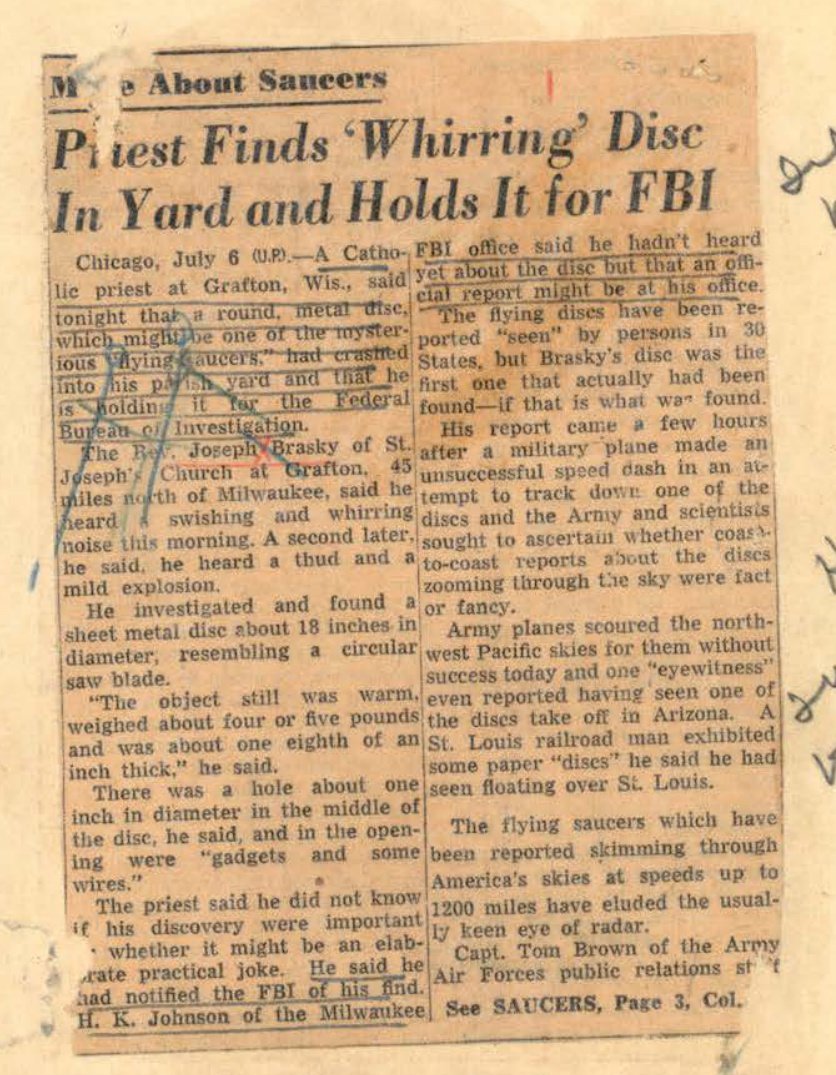
Dois homens de Tacoma contaram que discos soltaram fragmentos sobre um barco perto de Maury Island, e os dois oficiais de inteligência que os entrevistaram morreram na queda de um B-25 horas depois. Relatórios militares e do FBI preservam a investigação, fotografias das amostras e a declaração assinada em que os dois negaram qualquer ligação do material com discos.
- Data do evento
- 21/06/1947, data alegada do episódio; entrevista em 31/07/1947 e queda do B-25 em 01/08/1947
- Local
- Maury Island e Tacoma, Washington; queda do avião perto de Kelso, Washington, EUA
- Tema
- Arquivo do FBI
- Órgãos das fontes
- FBI · Arquivo histórico
- Documentos
- 4 documentos · 747 páginas
- Leitura
- 254 min
 FotografiaPágina física 20
FONTES DOCUMENTAIS · FBI / Arquivo histórico
O que os registros contam
Na tarde de 31 de julho de 1947, Kenneth Arnold, o piloto cujo relato de 24 de junho deu início à onda de notícias sobre discos voadores, telefonou ao tenente Frank M. Brown, da contrainteligência da Quarta Força Aérea. Segundo o relatório militar copiado no arquivo do FBI, Arnold e o capitão Emil Smith, da United Air Lines, estavam em Tacoma para investigar uma suposta explosão de disco sobre uma embarcação em 21 de junho. O documento diz que a viagem fora pedida e custeada por Ray A. Palmer, da Venture Press, de Evanston, Illinois.
A história chegou aos investigadores de segunda mão. Conforme Arnold e Smith contaram ao major George Sander, de McChord Field, Harold A. Dahl navegava ao sul de Maury Island no barco de Fred L. Crisman quando cinco discos desceram das nuvens e circularam devagar sobre a baía, a cerca de 500 pés. Seriam achatados como uma câmara de pneu vazia, com uns 100 pés de diâmetro e uma abertura de 25 pés no centro. Um deles teria oscilado e, tocado por outro, despejado “toneladas” de material sobre o barco, quebrando o corrimão e matando o cachorro de Dahl. Crisman teria dito depois ter visto outro disco no local.
Brown e o capitão William L. Davidson entrevistaram Dahl e Crisman num quarto do Winthrop Hotel até cerca de meia-noite e levaram amostras. O chefe da tripulação disse ter posto uma caixa de papelão no compartimento traseiro do B-25. O avião decolou de McChord por volta das 2h e caiu perto de Kelso por volta das 2h30 de 1º de agosto. Um resumo do FBI atribui a queda a um escapamento queimado no motor esquerdo, que incendiou a asa até ela se soltar, e diz que os oficiais morreram; logo depois, o mesmo texto afirma que o chefe da tripulação e “cada oficial” saltaram de paraquedas em segurança. A contradição está no original datilografado.
O oficial da Quarta Força Aérea que redigiu o relatório embarcou com o major Sander no barco, no porto de Tacoma, em 6 de agosto. Faltava um corrimão, mas o ponto de fixação tinha várias demãos de tinta e rachaduras de intempérie que, a seu ver, levariam várias estações para se formar. Se o material tivesse caído ali, escreveu, o convés dianteiro e o teto da cabine teriam de ser trocados. Ele também não encontrou nos jornais, a partir de 21 de junho, notícia de objeto estranho sobre o porto, e recomendou que a Força Aérea não prosseguisse com o caso.
Segundo resumo do FBI de 14 de agosto, Dahl e Crisman declararam por escrito, em 7 de agosto, que haviam recolhido “formações rochosas estranhas” numa cascalheira de Maury Island no início de junho. Admitiram que era “inteiramente falsa” a carta em que Dahl apresentara o material a Palmer como parte de um disco. No mesmo dia, o FBI concluiu que o avião não levava peças de disco e que não havia base para a acusação de sabotagem, espalhada por telefonemas anônimos à imprensa de Tacoma. Em entrevistas ao FBI, Arnold e Smith disseram que o major Sander chamou os fragmentos de escória de fundição.
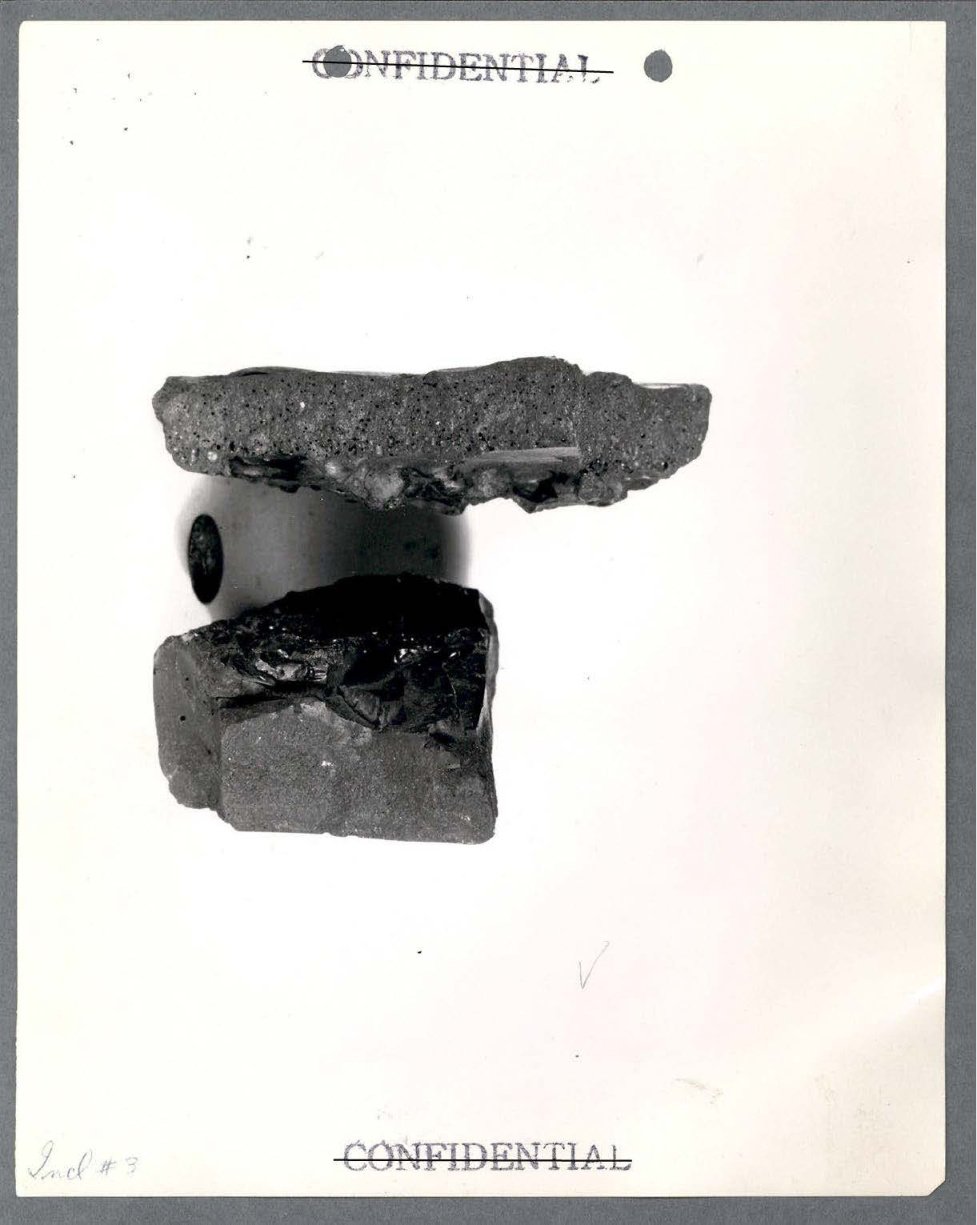
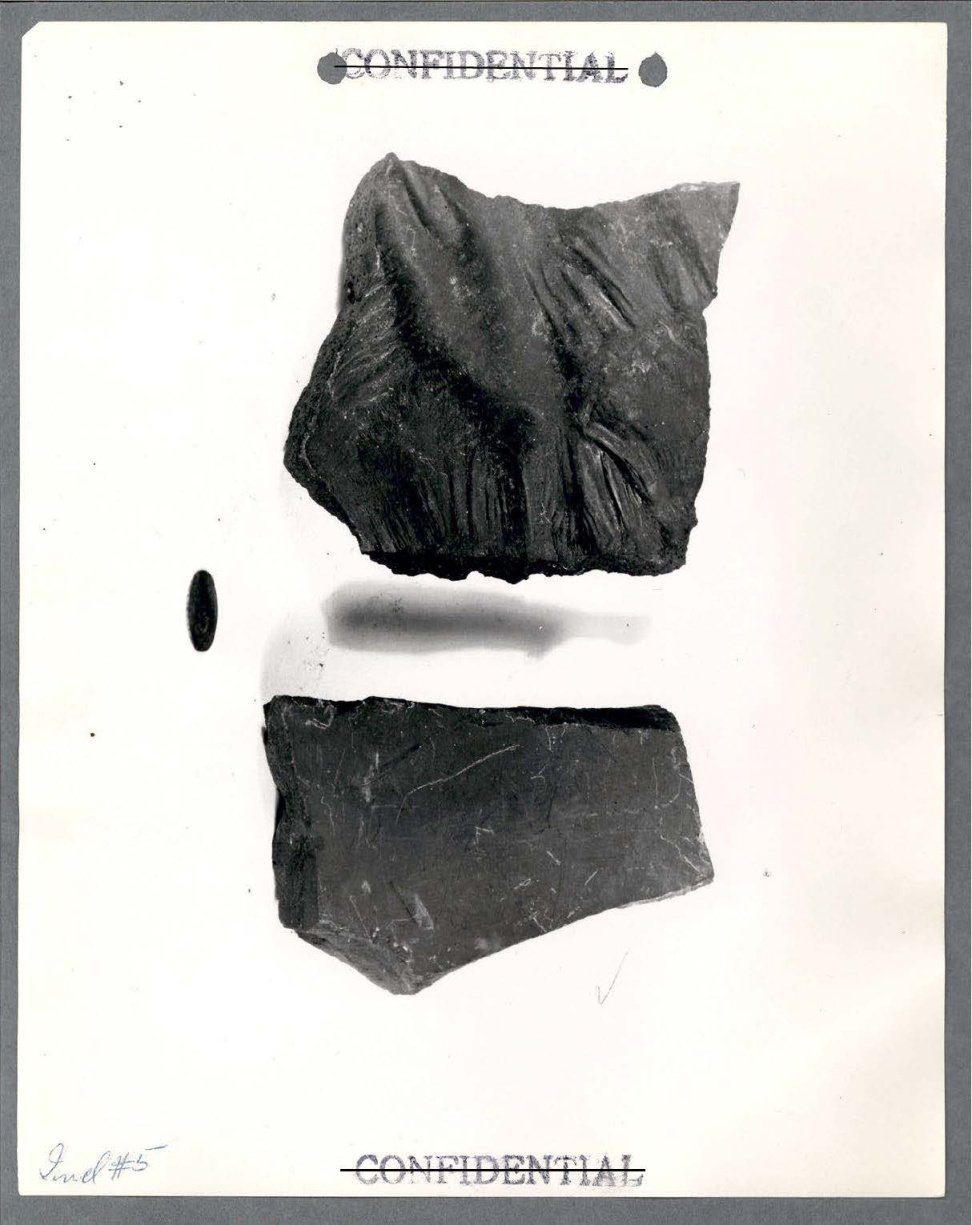
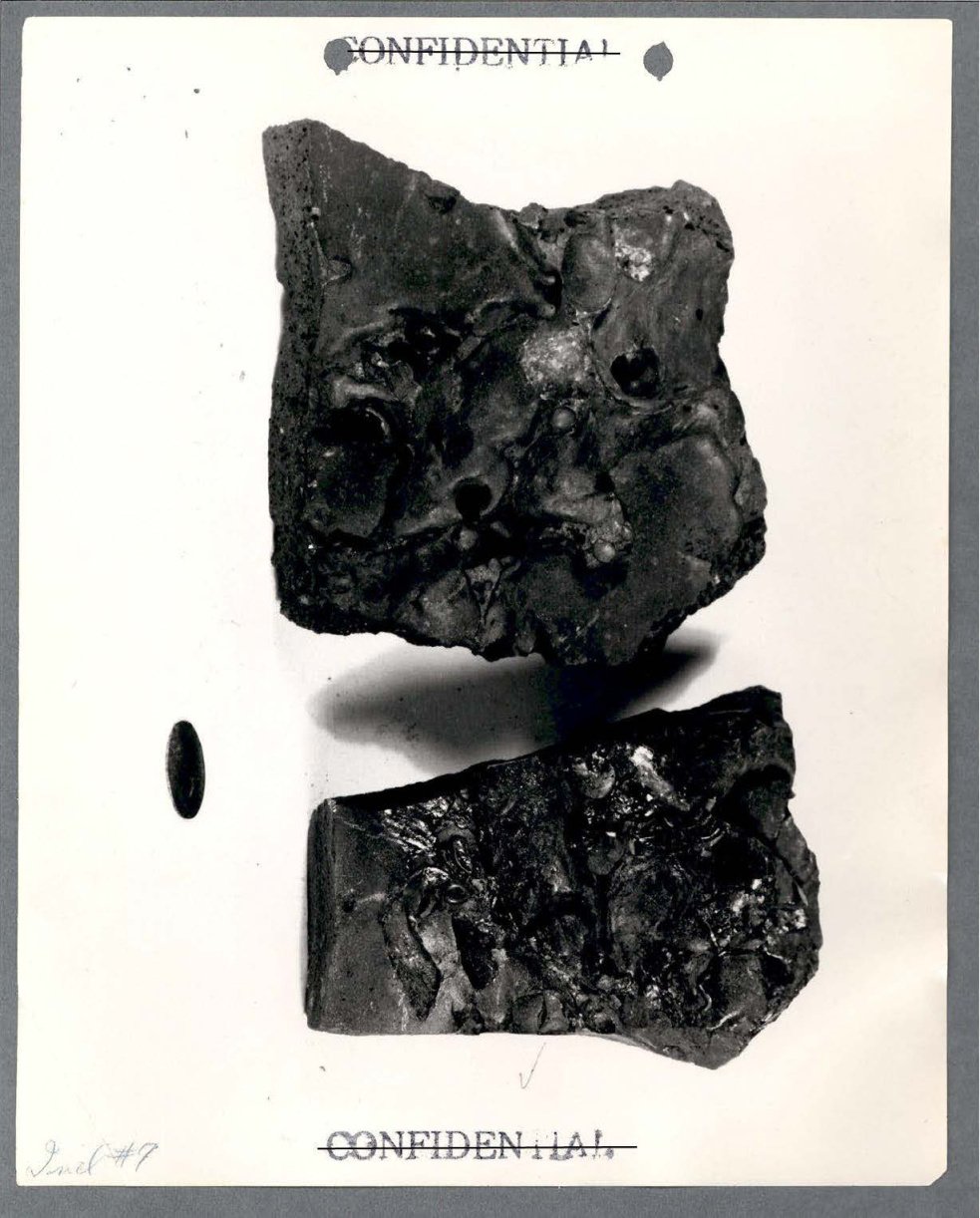
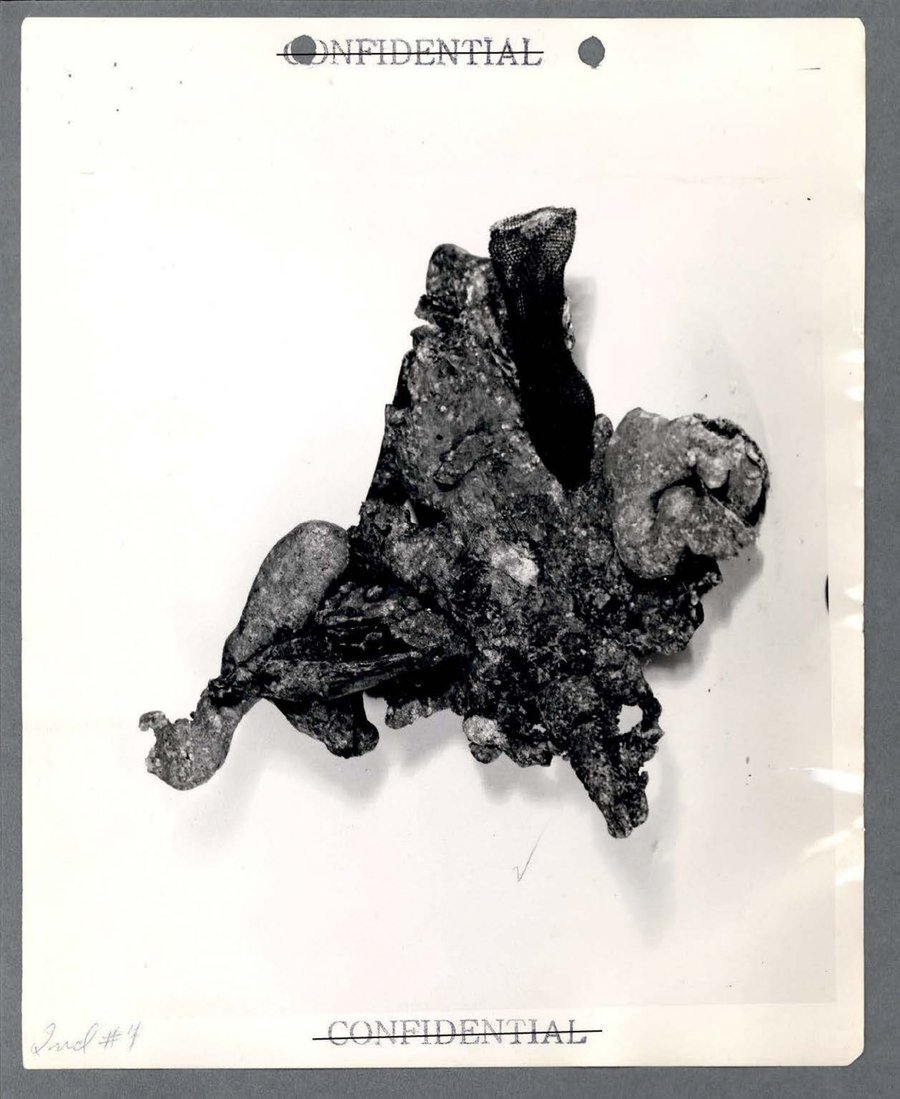
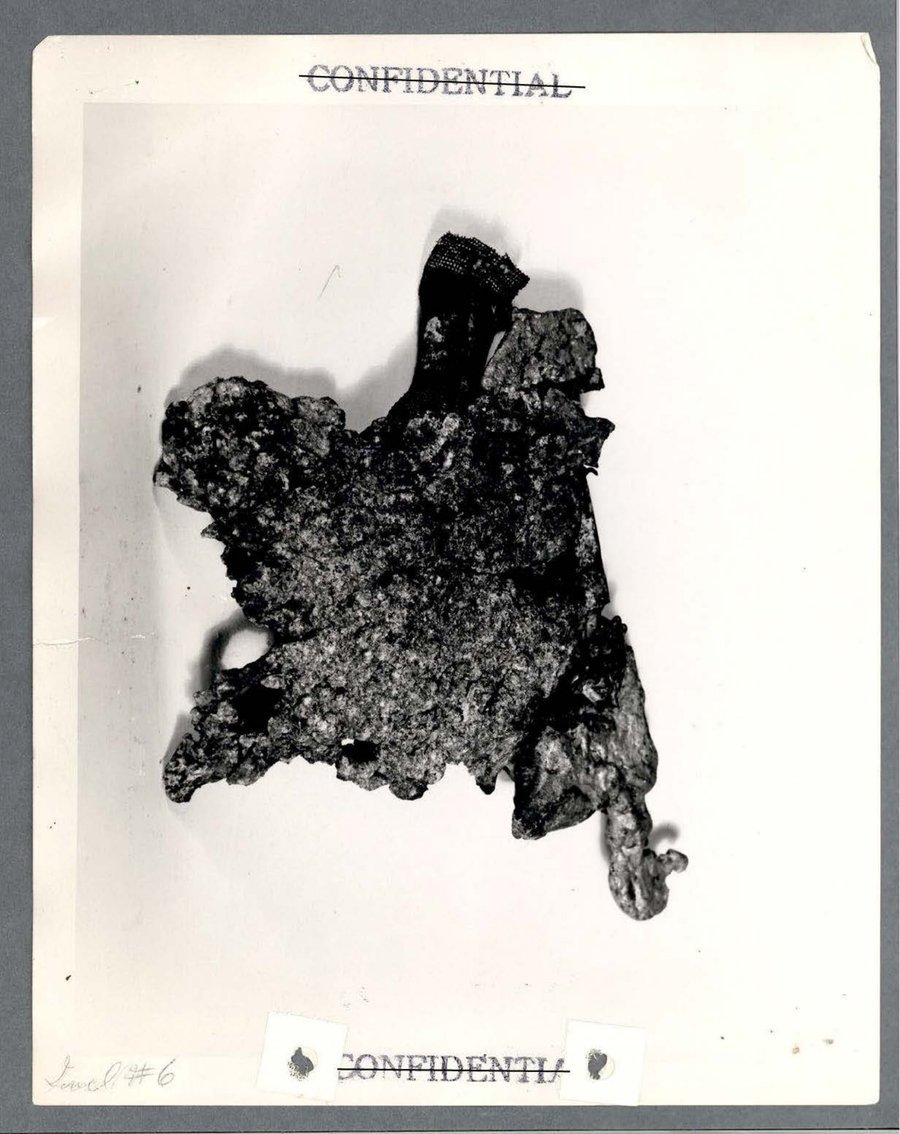
O relatório militar trazia como anexos 3 a 7 cinco fotografias das amostras, reproduzidas nas páginas 20 a 25 do arquivo. Segundo o texto, as peças fotografadas foram tiradas por Arnold da mesma caixa entregue aos oficiais. As imagens mostram blocos escuros, irregulares e porosos, e não permitem determinar composição, tamanho exato ou origem. Não há, nestas páginas, laudo de laboratório sobre o material; a escória é a opinião atribuída ao major Sander, reforçada por uma comparação visual feita numa fundição perto de Tacoma.
O relatório do escritório do FBI em Seattle, de 18 e 19 de agosto de 1947, assinado por Jack B. Wilcox, reconstrói a história desde o início. Em junho, o operador da Associated Press Ernie Vogel foi à casa de Dahl conferir o boato; a mulher de Dahl entrou na cozinha irritada, mandou-o admitir que tudo era fantasia, e Dahl admitiu que era farsa. Cinco telefonemas anônimos a jornalistas de Tacoma, entre 31 de julho e 2 de agosto, anteciparam os nomes dos oficiais mortos e depois falaram em canhão de 20 mm e em fazer a informação “chegar a Nova Jersey”. O FBI achou Crisman o autor mais provável, sem prova.
As versões de Dahl mudam conforme o ouvinte. A Arnold, falou em 21 de junho, seis objetos em forma de câmara de pneu e uma chuva de “lava” de metal branco que fazia a água ferver, matou o cachorro e feriu o filho; disse ainda que um homem o mandara esquecer tudo. No depoimento juramentado de Emil Smith, a data é 24 de junho, os objetos são quatro ou cinco e os detritos saem de uma vigia. Na declaração assinada ao FBI em 7 de agosto, restam pedras de uma cascalheira mandadas a Ray Palmer, que teria oferecido pagar por uma história exclusiva se fossem de disco.
O relatório de resgate resolve a contradição sobre o acidente: saltaram o passageiro, sargento Taff, e o chefe da tripulação, sargento Mathews, e Davidson e Brown morreram. Em 14 de agosto, Hoover observou que, se a farsa tivesse sido admitida aos oficiais, eles provavelmente não levariam os fragmentos no voo fatal. O relatório de Seattle registra ainda que o Quartel-General da Força Aérea pediu ao oficial de relações públicas de McChord uma declaração assinada de Dahl e Crisman “que pudesse ser publicada” para encerrar o caso. As fotografias dos anexos 4 e 6 do relatório militar mostram outras duas peças escuras e irregulares; nenhuma página traz laudo de laboratório.
O relatório final do Serviço de Resgate Aéreo de McChord Field, de 4 de agosto de 1947, reconstrói a madrugada da queda. O B-25 nº 1316 decolou às 2h12 rumo a Hamilton Field, e o chefe de polícia de Kelso viu um avião passar baixo e cair a leste por volta das 2h36, com lua cheia e boa visibilidade. Segundo os dois sobreviventes, o motor esquerdo pegou fogo e as chamas chegaram logo à cabine. Saltaram de paraquedas o passageiro, sargento E. L. Taff, e o chefe da tripulação, sargento técnico W. D. Mathews. A asa esquerda se soltou antes do impacto, o avião entrou em parafuso e os dois oficiais morreram nos destroços.
Esse relatório, arquivado como anexo 8 do relatório da Quarta Força Aérea, desfaz a frase contraditória do resumo do FBI de 14 de agosto. A frase nasceu no teletipo de Seattle de 7 de agosto, que diz num período que Davidson e Brown morreram e, no seguinte, que "o chefe da tripulação e cada oficial" saltaram em segurança. O relatório de resgate registra também que havia "material ultrassecreto" no estojo do navegador e que um agente da contrainteligência recolheu os documentos à noite. O texto não diz que material era esse, e nada indica que fossem as pedras de Maury Island, levadas numa caixa de papelão no compartimento traseiro.
Cartas e telegramas anexados ao processo mostram como Arnold entrou no caso. Em 22 de julho, Ray Palmer ofereceu pagar a viagem a Tacoma para conferir a história de Dahl e Crisman, que falava em seis discos e "vinte toneladas" de material na praia. Em 29 de julho, o jornalista Dave Johnson, de Boise, telegrafou ao tenente Brown avisando que Palmer mandara 200 dólares a Arnold e que a editora devia ser investigada. Ao FBI, Arnold contou que voou a Tacoma em 30 de julho e que Dahl, no hotel, pediu que ele fosse embora e esquecesse os discos.
No relato de Arnold ao FBI de Butte, Crisman chegou ao hotel em 31 de julho com uma braçada de fragmentos e contou que, em 23 de julho, vira sobre Maury Island um objeto parecido com um balão, com vigias e janelas. Brown teria comentado com Arnold, em confidência, uma foto de disco tirada por um homem em Phoenix, que parece ser a de William Rhodes, tratada em outro dossiê. Depois de ouvir Dahl, disse Arnold, os oficiais pareceram desinteressados, recusaram ir à ilha e recolheram com cuidado todos os fragmentos. Na manhã seguinte, foi Crisman quem avisou Arnold das mortes, antes de qualquer anúncio do Exército.
Os boatos correram mais rápido que os fatos. Cinco telefonemas anônimos a jornalistas de Tacoma falaram em avião abatido ou sabotado; um jornalista da United Press repassou a Arnold a versão de que o avião soltara um sinalizador e mergulhara numa encosta. Palmer escreveu a Arnold em 5 de agosto que não havia "trama horrível" e que as mortes provavelmente foram acidente. O FBI considerou Dahl ou Crisman os autores mais prováveis das ligações, para valorizar a história junto à revista, mas não provou isso. Em 14 de agosto, Seattle corrigiu um ponto: Dahl não admitira a Smith a farsa, só disse que a chamaria assim se fosse interrogado.
Em Washington, a notícia chegou distorcida. Em 6 de agosto, a inteligência das Forças Aéreas do Exército disse ao FBI saber apenas que um agente da contrainteligência morrera numa queda durante "missão ultrassecreta", talvez ligada a Arnold, e que não acreditava em discos recuperados. No mesmo dia, o FBI de Portland repassou uma notícia da United Press segundo a qual a análise dos fragmentos apontava escória de uma usina de Tacoma; nenhum laudo aparece no arquivo. O tenente-coronel Springer foi pessoalmente à região de Kelso, e em 25 de agosto o general Hale respondeu ao Seattle Times que não havia declaração oficial a fazer nem censura sobre o caso.
O Chicago Times de 3 de agosto, resumido pelo FBI de Chicago em setembro, espalhou uma versão cheia de erros: explosão em 24 de junho, reunião do Exército e da Marinha em 1º de agosto, queda perto de Hamilton Field e um "metal de óxido de lava" que teria feito o avião explodir. Os documentos militares desmentem cada ponto. O escritório de Chicago levantou a hipótese de que Palmer, editor da revista Amazing, explorava os discos para promover as histórias de Richard Shaver; é suposição do FBI, não conclusão. Em 1948, uma carta de um particular arquivada pela Força Aérea ainda repetia o boato dos dois oficiais mortos com "provas materiais".
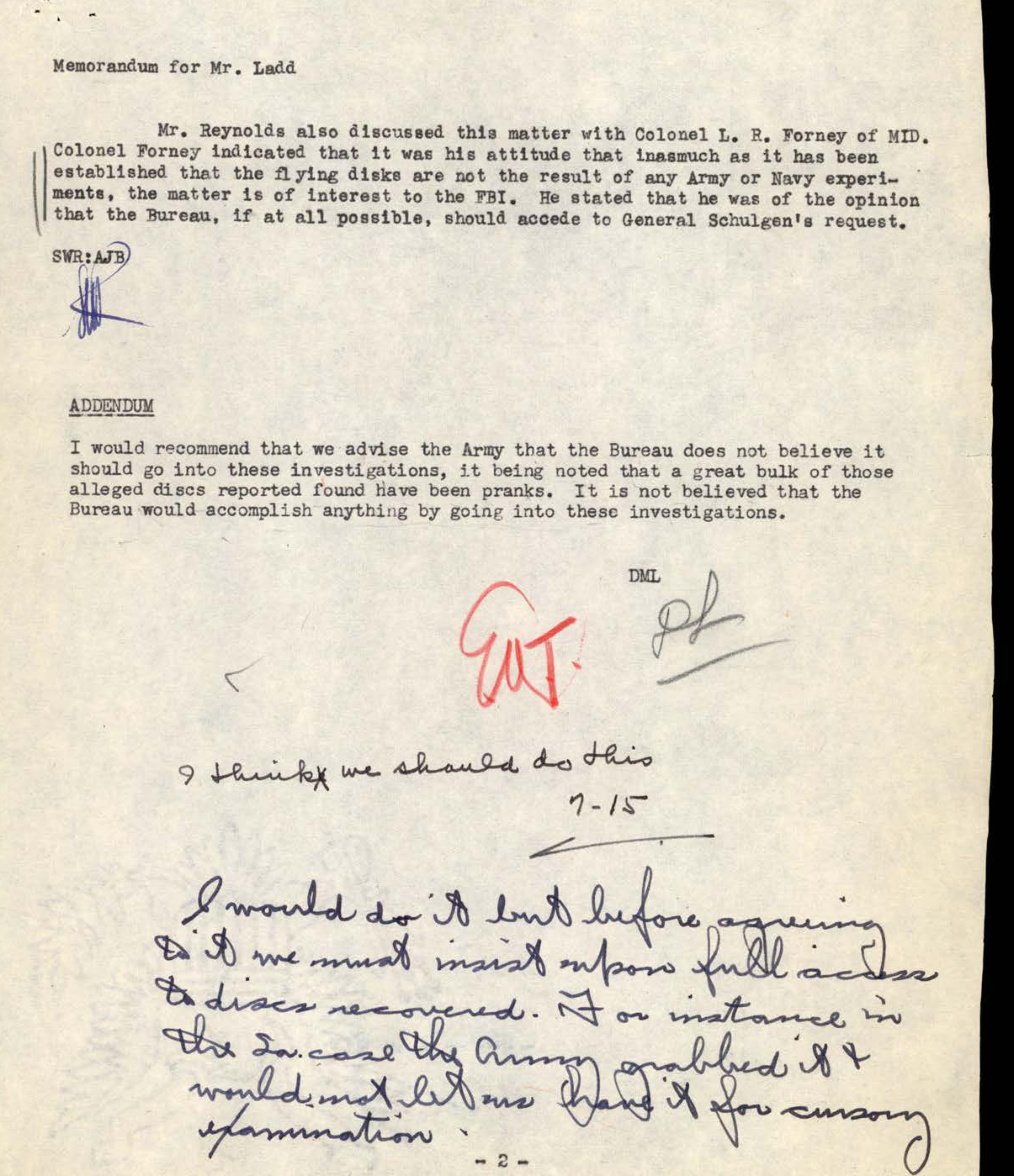
A queda do B-25 também gerou papelada interna no FBI. Num memorando de agosto de 1947 (dia 11 ou 14, com o dígito mal impresso), J. P. Coyne enviou a D. M. Ladd duas cópias de um "memorando cego", sem timbre nem assinatura, que expunha os fatos sobre o acidente aéreo em que morreram dois oficiais das Forças Aéreas do Exército que investigavam queixas de discos voadores. Coyne recomendou que a Seção de Ligação entregasse uma cópia à inteligência da Força Aérea. O memorando cego em si não está nesta página do arquivo.
Mais imagens do documento
LEITURA DIRETA DO ARQUIVO
O documento, em português
Documentos do governo dos EUA: trechos decisivos traduzidos. O relato de Dahl é tratado como alegação de terceiros, depois retratada em declaração assinada; não é contado como observação independente. Números de avistamento são alegações, não medições.
TRECHO 1 · PÁGINA FÍSICA 14
Folha de síntese do relatório da Quarta Força Aérea, 12/08/1947, página física 14 (íntegra)
Quartel-general da Quarta Força Aérea, Gabinete do Chefe-Adjunto de Estado-Maior, A-2, Inteligência, Hamilton Field, Califórnia. CONFIDENCIAL. Título: investigação de disco voador. Local da investigação: Tacoma e Kelso, Washington. Arquivo nº 4AF-1208-I. Órgão controlador: Comando de Defesa Aérea, Mitchel Field. Período: 31 de julho a 7 de agosto de 1947. Classificação: incidente. Data: 12 de agosto de 1947. Situação: pendente. MOTIVO DA INVESTIGAÇÃO: aberta a pedido do Comando de Defesa Aérea, carta do QG do ADC de 7 de julho de 1947, arquivo D333.5ID, assunto: investigação de disco voador. SÍNTESE: Em 31 de julho de 1947, o Sr. Arnold, editor de aviação do Idaho Daily Statesman, telefonou ao tenente Brown pedindo que voltasse a Tacoma porque acreditava ter informação muito importante sobre o disco voador. O tenente Brown e o capitão Davidson entrevistaram um certo Sr. Fred L. Crisman e um certo Sr. Harold A. Dahl, junto com o capitão Smith, da United Air Lines, e o Sr. Arnold, no Winthrop Hotel, em Tacoma, Washington, na noite de 31 de julho de 1947. O resumo do interrogatório e das conclusões foi relatado ao major Sander, oficial de informação pública de McChord Field, pelo Sr. Arnold e pelo capitão Smith. O major Sander recontou os resultados a este oficial a partir de suas anotações. O Sr. Dahl e o Sr. Crisman não estiveram disponíveis para entrevista enquanto este oficial esteve na área, embora todo esforço tenha sido feito para contatá-los. A continuação da investigação deste incidente ficou com o Sr. Brady, agente residente do FBI em Tacoma, Washington. Ficou claro, por recortes de jornal, telefonemas a este oficial e conversas com o major Sander, que um correspondente da United Press, do Tacoma Times, foi decisivo para manter o caso vivo. Este oficial e o major Sander, embora citados muitas vezes na imprensa, não discutiram o assunto com a imprensa durante o período deste relatório. O misterioso autor anônimo dos telefonemas em Tacoma poderia ser o Sr. Crisman. Distribuição: AAF 2; ADC 1; G-2 do 6º Exército 1; FBI Seattle 1; FBI San Francisco 1; arquivo da 4ª FA 1. Aprovado: Donald L. Springer, tenente-coronel, GSC, chefe-adjunto de Estado-Maior, A-2.Nota editorial: O número do arquivo de referência foi lido como D333.5ID, com leitura incerta de um caractere.
Conferir original em inglês
HEADQUARTERS FOURTH AIR FORCE, Office of the Assistant Chief of Staff, A-2, Intelligence, Hamilton Field, California. CONFIDENTIAL. Title: Investigation of Flying Disc. Investigation made at: Tacoma and Kelso, Washington. File No. 4AF-1208-I. Controlling office: Air Defense Command, Mitchel Field. Period covered: 31 July through 7 August 1947. Case classification: Incident. Date: 12 August 1947. Status of case: Pending. REASON FOR INVESTIGATION: Investigation initiated at the request of Air Defense Command, reference ltr Hq ADC, dtd 7 Jul 47, file D333.5ID, subj: Investigation of Flying Disc. SYNOPSIS: On 31 July 47, Mr. Arnold, Aviation Editor of the Idaho Daily Statesman, telephoned Lt. Brown requesting he return to Tacoma because Arnold believed he had some very vital information on the flying disc. Lt. Brown and Capt. Davidson interviewed a Mr. Fred L. Crisman and a Mr. Harold A. Dahl, along with Capt. Smith of the United Air Lines, and Mr. Arnold, at the Winthrop Hotel in Tacoma, Washington, on the night of 31 July 1947. The summary of their interrogation and findings was related to Major Sander, Public Information Officer, McChord Field, by Mr. Arnold and Capt. Smith. Major Sander retold the results of the investigation to this officer from his notes. Mr. Dahl and Mr. Crisman were not available for interview while this officer was in that area, although every effort was made to contact them. Further investigation of this particular incident was left with Mr. Brady, Resident Agent, FBI, Tacoma, Washington. It was apparent from newspaper clippings, telephone calls to this officer, and conversations with Major Sander, that a United Press correspondent, of the Tacoma Times, was instrumental in keeping this case alive. This officer and Major Sander, although quoted many times in the press, did not discuss this matter with the press during the period of this report. The anonymous mystery caller in Tacoma could possibly be Mr. Crisman. Distribution: AAF 2; ADC 1; G-2 6th Army 1; FBI, Seattle 1; FBI, San Francisco 1; 4AF Files 1. Approved: Donald L. Springer, Lt. Colonel, GSC, AC of S, A-2.Consultar a ficha do documento ↗ · Página física 14, contando a capa.
TRECHO 2 · PÁGINA FÍSICA 15
Relatório da Quarta Força Aérea, detalhes, página física 15 (íntegra; endereço comercial omitido)
Relatório CI-R1. CONFIDENCIAL. DETALHES: 1. Na tarde de 31 de julho de 1947, o Sr. Arnold, editor de aviação do Idaho Daily Statesman, telefonou ao tenente Brown, comandante do subdestacamento do CIC [Corpo de Contrainteligência] no Quartel-General da Quarta Força Aérea, e disse em substância que ele, Arnold, e o capitão Smith tinham chegado a Tacoma para investigar a suposta explosão de um disco voador sobre uma embarcação em 21 de junho de 1947. Essa investigação fora pedida e financiada por um certo Sr. R. A. Palmer, da Venture Press, [endereço omitido], Evanston, Illinois. NOTA DO AGENTE: ver anexos 1 e 2. A assinatura do anexo 2, Sr. Dave Johnson, é a do editor do Idaho Daily Statesman. O Sr. Johnson é ex-oficial da Força Aérea do Exército e, por todos os indícios, um americano muito patriota. Ao receber o anexo 2 no QG da Quarta Força Aérea, este oficial pediu ao escritório do FBI em San Francisco que consultasse o escritório de Chicago sobre R. A. Palmer e a Venture Press. A resposta, por telefone, foi que os índices do FBI em Chicago, a polícia de Chicago e o serviço de crédito não tinham registro de R. A. Palmer nem da Venture Press. 2. O tenente Brown e o capitão Davidson chegaram a McChord Field na tarde de 31 de julho de 1947. Trocaram o uniforme por roupas civis dentro do avião e, perguntados pelas Operações por que queriam transporte até Tacoma, responderam que iam fazer um discurso. NOTA DO AGENTE: isso cumpria o parágrafo 4 da carta do QG do ADC, arquivo D333.5ID, de 7 de julho de 1947, assunto: investigação de disco voador. Segundo o major George Sander, oficial de informação pública de McChord Field, o Tacoma Times recebeu um telefonema anônimo dizendo que Arnold e Smith estavam no Winthrop Hotel para investigar o disco voador. O jornal verificou e constatou que era verdade, para grande surpresa de Arnold e Smith. O tenente Brown e o capitão Davidson de fato entrevistaram o Sr. Harold A. Dahl e o Sr. Fred L. Crisman num quarto do Winthrop Hotel, em Tacoma, na presença do Sr. Arnold e do capitão Smith. Se foram feitas anotações dessa conversa, elas se perderam no acidente do avião. O Sr. Arnold disse ao major Sander que o tenente Brown obteve do Sr. Dahl e do Sr. Crisman amostras de uma substância não identificada idênticas às que aparecem nos anexos 3 a 7. As amostras fotografadas nos anexos 3 a 7 foram tiradas pelo Sr. Arnold da mesma caixa que Dahl e Crisman ofereceram ao tenente Brown e da qual ele tirou suas amostras. O sargento técnico Matthews, chefe da tripulação do avião acidentado, interrogado por este oficial, declarou que colocou uma caixa de papelão pesada no compartimento traseiro do B-25 que caiu. Não olhou dentro da caixa nem ouviu comentários do tenente Brown ou do capitão Davidson sobre o conteúdo. 3. O que segue resume o que o Sr. Arnold e o capitão Smith contaram ao major Sander sobre o interrogatório feito pelo tenente Brown e pelo capitão Davidson: em 21 de junho de 1947, o Sr. Dahl navegava ao sul de Maury Island no barco do Sr. Crisman. Cinco discos voadores desceram das nuvens e circularam devagar sobre a baía, baixando a uma altitude estimada de 500 pés. Esses discos pareciam redondos eNota editorial: Endereço comercial da Venture Press omitido. O número do arquivo do ADC tem um caractere de leitura incerta.
Conferir original em inglês
CI-R1 Report. CONFIDENTIAL. DETAILS: 1. During the afternoon of 31 July 47, Mr. Arnold, Aviation Editor of the Idaho Daily Statesman, telephoned Lt Brown, CIC Sub-Detachment Commander at Headquarters Fourth Air Force, and stated in substance: That he, Arnold, and Capt Smith had arrived in Tacoma to investigate the purported flying disc explosion on a surface craft on 21 June 47. This investigation was requested and financed by a Mr. R. A. Palmer of the Venture Press, [address omitted], Evanston, Illinois. AGENT'S NOTE: See Inclosure 1 and Inclosure 2. The signature to Inclosure 2, Mr. Dave Johnson, is that of the editor of the Idaho Daily Statesman. Mr. Johnson is a former Army Air Force officer and from all indications is a very patriotic American. On the receipt of Inclosure 2 at Headquarters Fourth Air Force, this officer requested the San Francisco FBI Office to check the Chicago FBI Office for R. A. Palmer and the Venture Press. The return answer, by telephone, was to the effect that the Chicago indices of the FBI, the Chicago Police, and Credit Bureau had no record on R. A. Palmer or the Venture Press. 2. Lt Brown and Capt Davidson arrived at McChord Field during the afternoon of 31 July 47. They changed from their uniforms to civilian clothing in the aircraft and, on being queried by Operations as to why they desired transportation to Tacoma, they replied they were to make a speech. AGENT'S NOTE: This was in compliance with par 4, ltr fr Hq ADC, File D333.5ID, 7 Jul 47, subj: Investigation of Flying Disc. According to Major George Sander, Public Information Officer, McChord Field, The Tacoma Times received an anonymous telephone call that Arnold and Smith were present in the Winthrop Hotel for the purpose of conducting an investigation on the flying disc. The Tacoma Times checked and found this to be true, much to Arnold's and Smith's surprise. Lt Brown and Capt Davidson did interview Mr. Harold A. Dahl, Mr. Fred L. Crisman, in a hotel room in the Winthrop Hotel, Tacoma, Wash., in the presence of Mr. Arnold and Capt Smith. If notes were taken of this conversation, they were destroyed in the aircraft accident. Mr. Arnold stated to Major Sander that Lt Brown obtained from Mr. Dahl and Mr. Crisman samples of an unidentified substance that were identical to those appearing in Inclosures 3 to 7. The samples pictured in Inclosures 3 to 7 were taken by Mr. Arnold from the same box that Dahl and Crisman offered Lt. Brown and from which he obtained his samples. T/Sgt Matthews, Crew Chief on the wrecked aircraft, upon being interrogated by this officer, stated that he placed a heavy cardboard carton in the rear compartment of the B-25 that crashed. He did not look in the box nor hear any comments from Lt Brown or Capt Davidson as to its contents. 3. The following summarizes what was related by Mr. Arnold and Capt Smith to Major Sander as to the substance of the interrogation by Lt Brown and Capt Davidson: That on 21 Jun 47 Mr. Dahl was proceeding south of Maury Island in Mr. Crisman's boat. Five flying discs came down out of the clouds and circled slowly around the bay, dropping to an estimated elevation of 500 feet. These discs appeared round andConsultar a ficha do documento ↗ · Página física 15, contando a capa.
TRECHO 3 · PÁGINA FÍSICA 16
Relatório da Quarta Força Aérea, continuação, página física 16 (íntegra)
achatados, semelhantes a uma câmara de pneu de automóvel murcha. Dahl calculou que tinham cerca de 100 pés de diâmetro, com uma abertura de 25 pés no centro. A borda externa do objeto tinha vigias redondas, e o anel interno, janelas ou vigias quadradas. Os discos eram silenciosos e, de onde estava, ele não via meio de propulsão. Um dos discos pareceu vacilar e oscilar no ar; outro dos cinco desceu junto ao que oscilava e bateu nele, despejando “toneladas” do material mostrado nos anexos 3 a 7 sobre o barco, arrancando o corrimão e a buzina, causando danos de cerca de 200 dólares e matando o cachorro de Dahl. NOTA DO AGENTE: Este oficial, com o major Sander, subiu a bordo do barco, atracado no porto de Tacoma, em 6 de agosto de 1947. Faltava um corrimão, mas o ponto onde ele era preso tinha sido coberto com várias demãos de tinta e estava rachado pelo tempo. O convés e o teto da cabine eram de construção muito fina, e a cabine tinha vidro na frente e nos lados. Na opinião deste oficial, se qualquer dos objetos apresentados por Dahl como amostras do material despejado pelo disco tivesse atingido o barco, certamente teria sido preciso trocar o convés dianteiro e o teto da cabine. Essas duas áreas tinham várias demãos de tinta e rachaduras profundas de intempérie que levariam várias estações para se formar. O Sr. Crisman, dono do barco, que faz patrulha costeira para várias empresas, aparentemente foi à área de Maury Island conferir a história de Dahl. Teria dito que encontrou o material entregue ao tenente Brown e ao capitão Davidson num areal perto de onde o incidente teria ocorrido. Enquanto ele, Crisman, estava no local, um disco voador saiu das nuvens e se comportou como os já descritos. NOTA DO AGENTE: A observação, em duas ocasiões, em plena luz do dia, de um objeto tão grande e visível a poucas milhas da cidade de Tacoma certamente deveria ter sido vista e relatada por outras pessoas além de Dahl e Crisman. Os jornais de 21 de junho em diante foram verificados e não se encontrou menção a objeto misterioso sobre o porto de Tacoma. O Sr. Crisman teria enviado amostras dos objetos recolhidos no areal de Maury Island a um amigo na Universidade de Chicago, para análise. Consta que não recebeu o resultado. NOTA DO AGENTE: É possível que o Sr. R. A. Palmer, mencionado nos anexos 1 e 2, tenha sabido do incidente pela Universidade de Chicago. O interrogatório de Dahl e Crisman pelo tenente Brown terminou por volta da meia-noite de 31 de julho para 1º de agosto. O tenente Brown e o capitão Davidson voltaram a McChord Field e se prepararam para um voo noturno até Hamilton Field. O tempo estava limpo, com lua brilhante. Decolaram por volta das 2h e caíram por volta das 2h30 de 1º de agosto de 1947 (ver anexo 8). 4. Em 6 de agosto de 1947, este oficial, com o major Sander, de McChord Field, e o Sr. Brady, agente residente do FBI em Tacoma, tentouNota editorial: Os dois trechos desta página já publicados estão incluídos aqui na íntegra da página.
Conferir original em inglês
flattened similar to a deflated automobile innertube. They were judged by Dahl to be approximately 100 feet across with a 25 foot opening in the center. The outer edge of the object had round portholes and the inner ring had square windows or portholes. The discs were silent and from his viewpoint he could see no means of propulsion. One of these discs appeared to falter and waver in the air, another of these aforementioned five discs dropped down close to the disc that appeared to waver and bumped it, dumping "tons" of the stuff as pictured in inclosure 3 to 7 on his boat, knocking off the handrail, horn, and generally damaging the boat to the extent of $200.00, and killing Dahl's dog. AGENT'S NOTE: This officer, in the company of Major Sander, boarded the aforementioned boat where it was docked in the Tacoma harbor on 6 Aug 47. A hand rail was missing, but the area where the hand rail was previously fastened had been painted over with several coats of paint and was cracked by the weather. The deck and roof of the cabin was of a very thin construction and the cabin further had glass on the front and sides. It is this officer's opinion that if any of the objects presented by Dahl as samples of the material dropped by the flying disc had hit this boat, it would have certainly been necessary to replace the foredeck and the cabin roof. These two areas were very heavily coated with several coats of paint and had deep weather cracks that would take several seasons to acquire. Mr. Crisman, who owns the boat and operates a shoreline water patrol for various business firms, evidently visited the area at Maury Island to check Dahl's story. He is supposed to have stated that he found the material that he presented to Lt Brown and Capt Davidson in a sand pit near where the incident was supposed to have occurred. While he, Crisman, was at the scene of the incident, a flying disc came out of the clouds and behaved in a similar manner as the ones previously described. AGENT'S NOTE: The witnessing on two occasions, in broad daylight, of an object so large and clearly visible within several miles of the city of Tacoma certainly should have been seen and reported on by other than Dahl and Crisman. A check was made of the newspapers on and after 21 June and no mention could be found of a mysterious object appearing over the Tacoma harbor. Mr. Crisman is supposed to have sent samples of the objects that he picked up in the Maury Island sand pit to a friend of his at the University of Chicago for an analysis report. He is reported to have not received the analysis report. AGENT'S NOTE: It is possible that the Mr. R. A. Palmer, reference Inclosure 1 and 2, might have come across this incident through the University of Chicago. The interrogation of Dahl and Crisman by Lt Brown was completed about midnight on 31 July/1 August. Lt Brown and Capt Davidson returned to McChord Field and prepared for a night flight to Hamilton Field. The weather was clear with a bright moon shining. They departed approximately 0200 hours and crashed at approximately 0230 hours on 1 August 1947. (See Inclosure 8). 4. On 6 August 47, this officer, in the company of Major Sander, McChord Field, and Mr. Brady, resident agent, Tacoma Federal Bureau of Investigation, attempted toConsultar a ficha do documento ↗ · Página física 16, contando a capa.
TRECHO 4 · PÁGINA FÍSICA 17
Relatório da Quarta Força Aérea, fecho e recomendações, página física 17 (íntegra; dados pessoais omitidos)
contatar o Sr. Dahl ou o Sr. Crisman, sem sucesso. O capitão Smith e o Sr. Arnold deixaram a área de Tacoma em 3 de agosto de 1947; por isso, este oficial não teve oportunidade de conversar diretamente com eles. NOTA DO AGENTE: O Sr. Brady consultou por telefone o escritório do FBI em Seattle sobre registros do Sr. Crisman e do Sr. Dahl. A consulta sobre Crisman foi negativa. [Frase sobre registros atribuídos a um homônimo omitida por privacidade.] Não foi possível determinar na ocasião se Harold A. Dahl, o envolvido, e o Harold Dahl dos índices do FBI eram a mesma pessoa. 5. O Sr. Crisman dissera ao capitão Smith, a Arnold e aos demais que era ex-piloto de caça e capitão da Reserva Aérea. NOTA DO AGENTE: Em 6 de agosto de 1947, este oficial consultou os registros da 406ª Unidade de Base da AAF (RT) e verificou que Fred L. Crisman estava inscrito nessa unidade da reserva como capitão, [número de série e residência omitidos], especialidades militares 1054 e 1055. Em 1942 esteve na Divisão de Investigação Criminal do estado de Washington e antes fora técnico de petróleo da ferrovia Union Pacific. Crisman entrou no serviço em 1942 como praça e serviu assim por dezessete meses. Em 1943 foi comissionado ao se formar na escola de voo e serviu ao todo vinte e nove meses. Consultou-se a lista da cidade de Tacoma sobre Harold A. Dahl, [endereços residencial e comercial e telefones omitidos]. RECOMENDAÇÃO: 1. Que o pessoal da Força Aérea do Exército não faça mais nenhuma investigação sobre este incidente específico. 2. Que, em vista das declarações atribuídas ao Sr. Crisman, se considere revogar sua patente na Reserva Aérea e seu status de voo, por ser oficial indesejável e não confiável. 8 anexos: 1. Fotostática, carta de R. A. Palmer. 2. Fotostática, telegrama de Dave Johnson. 3 a 7. Fotografias, substância não identificada. 8. Relatório final de missão, Serviço de Resgate Aéreo.Nota editorial: Omitidos: registros atribuídos em índice a um homônimo não confirmado, número de série militar, endereços e telefones.
Conferir original em inglês
contact either Mr. Dahl or Mr. Crisman, without success. Capt Smith and Mr. Arnold departed the Tacoma area on 3 August 47, therefore, this officer did not have the opportunity of conversing with them directly. AGENT'S NOTE: A record check was made by telephone by Mr. Brady with the Seattle Field Office, FBI, for records on Mr. Crisman and Mr. Dahl. The check on Mr. Crisman was negative. [Sentence on records attributed to a person of the same name omitted.] It could not be determined at the time whether Harold A. Dahl, the subject in question, and Harold Dahl of the FBI indices, was one and the same. 5. Mr. Crisman had indicated to Capt Smith, Arnold, et al, that he was a former fighter pilot and held commission as Captain in the Air Reserve. AGENT'S NOTE: On 6 August 47, this officer checked the records of the 406th AAF BU(RT) and determined that Fred L. Crisman was registered with that Reserve Unit as Captain, [serial number and residence omitted], Primary MOS 1054 and 1055. In 1942 he was with the Criminal Investigation Division, State of Washington, and previously had been an oil technician with the Union Pacific Railway. Crisman entered the service in 1942 as an enlisted man and served as such for seventeen months. In 1943 he was commissioned on graduation from flying school and served a total of twenty-nine months. A check of the Tacoma city directory was made on Harold A. Dahl, [home and business addresses and telephones omitted]. RECOMMENDATION: 1. That no further investigation be undertaken on this specific incident by Army Air Force personnel. 2. That in view of the reported statements by Mr. Crisman, that consideration be given to revoke his Air Reserve commission and flying status as an undesirable and unreliable officer. 8 Incls: 1. Photostat, ltr fr R. A. Palmer. 2. Photostat, telegram fr Dave Johnson. 3. to 7. Photographs, Unidentified Substance. 8. Final Mission Report, Air Rescue Service.Consultar a ficha do documento ↗ · Página física 17, contando a capa.
TRECHO 5 · PÁGINA FÍSICA 31
Memorando de D. M. Ladd ao diretor do FBI, 14/08/1947, página física 31 (íntegra)
Memorando interno do governo dos Estados Unidos. Para: o Diretor. De: Sr. D. M. Ladd. Data: 14 de agosto de 1947. Assunto: discos voadores. Em resposta ao seu pedido de informação sobre os fatos relativos às notícias de discos voadores na região de Portland e à suposta reunião de oficiais do Exército em Portland sobre discos voadores, o escritório de Portland informou que Leaveritt G. Richards, editor de aviação do Oregonian, declarou que o capitão William L. Davidson e o tenente Frank M. Brown, do Quartel-General da Quarta Força Aérea, em San Francisco, estiveram em Portland em 27 de julho de 1947. Lá entrevistaram Dick Rankin, piloto experiente, que relatara ter visto em 14 de junho uma formação de dez discos voadores sobre Bakersfield, Califórnia. Richards acrescentou que Davidson e Brown também entrevistaram quatro pilotos experientes que estavam entre os primeiros a relatar discos: Kenneth Arnold, empresário de Boise, Idaho; o capitão E. J. Smith, copiloto; Ralph Stevens, da United Airlines; e Dave Johnson, editor de aviação do Idaho Statesman. Para saber o objetivo dessas entrevistas, Richards procurou o major-general Twining, de Wright Field, Ohio, e dele ficou com a impressão de que a AAF abrira a investigação para desfazer as notícias de discos, já que eles decididamente não são de origem da AAF. Na sexta-feira, 1º de agosto, o avião em que voavam os investigadores da AAF, capitão Davidson e tenente Brown, caiu em Kelso, Washington, e ambos morreram. Os destroços foram vasculhados pela inteligência da AAF de McChord Field. O Tacoma News Tribune e, por meio dele, a United Press divulgaram que o avião levava partes de um disco que teria atingido um barco de Harold Dahl e Fred Chrisman. Também se insinuou que o avião foi sabotado para impedir o exame dessas peças. SITUAÇÃO: a investigação do Bureau mostrou que o avião decididamente não levava partes de disco e que não há fundamento para a acusação de sabotagem. Para sua informação, segue anexo um memorando sem identificação de origem com mais detalhes da investigação sobre a queda. Nenhuma outra diligência está sendo feita. PROVIDÊNCIA: a inteligência da Força Aérea foi informada dos resultados da nossa investigação.Nota editorial: A data impressa está parcialmente coberta; lê-se 14 de agosto de 1947. O memorando registra “14 de junho” para a observação de Rankin.
Conferir original em inglês
Office Memorandum, United States Government. TO: The Director. FROM: Mr. D. M. Ladd. DATE: August 14, 1947. SUBJECT: FLYING DISCS. In connection with your request to be advised as to the facts concerning newspaper reports of flying discs in the Portland area and the reported conference of army officials in Portland concerning flying discs, the Portland Office has advised that Leaveritt G. Richards, aviation editor of the "Oregonian," has stated that Captain William L. Davidson and Lieutenant Frank M. Brown of the Fourth AAF Headquarters, San Francisco, were in Portland on July 27, 1947. While in Portland they interviewed Dick Rankin, an experienced pilot, who had reported that he observed, on June 14, a formation of ten flying discs over Bakersfield, California. Richards added that Davidson and Brown had also interviewed the following four experienced pilots who were among the first to report seeing discs, Kenneth Arnold, businessman from Boise, Idaho; Captain E. J. Smith, a co-pilot; Ralph Stevens, United Airlines and Dave Johnson, aviation editor, Idaho "Statesman." In order to determine the purpose of these interviews Richards contacted Major General Twining of Wright Field, Ohio, and from him gained the impression that the AAF instituted this investigation to wash out the disc reports since they are definitely not of AAF origin. On Friday, August 1, the plane in which AAF investigators, Captain Davidson and Lieutenant Brown, were flying, crashed at Kelso, Washington and both were killed. The wreckage was screened by AAF Intelligence from McChord Field. The "Tacoma News Tribune" and through them the United Press put out a story that the plane was carrying parts of a disc which had struck a boat owned by Harold Dahl and Fred Chrisman. It has also been inferred that this plane was sabotaged to prevent these disc parts from being examined. STATUS: Investigation by the Bureau has reflected that this plane was definitely not carrying parts of a disc and there appears to be no substantiation of a sabotage charge. For your further information there is attached a blind memorandum setting forth in more detail the results of the investigation surrounding the above plane crash. No further inquiry is being made in this matter. ACTION: Air Force Intelligence has been advised of the results of our investigation.Consultar a ficha do documento ↗ · Página física 31, contando a capa.
TRECHO 6 · PÁGINA FÍSICA 33
Resumo do FBI de 14/08/1947 (memorando sem identificação de origem), página física 33 (íntegra)
14 de agosto de 1947. Discos voadores. O Tacoma News Tribune e, por meio dele, a United Press divulgaram que um avião do Exército, que supostamente levava partes de um disco que teria atingido um barco de Harold Dahl e Fred Chrisman, caíra em 1º de agosto de 1947, matando dois oficiais de inteligência da Força Aérea que entrevistavam pessoas que teriam visto discos voadores. Harold A. Dahl e Fred Chrisman, entrevistados por agentes do Bureau, declararam por escrito em 7 de agosto de 1947 que, no início de junho de 1947, recolheram algumas formações rochosas estranhas numa cascalheira de Maury Island, Washington. Mandaram uma caixa de charutos dessas formações a um certo Ray Palmer, editor da revista Venture, em Evanston, Illinois, e também da revista Fantasy, em Chicago. Segundo eles, pediram a Palmer apenas uma análise química das formações rochosas. Palmer escreveu pedindo mais amostras e dizendo que não conseguira analisar o material. Dahl e Chrisman observaram que, poucos dias depois de surgirem as notícias de discos voadores, no fim de junho, Palmer telefonou dizendo que pagaria por uma história exclusiva se os materiais enviados fossem fragmentos de um disco voador. Dahl disse que escreveu a Palmer uma carta em que apresentava o material como parte de um disco voador, e ambos admitiram que essa afirmação era inteiramente falsa. Dahl e Chrisman receberam então um telefonema de um certo Kenneth Arnold, de Boise, Idaho, que pediu para encontrá-los no Winthrop Hotel, em Tacoma, em 31 de julho de 1947. Segundo eles, Arnold chamou oficiais de inteligência do Exército de Hamilton Field, Califórnia, e um certo capitão Emil H. Smith, da United Airlines, de Seattle, para a reunião. Dahl e Chrisman sustentaram que contaram aos oficiais de inteligência, capitão Davidson e tenente Brown, a Kenneth Arnold e a Emil H. Smith exatamente como obtiveram as formações rochosas e que elas não tinham ligação com discos voadores. Disseram que então entregaram parte das formações aos oficiais como amostras. O capitão Davidson e o tenente Brown deixaram Tacoma num B-25 para voltar a Hamilton Field por volta das 2h30 de 1º de agosto de 1947 e morreram quando o avião caiu em Kelso, Washington, depois que o motor esquerdo queimou um tubo de escapamento, que por sua vez incendiou a asa esquerda e a fez se soltar. O chefe da tripulação e cada oficial saltaram de paraquedas em segurança. Ernie Vogel, operador de telégrafo da Associated Press em Tacoma, informou que, dois ou três dias depois de a história do disco começar, procurou Dahl para verificá-laNota editorial: A frase “O chefe da tripulação e cada oficial saltaram de paraquedas” contradiz a morte dos oficiais no mesmo parágrafo; o teletipo de Seattle de 6 de agosto (seção 2, página 24) diz que saltaram o chefe da tripulação e um passageiro de carona. A grafia “Mauri Island” é do original.
Conferir original em inglês
August 14, 1947. FLYING DISCS. The "Tacoma News Tribune" and through them the United Press put out a story that an army plane which was allegedly carrying parts of a disc which had struck a boat owned by Harold Dahl and Fred Chrisman had crashed on August 1, 1947, killing two Air Force Intelligence officers who were interviewing persons who were alleged to have seen flying discs. Harold A. Dahl and Fred Chrisman, when interviewed by Bureau Agents, advised in a signed statement on August 7, 1947, that in the early part of June, 1947, they picked up some strange rock formations from a gravel pit on Mauri Island, Washington. They sent a cigar box of these formations to one Ray Palmer, editor of the Venture magazine in Evanston, Illinois and also editor of the Fantasy magazine in Chicago, Illinois. According to them they requested Palmer to make only a chemical analysis of the rock formations. Palmer then wrote asking for additional samples stating he had been unable to analyze the material. Dahl and Chrisman remarked that a few days after the flying disc stories appeared during the latter part of June, Palmer contacted them by telephone saying he would pay for an exclusive story if the materials they had sent him were fragments of a flying disc. Dahl said he wrote Palmer a letter in which he represented the material as being a part of a flying disc, and both Dahl and Chrisman admitted that this statement was entirely false. Dahl and Chrisman then received a call from one Kenneth Arnold of Boise, Idaho who requested them to meet him at the Winthrop Hotel in Tacoma on July 31, 1947. According to them Arnold called in army intelligence officers from Hamilton Field, California and one Captain Emil H. Smith of United Airlines of Seattle, Washington to attend this meeting. Dahl and Chrisman maintained they told the intelligence officers Captain Davidson, Lieutenant Brown, Kenneth Arnold and Emil H. Smith exactly how they got the rock formations and that they had no connection with any flying discs. Dahl and Chrisman stated that they then furnished some of the rock formation to the intelligence officers as samples. Captain Davidson and Lieutenant Brown left Tacoma, Washington in a B-25 to return to Hamilton Field, California about 2:30 A.M. August 1, 1947, and were killed when their plane crashed at Kelso, Washington, after the left engine burned out an exhaust stack which in turn caught the left wing on fire which caused it to break off. The crew chief and each officer parachuted to safety. Ernie Vogel, an Associated Press wireman at Tacoma advised that two or three days after the flying disc story started he contacted Dahl to check the storyConsultar a ficha do documento ↗ · Página física 33, contando a capa.
TRECHO 7 · PÁGINA FÍSICA 34
Resumo do FBI de 14/08/1947, continuação, página física 34 (íntegra)
que o Seattle Post-Intelligencer recebera do chefe dos bombeiros de Harbor, Washington, segundo a qual Dahl tinha alguns fragmentos de disco voador. Nessa ocasião, Dahl admitiu a Vogel que a história inteira era falsa. Quanto a Arnold, Dahl e Chrisman disseram que ele foi pago por Ray Palmer, da revista Fantasy, e possivelmente pelo Boise Statesman para ir a Tacoma e obter deles uma história sobre os fragmentos de disco. Em 31 de julho e 1º de agosto, um repórter do Tacoma Times e o operador da United Press em Tacoma receberam ao todo cinco telefonemas anônimos com informações sobre a reunião no Winthrop Hotel a respeito dos fragmentos e dizendo que o B-25 fora abatido ou sabotado, o que matou o capitão Davidson e o tenente Brown, insinuando que isso aconteceu porque os oficiais levavam fragmentos de disco no avião. Dahl e Chrisman disseram que os telefonemas só poderiam ter vindo deles mesmos, de Arnold ou de Smith, que, segundo eles, tinha um amigo no Chicago Times e talvez estivesse vendendo a história ao jornal por meio desse amigo. Dahl e Chrisman negaram ter feito os telefonemas. Smith, entrevistado, disse que o repórter Lantz, do Tacoma Times, e Morello, da United Press em Tacoma, lhe contaram que Arnold recebera vários telefonemas anônimos e, pela precisão das informações, Smith acredita que foram feitos por Dahl ou por Chrisman.Nota editorial: “Harbor, Washington” é como está no original; o nome completo da localidade não aparece.
Conferir original em inglês
that the Seattle Post-Intelligencer had received from the Fire Chief at Harbor, Washington, to the effect that Dahl had some flying disc fragments. At this time Dahl admitted to Vogel that the entire story was false. Relative to Arnold, Dahl and Chrisman stated that he was paid by Ray Palmer of the Fantasy magazine and possibly the Boise "Statesman" to come to Tacoma and obtain a story from them regarding the flying disc fragments. On July 31 and August 1, a total of five anonymous calls were received by a Tacoma Times reporter and the United Press Wireman at Tacoma giving information regarding the meeting at the Winthrop Hotel over the disc fragments and stating that the B-25 had been shot down or sabotaged which killed Captain Davidson and Lieutenant Brown, inferring that this was done because the intelligence officers were carrying disc fragments in their plane. Dahl and Chrisman stated that these calls could only have come from themselves, Arnold or Smith, who, they stated, had a friend on the Chicago Times and was possibly selling the story to the Chicago Times through this friend. Dahl and Chrisman denied making these calls. Smith, upon interview, stated that reporter Lantz of the Tacoma Times and Morello of the United Press office in Tacoma had informed him that Arnold had several anonymous calls and from the accuracy of the information transmitted Smith believes they were made by either Dahl or Chrisman. - 2 -Consultar a ficha do documento ↗ · Página física 34, contando a capa.
TRECHO 8 · PÁGINA FÍSICA 48
Relatório do escritório do FBI em Seattle, 19/08/1947, entrevista de Emil J. Smith, página física 48 (íntegra)
19 de agosto de 1947. Smith e Arnold foram à redação do Tacoma Times, onde um repórter os recebeu e os levou a Morrello, no escritório da United Press. Lá leram os últimos despachos e conversaram com Morrello sobre os telefonemas anônimos. Na conversa, Morrello mencionou o nome do major George Sanders, oficial de relações públicas de McChord Field, como um dos oficiais interessados na investigação. Depois dessa conversa, durante a qual, segundo Smith, eles continuaram se recusando a dar mais informações, Smith e Arnold voltaram ao hotel para passar a noite. Na manhã de domingo, 3 de agosto de 1947, Dahl apareceu no quarto do hotel e disse ter recebido uma carta de Crisman que dizia, em resumo: “Cuide dos meus negócios. Vou ficar fora da cidade três ou quatro dias.” Dahl trazia uma carta, mas não a mostrou a Smith nem a Arnold. Os três foram de carro buscar a secretária de Dahl em casa, em South Tacoma, e os quatro foram tomar café da manhã na estrada de South Tacoma. Durante o café, Smith pediu licença, telefonou ao major Sanders em McChord Field e marcou encontro com ele no saguão do hotel às 11h. Depois levaram a secretária para casa, onde Dahl pegou uma máquina de escrever, e ele levou Smith e Arnold de volta ao hotel. Perguntaram se ele os levaria a Maury Island naquele dia, e ele respondeu que não. Disse ainda que estava farto de todo aquele assunto e que, se fosse procurado pelo Exército ou pelas autoridades, negaria ter visto qualquer coisa e se diria “o maior mentiroso que já existiu”. Pouco depois de voltar ao hotel, Smith encontrou o major Sanders no saguão e os dois foram, no carro de Smith, a uma cafeteria em South Tacoma, onde Smith contou ao major toda a história dos acontecimentos de Tacoma sobre o relato de Crisman e Dahl desde a tarde de quinta-feira. Em seguida, Smith levou o major de volta ao hotel, apresentou-o a Arnold e sugeriu que Arnold também lhe contasse tudo. Arnold o fez. O major Sanders, depois de olhar os fragmentos que ainda estavam no quarto, sugeriu irem à fundição perto de Tacoma, pois achava que a escória de lá teria nítida semelhança com esses fragmentos. Os três foram à fundição, e a escória se mostrou definitivamente parecida com os fragmentos que Crisman e Dahl haviam deixado no quarto. Voltaram ao hotel e o major Sanders os deixou. Depois de fazer as malas, Smith levou Arnold ao aeroporto Berry, onde estava o avião dele, e voltou dirigindo para Seattle. Cerca de uma hora depois de chegar a Seattle, por volta das 19h30, Lantz, do Tacoma Times, apareceu na casa de Smith com o jornal que trazia a notícia da Associated Press originada em Boise, Idaho, no Boise Statesman, escrita por Johnson depois que Smith lhe admitira que os fragmentos tinham sido levados pelo tenente Brown e pelo capitão Davidson no voo fatal do B-25. Smith, nessa ocasião, continuou a se recusar a dar declarações à imprensa e disse a Lantz que tinha colocadoNota editorial: O documento grafa “Sanders”; o relatório militar grafa “Sander”. Mantidas as duas formas conforme cada fonte.
Conferir original em inglês
August 19, 1947. SMITH and ARNOLD went to the Tacoma Times Office where a reporter met them and took them to MORRELLO in the United Press Office. There they read the latest press releases and had a discussion with MORRELLO regarding the anonymous phone calls. In the course of this discussion MORRELLO mentioned the name of Major GEORGE SANDERS, Public Relations Officer at McChord Field as being one of the officers interested in the investigation. Following this discussion with MORRELLO, at which time SMITH states they still refused to divulge any further information, SMITH and ARNOLD returned to the Hotel for the night. On Sunday morning, August 3, 1947, DAHL appeared at the Hotel room and told them that he had received a letter from CRISMAN which said in effect, "Take care of my business. I'll be out of town for three or four days." DAHL had a letter with him but he did not show it to SMITH or ARNOLD. The three men then drove to DAHL's secretary's house in South Tacoma and picked her up and the four of them then went to breakfast on the South Tacoma highway. While the four of them then went to breakfast SMITH excused himself and called Major SANDERS at McChord Field and arranged an appointment to meet him at the Hotel lobby at 11:00 A.M. They then took DAHL's secretary to her home where DAHL picked up a typewriter and then drove SMITH and ARNOLD back to the Hotel. They asked him if he was going to take them to Maury Island that day and he replied that he was not. He further stated that he was sick of the entire business and that if he was ever contacted by the Army or the authorities he was going to deny ever having seen anything and claim to be "the biggest liar that ever lived". Shortly after returning to the Hotel, SMITH met Major SANDERS in the lobby and they went in SMITH's car to a coffee shop in South Tacoma where SMITH proceeded to tell Major SANDERS the entire story of the incidents which had occurred in Tacoma regarding the CRISMAN and DAHL story since Thursday afternoon. Following this, SMITH took Major SANDERS back to the Hotel and introduced him to ARNOLD and suggested to ARNOLD that he also tell Major SANDERS the entire story of what had occurred. ARNOLD did so. Major SANDERS after looking at the fragments which were still in the room suggested that they drive out to the Smelter near Tacoma as he believed the slag at the Smelter would bear a distinct resemblance to these fragments. The three men then drove to the Smelter and the slag was noted to be definitely similar to the fragments which CRISMAN and DAHL had left in the Hotel room. They then returned to the Hotel room and Major SANDERS left them. After packing their bags, SMITH took ARNOLD to Berry's Airport where his plane was parked and then SMITH drove himself back to Seattle. About an hour after his arrival in Seattle, which was approximately 7:30 P.M., LANTZ of the Tacoma Times appeared at SMITH's home with the newspaper containing the Associated Press story which had originated in Boise, Idaho in the Boise Statesman and which was written by JOHNSON following SMITH's admission to him that fragments had been carried by Lieutenant BROWN and Captain DAVIDSON on the fatal B-25 flight. SMITH at this time continued to refuse to give any statements for the Press and told LANTZ that he had placed - 13 -Consultar a ficha do documento ↗ · Página física 48, contando a capa.
TRECHO 9 · PÁGINA FÍSICA 94
Relatório do escritório do FBI sobre a entrevista de Kenneth Arnold, 27/08/1947, página física 94 (íntegra)
27 de agosto de 1947. Ao diretor do FBI. Assunto: discos voadores, Tacoma, Washington. [...] 1947; porém, quando Crisman foi procurado para isso e eles foram ao galpão onde Crisman guardava o barco, Crisman não conseguiu fazer o barco funcionar e, depois de dar algumas desculpas de que precisava voltar ao escritório, disse que retornaria em cerca de uma hora, quando seu mecânico já teria consertado o barco e todos poderiam ir a Maury Island. O Sr. Arnold informou que Crisman nunca voltou e que não conseguiram localizá-lo em nenhum dos telefones que ele lhes dera. Segundo Arnold, encontraram Dahl num cinema, e Dahl, depois de tentar localizar Crisman, informou que ele saíra da cidade por alguns dias. Disse ainda que, por essa época, a imprensa os procurou e contou que um informante telefonara dizendo que Crisman estava a caminho do Alasca num avião do Exército. O Sr. Arnold disse que o capitão Smith lhe informou ter marcado encontro com o major Sanders em McChord Field e que pretendia contar-lhe a história completa. À tarde, segundo Arnold, o capitão Smith e o major Sanders foram ao quarto do hotel, e alguns dos fragmentos que Dahl levara ao quarto de Arnold depois da reunião foram mostrados ao major. Ao ver os fragmentos, o major Sanders, segundo Arnold, disse que não passavam de escória da usina de cobre; porém, antes de sair, recolheu todos os fragmentos que havia no quarto e os levou consigo, ainda segundo Arnold. O Sr. Arnold disse que então partiu para Boise, Idaho. O Sr. Arnold apresentou uma carta de Palmer, de 5 de agosto de 1947, em que Palmer tenta incentivá-lo a continuar a investigação sobre discos voadores. Essa carta também segue anexa ao Bureau. O Sr. Arnold entregou ainda ao agente especial Jette uma cópia do artigo enviado ao Sr. Palmer e ao general comandante de Wright Field, Dayton, Ohio, sobre sua observação dos nove discos perto do monte Rainier em 24 de junho de 1947. Esse artigo também segue anexo. O Sr. Arnold disse ter interesse vital no assunto e saber que deve haver algo na história dos discos voadores. Afirmou que fará tudo a seu alcance para ajudar o Bureau. Disse também não ter nenhuma ligação com o Boise Statesman, que nunca lhe pagou por informação alguma, e que acredita sinceramente que o jornal tenta, como ele, chegar ao fundo da história. O Sr. Arnold declarou ter contado essa história à inteligência do Exército e ao major Sanders e a ninguém mais, exceto ao agente especial Jette. Dave Johnson, do Boise Statesman, de Boise, Idaho, informou que o jornal nunca pagou ao Sr. Arnold por notícia alguma, nem o procurou com essa proposta. Disse que o Boise Statesman não tenta promover a história dos discos voadores, mas apenas tentaNota editorial: A página começa no meio de uma frase iniciada na página 93, marcada [...]. “McCord Field” e “Mauri Island” são grafias do original.
Conferir original em inglês
August 27, 1947. Director, FBI. Re: Flying Discs - Tacoma, Wn. 1947, however, when CHRISMAN was approached in this regard, and they had gone to the boat house where CHRISMAN kept his boat, CHRISMAN could not seem to make the boat run, and after making some excuses that he had to return to his office, had stated that he would return in about an hour, and by that time his mechanic should have the boat repaired and they could all proceed to Mauri Island. Mr. ARNOLD informed that CHRISMAN never returned, and that they were unable to locate CHRISMAN at any of the telephone numbers he had given them. They located DAHL in a movie, according to ARNOLD, and that DAHL, after making some efforts to locate CHRISMAN, had informed them that CHRISMAN had left town for a few days. He further informed that about this time the press contacted them and told them an informant had called and told them that CHRISMAN was on his way to Alaska in an Army plane. Mr. ARNOLD advised that Captain SMITH had informed him that he had made an appointment with Major SANDERS at McCord Field and intended to tell Major SANDERS the complete story. During the afternoon, Captain SMITH and Major SANDERS came to the hotel room, according to ARNOLD, and some of the fragments that DAHL had brought to Mr. ARNOLD's room, following the conference, were shown to Major SANDERS. Upon viewing the fragments, Major SANDERS, according to Mr. ARNOLD, stated that they were nothing but slag from the copper mill, however, before Major SANDERS left, he gathered up every fragment in the room, according to Mr. ARNOLD, and took them with him. Mr. ARNOLD stated that he then left for Boise, Idaho. Mr. ARNOLD produced a letter dated August 5, 1947, from PALMER in which PALMER attempts to encourage Mr. ARNOLD to continue his investigation into the flying discs. This letter is also being enclosed to the Bureau. Mr. ARNOLD also gave SA JETTE a copy of the article sent to Mr. PALMER and to the Commanding General, Wright Field, Dayton, Ohio, regarding his sighting of the nine discs near Mount Rainier on June 24, 1947. This article is also being enclosed to the Bureau. Mr. ARNOLD advised that he is vitally interested in this matter and knows that there must be something to the flying discs story. He stated that he will do everything in his power to help the Bureau in this matter. He also advised that he has no connection whatsoever with the Boise Statesman. He stated that the Boise Statesman has never paid him for any information he has given them. He informed that he sincerely believes that the Boise Statesman is attempting, as he is, to get to the bottom of the flying discs story. Mr. ARNOLD stated that he has told the above story to Army Intelligence and Major SANDERS and to no one else, with the exception of SA JETTE. DAVE JOHNSON, Boise Statesman, Boise, Idaho, advised that the Boise Statesman has never paid Mr. ARNOLD for any news item he has given them, and has never approached him in this manner. He stated that the Boise Statesman is not attempting to push the flying discs story, but merely attempting to - 5 -Consultar a ficha do documento ↗ · Página física 94, contando a capa.
TRECHO 10 · PÁGINA FÍSICA 24
Teletipo urgente do FBI em Seattle ao diretor, 06/08/1947, página física 24 (íntegra)
FBI Seattle, 6/8/1947, 19h13 (hora do Pacífico). Ao diretor do FBI, URGENTE. Discos voadores, assunto de segurança X. Referência ao telegrama de Portland ao diretor, a San Francisco e a Seattle de 5 de agosto. Oficiais de inteligência de McChord Field, Washington, informam que, na opinião deles e pela investigação feita, não há dúvida de que a queda do B-25 em Kelso, Washington, por volta das 2h50 de 1º de agosto, não foi causada por sabotagem. Dizem que a investigação indica que o motor esquerdo queimou um tubo de escapamento, o que fez a asa pegar fogo e se soltar. A asa esquerda, ao se soltar, arrancou a cauda, e o avião caiu no chão, matando o capitão Davidson e o tenente Brown, oficiais de inteligência da Quarta Força Aérea que voltavam de McChord Field, Washington, para Hamilton Field, Califórnia. O chefe da tripulação e um passageiro de carona saltaram de paraquedas em segurança. Só quatro pessoas estavam a bordo; Davidson e Brown eram piloto e copiloto e não tiveram chance de escapar quando a asa se soltou. O tenente-coronel Donald L. Springer, oficial A-2 da Quarta Força Aérea, Hamilton Field, Califórnia, informou que o capitão Davidson e [o tenente] Brown foram enviados de Hamilton Field para entrevistar Harold A. Dahl e Fred Crisman em Tacoma, Washington, sobre o relato de terem visto discos voadores sobre Maury Island, e que obtiveram alguns dos fragmentos do disco. Crisman e Dahl são sócios num negócio de madeira em Tacoma, Washington.Nota editorial: Palavras datilografadas e riscadas no original foram desconsideradas. A hora da queda aqui é 2h50; o relatório militar diz 2h30.
Conferir original em inglês
FBI SEATTLE 8-6-47 7-13 PM PST. DIRECTOR FBI URGENT. FLYING DISCS, S. M. - X. RETEL PORTLAND TO DIRECTOR, SAN FRANCISCO, AND SEATTLE AUGUST FIVE LAST. INTELLIGENCE OFFICERS MCCORD FIELD, WN., ADVISE THAT IN THEIR OPINION AND FROM THEIR INVESTIGATION THERE IS NO QUESTION OF THE CRASH OF THE B- TWENTYFIVE AT KELSO, WN. APPROXIMATELY TWO FIFTY A. M., AUGUST ONE LAST HAVING BEEN CAUSED BY ANY SABOTAGE. THEY STATE THEIR INVESTIGATION INDICATES THE LEFT ENGINE BURNED OUT AN EXHAUST STACK WHICH CAUSED THE WING TO BURN AND BREAK OFF. THE LEFT WING AS IT BROKE OFF TORE OFF THE TAIL AND THE PLANE CRASHED INTO THE GROUND KILLING CAPT. DAVIDSON AND LT. BROWN INTELLIGENCE OFFICERS OF THE FOURTH AIR FORCE WHO WERE RETURNING FROM MCCORD FIELD, WN., TO HAMILTON FIELD, CALIFORNIA. THE CREW CHIEF AND A HITCHHIKER PARACHUTED TO SAFETY FROM THE PLANE. ONLY FOUR MEMBERS WERE ABOARD THE PLANE, DAVIDSON AND BROWN BEING PILOT AND CO- PILOT AND HAD NO CHANCE TO ESCAPE WHEN THE WING BROKE OFF. LT. COL. DONALD L. SPRINGER, A- TWO OFFICER FOR THE FOURTH AIR FORCE, HAMILTON FIELD, CALIFORNIA, ADVISED THAT CAPTAIN DAVIDSON AND BROWN WERE SENT FROM HAMILTON FIELD TO INTERVIEW HAROLD A. DAHL AND FRED CRISMAN AT TACOMA, WN., REGARDING THEIR REPORT OF SEEING SOME FLYING DISCS OVER MAURY ISLAND, WN., AND THAT THEY OBTAINED SOME OF THE DISC FRAGMENTS. CRISMAN AND DAHL ARE PARTNERS IN A LUMBER BUSINESS AT TACOMA, WASHINGTON.Consultar a ficha do documento ↗ · Página física 24, contando a capa.
TRECHO 11 · PÁGINA FÍSICA 26
Teletipo do FBI em Seattle, página dois, 06/08/1947, página física 26 (íntegra)
Página dois. O capitão Davidson e o tenente Brown, na quinta-feira, 31 de julho, entrevistaram Dahl, Crisman, Kenneth Arnold, de Boise, Idaho, um dos primeiros a relatar discos voadores, e Emil H. Smith, piloto da United Airlines de Seattle, Washington, que também relatou ter visto discos. A entrevista foi no Winthrop Hotel, na tarde de 31 de julho. O capitão Davidson e o tenente Brown voltavam a Hamilton Field para o Dia da Força Aérea e levavam consigo alguns dos fragmentos de disco, conforme relatado por Dahl e Crisman. O repórter Paul Lantz, do Tacoma Times, e o operador da United Press Ted Morello, de Tacoma, receberam telefonemas anônimos em 31 de julho e 1º de agosto sobre a reunião no Winthrop Hotel a respeito dos fragmentos e dizendo que o B-25 que caiu na manhã de 1º de agosto foi sabotado ou abatido. Informação ainda não verificada indica que toda a história foi iniciada por Dahl e Crisman, possivelmente para promover a venda de escória encontrada numa cascalheira de Maury Island, Washington. Ainda não há informação sobre a identidade de quem fez os telefonemas anônimos ao Tacoma Times e à United Press. Dahl e Crisman serão entrevistados assim que possível. Investigação em andamento. Wilcox. Fim.Nota editorial: A hipótese de venda de escória é dada pelo próprio teletipo como informação não verificada.
Conferir original em inglês
PAGE TWO. CAPTAIN DAVIDSON AND LT. BROWN ON THURSDAY, JULY THIRTYFIRST LAST INTERVIEWED DAHL, CRISMAN, KENNETH ARNOLD, FROM BOISE, IDAHO, WHO WAS ONE OF THE FIRST THAT REPORTED SEEING FLYING DISCS AND EMIL H. SMITH, UNITED AIRLINES PILOT FROM SEATTLE, WN., WHO ALSO REPORTED SEEING FLYING DISCS. THIS INTERVIEW TOOK PLACE AT THE WINTHROP HOTEL ON THE AFTERNOON OF JULY THIRTYFIRST LAST. CAPTAIN DAVIDSON AND LT. BROWN WERE RETURNING TO HAMILTON FIELD FOR AIRFORCE DAY AND HAD WITH THEM SOME OF THE DISC FRAGMENTS AS REPORTED BY DAHL AND CRISMAN. REPORTER PAUL LANTZ OF TACOMA TIMES, AND UNITED PRESS WIREMAN TED MORELLO OF TACOMA, RECEIVED ANONYMOUS PHONE CALLS JULY THIRTYFIRST AND AUGUST FIRST LAST REGARDING THE MEETING AT THE WINTHROP HOTEL OVER THE DISCS FRAGMENTS AND THAT THE B- TWENTYFIVE WHICH CRASHED THE MORNING OF AUGUST ONE WAS SABOTAGED OR SHOT DOWN. INFORMATION AS YET NOT VERIFIED INDICATED THE ENTIRE STORY STARTED BY DAHL AND CRISMAN POSSIBLY TO PROMOTE SALE OF SLAG FOUND IN A GRAVEL PIT ON MAURY ISLAND, WN. NO INFORMATION AVAILABLE AS YET AS TO THE IDENTITY OF THE INDIVIDUAL WHO MADE THE ANONYMOUS PHONE CALL TO THE TACOMA TIMES AND THE UNITED PRESS, DAHL AND CRISMAN WILL BE INTERVIEWED AS SOON AS POSSIBLE. INVESTIGATION CONTINUING. WILCOX. END.Consultar a ficha do documento ↗ · Página física 26, contando a capa.
TRECHO 12 · PÁGINA FÍSICA 28
Telegrama urgente de Hoover ao SAC de Seattle, 14/08/1947, página física 28 (íntegra)
Departamento Federal de Investigação, Departamento de Justiça dos Estados Unidos. 14 de agosto de 1947. À Seção de Comunicações: transmita a seguinte mensagem ao SAC de Seattle. URGENTE. Referência ao seu telegrama de 12 de agosto. Nota-se, pelo interrogatório de Emil Smith, que Smith afirma que, durante a reunião de 31 de julho, Dahl e Chrisman aparentemente repetiram sua história falsa de que o material era fragmento de um disco voador, e que só na noite de sábado, 2 de agosto, Dahl admitiu que a história era uma farsa. Se for assim, pareceria que Smith ou Arnold fizeram os telefonemas anônimos, pois naquele momento estariam sob a impressão de que o material entregue ao capitão Davidson e ao tenente Brown era de fato parte de um disco voador. Pareceria também que Dahl e Chrisman não admitiram a farsa aos oficiais de inteligência do Exército, porque, se o tivessem feito, os oficiais provavelmente não teriam levado os supostos fragmentos no voo fatal. Esse ponto deve ser esclarecido em nova entrevista com Dahl e Chrisman. Esclarecido esse ponto, nenhuma outra investigação é necessária. Hoover.Nota editorial: O telegrama contradiz a declaração assinada de Dahl e Crisman (página 33 da seção 3), segundo a qual eles contaram aos oficiais a origem real das pedras.
Conferir original em inglês
FEDERAL BUREAU OF INVESTIGATION, UNITED STATES DEPARTMENT OF JUSTICE. August 14, 1947. TO: COMMUNICATIONS SECTION. Transmit the following message to: SAC, Seattle. URGENT. REURTEL AUGUST TWELVE. IT IS NOTED FROM INTERROGATION OF EMIL SMITH, SMITH CLAIMS THAT DURING THE CONFERENCE ON JULY THIRTY ONE THAT DAHL AND CHRISMAN APPARENTLY REPEATED THEIR FALSE STORY ABOUT THE MATERIAL BEING FRAGMENTS OF A FLYING DISC AND ONLY ON SATURDAY NIGHT AUGUST SECOND DID DAHL ADMIT THAT THE STORY WAS A HOAX. IF SUCH IS THE CASE IT WOULD APPEAR EITHER SMITH OR ARNOLD MADE THE ANONYMOUS PHONE CALLS SINCE THEY WOULD HAVE BEEN UNDER THE IMPRESSION AT THAT TIME THAT THE MATERIAL FURNISHED TO CAPTAIN DAVIDSON AND LIEUTENANT BROWN WAS ACTUALLY PARTS OF A FLYING DISC. IT WOULD ALSO APPEAR THAT DAHL AND CHRISMAN DID NOT ADMIT THE HOAX TO THE ARMY INTELLIGENCE OFFICERS BECAUSE IF THEY HAD DONE SO THE OFFICERS PROBABLY WOULD NOT HAVE TAKEN THE ALLEGED FRAGMENTS WITH THEM ON THEIR FATAL FLIGHT. THIS MATTER SHOULD BE CLEARED UP UPON REINTERVIEW WITH DAHL AND CHRISMAN. WHEN THIS POINT CLARIFIED NO FURTHER INVESTIGATION NECESSARY. HOOVER. RGF:mjpConsultar a ficha do documento ↗ · Página física 28, contando a capa.
TRECHO 13 · PÁGINA FÍSICA 35
Relatório do SAC de Seattle ao diretor do FBI, 18/08/1947, página física 35 (íntegra)
Departamento Federal de Investigação, Departamento de Justiça dos Estados Unidos, Tribunal Federal, sala 407, Seattle, Washington, 18 de agosto de 1947. Ao diretor do FBI. Assunto: discos voadores vistos por Fred Crisman e Harold A. Dahl, Tacoma, Washington. Segurança, X. Prezado senhor: seguem, em linhas gerais, os fatos sobre a história de disco voador iniciada por Fred Crisman e Harold A. Dahl, que resultou em notícias do Tacoma Times, do Boise Statesman e do Chicago Times de que um B-25 que levava oficiais de inteligência do Exército foi abatido ou sabotado sobre Kelso, Washington, em 1º de agosto de 1947, por carregar fragmentos de disco voador. A história original, como contada por Fred Crisman e Harold Dahl, era que Dahl, patrulhando em seu barco perto de Maury Island, Washington, avistou seis discos voadores, um dos quais desceu tremulando até o chão e se desintegrou, cobrindo o barco de fragmentos que causaram alguns danos e mataram seu cachorro. Harold Dahl escreveu a Ray A. Palmer, da Ziff-Davis, empresa que publica revistas de aventuras fantásticas em Chicago, mandando-lhe fragmentos do disco e contando essa história. Ray Palmer pediu à Trans-Radio News, de Chicago, que verificasse a história contada por Harold Dahl, e Fred Crisman telegrafou a Ray Palmer confirmando a história de Dahl. Ray Palmer então contratou Kenneth Arnold, de Boise, Idaho, o primeiro a relatar ter visto o disco voador e com quem Palmer já tinha contrato para uma história sobre o disco, para ir a Tacoma conferir a história de Crisman e Dahl. Kenneth Arnold chegou a Tacoma em 30 de julho de 1947 e marcou para o dia seguinte, 31 de julho, uma reunião com Fred Crisman e Harold Dahl em seu quarto 502 do Winthrop Hotel, em Tacoma. Kenneth Arnold chamou também para a reunião o capitão Emil J. Smith, piloto da United Airlines, que também relatara ter visto discos voadores [o texto diz “fragmentos de disco”], e a inteligência do Exército, para assistirNota editorial: O texto diz que Smith relatara ter visto “fragmentos” de disco; Smith relatara objetos em voo em 4 de julho (página 43). Mantido como está.
Conferir original em inglês
Federal Bureau of Investigation, United States Department of Justice, 407 U. S. Court House, Seattle 4, Washington, August 18, 1947. DIRECTOR, FBI. RE: FLYING DISCS SIGHTED BY FRED CRISMAN and HAROLD A. DAHL, TACOMA, WASHINGTON. SM - X. Dear Sir: The following, in general, are the facts regarding the flying disc story that started by FRED CRISMAN and HAROLD A. DAHL which subsequently resulted in news stories by the Tacoma Times, the Boise Statesman and the Chicago Times that a B-25 carrying Army Intelligence officers was shot down or sabotaged over Kelso, Washington on August 1, 1947 because it was carrying some flying disc fragments. The original story, as related by FRED CRISMAN and HAROLD DAHL, was to the effect that DAHL, while patrolling in his boat near Maury Island, Washington, sighted six flying discs, one of which fluttered to the earth and disintegrated, showering his boat with fragments which caused some damage to the boat and killed his dog. HAROLD DAHL wrote a letter to RAY A. PALMER of Ziff-Davis Company which publishes fantastic adventure magazines in Chicago, sending him fragments of the flying disk and relating the above story. RAY PALMER requested Trans-Radio News in Chicago to verify the story as related by HAROLD DAHL and FRED CRISMAN telegraphed RAY PALMER confirming DAHL's story. RAY PALMER then engaged KENNETH ARNOLD, Boise, Idaho, who was the first to report sighting the flying disc and whom RAY PALMER had previously made a contract for a story regarding the flying disc, to come to Tacoma and check the story as related by FRED CRISMAN and HAROLD DAHL. KENNETH ARNOLD came to Tacoma, Washington July 30, 1947 and arranged for a meeting the following day, July 31, with FRED CRISMAN and HAROLD DAHL in his room 502, Winthrop Hotel, Tacoma, Washington. KENNETH ARNOLD also called to attend the meeting Captain EMIL J. SMITH, United Airlines Pilot who had also reported seeing flying disc fragments, and Army Intelligence to attendConsultar a ficha do documento ↗ · Página física 35, contando a capa.
TRECHO 14 · PÁGINA FÍSICA 36
Relatório do SAC de Seattle, 19/08/1947, página física 36 (íntegra)
a reunião. Kenneth Arnold, o capitão Emil J. Smith, Fred Crisman, Harold Dahl, o capitão Davidson e o tenente Brown, da inteligência A-2 do Exército de Hamilton Field, Califórnia, estiveram todos no quarto de Arnold em vários momentos da tarde e da noite de 31 de julho de 1947 e discutiram a história de disco contada por Crisman e Dahl. Os oficiais de inteligência, capitão Davidson e tenente Brown, partiram por volta das 2h de 1º de agosto de 1947 num B-25, de volta a Hamilton Field para o Dia da Força Aérea, levando alguns dos supostos fragmentos. O motor esquerdo do B-25 queimou um tubo de escapamento, que incendiou a asa esquerda; a asa se soltou e arrancou a cauda. O B-25 caiu, matando o capitão Davidson e o tenente Brown. O chefe da tripulação e um passageiro de carona saltaram de paraquedas em segurança. Oficiais de inteligência de McChord Field disseram não haver indício de sabotagem. O avião caiu em Kelso, Washington, por volta das 2h50 de 1º de agosto de 1947. Cinco telefonemas anônimos foram recebidos por um repórter do Tacoma Times e pelo operador da United Press em Tacoma entre 11h30 de 31 de julho e 17h30 de 2 de agosto de 1947. O primeiro, por volta das 11h30 de 31 de julho, a um repórter do Tacoma Times: havia naquele momento uma reunião no quarto 502 do Winthrop Hotel sobre os fragmentos de disco encontrados em Maury Island. O segundo, entre 11h e meio-dia de 1º de agosto, ao mesmo repórter: naquele momento havia uma grande reunião no quarto 502 de Arnold; o B-25 que caiu levava fragmentos de disco, e autoridades de McChord Field teriam dito que ele foi abatido ou sabotado. O terceiro, na sexta-feira, 1º de agosto, às 17h30, ao operador da United Press: o B-25 que caiu em Kelso levava fragmentos de disco, e os mortos eram o capitão Davidson e o tenente Brown, oficiais de inteligência A-2 de Hamilton Field. Essa ligação foi anterior à divulgação dos nomes pelo Exército, e o autor disse que a divulgação confirmaria suas informações. O quarto, por volta das 18h45 de sexta-feira, 1º de agosto, ao operador da United Press: o B-25 fora definitivamente abatido, e os oficiais de inteligência do Exército não negariam. O quinto, às 17h30 de 2 de agosto, ao operador da United Press: o B-25 fora derrubado no ar com um canhão de 20 mm; o avião dos Fuzileiros Navais achado havia pouco no monte Rainier também fora abatido; e o capitão Smith seria levado a Wright Field na terça de manhã. Quando o Exército divulgou os nomes dos oficiais mortos, confirmando o que dissera o autor anônimo, o Tacoma Times publicou a história em 2 de agosto de 1947 e vários artigos depois, insinuando que o B-25 fora abatido ou sabotado por levar fragmentos de disco. Dahl e Crisman admitiram que o material enviado a Ray Palmer não tinha ligação com discos voadores e deram declaração assinada nesse sentido, que está sendoConferir original em inglês
this meeting. KENNETH ARNOLD, Captain EMIL J. SMITH, FRED CRISMAN, HAROLD DAHL, Captain DAVIDSON and Lieutenant BROWN of Army A-2 Intelligence from Hamilton Field, California, all met in ARNOLD's room at various times during the afternoon and evening of July 31, 1947 and discussed the flying disc story as related by CRISMAN and DAHL. The Army Intelligence Officers, Captain DAVIDSON and Lieutenant BROWN, left about 2:00 A.M. the morning of August 1, 1947 to return to Hamilton Field, California for Air Force Day in a B-25 and were carrying some of the reported disc fragments. The left engine on the B-25 burned an exhaust stack which in turn caught the left wing afire, the wing subsequently breaking off and tearing off the tail. The B-25 crashed, killing Captain DAVIDSON and Lieutenant BROWN. However, the Crew Chief and a hitch-hiker parachuted to safety. Intelligence Officers at McChord Field, Washington advised there was no indication of any sabotage. The plane crashed at Kelso, Washington approximately 2:50 A.M. August 1, 1947. Five anonymous calls were received by a reporter, Tacoma Times, and the United Press Wireman, Tacoma, between 11:30 A.M., July 31, 1947 and 5:30 P.M., August 2, 1947. The first call was to a Tacoma Times reporter approximately 11:30 A.M., July 31, in which the caller stated that there was a meeting taking place at that time in room 502 of the Winthrop Hotel concerning the disc fragments found on Maury Island. The second call was received between 11:00 A.M. and 12:00 noon, August 1, 1947 by the Tacoma Times reporter in which the caller advised that at that moment a big meeting was taking place in ARNOLD's room number 502, Winthrop Hotel; that the B-25 which crashed was carrying disc fragments and that McChord Field officials had stated it was shot down or sabotaged. The third call was received Friday, August 1, 1947 at 5:30 P.M. by the United Press Wireman, Tacoma, in which the caller stated that the B-25 which crashed at Kelso, Washington was carrying flying disc fragments and that the dead officers were Captain DAVIDSON and Lieutenant BROWN, A-2 Intelligence Officers at Hamilton Field, California. This call was prior to the release of the dead officers' names by Army authorities and the caller indicated that when the names were released, it would verify the information he was furnishing was correct. The fourth phone call was received at approximately 6:45 P.M., Friday, August 1 by the United Press Wireman in which call the caller stated the B-25 was definitely shot down and that if he contacted Army Intelligence officers, they would not deny it. The fifth phone call was received by the United Press Wireman, Tacoma, at 5:30 P.M. August 2, 1947 at which time the caller stated the B-25 was shot down from the air with a 20 m.m. cannon; that the Marine plane found recently on Mt. Rainier had also been shot down and that Captain SMITH would be taken to Wright Field Tuesday morning. When the Army authorities released the names of the dead Intelligence officers which verified the information as given by the anonymous caller, the Tacoma Times printed this story on August 2, 1947 and carried several articles thereafter inferring that the B-25 had been shot down or sabotaged because of the fact that it was carrying disc fragments. DAHL and CRISMAN have admitted that the material which they sent to RAY PALMER had no connection with any flying discs and have given a signed statement to that effect which are beingConsultar a ficha do documento ↗ · Página física 36, contando a capa.
TRECHO 15 · PÁGINA FÍSICA 37
Relatório do SAC de Seattle, página física 37 (íntegra; endereço e expressão sobre saúde mental omitidos)
enviada junto. Dahl e Crisman negam, porém, que tenham de fato iniciado a história e negam o papel que tiveram nela. O piloto Emil J. Smith, da United Airlines, afirma que Dahl e Crisman, em 31 de julho de 1947, contaram os dois a história original dos fragmentos de disco. As informações reunidas indicam que os telefonemas anônimos possivelmente foram feitos por Fred Crisman para inflar a história até poderem vendê-la com lucro a Ray Palmer, de Chicago. Nenhum fato apurado prova de forma definitiva que Crisman fez as ligações. Porém, por todos os fatos e informações reunidos, ele parece o mais provável autor. As entrevistas detalhadas vêm a seguir. A investigação seguinte foi feita pelo agente especial David A. MacCulloch em Tacoma, em 6 e 7 de agosto de 1947: Ernie Vogel, operador de telégrafo da Associated Press em Tacoma, disse que no início de junho de 1947 o Seattle Post-Intelligencer lhe pediu que verificasse uma história que, segundo lhe disseram, viera do chefe dos bombeiros de Harper, Washington, e que teria se originado com Fred Crisman. A história era que Dahl, patrulhando em seu barco perto de Maury Island, viu cinco ou seis discos voadores, um dos quais desceu tremulando e acabou se desintegrando; fragmentos teriam caído sobre o barco de Harold Dahl, causando danos e matando seu cachorro. Vogel disse que foi à casa de Harold Dahl, [endereço omitido], em Tacoma, para conferir a história. Pelo que se lembrava, foi poucos dias depois das primeiras notícias de discos voadores, num domingo à noite; ele achava que era início de junho. Dahl o levou à cozinha e passou a falar da história em voz baixa e abafada. Dahl agia de modo bastante suspeito, e logo sua mulher entrou na cozinha, muito irritada, mandando Dahl admitir que a história toda era pura fantasia inventada por ele. Depois que a mulher mandou Dahl admitir que tudo era falso, Dahl admitiu que não havia nada na história e que era uma farsa completa. Vogel disse que, diante da irritação da mulher de Dahl, saiu imediatamente e informou ao Seattle Post-Intelligencer que a história era uma farsa e não deveria ser publicada de forma alguma. Disse ainda ter informado ao jornal que [observação sobre o estado mental de Dahl omitida] e que nada do que ele contara deveria virar notícia. Vogel disse que desde então recebeu pedidos repetidos do Boise Statesman por informações sobre as histórias de discos atribuídas a Fred Crisman e Harold Dahl. Disse que nunca, em sua experiência, sofrera tanta pressão para liberar uma notícia e que repetidamente avisou ao Boise Statesman que a história de Dahl e Crisman era uma completa inven-Nota editorial: “Harper” é a grafia desta página; a página 34 diz “Harbor”. Endereço residencial e um comentário depreciativo sobre a saúde mental de Dahl foram omitidos por privacidade.
Conferir original em inglês
forwarded herein. DAHL and CRISMAN deny, however, that they actually started the flying disc story and their actual part in the story. United Airlines pilot, EMIL J. SMITH, states that DAHL and CRISMAN on July 31, 1947, both related their original flying disc fragment story. Information gathered would indicate that the anonymous phone calls were possibly made by FRED CRISMAN in order to build up the flying disc story to the point where they could make a profitable sale of the story to RAY PALMER, Chicago, Illinois. No facts have been developed which would definitely prove that CRISMAN made these calls. However, from all facts and information gathered, it appears he is probably the most likely to have made the anonymous calls. The detailed interviews of the persons contacted in regard to this flying disc story are being set out below. The following investigation was conducted by Special Agent DAVID A. MacCULLOCH at Tacoma, Washington on August 6, 7, 1947: ERNIE VOGEL, Associated Press Wireman, Tacoma, Washington, advised that in the early part of June, 1947 he was requested by the Seattle Post Intelligencer to check on a story which he was informed had been obtained from the Fire Chief at Harper, Washington. The story was supposed to have originated with FRED CRISMAN. Mr. VOGEL stated that the story was to the effect that DAHL, while patrolling in his boat near Maury Island, saw five or six flying discs, one of which fluttered toward the ground and finally disintegrated. Fragments of the disc were reported to have showered down on the boat of HAROLD DAHL, causing some damage and killing his dog. Mr. VOGEL stated that he went to the home of HAROLD DAHL on [address omitted], Tacoma, Washington to check with him on this flying disc story. He stated that as best he could recall, this was just a few days after the first flying disc stories had appeared in the paper and was on a Sunday evening. He believed it was the early part of June. He stated that DAHL took him in the kitchen and proceeded to talk about this flying disc story in low muffled tones. He stated that DAHL acted rather suspicious and that shortly his wife came into the kitchen and was in a considerable rage, telling DAHL to admit that the entire story was a plain fantasy which he had dreamed up. He stated that after his wife told DAHL to admit the entire story was false, that DAHL then admitted that there was nothing whatever to the story and it was an entire hoax. VOGEL stated that in view of the enraged condition of DAHL's wife, he immediately left and reported to the Seattle Post Intelligencer that the entire story was a hoax and that they should not print it in any way. He further stated that he advised the Seattle Post Intelligencer that [remark on Dahl's mental state omitted] and that nothing which he had reported should be carried as far as a news story. Mr. VOGEL stated that since that time he had received repeated requests from the Boise Statesman requesting information as to the flying disc stories reportedly originating with FRED CRISMAN and HAROLD DAHL. VOGEL stated that he had never, in his experience, had such pressure brought upon him to release a news story and that he repeatedly advised the Boise Statesman that the story of seeing the flying discs by DAHL and CRISMAN was a complete fabri-Consultar a ficha do documento ↗ · Página física 37, contando a capa.
TRECHO 16 · PÁGINA FÍSICA 38
Relatório do SAC de Seattle, página física 38 (íntegra; endereço e telefone omitidos)
ção e não deveria de forma alguma virar notícia, e recusou-se a dar informações. Disse também ter avisado ao Boise Statesman, pouco antes ou no momento em que Kenneth Arnold deixou Boise rumo a Tacoma, que Arnold não deveria vir, porque a história toda era uma farsa. As informações seguintes foram obtidas de Paul Lantz, [endereço e telefone omitidos], repórter do Tacoma Times: foi o Tacoma Times que publicou primeiro, em 2 de agosto, e depois em outras matérias, que o B-25 caído em Kelso na madrugada de 1º de agosto teria sido sabotado ou abatido por levar fragmentos de disco. Lantz disse que na quinta-feira, 31 de julho, por volta das 11h30, recebeu um telefonema anônimo dizendo que Kenneth Arnold e oficiais de inteligência do Exército estavam reunidos no quarto 502 do Winthrop Hotel para verificar a história de disco da qual se obtiveram fragmentos em Maury Island. Lantz virou-se para falar com o editor e, quando voltou ao telefone, a linha estava muda. O autor da ligação pedira para falar com Burt McMurtie, repórter do jornal, que estava fora. Burt McMurtie ligou para Arnold no quarto 502, e Arnold disse que não podia dar informação porque estava lá em missão do governo. Lantz disse que na sexta-feira, 1º de agosto, entre 11h e meio-dia, recebeu outra ligação para Burt McMurtie, na qual o anônimo disse que talvez tivesse informação para ele. Lantz perguntou se era a mesma pessoa do dia anterior, e ele disse que sim. Contou então que naquele momento havia uma grande reunião no quarto 502 de Arnold; que o B-25 caído naquela manhã em Kelso levava fragmentos de disco da Califórnia; e que autoridades de McChord Field teriam dito que o avião foi sabotado ou abatido. Desligou depois de dizer algo como ser telefonista da mesa. Lantz foi ao Winthrop Hotel na sexta por volta do meio-dia e constatou que não havia telefonista homem de serviço. Foi então ao quarto 502; Arnold atendeu a porta, e o capitão Emil J. Smith, piloto da United Airlines, estava ao telefone. Lantz ouviu Smith dizer algo como que a informação tinha de ser estritamente confidencial. Havia no quarto uma ou duas pessoas além de Smith e Arnold, que ele não identificou. Arnold disse que não podia dar declarações e que tentara verificar a história com várias pessoas em Maury Island, sem resultado. Por volta das 15h30 de sexta, Lantz escreveu uma matéria sobre o informante misterioso e ligou para Arnold no hotel dizendo que a escrevera e que Arnold deveria conferi-la. Falou com Morrello, operador da United Press em Tacoma, que achou a história fantástica. Lantz disse que por volta das 17h30 de sexta, 1º de agosto, um anônimo ligou para Ted Morrello, oConferir original em inglês
cation and should be in no way, carried as a news story and refused to furnish any information regarding these reports. He further stated that he advised the Boise Statesman shortly before, or at the time KENNETH ARNOLD left Boise to come to Tacoma to check on the flying disc stories with DAHL and CRISMAN, that ARNOLD should not come as the entire story was a hoax. The following information was obtained from PAUL LANTZ, [address and phone omitted], a reporter for the Tacoma Times: It was the Tacoma Times paper which first issued a story on August 2 and subsequent stories intimating that the B-25 which crashed at Kelso, Washington on the early morning of August 1, had been sabotaged or shot down because of the fact that it carried flying disc fragments. LANTZ stated that on Thursday, July 31, at approximately 11:30 A.M. he received an anonymous phone call in which the caller stated that KENNETH ARNOLD and Army Intelligence officers were meeting in room 502 of the Winthrop Hotel to check on the flying disc story from which fragments were obtained on Maury Island. LANTZ stated he turned around to speak to his editor and when he picked up the phone again the line was dead. He stated that the caller asked for BURT McMURTIE, a reporter on the Tacoma Times who was out at the time of the call. He stated that BURT McMURTIE called ARNOLD at room 502 in the Winthrop Hotel and was advised by ARNOLD that he could furnish no information as he was there on a Government mission. LANTZ stated that on Friday, August 1, between 11:00 A.M. and noon, he received another phone call for BURT McMURTIE in which the anonymous caller stated that he might have some information for him. LANTZ asked the caller if he was not the same party that had called the previous date and he said yes. The caller then related that at that moment there was a big meeting in progress in ARNOLD's room, 502, in the Winthrop Hotel; that the B-25 which crashed that morning in Kelso was carrying flying disc fragments from California and that McChord Field officials had stated the plane was sabotaged or shot down. The caller then hung up after making some statement to the effect that he was a switchboard operator. LANTZ stated that he went to the Winthrop Hotel on Friday about noon and found that there was no male operator on duty. He stated he then went to room 502 and ARNOLD answered the door and that Captain EMIL J. SMITH, United Airlines pilot, was on the phone. LANTZ stated that he heard SMITH make a statement to the effect that the information must be very strictly confidential. He stated that there were one or two others in the room besides SMITH and ARNOLD, but that he could not identify them. He stated that ARNOLD told him he could make no statement and that he had attempted to check the story with various people on Maury Island with negative results. He stated that about 3:30 P.M., Friday, he wrote a story regarding the mysterious informant and called ARNOLD at his hotel room, stating that he had written this story and that ARNOLD had better check it. He stated that he talked to MORRELLO, the United Press Wireman, Tacoma, who advised that the story sounded fantastic. LANTZ stated that about 5:30 P.M., Friday, August 1, an anonymous caller called TED MORRELLO, theConsultar a ficha do documento ↗ · Página física 38, contando a capa.
TRECHO 17 · PÁGINA FÍSICA 39
Relatório do SAC de Seattle, página física 39 (íntegra; endereço omitido)
operador da United Press, dizendo que o capitão Davidson e o tenente Brown eram os oficiais de inteligência mortos na queda do B-25 e que civis e o xerife tinham sido mantidos longe dos destroços, guardados pelo Exército. O anônimo disse que os nomes ainda não tinham sido divulgados pelo Exército e que isso confirmaria o que dizia. Paul Lantz disse que na manhã seguinte, sábado, 2 de agosto, o Exército confirmou que os mortos eram o capitão Davidson e o tenente Brown e, dois dias depois, que eram oficiais de inteligência. Lantz disse que o anônimo voltou a ligar para Ted Morrello, chamando-o pelo nome, e dessa vez disse que não tinha ligado para o Tacoma News Tribune nem para a Associated Press e negou ter ligado para Paul Lantz ou Burt McMurtie. Nessa ligação disse: “Não pense que estou fazendo isso por você.” Perguntou se a história já tinha sido posta no telégrafo e, quando Morrello disse que sim, afirmou: “Queremos que isto chegue a Nova Jersey.” Disse ainda que o B-25 foi derrubado por um canhão de 20 mm e que o avião dos Fuzileiros Navais achado havia pouco destroçado na encosta do monte Rainier, desaparecido fazia meses, também fora abatido. Disse a Morrello que procurasse um aviador chamado Morgan, da United Airlines, que estaria com o capitão Smith quando atiraram neles sobre Montana. Depois disse: “Vejo você na terça. Vou para San Francisco.” Lantz disse que conferiu com o capitão Emil Smith, da United Airlines, que negou conhecer piloto chamado Morgan e negou ter voado sobre Montana. Lantz disse que Morrello recebeu outra ligação anônima dizendo que Smith seria mandado a Wright Field na terça e que, no sábado, um dos homens que acharam fragmentos do disco seria levado de avião ao Alasca. Lantz disse que, como a informação sobre os oficiais do B-25 dada pelo anônimo foi depois confirmada pelo Exército, publicou-se que o B-25 levava fragmentos de disco para Hamilton Field, insinuando que fora sabotado ou abatido. Por volta das 20h de domingo, 3 de agosto, Lantz procurou o capitão Emil Smith em casa, [endereço omitido], Seattle; Smith disse que não dera história alguma ao Post-Intelligencer; que recebera um telegrama para ligar para um número em Boise e, ao descobrir que era o Boise Statesman, desligara. O Boise Statesman então o procurou, e ele admitiu ter visto os fragmentos, mas disse não ter ficado com nenhum. Smith contou a Lantz que passara a tarde toda, até cerca de 15h45, com o major George Sanders, oficial de relações públicas de McChord Field, e que contara às autoridades do Exército tudo o que ele e Arnold sabiam sobre a história dos fragmentos desde que Arnold saíra de Boise e ele de Seattle. Smith admitiu dessa vez que havia alguns dos supostos fragmentos no quarto de Arnold no Winthrop Hotel e que Crisman e Dahl estiveram no quarto na tarde de quinta. Na segunda-feira, Paul Lantz ligou para Harold Dahl, que disse que, se aquilo não fosse publicado, ele e FredNota editorial: “LANCE” no original, no meio da página, é erro de datilografia para Lantz.
Conferir original em inglês
United Press Wireman, stating that Captain DAVIDSON and Lieutenant BROWN were the Intelligence officers that were killed in the crash of the B-25 and that civilians and the sheriff had been kept away from the wreckage with the Army guarding it. He stated the anonymous caller then said that the names had not been released yet by the Army and that this would verify his statements. PAUL LANTZ stated that the following morning, Saturday, August 2, the Army verified that the officers killed were Captain DAVIDSON and Lieutenant BROWN and two days later verified that they were Army Intelligence officers. LANTZ stated that the anonymous caller again later contacted TED MORRELLO, calling him by that name, and at this time stated he did not call the Tacoma News Tribune or the Associated Press and denied calling PAUL LANTZ or BURT McMURTIE. In this call the anonymous caller stated that, "Don't think I'm doing this for you." He then asked if the story had been put on the wire and when MORRELLO said yes, the caller stated, "We want this to get back to New Jersey." The caller further stated that the B-25 was shot down by a 20 m.m. cannon and that the marine plane which was recently found wrecked on the side of Mt. Rainier, having been missing for several months, had also been shot down. The caller stated to MORRELLO that he should get in touch with a flyer named MORGAN with United Airlines who, he stated, was with Captain SMITH when they were shot at over Montana. The caller then stated, "I'll see you Tuesday. I'm going to San Francisco." LANTZ stated that he had checked with Captain EMIL SMITH of United Airlines who denied knowing any pilot by the name of MORGAN; denied ever having flown over Montana. LANTZ stated that MORRELLO received another anonymous call in which the caller stated that SMITH would be sent to Wright Field on Tuesday and that Saturday one of the men who found fragments of the flying disc was to be flown to Alaska. LANTZ stated that in view of the fact that the information as to the Intelligence officers on the B-25 had been as furnished by the anonymous caller, had subsequently been verified by the Army, the story was released that the B-25 was carrying disc fragments returning to Hamilton Field, California and furnishing the inference that the plane had been sabotaged or shot down. LANTZ stated that about 8:00 P.M. on Sunday, August 3, he contacted Captain EMIL SMITH at his home, [address omitted], Seattle at which time SMITH stated he had not given any story out to the Post Intelligencer at Seattle; stated that he had gotten a telegram to call a number in Boise and when he called and found out it was the Boise Statesman, he had hung up. He stated that the Boise Statesman then contacted him, at which time he admitted he had seen the disc fragments, but that he did not take any of them. This time SMITH informed LANTZ that he had been with Major GEORGE SANDERS, Public Relations Officer from McChord Field, all afternoon until about 3:45 P.M. SMITH informed LANTZ that he had told the Army authorities everything that he and ARNOLD knew about the flying disc fragments story from the time that KENNETH ARNOLD left Boise, Idaho and he had left Seattle, Washington. This time SMITH admitted that there were some of the supposed disc fragments in ARNOLD's room at the Winthrop Hotel and that CRISMAN and DAHL had been in the room Thursday afternoon. On Monday PAUL LANTZ stated that he called HAROLD DAHL who advised that if this were not used in the paper, he and FREDConsultar a ficha do documento ↗ · Página física 39, contando a capa.
TRECHO 18 · PÁGINA FÍSICA 40
Relatório do SAC de Seattle, página física 40 (íntegra)
Crisman o veriam depois do almoço. Por volta do meio-dia, Dahl e Crisman procuraram Lantz, e Dahl disse que ele e o filho estavam explorando uma cascalheira em Maury Island e encontraram formações rochosas estranhas. Pegaram algumas amostras; Fred Crisman as viu depois, e voltaram a Maury Island, onde obtiveram mais amostras, que Crisman mandou analisar por um amigo na Universidade de Chicago. Disseram que receberam um relatório e que, aparentemente, esse amigo pedira a um jornalista que descobrisse onde as formações tinham sido obtidas. Crisman e Dahl contaram a Lantz que, algum tempo depois da primeira notícia de discos voadores, receberam um telegrama da Trans-Ocean Press, de Chicago, pedindo informações sobre os fragmentos. Fred Crisman disse que em momento algum indicaram que as formações rochosas fossem parte de um disco voador, que o capitão Emil Smith e Kenneth Arnold não se interessaram por elas, e negaram tê-las dado a Smith e Arnold. Ted Morrello, operador da United Press em Tacoma, deu em substância as mesmas informações de Paul Lantz sobre as ligações anônimas que recebeu. Disse que a primeira foi na sexta-feira, 1º de agosto, por volta das 17h30: o B-25 caído em Kelso levava fragmentos de disco, os mortos eram o capitão Davidson e o tenente Brown, oficiais da inteligência A-2 de Hamilton Field, e os fragmentos eram material ultrassecreto; quando o Exército divulgasse os nomes, isso confirmaria a informação. A segunda, por volta das 18h45 de sexta: o B-25 fora definitivamente abatido, e o responsável pela inteligência A-2 não negaria. Morrello achou que o homem falou em procurar um coronel “Guys”, mas depois soube-se que o chefe da A-2 era o coronel Gregg. O anônimo disse ainda que o xerife fora mantido longe da queda e que nenhum civil pôde se aproximar do avião. A terceira foi às 17h30 de 2 de agosto: um dos homens que conversaram com o capitão Smith e Kenneth Arnold fora levado ao Alasca naquele dia; o B-25 fora derrubado no ar com canhão de 20 mm; o avião dos Fuzileiros achado havia pouco no monte Rainier também fora abatido; o capitão Smith seria levado a Wright Field na terça de manhã; e um piloto da United Airlines chamado Morgan voava com Smith quando atiraram neles sobre Montana. O anônimo disse que ia para San Francisco e voltaria na terça. Paul Lantz e Ted Morrello disseram ter feito pouco esforço para interrogar o anônimo sobre sua identidade, por julgarem inútil e porque, se começassem a questioná-lo, eleNota editorial: O filho de Dahl mencionado é menor de idade e não é nomeado.
Conferir original em inglês
CRISMAN would see him after lunch. LANTZ stated that about noon DAHL and CRISMAN contacted him at which time DAHL stated that he and his son had been exploring a gravel pit on Maury Island and found some strange rock formations. He stated they picked up some of these samples and that FRED CRISMAN later saw them and they went back over to Maury Island at which time additional samples were obtained and that CRISMAN sent these to a friend of his at the University of Chicago to have analyzed. They stated that they received a report and that apparently this friend had asked a newspaperman to find out where the rock formations were obtained. CRISMAN and DAHL told LANTZ that sometime after the first flying disc story had appeared, they received a telegram from Trans-Ocean Press from Chicago wanting information on the flying disc fragments. FRED CRISMAN stated that they had at no time indicated the rock formations were a part of a flying disc and that Captain EMIL SMITH and KENNETH ARNOLD were not interested in the rock formations and they denied giving them to SMITH and ARNOLD. TED MORRELLO, a United Press Wireman, Tacoma, Washington furnished substantially the same information that was obtained from PAUL LANTZ, the Tacoma Times reporter, regarding the anonymous phone calls which he had received. He stated further that the first call he received was on Friday, August 1, at around 5:30 P.M. At this time the caller stated that the B-25 which crashed at Kelso, Washington was carrying disc fragments and that the two officers killed were Captain DAVIDSON and Lieutenant BROWN, officers with Army A-2 Intelligence at Hamilton Field and that the fragments were top secret material. He stated the caller indicated that when the Army released the names of the dead officers it would verify that the information he was furnishing was correct. MORRELLO stated that the second call he received at approximately 6:45 P.M. Friday, August 1 at which time the caller stated that the B-25 was definitely shot down and that if he contacted Army Intelligence A-2, the man in charge would not deny it. MORRELLO stated he thought the man said to contact Colonel GUYS, but it was found out it was Colonel GREGG who was in charge of Army Intelligence A-2. The caller further stated that the Sheriff's Office had been kept away from the crash and that no civilians had been allowed near the plane. MORRELLO stated the third call he received at 5:30 P.M., August 2, and that this time the caller stated that one of the men who had been conferring with Captain SMITH and KENNETH ARNOLD was taken to Alaska that day. The caller further stated that the B-25 was shot down from the air with a 20 m.m. cannon; that the Marine plane found recently on Mt. Rainier had also been shot down; that Captain SMITH would be taken to Wright Field Tuesday morning and that a United Airlines pilot by the name of MORGAN flew with Captain SMITH when they were shot at over Montana. The caller stated he was leaving for San Francisco and would be back Tuesday. PAUL LANTZ and TED MORRELLO both stated that they had made very little effort to question the anonymous caller to obtain his identity as they felt it was useless and that if they started questioning him he wouldConsultar a ficha do documento ↗ · Página física 40, contando a capa.
TRECHO 19 · PÁGINA FÍSICA 41
Relatório do SAC de Seattle, página física 41 (numerada 6A; íntegra)
se recusaria a dar mais informações. Em 5 de agosto de 1947, Fred Crisman procurou o agente especial David A. MacCulloch no escritório da agência residente em Tacoma. Perguntou se o escritório de Seattle investigava a queda do B-25 e foi informado de que não. Crisman contou então, de forma desconexa, que recolhera algumas formações rochosas estranhas, que mandara analisar por um amigo na Universidade de Chicago, e que depois, de algum modo que ele desconhecia, essas formações foram noticiadas como fragmentos de disco voador. Em 7 de agosto de 1947, Fred Crisman e Harold Dahl foram entrevistados no escritório de Tacoma. Ambos negaram de início saber como as formações rochosas que recolheram para análise tinham se ligado às histórias de discos voadores. Ambos negaram ter dito a alguém que eram pedaços de disco. Desde o início da entrevista ficou claro que não contavam toda a verdade sobre sua ligação com a história. Recusaram-se a dizer claramente o que disseram ou fizeram, deram respostas evasivas e repetiram que nada tinham a ver com aquilo e não entendiam como ficaram ligados à história. Depois de muitas perguntas, disseram que no início de junho mandaram a Ray Palmer, da editora Ziff-Davis, que publicava a revista Fantasy em Chicago e a Venture em Evanston, Illinois, algumas formações rochosas encontradas em Maury Island, pedindo que as mandasse analisar. Palmer depois escreveu pedindo mais amostras e dizendo que não conseguira analisá-las. Crisman e Dahl disseram nunca ter mandado mais amostras e que a notícia seguinte sobre as formações foi quando Palmer telefonou a Harold Dahl perguntando se elas poderiam ter vindo de um disco voador. Dahl disse ter comentado que talvez pudessem, e que logo se sentou e escreveu a Palmer, no fim de junho, dizendo que o material poderia ser parte de um disco voador. Dahl disse achar que contou a Palmer por telefone algo sobre estar no barco quando obteve as formações, mas que não se lembrava do que escrevera e que tratou tudo como brincadeira. Crisman e Dahl foram longamente interrogados para dizer exatamente o que cada um fizera com as formações. Cada um disse que a única coisa que fizeram foi dizer a Ray Palmer que as formações poderiam ter vindo de um disco voador, porque parecia “que era isso que ele queria que dissessem”. Não se obteve de nenhum dos dois informação precisa sobre o que cada um fizera para iniciar a história. A declaração assinada obtida de Crisman eNota editorial: “investigation” por “investigating” é erro do original.
Conferir original em inglês
refuse to furnish any further information. On August 5, 1947 Special Agent DAVID A. MacCULLOCH was contacted in the resident agency office, Tacoma, Washington by FRED CRISMAN. At this time CRISMAN asked if the Seattle Office was investigation the crash of the B-25 and he was informed that no investigation was being conducted by the Seattle Office. CRISMAN at this time related in a rambling story that he had picked up some strange rock formations which he had forwarded to a friend of his in the University of Chicago to have analyzed and that later, in some manner unknown to him, these rock formations had been reported as being fragments of a flying disc. On August 7, 1947 FRED CRISMAN and HAROLD DAHL were interviewed at the Tacoma resident agency office. Both DAHL and CRISMAN at first denied any knowledge of how the rock formations which they had picked up to have analyzed became connected with the flying disc stories. Both denied making any statement to anyone that these rock formations were portions of a disc fragment. It was apparent from the start of the interview that DAHL and CRISMAN were not telling their complete and true connection with the flying disc story. They refused to give any definite information as to what they said or had done which caused them to become involved in a flying disc story, but gave evasive answers and repeatedly stated that they had nothing to do with it and were at a loss to understand how they became connected with the flying disc story. After considerable questioning, they stated that in the early part of June they sent to RAY PALMER of the Ziff-Davis Publishing Company which published the Fantasy magazine in Chicago and the Venture magazine in Evanston, Illinois, some rock formations which they had found on Maury Island. They stated they sent these formations, asking PALMER to have them analyzed. They stated that later PALMER wrote and asked for more samples, advising he had failed to analyze the samples. CRISMAN and DAHL stated they have never sent any additional samples and that the next they heard regarding the rock formations which they had sent PALMER was when he called HAROLD DAHL and asked if the rock formations could have come from a flying disc. DAHL stated he made some remark that they possibly could have come from a flying disc and that he immediately sat down and wrote a letter to PALMER, which was in the latter part of June in which he stated the material could have been portions of a flying disc. DAHL claimed that he thought he told PALMER over the phone something about being in his boat when he obtained these rock formations, but stated he could not recall what he had written to PALMER and claimed that he passed the whole thing off as a joke. CRISMAN and DAHL were questioned at length in an attempt to obtain specific information as to exactly what each one had done with regard to the rock formations. However, each stated that the only thing they had done was tell RAY PALMER the formations could have come from a flying disc in view of the fact it appeared "that's what he wanted them to say". No definite information could be obtained from either DAHL or CRISMAN as to what each specifically had done to start the flying disc story. The signed statement which was obtained from CRISMAN andConsultar a ficha do documento ↗ · Página física 41, contando a capa.
TRECHO 20 · PÁGINA FÍSICA 42
Relatório do SAC de Seattle, página física 42 (íntegra; endereços e número militar omitidos)
Dahl, na qual admitem que as formações rochosas não tinham ligação com discos voadores, segue anexa ao Bureau. A declaração não contém informação de valor e por isso não é transcrita aqui. Sobre a reunião no Winthrop Hotel na quinta-feira, 31 de julho, Crisman e Dahl disseram que encontraram Kenneth Arnold lá por volta das 13h. Todos deixaram o quarto de Arnold por volta das 15h; Crisman levou Arnold ao aeroporto Berry, em Tacoma, e Arnold voou em seu avião até Seattle, onde pegou o capitão Emil Smith. Crisman disse que buscou Arnold e Smith no aeroporto Berry por volta das 17h e que Harold Dahl chegou ao quarto de Arnold por volta das 19h. Crisman e Smith saíram por volta das 20h30, quando Crisman levou Smith a Seattle para pegar o carro, e Dahl foi para casa. Crisman disse que voltaram por volta das 23h30, quando os oficiais de inteligência estavam no quarto de Arnold, e que ele saiu por volta da meia-noite. Voltou ao quarto de Arnold na sexta à tarde por cerca de meia hora, das 14h30 às 15h, quando Arnold e Smith ainda estavam lá; nenhum dos dois conseguiu lembrar se Dahl esteve no quarto na sexta, 1º de agosto. O máximo que se obteve de Crisman e Dahl sobre o que aconteceu no quarto foi que a conversa foi quase toda sobre aviação, que ninguém pareceu muito interessado nas formações rochosas e que, até onde sabiam, elas não tinham ligação com disco voador. Crisman disse que Kenneth Arnold queria fotografar o lugar onde as formações foram obtidas e que os oficiais de inteligência não pareceram interessados de forma alguma. Harold Dahl dirige a Commercial Lumber Company, [endereço omitido], em Tacoma, e Fred Crisman tem trabalhado com ele comprando madeira. Também estão ligados à Harbor Patrol Association, de Tacoma, que faz patrulha e policiamento em partes do porto não cobertas pela polícia de Tacoma nem pelo xerife. Fred Crisman mora em [endereço omitido], Tacoma, número de série do Exército [omitido]. Na guerra foi piloto e acredita-se que seja hoje capitão da reserva. Sobre o B-25 que caiu, matando o capitão Davidson e o tenente Brown, da 4ª Força Aérea, o capitão Robert G. Bjorning, oficial A-2 de McChord Field, informou que a investigação mostrou que um tubo de escapamento queimou no motor esquerdo, incendiando a asa esquerda, que ao se soltar arrancou também a cauda. O avião levava o capitão Davidson, o tenente Brown, o passageiro de carona e um chefe de tripulação para cuidar do avião. O chefe de tripulação e o passageiro saltaram de paraquedas; o capitão Davidson e o tenente Brown morreram. A investigação não mostrou nenhum indício de sabotagem. Os registros do Winthrop Hotel mostram que Kenneth Arnold, com endereço [omitido] em Boise, Idaho, alugou o quarto 502 de 30 de julho, às 19h43, atéConferir original em inglês
DAHL and in which they admitted the rock formations had no connection with any flying discs is being forwarded to the Bureau herewith. The statement contains no information of value and therefore is not being set forth herein. Regarding the meeting which was held in the Winthrop Hotel on Thursday, July 31, CRISMAN and DAHL stated that they both met KENNETH ARNOLD there about 1:00 P.M. They stated that they all left ARNOLD's room about 3:00 P.M. and that CRISMAN took ARNOLD to Berry's Airport at Tacoma and ARNOLD flew his plane to Seattle where he picked up Captain EMIL SMITH. CRISMAN stated that he picked up ARNOLD and SMITH at Berry's Airport about 5:00 P.M. and that HAROLD DAHL came to ARNOLD's room about 7:00 P.M. CRISMAN stated that he and SMITH left about 8:30 P.M. when he drove SMITH to Seattle to get his car and that DAHL went home at this time. CRISMAN stated they returned about 11:30 P.M. at which time the Army Intelligence officers were in ARNOLD's room and that CRISMAN left about midnight. He stated that he returned to ARNOLD's room Friday afternoon for approximately one-half hour from 2:30 to 3:00 P.M., at which time ARNOLD and SMITH were still there and neither seemed to be able to recall if DAHL was in ARNOLD's room on Friday, August 1. The best that could be obtained from CRISMAN and DAHL as to what took place in ARNOLD's room was to the effect that most of the talk was about flying, that no one seemed very interested in the rock formations and that they had no connection as far as they knew with any flying disc. CRISMAN stated that KENNETH ARNOLD wanted to obtain pictures of the place where the rock formations were obtained and that the Army Intelligence officers did not appear to be interested in any manner whatever. HAROLD DAHL operates the Commercial Lumber Company at [address omitted], Tacoma, Washington and FRED CRISMAN has recently been working with him buying timber. They have also been associated with the Harbor Patrol Association at Tacoma, Washington which furnishes patrol and police protection to parts of the harbor area which are not patrolled by Tacoma police or Sheriff's officers. FRED CRISMAN resides at [address omitted], Tacoma, Washington, Army serial number [omitted]. During the war he was a pilot and it is believed presently holds a Reserve Officer's commission as a Captain. Regarding the B-25 which crashed, killing Captain DAVIDSON and Lieutenant BROWN of the 4th Air Forces, Captain ROBERT G. BJORNING, A-2 Officer, McChord Field, advised that this investigation of the crash reflected an exhaust stack had burned out on the left engine which in turn caught the left wing afire and that when the left wing broke off, it also broke off the tail. The plane at the time of the crash was carrying Captain DAVIDSON, Lieutenant BROWN, the hitch-hiker and a man as Crew Chief to take care of the airplane. The Crew Chief and the hitch-hiker parachuted to safety, but Captain DAVIDSON and Lieutenant BROWN were killed. He stated that their investigation reflected no indication of any sabotage whatever. A check of the records of the Winthrop Hotel at Tacoma, Washington revealed that KENNETH ARNOLD, giving his address as [address omitted], Boise, Idaho rented room 502 from July 30 at 7:43 P.M. untilConsultar a ficha do documento ↗ · Página física 42, contando a capa.
TRECHO 21 · PÁGINA FÍSICA 43
Relatório do SAC de Seattle, página física 43 (íntegra; telefones e endereço omitidos)
3 de agosto. Um registro das ligações feitas do quarto 502 nesse período foi preparado pela Srta. Sarah Langberg. Ele mostra que Kenneth Arnold, em 31 de julho, ligou a cobrar para Palmer em [número omitido], Evanston, Illinois; no mesmo dia, ligou a cobrar para o tenente Brown em Hamilton Field, Califórnia; e ligou também para um número em Boise, Idaho. Em 1º de agosto, Arnold ligou para um número em Portland e para Palmer em Chicago; e Smith ligou para Roddy em Chicago. As duas ligações para Chicago foram a cobrar. As demais parecem pessoais e não são listadas. O registro fica guardado como prova no escritório de Seattle. As informações seguintes foram obtidas pelo agente especial Pierre H. Levec em entrevista de 12 de agosto de 1947 com o capitão Emil J. Smith, [endereço omitido], piloto da United Airlines. Note-se que o capitão Smith já tivera publicidade por supostamente ter visto discos voadores ou objetos semelhantes em 4 de julho, num voo de rotina da United Airlines saindo de Boise, Idaho, com o copiloto Ralph Stevens. Smith diz que decolaram de Boise às 20h12 rumo noroeste, a 300 graus, e, ainda subindo a 8.000 pés, o copiloto Stevens chamou sua atenção para alguns objetos no céu à frente, cerca de dez graus à esquerda, que nenhum dos dois conseguiu identificar. Smith chamou um operador de rádio da CAA em Ontario, Oregon, e pediu que saísse da cabine para ver se enxergava os objetos; a resposta foi negativa. Smith diz que conheceu Kenneth Arnold em 5 de julho, na redação do Seattle Post-Intelligencer, onde ambos eram entrevistados sobre seus avistamentos. Voltou a encontrá-lo cerca de três semanas antes, em Boise, numa escala de dez minutos de outro voo; Arnold estava com o capitão William L. Davidson e o tenente Frank M. Brown, oficiais de inteligência do Exército, e com um repórter, Johnson, do Boise Statesman. O contato seguinte foi na quinta-feira, 31 de julho, quando Arnold ligou de Tacoma no começo da tarde pedindo que Smith fosse a Tacoma, pois investigava uma história de disco voador para “alguém no Leste” e havia fragmentos que talvez interessassem a Smith. Depois de alguma conversa, Smith concordou; Arnold disse que iria buscá-lo de avião no aeroporto Boeing às 16h. Smith encontrou Arnold no Boeing Field por volta das 16h, e voaram até o aeroporto Berry, em Tacoma, onde Fred Crisman os esperava. Os três foram no carro de Crisman ao Winthrop Hotel, onde Arnold ocupava o quarto 502. Arnold pediu comida e, enquanto isso, Arnold ou Crisman ligou para um certo Harold Dahl e o convidou a subir. Smith diz que a essa altura já soubera por Arnold que Crisman e Dahl eram os protagonistas da última história de disco voador e que não conhecia nenhum dos dois antes desse dia. No quarto, Arnold mostrou a Smith uma carta de Raymond Palmer, da Venture Press, de Chicago, pedindo que investigasseNota editorial: Números de telefone e endereço residencial omitidos.
Conferir original em inglês
August 3. A record of the phone calls made from room 502 during this period was made by Miss SARAH LANGBERG. This record reveals that KENNETH ARNOLD on July 31 called PALMER at [number omitted], Evanston, Illinois, collect. On the same date called Lieutenant BROWN at [number omitted] Hamilton Field, California, collect. ARNOLD also called [number omitted] in Boise, Idaho on July 31. On August 1 ARNOLD called [number omitted], Portland; PALMER at [number omitted], Chicago; and SMITH called RODDY at [number omitted] at Chicago. Both Chicago calls were collect. The remainder of the calls appear to be personal calls and are not being set out. A record of the phone calls made are being retained as an exhibit in the Seattle Office. The following information was obtained by Special Agent PIERRE H. LEVEC in interview on August 12, 1947 with Captain EMIL J. SMITH, [address omitted], United Airlines pilot: It should be noted that Captain SMITH has previously received publicity for having supposedly seen flying discs or similar objects on July 4, last while on a routine United Airlines flight out of Boise, Idaho in company with his co-pilot RALPH STEVENS, concerning this incident. Captain SMITH states that they took off from Boise, Idaho at 8:12 P.M. and headed Northwest at 300 degrees and while still climbing at 8,000 feet, co-pilot STEVENS called his attention to some objects in the sky ahead of them about ten degrees left which neither one could identify. SMITH states that he called a CAA radio operator at Ontario, Oregon and requested him to step outside his radio shack and see if he could see any of these objects overhead. The CAA radio operator replied in the negative. Captain SMITH states that he first met KENNETH ARNOLD on July 5 in the offices of the Seattle Post Intelligencer where both were being interviewed concerning their sighting of flying discs. SMITH states that he next met ARNOLD about three weeks ago in Boise, Idaho at which time he, SMITH, was on another flight through Boise, Idaho and had a ten minute lay-over there. On this occasion ARNOLD was in company of Captain WILLIAM L. DAVIDSON and Lieutenant FRANK M. BROWN, Army Intelligence officers, and a reporter JOHNSON of the Boise Statesman. SMITH's next contact with ARNOLD was on Thursday, July 31, last when he received a telephone call from ARNOLD calling from Tacoma in the early afternoon at which time he asked SMITH to come over to Tacoma and join him as he was investigating a flying disc story for "someone back East" and some fragments were involved which SMITH might be interested in seeing. After some discussion SMITH agreed to join ARNOLD in Tacoma and ARNOLD told SMITH he would fly over and pick him up at Boeing Airport at 4:00 P.M. SMITH met ARNOLD at Boeing Field at about 4:00 P.M. and they flew to Berry's Airport at Tacoma, Washington where they were met by FRED CRISMAN. The three of them proceeded in CRISMAN's car to the Winthrop Hotel where ARNOLD was occupying room 502. ARNOLD ordered something to eat and during this time either ARNOLD or CRISMAN called a HAROLD DAHL and invited him up to the room. By this time SMITH states he had learned from ARNOLD that CRISMAN and DAHL were the participants in the latest flying disc story and SMITH states that he had no previous acquaintance with either of these men before meeting them in Tacoma on this date. While in the Hotel Room ARNOLD showed SMITH a letter which he had received from RAYMOND PALMER of the Venture Press of Chicago requesting that ARNOLD investigateConsultar a ficha do documento ↗ · Página física 43, contando a capa.
TRECHO 22 · PÁGINA FÍSICA 44
Relatório do SAC de Seattle, página física 44 (íntegra; trecho sobre o filho menor omitido)
a história de Crisman e Dahl em Tacoma. Arnold contou a Smith que, depois de receber a carta, telefonou a Palmer em Chicago, e Palmer lhe mandou 200 dólares para despesas da cobertura. Pouco depois, por volta das 19h30, Harold Dahl chegou ao quarto e começou a conversa entre os quatro sobre o que Dahl e Crisman tinham visto em Maury Island. Dahl mostrou relutância em contar, dizendo que vários incidentes infelizes ocorreram depois de ver os discos e que achava que tudo lhe trouxera azar. Disse que, quatro ou cinco dias depois do avistamento, um homem foi à sua casa e, na conversa, o advertiu a esquecer tudo o que vira em Maury Island ou perto dela. Além disso, [frase sobre o filho menor de Dahl omitida]. Depois de mais conversa, Dahl concordou em contar a história diante de Smith, desde que Smith prometesse não falar do assunto por pelo menos duas semanas. Note-se que Dahl já contara a história a Arnold e a Crisman. Dahl então relatou o incidente já descrito, que teria ocorrido por volta de 23 ou 24 de junho. Ao contá-lo, Dahl mencionou ter fotografado o disco, mas que as fotos reveladas saíram manchadas de pontos brancos. Quando Dahl terminou, Crisman contou que foi no dia seguinte a Maury Island conferir o que Dahl dissera sobre os fragmentos, recolheu vários e os levou consigo, e que também viu um dos discos pairando sobre a ilha, que depois sumiu numa nuvem. Terminado o relato, Arnold disse que mais cedo naquela noite ligara para o capitão Davidson e o tenente Brown, oficiais de inteligência do Exército, e que eles estavam a caminho do hotel. Dahl protestou que não queria contar a história a mais ninguém, e Smith lhe disse que, nesse caso, por que não ia embora antes de eles chegarem. Crisman, Dahl e Smith desceram. Dahl foi embora sozinho. Crisman levou Smith ao Boeing Field, perto de Seattle, para pegar o carro. Voltaram ao hotel e encontraram o capitão Davidson e o tenente Brown no quarto 502 com Kenneth Arnold. Arnold os recebeu à porta, agitado, explicando a Smith que o capitão Davidson acabara de desenhar a reprodução de um disco estranho supostamente visto por uma mulher no Arizona, e que o desenho era a reprodução exata do disco que ele, Arnold, vira semanas antes perto do monte Rainier. Smith diz que logo depois Crisman pareceu muito ansioso por contar a sua história e a de Dahl aos oficiais. Antes disso, Smith conversou com o tenente Brown e disse que tinham prometido a Dahl não divulgar a história por duas semanas e que, se Crisman contasse a história naquele momento, Brown e Davidson teriam de concordar em não divulgá-la por um mês. Feito o acordo, Crisman contou a história de Dahl e a sua sobre os discos em MauryNota editorial: A data que Dahl deu aqui (23 ou 24 de junho) difere da de 21 de junho do relatório militar e da página 91.
Conferir original em inglês
the CRISMAN-DAHL story in Tacoma. ARNOLD informed SMITH at this time that after receiving this letter he had called PALMER by telephone in Chicago as a result of which call PALMER had forwarded him $200.00 expense money for covering the story. Shortly thereafter, at about 7:30 P.M. HAROLD DAHL arrived at the Hotel room and the discussion began among the four men present as to what DAHL and CRISMAN had seen on Maury Island. DAHL professed reluctance to tell the story, claiming that several unfortunate incidents had occurred subsequent to his seeing the flying discs and he believed the entire incident had brought him bad luck. In this connection he stated that four or five days subsequent to his sighting the flying discs, a man called at his home and had a conversation with him the course of which DAHL was warned to forget all about everything he had seen on or near Maury Island. In addition to that, [sentence about Dahl's minor son omitted]. After some further discussion DAHL finally agreed to tell his story of the flying disc incident in front of SMITH after eliciting a promise from SMITH that he would not discuss the matter for at least two weeks. It should be noted that DAHL had previously told his story to ARNOLD and CRISMAN. At this point DAHL related the incident which has already been described and which he alleged had taken place on or about June 23 or 24. While relating the incident DAHL mentioned that he had taken pictures of the flying disc which he had seen but that the printed films were marred with white spots. When DAHL had concluded his story, CRISMAN related that he had gone the following day to Maury Island to verify what DAHL had told him concerning the fragments and had at this time picked up several fragments and taken them with him. At this time CRISMAN related that he also saw one of the flying discs hovering over the Island but that it had disappeared into a cloud. When DAHL and CRISMAN had finished telling their story ARNOLD told the group that he had earlier in that evening called Captain DAVIDSON and Lieutenant BROWN, Army Intelligence officers and that they were on their way to the Hotel room. At this point DAHL protested that he did not wish to tell his story before anyone else and he was advised by SMITH that if such was the case why didn't he just leave and not be there when they arrived. CRISMAN, DAHL and SMITH then left the room and went downstairs. DAHL departed alone. CRISMAN drove SMITH back to Boeing Field near Seattle where SMITH desired to pick up his own personal car, which he did. They then returned to the Hotel where they found Captain DAVIDSON and Lieutenant BROWN in room 502 with KENNETH ARNOLD. ARNOLD met them at the door and seemed excited, explaining to SMITH that Captain DAVIDSON had just drawn a reproduction of a freak disc which had supposedly been seen by a woman in Arizona and that this drawing was an exact reproduction of the flying disc which he, ARNOLD, had seen several weeks before, nearing Mt. Rainier. SMITH states that shortly after this CRISMAN seemed very anxious to tell his and DAHL's story to the Army officers. Before this was done, however, SMITH had a discussion with Lieutenant BROWN, informing him that they had promised DAHL not to release the story for two weeks and that if CRISMAN were allowed to tell the story at this time, BROWN and DAVIDSON must agree not to release the story for one month. Following this agreement, CRISMAN related DAHL's and his story of the flying discs over MauryConsultar a ficha do documento ↗ · Página física 44, contando a capa.
TRECHO 23 · PÁGINA FÍSICA 45
Relatório do SAC de Seattle, página física 45 (íntegra)
Island a Brown e Davidson. Depois do relato, o tenente Brown, respondendo a uma pergunta de Smith, disse que ele e o capitão Davidson achavam que poderia haver alguma verdade nas histórias de discos voadores, mas que seus superiores imediatos (presumivelmente a A-2 de Hamilton Field) discordavam. Brown e Davidson discutiram rapidamente se voltariam naquela mesma noite a Hamilton Field e decidiram que sim. Os cinco desceram ao saguão, onde Brown se afastou para ligar de uma cabine pedindo um carro de McChord Field. Smith também se afastou e encontrou Brown do lado de fora da cabine, onde conversaram rapidamente sobre a credibilidade da história de Crisman e Dahl. Brown sugeriu a Smith que tentasse descobrir se a história era séria e disse que ligaria no dia seguinte. O grupo foi então à frente do hotel, onde Crisman parou o carro e tirou do porta-malas uma caixa dos supostos fragmentos de disco recolhidos em Maury Island. Ofereceu-os a Brown e Davidson e, quando chegou o carro do Exército de McChord Field, a caixa foi posta no carro com os oficiais. Crisman foi embora sozinho, e Arnold e Smith foram comer algo e depois voltaram ao hotel para dormir. Na sexta de manhã, 1º de agosto de 1947, Crisman ligou para Arnold dizendo que um B-25 caíra durante a noite e que se acreditava ser o avião de Brown e Davidson. Depois, Crisman e Dahl foram ao quarto, e de lá Crisman ligou de novo para McChord Field para saber da queda. Smith tomou o telefone e falou com um coronel Gregg, identificando-se e perguntando se o B-25 caído fora o único a decolar de McChord na noite anterior. Gregg disse que sim. Em seguida, Arnold ligou para Raymond Palmer em Chicago e contou as conversas da noite anterior e que se acreditava que Davidson e Brown tinham morrido. Palmer disse a Arnold que encerrasse a investigação e que ele, Palmer, não estava mais interessado. Smith tomou o telefone e perguntou a Palmer se ele podia esclarecer algo. Smith não soube dizer qual foi a resposta de Palmer a Crisman. Depois dessas conversas, Smith diz ter ligado para Maurice Roddy, amigo pessoal e editor de aviação do Chicago Times, com quem tinha acordo de avisar se soubesse de alguma história de disco voador com valor de notícia. Pouco depois, o coronel Gregg ligou de McChord Field dizendo que Hamilton Field pedia que Arnold, Smith, Crisman e Dahl mandassem seus endereços para eventual investigação do Exército. Depois os quatro foram almoçar. Durante a refeição, Smith pediu licença e tentou ligar para o SAC Bobbitt, do escritório do FBI em Portland, que diz conhecer. Bobbitt não estava disponível, e Smith não conseguiu completar aNota editorial: A frase “resposta de Palmer a Crisman” está assim no original, embora o contexto seja a pergunta de Smith.
Conferir original em inglês
Island to BROWN and DAVIDSON. Following this recitation, Lieutenant BROWN, in answer to a query from SMITH, said that he and Captain DAVIDSON were of the opinion that there might be some truth in the current flying disc stories, but that their immediate superiors (presumably A-2 at Hamilton Field) did not agree with them. BROWN and DAVIDSON then held a brief discussion as to whether they should return that same night to Hamilton Field and they decided that they would. All five of the men then went down to the lobby where BROWN detached himself from the group and entered a phone booth to call for a car from McChord Field. SMITH also left the group and met BROWN outside the phone booth where they held a short discussion relative to the credibility of CRISMAN and DAHL's story. BROWN indicated to SMITH that he should attempt to find out if the story was on the level and that BROWN would call him the following day regarding this matter. The group then proceeded to the front of the Hotel at which time CRISMAN brought his car to the front of the Hotel and took from his trunk a box of the alleged flying disc fragments picked up on Maury Island. He offered them to BROWN and DAVIDSON and when the Army car arrived from McChord Field the box of fragments was placed in the car with the officers. CRISMAN departed alone and ARNOLD and SMITH went in search of something to eat and later returned to the Hotel for the night. On Friday morning, August 1, 1947, ARNOLD received a call from CRISMAN informing him that a B-25 had crashed during the night and it was believed to be the same plane which BROWN and DAVIDSON were flying. Following this call CRISMAN and DAHL came to the Hotel room and from the room CRISMAN again called McChord Field in an attempt to get information about the crash. SMITH took the phone from CRISMAN and spoke to a Colonel GREGG, identifying himself and asking if the B-25 which crashed was the only one which had taken off from McChord Field the previous night. GREGG told him that it was. Following this call ARNOLD called RAYMOND PALMER in Chicago and informed him of the previous night's conversations and the fact that DAVIDSON and BROWN were believed to have been killed. PALMER told ARNOLD to discontinue his investigation of the incident and that he, PALMER, was no longer interested. SMITH then took the phone from ARNOLD and asked PALMER if he could shed any light on the situation. SMITH was unable to say what PALMER's reply to CRISMAN was. Following these telephone discussions SMITH says that he called MAURICE RODDY whom he identifies as a personal friend of his and an aviation editor of the Chicago Times. SMITH states that he had previously made an agreement with RODDY in Chicago that should he ever run across any flying disc stories which showed promise of news value, that he would contact RODDY and this call was a result of that agreement. Shortly afterward, Colonel GREGG called him from McChord Field stating that Hamilton Field had requested that ARNOLD, SMITH, CRISMAN and DAHL submit their addresses to Hamilton Field for convenience of any Army investigation of the incident which may be forthcoming. After this call the four men went to a restaurant for lunch. During the course of this meal SMITH excused himself from the table and attempted to call SAC BOBBITT of the Portland Field Office, Federal Bureau of Investigation with whom he claims acquaintance. BOBBITT, however, was unavailable and SMITH was unable to complete theConsultar a ficha do documento ↗ · Página física 45, contando a capa.
TRECHO 24 · PÁGINA FÍSICA 46
Relatório do SAC de Seattle, página física 46 (íntegra)
ligação. De volta ao quarto, um repórter do Tacoma Times ligou tentando obter informações, mas não lhe deram nenhuma. Depois, um certo Sr. Morrello, da United Press, ligou; Smith falou com ele, mas recusou-se a dar informação. Smith conta ainda que, enquanto os quatro estavam no quarto, alguém enfiou um envelope por baixo da porta, e ele o pegou do chão. O aparecimento do envelope pareceu assustar muito Crisman, que chegou a ficar branco como papel, até Smith ler o bilhete sem assinatura: era um aviso do hotel de que uma greve dos funcionários era iminente e que os hóspedes não deveriam contar com serviço de quarto e telefone por muito tempo. Pouco depois, Dahl e Crisman deixaram o quarto, prometendo levar Arnold e Smith a Maury Island na manhã seguinte (sábado). Arnold e Smith saíram para jantar e, na volta, Smith encontrou na caixa um recado para ligar a certo número. Ligou do quarto e foi atendido por Lantz, repórter do Tacoma Times, que pediu que ligasse de um telefone público. Smith atendeu ao pedido, e Lantz contou que recebera dois telefonemas anônimos dizendo que havia no quarto 502 do Winthrop Hotel uma discussão sobre discos voadores com oficiais de inteligência do Exército. Pelas informações de Lantz, Smith se convenceu de que o anônimo devia ter estado presente à conversa, pois Lantz parecia saber de comentários feitos no quarto. Smith diz que não deu mais informações a Lantz e, terminada a ligação, voltou ao quarto, e ele e Arnold foram dormir. No sábado de manhã, 2 de agosto de 1947, Smith recebeu ligação de Maurice Roddy, de Chicago, mas não pôde lhe dar mais informações; disse que ligaria de volta às 14h30. Dahl então ligou de uma cafeteria próxima, e Arnold e Smith foram tomar café com Dahl, Crisman e um homem desconhecido, que tratava de negócios de madeira com Dahl e saiu depois do café. Ao sair, Smith perguntou a Dahl pelos negativos das fotografias que ele dizia ter feito dos discos. Dahl disse que estavam no porta-luvas do carro, mas a busca no porta-luvas não deu em nada. Os quatro foram no carro de Crisman ao cais para embarcar para Maury Island, mas o barco não pegou, e a viagem foi adiada para mais tarde. No cais, Smith pediu para ver os danos que o barco teria sofrido quando os fragmentos caíram. Crisman mostrou o que poderiam ser reparos no para-brisa e nas luzes, mas Smith não se convenceu de que tivessem sido feitos por causa do incidente. Crisman e Dahl levaram Arnold e Smith de volta ao hotel por volta das 10h45, e Crisman disse que ligaria depois para irem a Maury Island. De volta ao hotel, Smith ligou para Lantz no Tacoma Times e, por causa dessa ligação, ele e Arnold encontraram Lantz na cafeteria em frente aoNota editorial: “eminent” por “imminent” é grafia do original.
Conferir original em inglês
call. After returning to the Hotel room, a Tacoma Times reporter called attempting to gain information, but they did not give him any. Later, a Mr. MORRELLO of the United Press called and SMITH spoke to him on the telephone but refused to give out any information. SMITH further relates that while the four men were in the room at this time, an envelope was shoved under the door and that he retrieved it from the floor. SMITH states that the appearance of this envelope seemed to startle CRISMAN considerably and that in fact, CRISMAN turned white as a sheet until SMITH read the note unsigned which was a communication to the Hotel advising that a strike of Hotel employees was eminent and that guests should not expect room and telephone service much longer. Shortly after this incident DAHL and CRISMAN left the Hotel room after promising to take ARNOLD and SMITH to Maury Island the following morning, (Saturday). ARNOLD and SMITH then went out for dinner and on their return, SMITH found a note in the box requesting him to call a certain telephone number. He did this from the Hotel room and was answered by LANTZ, Tacoma Times reporter who requested SMITH to go out and call him from a pay station. SMITH complied and was informed by LANTZ that two anonymous telephone calls had been received by him that a discussion regarding flying discs had been taking place in room 502 at the Winthrop Hotel which involved Army Intelligence officers. From the information which LANTZ had received, SMITH was convinced that the anonymous caller must have been present at the discussion also, as LANTZ was seemingly in possession of pertinent remarks which had been made in the room. SMITH states that he did not give LANTZ any further information and that in conclusion of the call, he returned to the Hotel room and he and ARNOLD retired for the night. On Saturday morning, August 2, 1947 SMITH received a telephone call from MAURICE RODDY in Chicago, but was unable to give him any further information. SMITH advised him, however, that he would call him back at 2:30 that afternoon. DAHL then called from a coffee shop nearby and ARNOLD and SMITH joined DAHL, CRISMAN and an unknown man in the Coffee Shop for breakfast. The unknown person was discussing some lumber business with DAHL and left after breakfast. On leaving the coffee shop, SMITH asked DAHL about the negatives of the photographs which he claimed to have taken of the flying discs. DAHL said the negatives were in the glove compartment of his car, but a search of the instant glove compartment was fruitless. The four then proceeded in CRISMAN's car to the dock where they were to embark for Maury Island. The boat, however, could not be started and the trip was postponed until later in the day. While at the dock, however, SMITH asked to be shown the damage to the boat which had allegedly occurred when the fragments showered down on Maury Island. CRISMAN pointed out what may have been repairs to the windshield and lights on the boat, but SMITH was not personally satisfied that these repairs were made as a result of any such incident. CRISMAN and DAHL then drove ARNOLD and SMITH back to the Hotel at approximately 10:45 A.M. and CRISMAN told them he would call them later on and that they would go to Maury Island. On returning to the Hotel, SMITH called LANTZ at the Tacoma Times as a result of which call he and ARNOLD met LANTZ at the Coffee Shop across the street from theConsultar a ficha do documento ↗ · Página física 46, contando a capa.
TRECHO 25 · PÁGINA FÍSICA 47
Relatório do SAC de Seattle, página física 47 (íntegra; telefone omitido)
Winthrop Hotel. Smith disse que o objetivo do encontro era tentar saber mais sobre os telefonemas anônimos de que Lantz falara. Ele e Arnold continuaram a recusar informações sobre a reunião de quinta à noite, e Lantz disse que o Tacoma Times tinha medo de perder o furo e ia publicar algo naquele dia. Smith e Arnold voltaram ao hotel e logo receberam uma ligação de Crisman, cortada pela telefonista porque não era chamada de emergência. Desceram ao saguão e encontraram um telegrama de Dahl pedindo que ligassem para ele em [número omitido]; Smith não tem certeza do prefixo. Smith ligou, mas Dahl não estava. Foi então à Western Union e mandou um telegrama a cobrar a Maurice Roddy, no Chicago Times, com um resumo dos acontecimentos e pedindo um telefone onde encontrá-lo depois das 18h. Nunca recebeu resposta. Depois, Smith e Arnold estavam sentados no saguão do Olympic Hotel quando Lantz entrou e deu a cada um a última edição do Tacoma Times, com uma matéria insinuando sabotagem na queda do B-25 que matou o capitão Davidson e o tenente Brown. Smith e Arnold passaram quase toda a tarde no saguão, pois não podiam receber ligações no quarto por causa da greve. No fim da tarde, Lantz ligou pedindo que Smith o chamasse às 20h30, pois teria mais informações sobre os telefonemas anônimos. Smith também recebeu um telegrama pedindo que ligasse para um número em Boise; ligou e era Johnson, do Boise Statesman. Recusou-se a dar informações. Pouco depois, porém, Johnson ligou de Boise e disse que o Exército divulgara, por meio do general de brigada Shram, a missão confidencial de Brown e Davidson. Diante disso, pediu que Smith respondesse a uma pergunta: “Eles levavam supostos fragmentos de disco no avião?” Smith respondeu: “Sim, levavam.” Em seguida, Smith ligou para Lantz, como combinado, e soube que Morrello, da United Press, recebera outra ligação anônima na qual “a voz” dissera que o B-25 do Exército com o capitão Davidson e o tenente Brown fora derrubado com projéteis de 20 mm, e que o avião dos Fuzileiros achado no monte Rainier também. A voz disse ainda que Smith seria chamado a Wright Field na terça. Quando Morrello perguntou por que dava essas informações, a pessoa respondeu que não era para benefício dos jornais, mas porque queria que a informação chegasse a Nova Jersey. A voz também disse a Morrello que uma das duas pessoas que conversaram com Arnold e Smith tinha partido para o Alasca. Por isso, Smith decidiu verificar se Crisman ou Dahl tinham saído da cidade. Encontrou Dahl no cinema Sunset, e Dahl foi ao hotel encontrar Smith e Arnold. Não conseguiram localizar Crisman por telefone, e Dahl saiu dizendo que tentaria descobrir onde ele estava e que ligaria no dia seguinte (domingo) para irem a Maury Island. Depois que Dahl saiu,Nota editorial: Números de telefone omitidos.
Conferir original em inglês
Winthrop Hotel. SMITH stated that the purpose of this meeting was to try to find out something more about the anonymous phone calls which LANTZ had told him about. He and ARNOLD still refused to give out any further information regarding the Thursday evening conference to LANTZ and were informed by LANTZ that the Tacoma Times was afraid of being scooped on the story and was going to print something on that day. SMITH and ARNOLD then returned to the Hotel and shortly thereafter received a phone call from CRISMAN but the call was cut off by the switchboard operator since it was not an emergency call. SMITH and ARNOLD then returned to the Hotel lobby where they found a telegram from DAHL asking them to call him at [number omitted], SMITH is not sure of the exchange. SMITH called this number, but DAHL was not there. SMITH states that he went then to the Western Union Telegraph Office and dispatched a collect telegram to MAURICE RODDY at the Chicago Times which contained a brief resume of the incidents which had occurred and which requested RODDY to wire SMITH a telephone number where RODDY could be reached after 6:00 P.M. SMITH states that he has never received an answer to that wire. Following this, SMITH states that he and ARNOLD were sitting in the lobby of the Olympic Hotel when LANTZ entered and gave them each a copy of the latest edition of the Tacoma Times which contained a story hinting at sabotage in the crash of the Army B-25 which killed Captain DAVIDSON and Lieutenant BROWN. SMITH stated that he and ARNOLD continued to occupy seats in the Hotel lobby most of the afternoon inasmuch as they were unable to receive calls in the Hotel room due to the Hotel employees' strike. He relates that he received a call in the late afternoon from LANTZ advising him to call LANTZ that evening at 8:30 as LANTZ had further information regarding the anonymous calls. SMITH also received a telegram requesting that he call Boise [number omitted] which he did and found that it was JOHNSON, of the Boise Statesman. He refused to give JOHNSON any further information at this time. However, shortly thereafter, JOHNSON called from Boise and advised SMITH that the Army had released a story through Brigadier General SHRAM revealing the confidential assignment which BROWN and DAVIDSON had been engaged on. In view of this release, JOHNSON requested SMITH to answer one question for him which was, "Were they carrying any alleged disc fragments on the plane?" and SMITH answered, "Yes, they were." Following this SMITH called LANTZ as per his earlier request and was informed that MORRELLO of the United Press had received another anonymous phone call at which time "the voice" said that the Army B-25 carrying Captain DAVIDSON and Lieutenant BROWN had been shot down with 20 m.m. shells and that the Marine plane found on Mt. Rainier had also been shot down with 20 m.m. shells. The voice went on to state that SMITH would be called back to Wright Field on Tuesday. When MORRELLO asked why he was giving out this information the caller replied that it was not for the benefit of the newspapers, but that he was interested in seeing that the information got back to New Jersey. The voice also informed MORRELLO at this time that one of the two persons who had been talking to ARNOLD and SMITH had now left for Alaska. As a result of this latter bit of information SMITH decided to find out if CRISMAN or DAHL had left town. He located DAHL at the Sunset Theatre and DAHL came to the Hotel and met SMITH and ARNOLD. They were unable to locate CRISMAN by phone and DAHL left saying that he would try to find out where CRISMAN was and that he would call them tomorrow (Sunday) and that they would go out to Maury Island at that time. After DAHL left,Consultar a ficha do documento ↗ · Página física 47, contando a capa.
TRECHO 26 · PÁGINA FÍSICA 49
Relatório do SAC de Seattle, fecho, página física 49 (íntegra)
todas as suas informações nas mãos do Exército. Smith disse que, dois dias depois, ligou para o major Sanders em McChord Field e perguntou se havia novidade. O major Sanders lhe disse que Crisman ainda não fora contatado, mas que o FBI estava “armando uma armadilha para ele”. Smith informa ainda que na sexta-feira, 8 de agosto de 1947, compareceu perante o advogado John Nolan, no edifício do condado e da cidade, em Seattle, e prestou depoimento juramentado sobre os fatos de Tacoma, da tarde de quinta, 31 de julho, à manhã de domingo, 3 de agosto. Uma cópia desse depoimento está com o signatário e segue anexa ao Bureau. Note-se que o depoimento é bem menos completo que a declaração tomada pelo signatário acima, e transcrevê-lo aqui seria supérfluo. Cópias desta comunicação vão aos escritórios de Butte, Portland, San Francisco e Chicago, só para informação. Salvo instrução contrária do Bureau, esta investigação é considerada encerrada por este escritório. Para informação do Bureau: o capitão R. G. Bjorning, oficial de inteligência de McChord Field, Fort Lewis, Washington, informou na reunião semanal de inteligência ONI-SID-FBI que o oficial de relações públicas de McChord Field recebeu um telefonema de alguém do Quartel-General da Força Aérea do Exército em Washington, D.C., pedindo que obtivesse de Dahl e Crisman uma declaração assinada que pudesse ser publicada e assim encerrar publicamente o assunto. O capitão Bjorning disse não ter mais informações e não ter cuidado do caso. Atenciosamente, Jack B. Wilcox, agente especial encarregado. Anexos. Cópias: Butte, Portland, San Francisco, Chicago.Conferir original em inglês
all of his information in the hands of the Army. SMITH stated that a couple of days later he called Major SANDERS at McChord Field and asked him if there was any recent information concerning the incident. SMITH states that Major SANDERS informed him that CRISMAN had not yet been contacted, but that the Federal Bureau of Investigation was "setting a trap for him". SMITH further advises that on Friday, August 8, 1947, he appeared before Lawyer JOHN NOLAN at the County-City Building, Seattle and made a deposition of the facts relating to the incidents in Tacoma from Thursday afternoon, July 31, last until Sunday morning, August 3, last. A copy of this deposition is now in possession of the writer and is being forwarded herewith to the Bureau. It should be noted that this deposition is in no way as complete as the statement taken by the writer above and any setting out of this deposition in this communication would be superfluous. Copies of this communication are being sent to the Butte, Portland, San Francisco and Chicago Offices for their information only. Unless advised by the Bureau to the contrary, instant investigation is considered closed by this office. For the information of the Bureau, Captain R. G. BJORNING, Intelligence Officer, McChord Field, Ft. Lewis, Washington advised at the weekly O.N.I.-S.I.D.-F.B.I. Intelligence conference that the Public Relations Officer at McChord Field had received a telephone call from an individual at Army Air Forces Headquarters at Washington, D. C., during which call the Public Relations Officer was requested to obtain a signed statement from DAHL and CRISMAN which could be published and thus publicly close the matter. Captain BJORNING further related that he had no additional information in this matter and that he did not handle it. Very truly yours, JACK B. WILCOX, Special Agent in Charge. ENCLOSURES. DAM:PHL:MEK. 100-18945. CC - Butte, Portland, San Francisco, Chicago.Consultar a ficha do documento ↗ · Página física 49, contando a capa.
TRECHO 27 · PÁGINA FÍSICA 51
Declaração voluntária assinada por Harold A. Dahl e Fred Crisman, 07/08/1947, página física 51 (íntegra)
7 de agosto de 1947. Harold A. Dahl e Fred Crisman fazem a seguinte declaração voluntária ao agente especial David A. MacCulloch, do FBI. No início de junho de 1947 recolhemos algumas formações rochosas estranhas numa cascalheira de Maury Island, Washington. Mandamos uma caixa (de charutos) desses fragmentos a Ray Palmer, da revista Venture, em Evanston, Illinois, para análise. Depois Palmer escreveu pedindo mais amostras e dizendo que não conseguira analisá-las. Por volta do fim de junho, poucos dias depois de começarem as histórias de discos, Palmer nos procurou por telefone. Disse para não contarmos aos jornais sobre os fragmentos e que pagaria por uma história exclusiva se os fragmentos pudessem ser de um disco voador. Um de nós disse que os fragmentos poderiam ter vindo de um disco voador. Logo depois da conversa, Harold Dahl escreveu a Ray Palmer uma carta com algumas anotações sobre os fragmentos, indicando que poderiam ter vindo de discos voadores. A próxima notícia foi por volta de 1º de julho, quando recebemos um telegrama da Trans Ocean Press, de Chicago, perguntando sobre esses fragmentos. Dissemos que esquecessem o assunto. A seguinte foi quando Kenneth Arnold nos chamou para encontrá-lo no Winthrop Hotel em 31 de julho de 1947. Contamos a ele exatamente como encontramos os fragmentos e os mandamos a Palmer para análise. O que está acima é a história inteira e verdadeira de nossa ligação com as histórias de discos voadores etc., que surgiram por causa das amostras de minério que mandamos analisar. [Assinado] Fred L. Crisman, Harold Dahl. [Testemunha] David A. MacCulloch, FBI, Seattle, 7/8/1947.Nota editorial: O dia da data datilografada foi corrigido à mão; a assinatura da testemunha confirma 7/8/1947. “foluntary” é grafia do original.
Conferir original em inglês
August 7, 1947. HAROLD A. DAHL and FRED CRISMAN make the following foluntary statement to SA DAVID A. MAC CULLOCH of the Federal Bureau of Investigation. In the early part of June 1947 we picked up some strange rock formations from a gravel pit on Maury Island, Washington. We sent a box (cigar) of these fragments to RAY PALMER of Venture Magazine at Evanston Illinois to have it analyzed. Later PALMER wrote and asked for additional samples stating that he had failed to have them analyzed. Around the later part of June a few days after the first disc stories started PALMER contacted us by phone. He told us not to tell the newspapers about the fragments and he would pay for an exclusive story if the fragments could be from a flying disc. One of us told him the fragments could have been from a flying disc. Just after our phone conversation HAROLD DAHL wrote a letter to RAY PALMER setting out some notes etc. regarding the fragments and indicating they could have come from flying discs. The next thing we heard was about the first of July when we got a Trans Ocean Press telegram from Chicago asking about these flying disc fragments. We told them to forget the entire matter. The next we heard of these fragments was when we were called by KENNETH ARNOLD to meet with him in the Winthrop Hotel on July 31, 1947. We told him exactly how we had found the fragments and had forwarded them to PALMER to be analyzed. The above is the entire and true story as regards our connection with the flying disc stories etc. which originated over the ore samples which we sent to be analyzed. [signed] Fred L. Crisman, Harold Dahl. [witness] David A. MacCulloch, F.B.I., Seattle 8/7/47.Consultar a ficha do documento ↗ · Página física 51, contando a capa.
TRECHO 28 · PÁGINA FÍSICA 52
Depoimento juramentado de J. E. (Emil) Smith, agosto de 1947, página física 52 (íntegra)
Estado de Washington, Condado de King. J. E. Smith, devidamente juramentado, declara: Esta é uma narrativa do que aconteceu em Tacoma de quinta-feira, 31 de julho, a domingo, 3 de agosto. Na quinta recebi um telefonema de Tacoma de um certo Kenneth Arnold. Em resumo, ele achava que seria boa ideia eu ir a Tacoma ouvir a história de dois homens chamados Fred Crismon e Harold Dahl. Eu tinha encontrado esse Kenneth Arnold duas vezes: uma em 5 de julho, na redação do P.I. [Post-Intelligencer], em Seattle, muito rapidamente, e outra em Boise, Idaho, quando passei por lá numa de minhas viagens. Nessa conversa, eu disse que seria impossível ir a Tacoma porque partiria para Salt Lake City na manhã seguinte. Ele disse que viria de avião de Tacoma e me buscaria no Boeing Field. Concordei. Às 16h encontrei Arnold no Boeing Field; voamos de volta e pousamos no aeroporto Barry [Berry]. Fred Crismon nos buscou no aeroporto e nos levou ao Winthrop Hotel. Subimos ao quarto 502: Crismon, Arnold e eu. Fred Crismon telefonou a Harold Dahl e pediu que subisse ao quarto. Meia hora depois Harold Dahl apareceu. Havia então quatro homens no quarto: Crismon, Dahl, Arnold e eu. O Sr. Arnold pediu ao Sr. Dahl que contasse o que acontecera em 24 de junho. O Sr. Dahl hesitou muito em contar a história para mim. Arnold e o Sr. Crismon já conheciam o que Dahl dissera antes. O Sr. Dahl me disse que, se eu mantivesse em sigilo por duas semanas o que ele contasse, ele tinha certeza de que eu ia querer esquecer tudo. Respondi que, de minha parte, manteria em sigilo o que me dissesse por pelo menos duas semanas. Eis a história de Dahl: em 24 de junho (data a conferir depois) ele estava num barco de Fred Crismon, dono da Harbor Patrol em Tacoma. Eles, o Sr. Dahl, um certo Sr. Knight e o filho do Sr. Dahl, de 16 anos, navegavam em volta de Maury Island procurando toras que tinham se soltado das barreiras flutuantes. Estavam bem perto da margem de Maury Island quando viram quatro ou cinco objetos no céu, a cerca de 1.500 pés de altitude. Ele disse que esses objetos tinhamNota editorial: O depoimento grafa “Crismon” e “Barry's Airport”; mantido. O filho de Dahl, menor, não é nomeado.
Conferir original em inglês
STATE OF WASHINGTON ) ss COUNTY OF KING ). J. E. SMITH, being first duly sworn, on oath, deposes and says: This is a narrative statement as to what took place in Tacoma from Thursday, July 31 until Sunday, August 3. Thursday I received a telephone call from Tacoma from a Kenneth Arnold. The gist of this conversation was that he thought it would be a good idea for me to come to Tacoma and listen to the story of two men whose names were Fred Crismon and Harold Dahl. This Kenneth Arnold I had met two times previous -- once on July 5 at the office of the P.I. in Seattle for a very brief time and the second time in Boise, Idaho when I was passing through on one of my trips. In this conversation with Arnold on the phone, I made the statement that it would be impossible for me to go over to Tacoma due to my going out to Salt Lake City the next morning. He said that he would fly over from Tacoma and pick me up at Boeing Field. I agreed to this proposition from Arnold. At 4 o'clock I met Arnold at the Boeing Field and we flew back and landed at Barry's Airport. We were picked up at the airport by Fred Crismon, who drove the two of us into the Winthrop Hotel. We went up to Room 502 -- Crismon, Arnold and myself. Fred Crismon put a telephone call into Harold Dahl and asked him would he come up to the room. A half hour later Harold Dahl made his appearance. At this time there were four men in the room -- Crismon, Dahl, Arnold, and myself. Mr. Arnold asked Mr. Dahl to relate his story as to what took place on June 24. Mr. Dahl was very hesitant about telling the story to me. Arnold and Mr. Crismon were already aware of the statements that Dahl had made previous. Mr. Dahl made the statement to me that if any statements he would make relative to his story, if I would keep it confidential for two weeks, that he felt definitely that I would want to forget the whole thing. I made the statement to Mr. Dahl that as far as I was concerned, I would keep any statements he made to me confidential for at least two weeks. Here is Dahl's story: On June 24 (this date to be checked later) he was in a boat owned by Fred Crismon, who owns the Harbor Patrol in Tacoma. They -- Mr. Dahl, a Mr. Knight, and Mr. Dahl's son age 16, were cruising around Maury Island looking for logs that had broken away from booms. They were fairly close to shore of Maury Island when they saw four or five objects in the sky at an altitude of approximately 1500 feet. He said these objects wereConsultar a ficha do documento ↗ · Página física 52, contando a capa.
TRECHO 29 · PÁGINA FÍSICA 53
Depoimento juramentado de J. E. Smith, página 2, página física 53 (íntegra)
Página 2. 100 pés de diâmetro, forma circular, e parecia haver um buraco no centro de cada um, pois ele via o céu através dele. Mencionou também que, na parte de dentro do círculo, ou do buraco, viam-se vigias. A velocidade era mínima, pois pareciam pairar sobre um ponto. Um dos objetos parecia estar em dificuldade. Outro se aproximou e pareceu fazer contato. Depois de uns dois minutos de contato, voltou à posição original. Nesse momento, o objeto que parecia em dificuldade pareceu lançar muitos detritos por uma das vigias. Os objetos então sumiram de vista. Parte dos detritos que caíram quebrou a casa do leme do barco, o holofote e a buzina. Enquanto os detritos caíam, “meu filho” e o Sr. Knight saíram do barco e se esconderam sob umas toras. Os detritos mataram “nosso cachorro” e uma gaivota. Perguntei ao Sr. Dahl o que fizeram com o cachorro. Ele disse que o jogaram na água. A história foi contada ao Sr. Crismon, que no dia seguinte foi à ilha conferir. Ele confirmou os danos ao barco e que parecia haver muitos pedaços de rocha ou metal na margem. O Sr. Crismon disse também que, enquanto investigava em Maury Island, viu um disco, com a mesma forma e contorno dos objetos descritos pelo Sr. Dahl. Nesse ponto o Sr. Arnold me explicou por que investigava a história. Disse que recebera uma carta de um certo Sr. Raymond Palmer, supostamente editor da Venture Press, de Evanston, Illinois. Em resumo, o Sr. Palmer recebera uma carta do Sr. Dahl e do Sr. Crismon e um pacote desses fragmentos encontrados em Maury Island; dizia também que a Universidade de Chicago não conseguira analisar os fragmentos e pedia ao Sr. Arnold que investigasse a história. O Sr. Arnold recebeu um cheque da Western Union de 200 dólares para as despesas da investigação. O Sr. Arnold telefonara para Hamilton Field, procurando um capitão Davidson e um tenente Brown, da inteligência A-2, pedindo que também fossem a Tacoma ouvir a história de Dahl e Crismon. Quando o Sr. Arnold contou, diante do Sr. Dahl, que fizera essa ligação, o Sr. Dahl disse que não contaria a história a ninguém da inteligência do Exército. Eu disse ao Sr. Dahl que, se pensava assim, não deveria estar no quarto quando os dois oficiais chegassem. O Sr. Dahl achou a ideia excelente.Nota editorial: As expressões “meu filho” e “nosso cachorro” estão na primeira pessoa no original, como se Smith reproduzisse a fala de Dahl.
Conferir original em inglês
Page #2. 100 feet in diameter, circular in shape, and it appeared that there was a hole in the center of each as he could see the sky through this hole. He also mentioned that on the inside of the circle or the hole, that portholes were visible. Their speed was negligible as they appeared to hover over a given spot. One of these objects appeared to be in trouble. Another object came over and appeared to make contact. After making this contact for approximately two minutes, it rose to its original position. At this time the object that appeared to be in trouble seemed to throw a lot of debris from one of the portholes. These objects then disappeared from view. Some of this debris that landed broke in the wheelhouse of the boat, the spotlight, and the klaxon. While this debris was falling, my boy and Mr. Knight got off the boat and hid under some logs. This debris that fell killed our dog and a sea gull. I asked Mr. Dahl what was done with the dog. He made the statement they threw the dog into the water. This story was told to Mr. Crismon, who the next day went out to this Island to check on this story. He verified the fact of the damage to the boat, also to the fact that there appeared to be quite a few pieces of either rock or metal on the shore. Mr. Crismon also stated that while he was over there investigating on Maury Island, he also saw a disk. This disk was of the same shape and contour as the objects explained by Mr. Dahl. At this point Mr. Arnold clarified for me as to the reasons he was investigating this story. Mr. Arnold stated that he received a letter from a Mr. Raymond Palmer, supposedly editor of the Venture Press, Evanston, Illinois. The gist of this letter was that Mr. Palmer received a letter from Mr. Dahl and Mr. Crismon, also a package of these fragments that were found on Maury Island. Mr. Palmer also made the statement in the letter that the Chicago University failed to analyze these fragments and that would Mr. Arnold please investigate the story. Mr. Arnold was sent a Western Union check for $200.00 to take care of any expense that he might incur while making this investigation. Mr. Arnold had made a telephone call to Hamilton Field to contact a Captain Davidson and a Lieutenant Brown, who were with A-2 Intelligence at Hamilton Field, asking them would they make a trip to Tacoma to also listen to this story of Dahl and Crismon. When Mr. Arnold acquainted me with the fact that he had made this phone call in front of Mr. Dahl, Mr. Dahl made the statement that he would not tell this story to anybody in Army Intelligence. I made the statement to Mr. Dahl that if he felt this way, that he should not be in the room when these two Intelligence officers arrived. Mr. Dahl thought this was an excellent idea.Consultar a ficha do documento ↗ · Página física 53, contando a capa.
TRECHO 30 · PÁGINA FÍSICA 54
Depoimento juramentado de J. E. Smith, página 3, página física 54 (íntegra)
Página 3. O Sr. Dahl, o Sr. Crismon e eu descemos, pois o Sr. Crismon queria buscar um metal que estava na traseira do carro, recolhido em Maury Island, para levar ao quarto. O Sr. Harold Dahl foi embora. Eu disse ao Sr. Crismon que gostaria de buscar meu carro em Seattle. Ele me levou ao Boeing Field, em Seattle, e voltou para Tacoma; eu voltei para Tacoma com meu carro. Depois de guardá-lo numa garagem em Tacoma, subi ao Winthrop Hotel; no quarto estavam o Sr. Arnold, o Sr. Crismon e o capitão Davidson, da inteligência do Exército. O tenente Brown tinha descido para buscar sanduíches e café. Quando voltou, as histórias foram contadas de novo, e o tenente Brown disse que todos os fatos seriam mantidos em sigilo absoluto até que o Sr. Dahl os liberasse. Depois que o Sr. Crismon contou tudo, sua história e a do Sr. Dahl, pediu a opinião dos dois oficiais. O tenente Brown disse que gostaria de levar alguns desses fragmentos para Hamilton Field. O capitão Davidson e o tenente Brown discutiam se passariam a noite em Tacoma ou voltariam logo a Hamilton Field, pois o B-25 que pilotavam deveria estar lá no dia seguinte para a exibição aérea. Os cinco descemos ao saguão, onde o Sr. Brown ligou para McChord Field pedindo um motorista para ele e o capitão Davidson. O tenente Brown veio até mim e disse que ele e o capitão Davidson voltariam a Hamilton Field, que falaria comigo no dia seguinte e que, se depois de eu ver os fragmentos em Maury Island eu julgasse a história autêntica, eles sairiam imediatamente de Hamilton Field e voltariam. Eu deveria manter essa conversa em sigilo absoluto em relação aos outros três (Dahl, Crismon e Arnold). Descemos à rua, onde o Sr. Crismon parou o carro em frente, tirou uma caixa de fragmentos e a entregou a Davidson e Brown. Enquanto esperávamos o motorista de McChord Field, o tenente Brown e eu falamos de operações no Pacífico e de coisas alheias à missão. O capitão Davidson e o tenente Brown partiram por volta das 0h45. O Sr. Arnold e eu voltamos ao quarto depois de um lanche.Conferir original em inglês
Page #3. Mr. Dahl, Mr. Crismon, and myself left the hotel room to go downstairs as Mr. Crismon wanted to get some metal that was in the back of his car that he had picked up on Maury Island, to bring back to the hotel room. Mr. Harold Dahl departed. At this time I made the statement to Mr. Crismon that I should like to pick up my car in Seattle. Mr. Crismon drove me to Boeing Field, Seattle. After leaving me at Boeing Field, he drove back to Tacoma and I drove my own car back to Tacoma. After I had put my car in the garage at Tacoma, I went up to the Winthrop Hotel and in the room at that time was Mr. Arnold, Mr. Crismon, and Captain Davidson from Army Intelligence. Lieutenant Brown was downstairs getting sandwiches and coffee. When Lieut. Brown came back, the stories were again related and Lieut. Brown made a statement that all the facts of these stories would be held in strictest confidence until released by Mr. Dahl. After Mr. Crismon had told all the facts, relating not only his own story but that of Mr. Dahl, he asked for the opinion of both officers as to what they thought. Lieut. Brown made the statement that he would like to obtain some of these fragments to take back to Hamilton Field. At this time Capt. Davidson and Lieut. Brown were debating the thought as to whether to stay over night in Tacoma or leave for Hamilton Field immediately, as the B-25 they were flying was supposed to be at Hamilton Field the next day for the Air Show. The five of us then left the hotel room and went down to the hotel lobby where Mr. Brown made a telephone call to McChord Field asking them to send a driver to pick up Capt. Davidson and himself. Lieut. Brown came up to me and made the statement that he and Capt. Davidson were going back to Hamilton Field and that he would get in touch with me tomorrow and if after I had seen the fragments on Maury Island, if I thought in my own mind that this was authentic, they would immediately leave Hamilton Field and return. I was to hold this statement by Lieut. Brown in the strictest of confidence from the other group of three (Dahl, Crismon, and Arnold). We then went down to the street where Mr. Crismon drove his car up in front and took out a box of fragments and gave this box to Davidson and Brown. While waiting for the driver from McChord Field, Lieut. Brown and I discussed Pacific operations and things not pertaining to this mission. Capt. Davidson and Lieut. Brown departed at approximately 12:45 A.M. Mr. Arnold and I went back to our hotel room after having a midnight snack.Consultar a ficha do documento ↗ · Página física 54, contando a capa.
TRECHO 31 · PÁGINA FÍSICA 55
Depoimento juramentado de J. E. Smith, página 4, página física 55 (íntegra)
Página 4. Sexta-feira, dia 1º: por volta das 8h, o Sr. Crismon ligou para nosso quarto e nos informou que o B-25 tinha caído. Disse também que ligara para McChord Field e, pelas informações recebidas, confirmara que os dois homens no avião eram o capitão Davidson e o tenente Brown, além de um engenheiro de voo e um passageiro de carona. Isso deixou o Sr. Arnold e a mim muito preocupados. Cerca de uma hora depois, o Sr. Crismon e o Sr. Dahl apareceram no quarto. Eu ainda não tinha certeza de que era o mesmo B-25 em que os dois oficiais tinham partido na noite anterior. O Sr. Crismon ligou de novo para McChord Field, falou com um coronel Gregg, e foi confirmado novamente que os dois pilotos eram Davidson e Brown. Depois de uma hora, mais ou menos, o Sr. Crismon e o Sr. Dahl saíram, com o plano de nos encontrarmos os quatro na manhã seguinte (sábado) para o café e irmos a Maury Island. Naquela noite (sexta) havia um recado para eu ligar para certo número. Liguei e a pessoa pediu que eu ligasse de um telefone público. Era um certo Sr. Lantz, repórter do Tacoma Times. Ele me disse: “Com certeza estou perdendo uma boa matéria, mas achei que você devia saber que alguém tem ligado para este jornal e nos dado uma descrição lance a lance de tudo o que aconteceu no seu quarto desde que vocês chegaram.” Para comprovar, o Sr. Lantz me repetiu conversas que eu julgava terem ocorrido só no nosso quarto. Disse também que havia um vazamento, pela telefonista ou por grampo no quarto. Perguntei por que nos avisava. Ele disse que não se importava de fazê-lo se, em troca, qualquer informação que eu soltasse fosse dada a ele. Depois dessa conversa voltei ao quarto e contei ao Sr. Arnold. Sábado de manhã: o Sr. Arnold e eu encontramos o Sr. Dahl e Fred Crismon para o café. Fomos até o barco para ir à ilha. O barco estava inutilizável, e voltamos ao hotel. O Sr. Crismon disse que ligaria mais tarde para avisar quando o barco estivesse consertado. Foi a última vez que vi o Sr. Crismon. Por volta das 11h de sábado, o Sr. Crismon me ligou dizendo que seria impossível manter o compromisso. A telefonista cortou a ligação por não ser chamada de emergência, por causa de uma greve em todos os hotéis de Tacoma.Conferir original em inglês
Page #4. Friday the 1st: At approximately 8 o'clock in the morning, Mr. Crismon called up our hotel room and acquainted us with the fact that the B-25 had crashed. Also that he had called McChord Field and from information he received also verified the fact that the two men in the ship were Capt. Davidson and Lieut. Brown, plus a flight engineer and a hitch-hiker. This left both Mr. Arnold and myself in a very bad state of concern. Approximately an hour later Mr. Crismon and Mr. Dahl made their appearance in the hotel room. I still wasn't sure that this was the same B-25 that the two Intelligence officers had left in last night. Mr. Crismon then again called McChord Field and talked to a Colonel Gregg, and the fact was verified again that the two pilots were Davidson and Brown. After an hour or so Mr. Crismon and Mr. Dahl left the hotel room with a plan in mind of the four of us meeting the next morning (Saturday) for breakfast and going out to Maury Island. That evening (Friday) there was a message for me to call this particular telephone number that was on the message. I called this number and was asked by the party to please call them from a paystation. This party was a Mr. Lantz, a reporter on the Tacoma Times. He told me, "I most certainly am doing myself out of a good story but I thought you ought to know that somebody has been calling this paper and giving us a blow-by-blow description of all that has taken place in your room since you arrived." To verify this, Mr. Lantz repeated back to me discussions that I felt had only been taking place in our room. Mr. Lantz also made the statement that there was a leak either from the switchboard operator or our room had been tapped. I asked Mr. Lantz why he was tipping us off with this information. He made the statement that he didn't mind doing this if in return that any information that I may let out would be given to him. After this conversation with Mr. Lantz I went back to our room and told Mr. Arnold what took place on the telephone. Saturday morning: Mr. Arnold and I met Mr. Dahl and Fred Crismon for breakfast. We then drove out to the boat to go to the island. The boat was unserviceable at the time so we went back to the hotel. Mr. Crismon said that he would call later on in the day and let us know when the boat would be repaired. That was the last time I saw Mr. Crismon. Approximately 11 o'clock Saturday morning Mr. Crismon phoned me and made the statement it would be impossible for him to keep this appointment with me. We were cut off by the switchboard operator as this was classified as not an emergency call. The reason we were cut off was due to a strike in all the Tacoma hotels.Consultar a ficha do documento ↗ · Página física 55, contando a capa.
TRECHO 32 · PÁGINA FÍSICA 56
Depoimento juramentado de J. E. Smith, página 5 e termo notarial, página física 56 (íntegra)
Página 5. O Sr. Lantz ligou e disse que, se eu o chamasse às 20h30, teria mais informações. Liguei às 20h30. Ele disse que o anônimo voltara a ligar para um certo Sr. Marillo, da United Press, dizendo que uma das pessoas que o Sr. Arnold e eu tínhamos vindo ver fora levada de avião ao Alasca, e que o Sr. Smith seria chamado a Wright Field na terça. O anônimo disse ao Sr. Marillo que o B-25 fora abatido. O Sr. Marillo perguntou qual era o interesse dele. O anônimo respondeu: “Não pense que faço isso pelos jornais. Só me interessa que esta informação chegue a Nova Jersey.” Terminada a conversa com o Sr. Lantz, fui à United Press, falei com o Sr. Marillo e pedi que me lesse as conversas que tivera com o anônimo. Nem eu nem o Sr. Marillo demos opinião. No domingo de manhã liguei para um major Sander, da S-2 de McChord Field, e pedi que me encontrasse no Winthrop Hotel às 11h. Encontrei-o às 11h e fomos a uma pequena cafeteria na estrada de Tacoma, onde lhe contei a história completa. Voltamos ao Winthrop Hotel, onde apresentei o major Sander ao Sr. Arnold, e ele ouviu de novo a história do Sr. Arnold. O Sr. Arnold e eu deixamos o Winthrop Hotel no domingo por volta das 16h30. Certifico que a declaração acima foi tomada perante mim, tabelião; que, antes de fazê-la, a testemunha jurou dizer toda a verdade e nada além da verdade; e que a declaração foi reduzida a escrito e assinada por mim no dia ___ de agosto de 1947. Em testemunho do que, firmo e aponho meu selo oficial na data acima. Tabelião público do Estado de Washington, residente em Seattle.Nota editorial: “Marillo” é a grafia do depoimento para o operador que o FBI chama de Morrello. O dia e a assinatura do tabelião estão em branco nesta cópia.
Conferir original em inglês
Page #5. Mr. Lantz called up and said if I would call him at 8:30 that evening, he would have some additional information for me. I called Mr. Lantz at 8:30 that evening. He told me that this anonymous caller had again called a Mr. Marillo of the United Press and said that one of the parties that Mr. Arnold and I had come down to see was flown to Alaska. Also he made the statement Mr. Smith would be called to Wright Field Tuesday. This anonymous caller made the statement to Mr. Marillo that this B-25 was shot down. Mr. Marillo asked this person calling what his interest was. This anonymous caller made a statement - "Don't think I am doing it for the newspapers. All I am interested in is seeing that this information gets back to New Jersey." After I finished the conversation with Mr. Lantz, I went over to the United Press and talked with Mr. Marillo and had him read back to me the conversations that he had had with this anonymous caller. But no opinions at this time were voiced either by me or Mr. Marillo. Sunday morning I called a Major Sander of S-2 McChord Field and asked him to meet me at the Winthrop Hotel at 11 o'clock. I met this Major Sander at 11 o'clock and we drove to a small coffee shop on the Tacoma Highway where this complete story was related to him by me. We then drove back to the Winthrop Hotel where Major Sander was introduced to Mr. Arnold by me and again listened to Mr. Arnold's story. Mr. Arnold and I departed from the Winthrop Hotel Sunday afternoon at approximately 4:30. This is to certify that the foregoing statement was taken before me, a notary public; that prior to making said statement, the witness was first sworn to tell the whole truth and nothing but the truth; that the statement was then reduced to writing and signed by me on the ___ day of August, 1947. IN WITNESS WHEREOF I have hereunto set my hand and official seal the day and year last above written. Notary Public in and for the State of Washington, residing at Seattle.Consultar a ficha do documento ↗ · Página física 56, contando a capa.
TRECHO 33 · PÁGINA FÍSICA 91
Relatório do FBI sobre a entrevista de Kenneth Arnold, 27/08/1947, página física 91 (íntegra)
27 de agosto de 1947. Ao diretor do FBI. Assunto: discos voadores, Tacoma, Washington. [...] das informações disponíveis sobre os fragmentos de disco e que entendia que Dahl dissera à imprensa que não havia nada na história e que era uma fraude. Dahl respondeu na hora que sua história não era falsa nem fraude, mas que o que vira e o que lhe acontecera era tão incomum e fantástico que queria esquecer os fragmentos. Dahl então concordou em contar ao Sr. Arnold a história a seguir, desde que seu nome e a Harbor Patrol ficassem de fora: disse que seu cachorro foi morto, seu filho ferido e o suporte do leme do barco de patrulha atingido por fragmentos de disco; que cerca de vinte toneladas desse material caíram na praia de Maury Island e na baía; e que, um dia depois, um homem de uns quarenta anos o procurou e disse: “Sei o que você viu em Maury Island e estou lhe dizendo de modo gentil para esquecer isso e ficar de boca fechada.” Dahl disse que juntou grande quantidade de fragmentos e os levou para casa, mas que Fred Crisman, seu superior, mandou que os enviasse a Raymond Palmer, em Chicago, que analisaria as amostras de graça. Dahl continuou: na tarde de 21 de junho de 1947 patrulhava com o filho, o cachorro e dois marinheiros perto de uma enseada no lado leste de Maury Island. Olhou pelo para-brisa do barco e, a cerca de 1.000 pés de altura, viu seis objetos redondos e cinzentos, que pareciam grandes câmaras de pneu um pouco achatadas, com uns 100 pés de diâmetro e, no centro, um buraco de uns 25 pés. Dahl disse ter suposto que eram algum tipo de balão. O objeto do centro estava mais baixo que os outros, que circulavam em volta dele. O do centro parecia descer, e os outros o acompanhavam. Enquanto desciam, ele viu vigias em volta da parte interna do objeto e o que pareciam janelas. O objeto do centro desceu a uns 500 pés e, de repente, um dos que circulavam desceu, tocou o do centro e ficou assim alguns minutos, enquanto os outros continuavam a circular acima. O que descera e tocara o do centro subiu de novo e retomou seu lugar. Todos os objetos começaram então a subir, e o que pareciam jornais saiu do centro do objeto do meio. Então o céu pareceu chover lava, vinda do objeto central, e Dahl rumou com o barco para a margem. Disse que a lava vinda do objeto central parecia um metal branco e que, ao cair na água, levantava nuvens de vapor. Parte da lava caiu na praia. Disse ainda que o cachorro morreu, assim como uma gaivota, e que o filho foi ferido pela lava que caía. O Sr. Arnold continuou dizendo que Dahl contou ter fotografado o objeto e que Arnold poderia ficar com os negativos se quisesse. Naquela noite, Dahl levou o Sr. Arnold à casa de sua secretária e lhe mostrou alguns dos fragmentos que recolhera, lisos de um lado e ásperos do outro, segundo o Sr. Arnold.Nota editorial: A página começa no meio de uma frase iniciada na página 90. O nome de Crisman aparece datilografado de forma errada e corrigido à mão no original. Esta versão de Dahl (21 de junho, seis objetos, “lava” de metal branco, vapor na água, filho ferido) difere das versões de Smith (24 de junho, quatro ou cinco objetos, detritos lançados por uma vigia).
Conferir original em inglês
August 27, 1947. Director, FBI. Re: Flying Discs - Tacoma, Wn. of the information available regarding the disc fragments and that he understood that DAHL had told the press about the disc fragments, stating there was nothing to the story and that it was a phoney. DAHL immediately replied that his story was not false or phoney, but that what he had seen and what had happened to him was so unusual and fantastic that he wanted to forget about the disc fragments. DAHL then agreed to tell Mr. ARNOLD the following story, providing his name and the Harbor Patrols would be left out: DAHL stated that his dog had been killed and his boy hurt and that the wheel mount on his harbor patrol boat had been struck by disc fragments, and that about twenty ton of this material had fallen on the beach at Mauri Island, and into the bay, and that a day after this incident, a man about forty years of age had contacted him and told him, "I know what you saw at Mauri Island and I'm telling you in a nice way to forget about it and keep your mouth shut." DAHL stated that he had obtained a large number of the fragments and had taken them home, but that FRED CRISMAN, his superior officer, had told him to send the fragments to RAYMOND PALMER at Chicago; that PALMER would analyze the specimens free of charge. DAHL continued stating that on the afternoon of June 21, 1947, he was on patrol with his boy, dog, and two seamen near a cove on the east side of Mauri Island. He stated that he looked up through the windshield of the boat and at a height of about 1,000 feet, he saw six round circular grey objects that looked like large inner tubes slightly squashed. These objects appeared to be about 100 feet across and in the center was a hole about twenty-five feet. DAHL said he assumed they were some type of a balloon. The object in the center was lower than the rest of the other objects, and the other objects were circling around it. The object in the center seemed to be descending while the others followed. As the objects descended he saw port holes around the inside of the object and what appeared to be windows. He stated that the object in the center descended to about 500 feet, and that suddenly one of the circling objects came down and touched the object in the center and remained in this position for a few minutes, while the other objects continued to circle above. The object which had descended and touched the object in the center and which was lower, then rose and took its place with the other objects. All of the objects then started to rise and what appeared to be newspapers came out of the center of the object in the middle of the circling object. Then the sky seemed to rain lava, the lava coming from the object in the center and DAHL headed the boat for shore. He stated that the lava coming from the object in the center appeared to be a white metal, and as it fell into the water, clouds of steam rose from the water. He stated that some of the lava landed on the beach. He also stated that his dog was killed and also a sea gull in addition to his boy being hurt by the falling lava. Mr. ARNOLD continued stating that DAHL had said that he had taken pictures of the object and that if Mr. ARNOLD wanted them, he could have the negatives. DAHL took Mr. ARNOLD to the home of his secretary that evening and showed him some of the disc fragments he had picked up, which were smooth on one side and rough on the other, according to Mr. ARNOLD. -2-Consultar a ficha do documento ↗ · Página física 91, contando a capa.
TRECHO 34 · PÁGINA FÍSICA 5
Memorando do SAC de San Francisco ao diretor do FBI que encaminha os relatórios da Quarta Força Aérea sobre Guam e sobre Tacoma e Kelso, página física 5 (íntegra)
Memorando interno do governo dos Estados Unidos. PARA: diretor do FBI. Aos cuidados do diretor-assistente D. M. Ladd. DE: agente especial encarregado (SAC) de San Francisco. DATA: 4 de setembro de 1937 [assim no original]. Via aérea. ASSUNTO: relatos de discos voadores. Seguem, para seu conhecimento, cópias de duas cartas do tenente-coronel Donald L. Springer, da A-2 (inteligência) de Hamilton Field, Califórnia, datadas de 27 de agosto de 1947, com anexos que relatam o avistamento de "discos voadores" em Guam e o resultado da investigação da A-2 em Tacoma e Kelso, Washington. DWK:MR 62-2938. [Carimbos: anexo incluído; número de arquivo 62-83894-112; recebido pelo FBI em 24/09/1947; registrado; cópias destruídas em 18/11/1964; anotação manuscrita parcialmente legível.]Nota editorial: O ano datilografado é 1937, erro evidente do original: o texto cita cartas de agosto de 1947 e o carimbo de recebimento é de 24/09/1947. A parte sobre Guam não pertence a este caso; ela só aparece nesta folha de encaminhamento.
Conferir original em inglês
Office Memorandum - UNITED STATES GOVERNMENT. TO: Director, FBI. Atten: Assistant Director D. M. LADD. FROM: SAC, San Francisco. DATE: September 4, 1937 [sic]. AIRMAIL. SUBJECT: REPORTS OF FLYING DISCS. Enclosed for your information are copies of two letters from Lt. Col. DONALD L. SPRINGER of A-2, Hamilton Field, California, dated August 27, 1947, with attachments reporting the sighting of "flying discs" on Guam, and result of A-2 investigation at Tacoma and Kelso, Washington. DWK:MR 62-2938. [Anotações e carimbos: ENCLOSURE ATTACHED; 62-83894-112; FBI SEP 24 1947; RECORDED; EX-37; COPIES DESTROYED 270 NOV 18 1964; anotação manuscrita parcialmente legível.]Consultar a ficha do documento ↗ · Página física 5, contando a capa.
TRECHO 35 · PÁGINA FÍSICA 8
Carta de encaminhamento da Quarta Força Aérea ao FBI em San Francisco, 27/08/1947, página física 8 (íntegra)
CONFIDENCIAL [riscado]. Quartel-General da Quarta Força Aérea, Gabinete do Chefe-Assistente de Estado-Maior, A-2, Inteligência, Hamilton Field, Califórnia. Referência 4AFDA 333.5/1208-I. 27 de agosto de 1947. ASSUNTO: investigação de disco voador. PARA: agente especial encarregado, FBI, Departamento de Justiça dos EUA, Edifício Federal, sala 422, San Francisco, Califórnia. Segue, para seu conhecimento, o resumo anexo. 1 anexo: resumo de informação. Donald L. Springer, tenente-coronel do Estado-Maior Geral, chefe-assistente de Estado-Maior, A-2. [Carimbo de recebimento do FBI em San Francisco, 30/08/1947; número 62-83894-112; anexo.]Conferir original em inglês
CONFIDENTIAL [riscado]. HEADQUARTERS FOURTH AIR FORCE, Office of the Assistant Chief of Staff, A-2, Intelligence, Hamilton Field, California. 4AFDA 333.5/1208-I. 27 August 1947. SUBJECT: Investigation of Flying Disc. TO: Special Agent in Charge, FBI, U. S. Department of Justice, Federal Office Building, Room 422, San Francisco, California. Attached summary forwarded for your information. 1 Incl: Summary of Information. DONALD L. SPRINGER, Lt. Colonel, GSC, AC of S, A-2. [Carimbo: Federal Bureau of Investigation, AUG 30 1947, San Francisco; 62-83894-112; ENCLOSURE.]Consultar a ficha do documento ↗ · Página física 8, contando a capa.
TRECHO 36 · PÁGINA FÍSICA 9
Carta de encaminhamento da Quarta Força Aérea ao FBI em Seattle, 27/08/1947, página física 9 (íntegra)
CONFIDENCIAL [riscado]. Quartel-General da Quarta Força Aérea, Gabinete do Chefe-Assistente de Estado-Maior, A-2, Inteligência, Hamilton Field, Califórnia. Referência 4AFDA 333.5/1208-I. 27 de agosto de 1947. ASSUNTO: investigação de disco voador. PARA: agente especial encarregado, FBI, Departamento de Justiça dos EUA, Seattle, Washington. Segue, para seu conhecimento, o resumo anexo. 1 anexo: resumo de informação. Donald L. Springer, tenente-coronel do Estado-Maior Geral, chefe-assistente de Estado-Maior, A-2. [Carimbo parcialmente legível: 2 de setembro de 1947, San Francisco.]Nota editorial: Versão da mesma carta dirigida ao escritório de Seattle; o carimbo está apagado em parte.
Conferir original em inglês
CONFIDENTIAL [riscado]. HEADQUARTERS FOURTH AIR FORCE, Office of the Assistant Chief of Staff, A-2, Intelligence, Hamilton Field, California. 4AFDA 333.5/1208-I. 27 August 1947. SUBJECT: Investigation of Flying Disc. TO: Special Agent in Charge, FBI, U. S. Department of Justice, Seattle, Washington. Attached summary forwarded for your information. 1 Incl: Summary of Information. DONALD L. SPRINGER, Lt. Colonel, GSC, AC of S, A-2. [Carimbo parcialmente legível: SEP 2 1947, San Francisco.]Consultar a ficha do documento ↗ · Página física 9, contando a capa.
TRECHO 37 · PÁGINA FÍSICA 10
Relatório final de missão do Serviço de Resgate Aéreo de McChord Field, 04/08/1947, página 1, página física 10 (íntegra)
CONFIDENCIAL [riscado]. CÓPIA. Serviço de Resgate Aéreo, Destacamento 8 (62ª Unidade de Base das Forças Aéreas do Exército), McChord Field, Tacoma, Washington. 4 de agosto de 1947. ASSUNTO: relatório final de missão. PARA: oficial comandante, Serviço de Resgate Aéreo, MacDill Field, Flórida. 1. Missão número trinta e nove. 2. Natureza. a. Às 4h00 (hora do Pacífico) de 1º de agosto de 1947, o Serviço de Voo do Exército avisou este destacamento de que um avião fora visto cair e pegar fogo treze (13) milhas ao sul de Kelso, Washington (46°8' N, 122°55' O). 3. Providências. a. 1º de agosto de 1947. Às 4h30, o Serviço de Voo recebeu do sr. O. C. Clark, xerife local de Kelso, a informação de que o local da queda ficava de quinze (15) a vinte (20) milhas a leste de Kelso, nas proximidades de Coble Creek. O chefe de polícia de Kelso viu uma aeronave passar baixo sobre a cidade e depois cair e pegar fogo a leste. Eram cerca de 2h36. Uma verificação das aeronaves que se sabia estarem na região revelou que o B-25 nº 1316 decolara de McChord Field às 2h12 com destino a Hamilton Field, Califórnia. O tempo foi informado como CFR [sigla da época para regras de voo por contato visual, isto é, condições para voo visual]. A lua cheia deixava a visibilidade excepcionalmente boa. O nome do piloto era capitão W. C. Davidson; o avião levava mais três (3) pessoas. O oficial de operações e o oficial de relações públicas da base foram avisados. Este destacamento começou a organizar uma equipe de terra com pessoal da base para reforçar a que o chefe de polícia de Kelso estava formando. Às 5h00, o Serviço de Voo recebeu de Kelso a informação de que a neblina nos vales, no local da queda, impedia a equipe de terra de encontrar o avião. Como nenhuma comunicação fora recebida do B-25 nº 1316, supôs-se que fosse ele o avião dado como caído. O C-47 do Serviço de Resgate foi preparado para levar a equipe de terra do Exército até Kelso, mas as condições do campo de lá recomendaram uma aeronave menor. Dos dois C-45 disponíveis, o do Serviço de Voo estava sem manutenção depois de um voo noturno; o outro, do Serviço de Comunicações Aéreas (AACS), foi aprontado mesmo sem a presença de um oficial responsável daquela organização para autorizar o voo. A neblina em Kelso impediu a decolagem até as 7h00. A equipe de terra, chefiada pelos capitães W. L. Littrell e T. H. Forsberg, tinha seis homens, entre eles um técnico de saúde e um fotógrafo. Às 6h00, o chefe de polícia de Kelso avisou o Serviço de Voo de que um passageiro do avião acidentado estava em seu gabinete e confirmara [continua]. [Anotações: número 62-83894-112; anexo; à mão, "Anexo nº 8".]Nota editorial: A leitura foi feita na imagem. O original dá ao piloto as iniciais "W. C."; os demais documentos chamam o capitão de William L. Davidson. O "Incl #8" manuscrito indica que o relatório de resgate foi o anexo 8 do relatório 4AF-1208-I.
Conferir original em inglês
CONFIDENTIAL [riscado]. COPY. AIR RESCUE SERVICE, DETACHMENT 8 (62d AAF BU), McChord Field, Tacoma, Washington. 4 August 1947. SUBJECT: Final Mission Report. TO: Commanding Officer, Air Rescue Service, MacDill Field, Florida. 1. MISSION NUMBER Thirty-Nine. 2. NATURE. a. At 0400 PST, 1 August 47, ARMY FLIGHT SERVICE notified this detachment that a plane had been seen to crash and burn thirteen (13) miles south of KELSO, Washington (46°8'N, 122°55'W). 3. ACTION TAKEN. a. 1 Aug 47. At 04:30 PST, AFS received information from Mr. O. C. Clark, local sheriff of KELSO, Wash., that the scene of the crash was fifteen (15) to twenty (20) miles east of KELSO in the vicinity of COBLE CREEK. The KELSO Chief of Police saw an aircraft fly low over the town, then crash and burn to the east. The time was about 0236 PST. A check of aircraft known to be in the vicinity revealed that B-25 #1316 had departed MCCHORD FIELD at 0212 PST for HAMILTON FIELD, California. The weather was reported as CFR. A full moon made visibility exceptionally good. The pilot's name was CAPT. W. C. DAVIDSON; the plane carried three (3) additional persons. The Base Operations Officer and Base PIO were notified. This detachment began organizing a ground party of base personnel to supplement that being formed by the KELSO Chief of Police. At 0500 PST information was received from KELSO by AFS that ground fog in the valleys at the scene of the crash was preventing a ground party from locating the plane. Since no communication had been received from B-25 #1316, it was assumed that it was the plane reported as crashed. ARS C-47 was pre-flighted to transport the Army ground party to KELSO but a check of the field conditions there deemed it advisable to use a smaller aircraft. Of the two C-45s available, one belonging to AFS was unserviced after a night flight; the other, belonging to AACS, was readied even though a responsible officer of that organization was not present to authorize the flight. Fog at KELSO prevented take-off until 0700 PST. The ground party, led by CAPT. W. L. LITTRELL and CAPT. T. H. FORSBERG, consisted of six men including a medical technician and a photographer. At 0600 PST, the KELSO Chief of Police notified AFS that a passenger of the crashed airplane was in his office and had confirmed [continua]. [Anotações: 62-83894-112; ENCLOSURE; manuscrito "Incl #8".]Consultar a ficha do documento ↗ · Página física 10, contando a capa.
TRECHO 38 · PÁGINA FÍSICA 11
Relatório final de missão do Serviço de Resgate Aéreo, página 2, página física 11 (íntegra; ferimento de um tripulante descrito apenas de forma genérica)
CONFIDENCIAL [riscado]. Assunto: relatório final de missão, 4 de agosto de 1947. [...] a convicção de que a queda era a do B-25 que não dera notícia. O passageiro, sargento E. L. Taff, de Fort Lawton, Seattle, estava ileso, mas informou que o chefe da tripulação, sargento técnico W. D. Mathews, estava numa casa de fazenda perto do local da queda e estava ferido. O sargento Taff então guiou uma ambulância até o sargento Mathews, que depois foi levado a um hospital local. Às 6h10 tentou-se telefonar ao Esquadrão B em Hamilton Field, sem resposta; sabia-se, porém, que o Serviço de Voo de Hamilton estava a par do incidente e avisaria o Esquadrão B. Às 7h00 o capitão Littrell partiu num C-45 para Kelso. Às 7h45 o Esquadrão B foi contatado por telefone e recebeu um informe urgente. Às 9h05 o capitão Littrell telefonou para dizer que pusera o capitão Forsberg no comando do pessoal do Exército que seguia para o local da queda. Não foi preciso busca aérea, porque civis da área sabiam o ponto exato da queda e haviam informado ter achado um (1) corpo nos destroços. O capitão Littrell preparou-se para levar os sargentos Taff e Mathews de avião a McChord Field para atendimento médico, chegando às 9h45. Os sobreviventes disseram acreditar que nem o piloto nem o copiloto haviam saltado de paraquedas. A causa do incidente foi então determinada como um incêndio no motor esquerdo. O sargento Taff informou ao capitão Littrell que acreditava haver documentos sigilosos a bordo; o capitão Forsberg recebeu ordem de tomar as precauções necessárias. Uma ambulância esperou o avião que trazia os dois sobreviventes em McChord Field e levou-os ao hospital. O interrogatório revelou que o motor esquerdo pegara fogo na seção de potência e que as chamas e a fumaça se espalharam quase imediatamente até a cabine de comando. O chefe da tripulação, Mathews, ajudou Taff a prender o paraquedas de peito, e Taff abandonou o avião a uma altitude estimada de 10.000 pés (esse dado é duvidoso, mas não é considerado necessariamente relevante). Mathews ajudou o piloto e o copiloto a prender seus paraquedas de peito (todos estavam com o arnês) e, ao sair do avião, percebeu que o copiloto se preparava para segui-lo. O piloto começara a sair e, pelo que Mathews se lembra, estava parcialmente de pé, segurando o manche com a mão esquerda. As declarações de Mathews indicam que os procedimentos de emergência corretos foram cumpridos, mas que as chamas envolveram todo o lado esquerdo quase imediatamente. Taff declarou que, graças à lua cheia e à boa visibilidade, viu Mathews deixar o avião e pôde acompanhar o avião até o chão, e que não viu mais ninguém saltar. O aparelho estava envolto em chamas e começava a se desfazer antes de bater no chão, onde explodiu e queimou a cerca de uma (1) milha de onde ele, Taff, caiu. Ele ficou preso numa árvore e, sem saber soltar o paraquedas, do tipo de desengate rápido, cortou o arnês com o canivete. Esperneou, lutou e por fim pulou para o chão, sentindo o tranco do impacto, mas sem conseguir calcular de que altura caíra. Depois seguiu uma trilha de gado por cerca de duas (2) milhas até uma casa de fazenda, aonde chegou depois de Mathews. Enquanto isso, ao se afastar do avião, Mathews virou-se e viu o avião bater no chão, explodir e queimar. Pouco antes ou no exato momento do impacto, viu um objeto em chamas ser lançado para fora do avião, mas não soube dizer se era uma pessoa ou parte do avião. Mathews também ficou preso numa árvore e, depois de se soltar do arnês, caiu no chão e se feriu. Perdeu os sentidos e, ao voltar a si, foi até o avião em chamas, a cerca de cinquenta [continua] 2 CONFIDENCIAL [riscado]Nota editorial: O ferimento do sargento Mathews é mencionado sem detalhe médico. Esta página resolve a contradição do resumo do FBI (página 33): quem saltou foram o passageiro Taff e o chefe da tripulação Mathews; piloto e copiloto não saltaram. A página não trata de sabotagem.
Conferir original em inglês
CONFIDENTIAL [riscado]. Subject: Final Mission Report, 4 August 1947. [...] the belief that the crash was that of the unreported B-25. The Passenger, Sgt. E. L. TAFF, of FT. LAWTON, SEATTLE, was uninjured, but reported that the crew chief, T/Sgt. W. D. MATHEWS, was at a farm house near the scene of the crash and was injured. Sgt. TAFF then led an ambulance to Sgt. MATHEWS who was subsequently taken to a local hospital. At 0610 PST an attempt was made to telephone Sq. B at HAMILTON FIELD but no answer was received; however, it was known that HAMILTON AFS was aware of the incident and would notify Sq. B. At 0700 PST Capt. LITTRELL departed in a C-45 for KELSO. At 0745 PST Sq B was contacted by phone and given a flash report. At 0905 PST CAPT LITTRELL phoned and informed that he had placed CAPTAIN FORSBERG in charge of Army personnel proceeding to the scene of the crash. No aerial search was necessary as civilians in the area knew the exact location of the crash and had reported finding one (1) body in the wreckage. CAPT. LITTRELL prepared to fly Sgt's TAFF and MATHEWS to MCCHORD FIELD for medical attention, arriving at 0945 PST. The survivors stated that they believed neither the pilot nor co-pilot has parachuted from the plane. The cause of the incident was at this time determined to be a fire in the left engine. CAPT LITTRELL was informed by Sgt. TAFF that he believed classified documents had been aboard the plane; CAPT FORSBERG was instructed to take necessary precautions. An ambulance met the plane at MCCHORD FIELD carrying the two survivors and took them to the hospital. Interrogation revealed that the left engine had caught fire in the power section and flames and smoke had spread to the flight deck almost immediately. The crew chief, MATHEWS, assisted TAFF in attaching his chest pack and TAFF abandoned the plane at an estimated altitude of 10,000 ft (this fact is doubted but is not considered necessarily relevant). MATHEWS helped the pilot and co-pilot attach their chest packs (all personnel had been wearing the harness) and as he left the plane was aware that the co-pilot was preparing to follow. The pilot had started to leave and, to the best recollection of MATHEWS, was partially standing and holding the control wheel with his left hand. MATHEW'S statements indicate that proper emergency procedures had been performed but that the flames had enveloped the entire left side almost immediately. TAFF stated that, because of the full moon and good visibility, he saw MATHEWS leave the plane and was able to follow the plane to the ground and that he saw no one else bail out. The ship was enveloped in flames and was beginning to fall apart before hitting the ground where it exploded and burned about one (1) mile from where he, TAFF, landed. He lit in a tree, and not knowing how to release his parachute of the quick-detachable kind, cut himself loose from the harness with his pocket knife. He kicked and struggled and eventually jumped to the ground, receiving a jolt on impact but was unable to guess how far he had fallen. He then followed a cow path for an estimated two (2) miles to a farm house, arriving after MATHEWS. Meanwhile, as MATHEWS cleared the plane he turned and saw the plane strike the ground, explode and burn. Just before or just at the time of impact he saw an object afire thrown clear of the plane but did not know whether it was a person or part of the plane. MATHEWS also lit in a tree, and after freeing himself from his harness, fell to the ground where he injured his back. He lost consciousness and on recovering went to the burning plane, about fifty [continua] 2 CONFIDENTIAL [riscado]Consultar a ficha do documento ↗ · Página física 11, contando a capa.
TRECHO 39 · PÁGINA FÍSICA 12
Relatório final de missão do Serviço de Resgate Aéreo, página 3, página física 12 (íntegra)
CONFIDENCIAL [riscado]. Assunto: relatório final de missão, 4 de agosto de 1947. [...] cinquenta (50) jardas de distância. Sinalizadores estavam disparando e ele achou melhor deixar o local. Ouviu um riacho por perto e seguiu-o até chegar a uma casa, onde acordou os moradores. Logo Taff chegou à mesma casa e, por estar ileso, foi levado de carro até a cidade. Depois guiou uma ambulância para transportar Mathews a um hospital. Enquanto isso, civis chegaram ao local da queda, onde encontraram um corpo. Às 9h30, uma mensagem do Esquadrão B informou que havia material ultrassecreto no estojo do navegador e pediu que o comandante de McChord Field enviasse com urgência todas as informações disponíveis ao comandante de Hamilton Field. Nesse meio-tempo, o capitão Forsberg e quatro (4) praças saíram de Kelso às 8h30 rumo ao local da queda. Foram levados pela Polícia Estadual de Washington, que sabia a localização exata do avião (46°09' N, 122°43' O). Ao chegar, a equipe de terra constatou que havia dois (2) corpos nos destroços. Os indícios levaram a crer que o copiloto estava em chamas quando deixou o avião, um instante antes do impacto. Os restos do piloto foram achados nos destroços. A investigação preliminar do capitão Forsberg localizou a asa esquerda do avião a cerca de cento e vinte e cinco (125) jardas das partes da aeronave, muito espalhadas. A asa esquerda estava inteira e, ao que parece, se soltara logo além do motor esquerdo antes do impacto. A parte dianteira do toco da asa estava derretida, mas os dois terços traseiros indicavam que ela se rasgara da seção interna da asa. O bordo de ataque da asa não tinha danos. As luzes de navegação e de pouso estavam intactas. O aileron não tinha danos, mas a seção do flape estava amassada, o que leva a crer que a asa bateu na cauda. Por esses indícios, acredita-se que a asa se desprendeu do avião logo depois que Mathews saltou. O parafuso resultante impediu os demais tripulantes de saltar, embora o copiloto possa ter chegado à escotilha. Havia alguns civis na área quando o capitão Forsberg chegou, e ele tomou precauções para que não mexessem nos destroços. Às 11h57 o capitão Littrell levou de avião a Kelso o capitão Rich, do Corpo Médico. Uma ambulância enviada de McChord Field encontrou-os em Kelso e foi guiada até o local pela Polícia Estadual. Os corpos foram recolhidos e levados na ambulância para McChord Field. O capitão Littrell voltou a McChord Field, onde se preparou equipamento de acampamento para ser lançado à equipe de terra. Ao anoitecer, o capitão Littrell fez o lançamento com êxito, orientando-se por uma fogueira de sinalização. A equipe de terra acampou junto aos destroços para montar guarda e continuar a investigação no dia seguinte. Foi dispensada da responsabilidade por todos os documentos recuperados por um agente do CIC [Corpo de Contrainteligência] que chegara por volta das 18h00. b. 2 de agosto de 1947. A equipe de terra ficou no local da queda à espera da liberação oficial do incidente. Nenhuma atividade aérea. c. 3 de agosto de 1947. O oficial de operações de McChord Field partiu às 10h00 para investigar o acidente e render o capitão Forsberg, que voltou às 16h00. Incidente encerrado. 3 CONFIDENCIAL [riscado]Nota editorial: As coordenadas corretas do local dos destroços são 46°09' N e 122°43' O. O "material ultrassecreto no estojo do navegador" não é descrito no relatório; não há indicação de que fosse o material de Maury Island. O "agente do CIC" que recolheu os documentos não é nomeado.
Conferir original em inglês
CONFIDENTIAL [riscado]. Subject: Final Mission Report, 4 August 1947. (50) yards away. Flares were going off and he thought best to leave the scene. He heard a stream nearby and followed it until he came to a house and aroused the occupants. Soon TAFF arrived at the same house and, being uninjured, was driven into town. Then he led an ambulance to effect transportation of MATHEWS to a hospital. Meanwhile, civilians reached the scene of the crash where they found one body. At 0930 PST, a message from Sq B informed that top secret material was in the navigators kit and to request Commanding Officer MCCHORD FIELD to expedite all available information to Commanding Officer HAMILTON FIELD. Meanwhile, CAPT FORSBERG and four (4) enlisted men departed KELSO at 0830 PST for scene of the crash. They were transported by the WASHINGTON STATE POLICE who knew the exact location of the plane (46°09'N - 122°43'W). The ground party determined upon arrival at the scene, that two (2) bodies were in the wreckage. Indications led to the belief that the co-pilot was afire when he left the plane an instant before impact. The pilot's remains were found in the wreckage. Preliminary investigation by CAPT FORSBERG disclosed the planes left wing about one hundred twenty-five (125) yards from the widely scattered portions of the plane. The left wing was intact and had apparently torn off just outboard of the left engine before impact. The forward portion of the wing stub was melted but the rear two thirds indicated that it had ripped loose from the inboard section of the wing. The wing leading edge was undamaged. The navigation and landing lights were unbroken. The aileron was undamaged but the flap section was crushed, leading to the belief that the wing struck the tail section. From these indications it is believed the wing ripped from the airplane just after MATHEWS abandoned the plane. The resulting spin thus prevented the remaining crew members from bailing out although the co-pilot may have been in the hatch. A few civilians were in the area when CAPT FORSBERG arrived and he took precautions to prevent them from disturbing the wreckage. At 1157 PST CAPT LITTRELL flew CAPT RICH, M. C., to KELSO. An ambulance dispatched from MCCHORD FIELD, met them at KELSO, and was led to the scene of the crash by the STATE POLICE. The bodies were recovered and transported in the ambulance to MCCHORD FIELD. CAPT LITTRELL returned to MCCHORD FIELD where camping equipment was prepared to be dropped to the ground party. CAPT LITTRELL made a successful drop at dusk by sighting on a signal fire. The ground party set up camp at the wreckage scene to act as guard and to investigate further the following day. They were relieved of responsibility of all recovered documents by a CIC agent who had arrived about 1800 PST. b. 2 Aug 47. The ground party remained at the scene of the crash pending official securing of the incident. No aerial activity. c. 3 Aug 47. MCCHORD FIELD Operations Officer departed at 1000 PST to investigate the accident and to relieve CAPT FORSBERG, who returned at 1600 PST. Incident closed. 3 CONFIDENTIAL [riscado]Consultar a ficha do documento ↗ · Página física 12, contando a capa.
TRECHO 40 · PÁGINA FÍSICA 13
Relatório final de missão do Serviço de Resgate Aéreo, página 4 e fecho, página física 13 (íntegra)
CONFIDENCIAL [riscado]. CÓPIA. Assunto: relatório final de missão, 4 de agosto de 1947. 5. Resumo estatístico. a. Atividade em terra. (1) Total de horas-homem do pessoal do Serviço de Resgate Aéreo em campo: 72. (2) Total de horas-homem de outro pessoal do Exército (estimativa): 300. (3) Total de horas-homem de pessoal civil (estimativa): 150. (4) Milhas percorridas por veículos do Exército: 500. b. Atividade aérea. (1) Número total de saídas: 3. (2) Total de horas voadas por aeronaves do Exército: 6. c. Compras locais. (1) Nenhuma. 6. Comentários. a. A cooperação recebida de todos os órgãos civis envolvidos foi completa e excelente. 7. Recomendações. a. Nenhuma. Robert H. Masonheimer, capitão do Corpo Aéreo, oficial comandante. 1 anexo: fotografias. 4 CONFIDENCIAL [riscado]Nota editorial: O original pula do item 3 para o 5; não há item 4. O número de saídas aéreas é 3. É um resumo estatístico de horas e milhas, sem despesas. O anexo de fotografias citado não aparece nesta seção do arquivo.
Conferir original em inglês
CONFIDENTIAL [riscado]. COPY. Subject: Final Mission Report, 4 August 1947. 5. STATISTICAL SUMMARY. a. GROUND ACTIVITY. (1) Total man hours by ARS Personnel in field 72. (2) Total man hours by other Army Personnel (estimate) 300. (3) Total man hours by civilian personnel (est) 150. (4) No. of miles driven by Army Vehicles 500. b. AERIAL ACTIVITY. (1) Total No. of sorties flown 3. (2) Total hours flown by Army aircraft 6. c. LOCAL PURCHASES. (1) None. 6. COMMENTS. a. Cooperation received from all civilian agencies concerned was complete and excellent. 7. RECOMMENDATIONS. a. None. ROBERT H. MASONHEIMER, Captain, Air Corps, Commanding Officer. 1 Incl: 1-Photographs. 4 CONFIDENTIAL [riscado]Consultar a ficha do documento ↗ · Página física 13, contando a capa.
TRECHO 41 · PÁGINA FÍSICA 18
Carta de Ray A. Palmer, da Venture Press, a Kenneth Arnold, 22/07/1947, anexada ao relatório militar, página física 18 (síntese; carta particular)
Palmer diz a Arnold que ainda quer o artigo sobre o avistamento de 24 de junho, com fotografias dele e do avião, e faz outra proposta: pagar as despesas e uma boa quantia para que Arnold vá a Tacoma falar com Harold A. Dahl [caixa postal omitida] e com Fred L. Crisman, apresentado como dono da Tacoma Harbor Patrol, Inc. Segundo a carta, Dahl e outros dois marinheiros, numa patrulha perto de "Murry Island", viram seis discos, um deles "em apuros", testemunharam uma explosão e viram cair material que quebrou a casa do leme e o holofote e caiu na praia, "cerca de vinte toneladas, disseram eles". Palmer afirma ter recebido amostras que a Universidade de Chicago não conseguira analisar, pede uma foto da praia e do material e alguém que apure "se esses rapazes são honestos". Assinatura: R. A. Palmer. Anotação manuscrita no alto, à direita, com um número de telefone [omitido].Nota editorial: O original grafa "Murry Island" para Maury Island. A carta é de particular, não do governo; por isso vai em síntese com citação curta. Chegou ao arquivo como anexo do relatório 4AF-1208-I.
Conferir original em inglês
[Carta particular de R. A. Palmer, Venture Press, Evanston, Illinois, a Kenneth Arnold, Boise, Idaho, datada de July 22, 1947; cópia fotostática em negativo carimbada CONFIDENTIAL. Texto integral não reproduzido: correspondência privada de terceiro. Trecho citado: "Dahl, and two other seamen, on a patrol near Murry Island, off Tacoma, saw six discs".]Consultar a ficha do documento ↗ · Página física 18, contando a capa.
TRECHO 42 · PÁGINA FÍSICA 19
Telegrama de Dave Johnson ao tenente Frank M. Brown, Boise, 29/07/1947, página física 19 (síntese; telegrama particular)
Telegrama enviado de Boise, Idaho, às 14h55 de 29 de julho de 1947, pelo jornalista Dave Johnson ao tenente Frank M. Brown, da A-2 da Quarta Força Aérea em Hamilton Field. Johnson informa que Ray A. Palmer, da Venture Press, de Evanston, Illinois, mandou 200 dólares a Arnold para ir a Tacoma investigar um relato de disco voador. Considera isso fora de propósito diante do interesse público pelo assunto e repete o que dissera a Brown na visita dele a Boise: a Venture Press devia ser investigada. Assinatura: Dave Johnson. No pé, a anotação de serviço "305 1718 $200" e a hora 15h08.Nota editorial: É a primeira notícia, no arquivo, de que a viagem de Arnold a Tacoma foi paga por Palmer; o aviso chegou a Brown dois dias antes da entrevista no hotel. Telegrama de particular, em síntese com citação curta.
Conferir original em inglês
[Telegrama Western Union, BOISE IDA JULY 29 1947 255P, de Dave Johnson para LT FRANK M BROWN, A-2, Office 4th Airforce, Hamilton Field, Calif. Cópia fotostática em negativo. Trecho citado: "SENT ARNOLD $200 TO GO TO TACOMA TO INVESTIGATE FLYING DISC REPORT THERE".]Consultar a ficha do documento ↗ · Página física 19, contando a capa.
TRECHO 43 · PÁGINA FÍSICA 58
Folha de rosto do anexo com o depoimento de Emil J. Smith, página física 58 (íntegra)
Depoimento juramentado de Emil J. Smith. Referência: discos voadores avistados por Fred Crisman e Harold A. Dahl, Tacoma, Washington. SM-X [classificação do FBI para assunto de segurança]. [À mão:] 62-83894-106.Nota editorial: Folha de rosto do depoimento traduzido nas páginas 52 a 56.
Conferir original em inglês
Affidavit of EMIL J. SMITH. Re: FLYING DISCS SIGHTED BY FRED CRISMAN and HAROLD A. DAHL, Tacoma, Washington. SM - X. [manuscrito] 62-83894-106Consultar a ficha do documento ↗ · Página física 58, contando a capa.
TRECHO 44 · PÁGINA FÍSICA 59
Folha de rosto do anexo com a declaração assinada de Crisman e Dahl, página física 59 (íntegra)
Declaração assinada de Fred L. Crisman e Harold A. Dahl. Referência: discos voadores avistados por Fred Crisman e Harold A. Dahl, Tacoma, Washington. SM-X. [À mão:] 62-83894-106.Nota editorial: Folha de rosto da declaração traduzida na página 51.
Conferir original em inglês
Signed statement of Fred L. Crisman and Harold A. Dahl. Re: FLYING DISCS SIGHTED BY FRED CRISMAN and HAROLD A. DAHL, Tacoma, Washington. SM - X. [manuscrito] 62-83894-106Consultar a ficha do documento ↗ · Página física 59, contando a capa.
TRECHO 45 · PÁGINA FÍSICA 89
Relatório do SAC de Butte ao diretor do FBI sobre a entrevista de Kenneth Arnold, 27/08/1947, página 1, página física 89 (íntegra; endereço residencial omitido)
Memorando interno do governo dos Estados Unidos. Arquivo 65-477. PARA: diretor do FBI. DE: SAC de Butte. DATA: 27 de agosto de 1947. ASSUNTO: discos voadores avistados por Fred Chrisman e Harold A. Dahl, Tacoma, Washington. Assunto de segurança, X. Referência: teletipos de Seattle de 7 e 12 de agosto de 1947 sobre o assunto acima. Kenneth Arnold, [endereço omitido], Boise, Idaho, foi entrevistado na agência residente de Boise pelo agente especial Joseph E. Jette em 19 de agosto de 1947. O sr. Arnold informou ter recebido uma carta de Raymond A. Palmer, editor da Venture Press, de Evanston, Illinois, datada de 26 de junho de 1947, em que Palmer dizia querer publicar em sua revista um artigo sobre os discos voadores que Arnold vira perto do monte Rainier em 24 de junho de 1947; a carta segue anexa para o Bureau. Arnold disse não ter dado muita atenção à carta até que Palmer lhe escreveu de novo, contando que Fred Chrisman e Harold A. Dahl, de Tacoma, lhe haviam mandado fragmentos de um disco voador e que gostaria que ele, Arnold, fosse a Tacoma procurar os dois para saber se havia alguma verdade na história dos fragmentos. Disse que não respondeu, mas pediu a opinião de vários amigos, e todos lhe disseram que, se Palmer queria pagar as despesas para ele ir a Tacoma verificar o assunto, não viam o que ele tinha a perder. Contou que deu uma palestra no Ad Club de Boise em 25 de julho de 1947 sobre os discos que vira e também sobre o pedido de Palmer para ir a Tacoma apurar as novas informações sobre o achado de fragmentos por Chrisman e Dahl. Arnold informou que, depois da palestra, foi abordado por uma pessoa que disse conhecer Chrisman e Dahl e que eles eram muito confiáveis. Declarou que, depois de pensar, telefonou a Palmer e disse que procuraria Chrisman e Dahl e apuraria a questão dos fragmentos se Palmer lhe mandasse 200 dólares para despesas. Disse ter recebido os 200 dólares de Palmer pela Western Union na manhã seguinte. Informou que partiu para Tacoma em seu avião particular em 30 de julho de 1947. Ao chegar a Pendleton, Oregon, contou a história a Ed Leach, inspetor da Autoridade de Aeronáutica Civil (CAA) de Portland, Oregon, que o aconselhou a seguir com a investigação. Declarou que pousou no aeroporto Barry's, em Tacoma, e se hospedou no Winthrop Hotel. Informou que telefonou então a Dahl para combinar uma conversa sobre os fragmentos. Disse que Dahl insistiu em ir ao quarto do hotel imediatamente. Ao chegar ao quarto do sr. Arnold, Dahl disse que queria esquecer os discos porque muitas coisas vinham acontecendo com ele, e aconselhou Arnold a voltar para casa e esquecer os discos. O sr. Arnold declarou que disse a Dahl que queria obter todas [continua]. [Carimbos: 3 anexos; EX-46; número 62-83894-111; FBI; cópias destruídas em 18/11/1964; anotação manuscrita R. H. Fletcher.]Nota editorial: O endereço residencial de Arnold foi omitido. O relatório grafa Crisman como "Chrisman". A página seguinte (página física 91) já está traduzida no dossiê.
Conferir original em inglês
Office Memorandum - UNITED STATES GOVERNMENT. 65-477. TO: Director, FBI. FROM: SAC, Butte. DATE: August 27, 1947. SUBJECT: FLYING DISCS SIGHTED BY FRED CHRISMAN AND HAROLD A. DAHL, TACOMA, WASHINGTON. SECURITY MATTER - X. Re Seattle tels August 7, 1947, and August 12, 1947, in the above captioned matter. KENNETH ARNOLD, [endereço omitido], Boise, Idaho, was interviewed at the Boise Resident Agency, Boise, Idaho, by SA JOSEPH E. JETTE on August 19, 1947. Mr. ARNOLD advised that he received a letter from RAYMOND A. PALMER, Editor, Venture Press, Evanston, Illinois, dated June 26, 1947, in which Mr. PALMER advised that he was interested in publishing an article in his magazine concerning the flying discs seen by Mr. ARNOLD near Mount Rainier on June 24, 1947, which letter is being enclosed to the Bureau. Mr. ARNOLD stated that he did not give much thought to PALMER's letter until PALMER wrote him again and informed him that FRED CHRISMAN and HAROLD A. DAHL of Tacoma, Washington, had sent him fragments of a flying disc and that he would like him (ARNOLD) to go to Tacoma, Washington, and contact CHRISMAN and DAHL to find out if there was any truth in their story about the disc fragments. He stated that he did not answer PALMER's letter, but inquired of several friends for their opinion in the matter, and that they all told him if PALMER desired to pay his expenses to go to Tacoma, Washington, and look into this matter, that they did not see where he had anything to lose. He informed that he gave a talk at the Boise Ad Club on July 25, 1947, about the flying discs he had seen, and also of the request contained in PALMER's letter to go to Tacoma to investigate additional information regarding the finding of disc fragments by CHRISMAN and DAHL. ARNOLD advised that following his talk, he was approached by a person who said he knew both CHRISMAN and DAHL and that they were very reliable individuals. He stated that after thinking it over, he called PALMER by telephone and at which time he informed PALMER that he would contact CHRISMAN and DAHL and investigate the matter regarding the disc fragments, if PALMER would send him $200.00 expense money. He also advised that he received $200.00 expense money from PALMER via Western Union the next morning. He informed that he left for Tacoma, Washington, via his personal plane on July 30, 1947. Upon arriving at Pendleton, Oregon, he told his story to ED LEACH, CAA Inspector from Portland, Oregon, who advised him to go ahead with his investigation. He stated that he landed at Barry's Airport in Tacoma and obtained a room at the Winthrop Hotel. He informed that he then called DAHL by telephone to make arrangements to talk to him regarding the disc fragments. He advised that DAHL insisted on coming to the hotel room immediately. Upon arriving at Mr. ARNOLD's hotel room, DAHL stated that he wanted to forget about the discs as too many things had been happening to him, and advised Mr. ARNOLD to return home and forget about the discs. Mr. ARNOLD stated that he informed DAHL that he wanted to obtain all [continua]. [Carimbos: 3 ENCL; EX-46; 62-83894-111; FBI; COPIES DESTROYED 270 NOV 18 1964; anotação manuscrita R. H. Fletcher.]Consultar a ficha do documento ↗ · Página física 89, contando a capa.
TRECHO 46 · PÁGINA FÍSICA 92
Relatório do SAC de Butte sobre a entrevista de Kenneth Arnold, página 3, página física 92 (íntegra)
Ao diretor do FBI. 27 de agosto de 1947. Referência: discos voadores, Tacoma, Washington. O sr. Arnold declarou que, ao voltar ao quarto do hotel, recebeu um telefonema da imprensa querendo saber dos fragmentos de disco voador, e respondeu que não falaria enquanto não tivesse provas. Disse não saber como a imprensa descobrira que ele estava em Tacoma ou que tinha visto Dahl. O sr. Arnold informou que às 9h30 da manhã seguinte, 31 de julho de 1947, Dahl e Chrisman apareceram no seu quarto e Dahl voltou a pedir que ele fosse para casa e esquecesse os discos; disse que sua história não era falsa, mas que já tivera problemas demais. Dahl contou que o filho sumira certa manhã e fora encontrado em "Lust", Montana [assim no original], servindo mesas num café; que não sabia como o rapaz fora parar lá e que coisas demais estavam acontecendo. O sr. Arnold declarou que, quando Dahl e Chrisman chegaram ao quarto, traziam uma braçada de fragmentos, e que Chrisman então contou como tinha visto um objeto parecido com os que Dahl vira. Chrisman disse que saíra com o barco de patrulha em 23 de julho de 1947, fora a "Mauri Island" e encontrara a praia coberta de lava. Disse que olhou para cima e viu um objeto semelhante a um balão, com vigias e janelas, que desapareceu numa grande nuvem. Arnold declarou que pediu de novo a Dahl para ver as fotografias dos objetos, e Dahl de novo concordou em mostrá-las. O sr. Arnold informou que perguntou então a Dahl e Chrisman se podia chamar um amigo, o capitão Smith, que também vira discos voadores, para ver os fragmentos e ouvir a história de Dahl. Dahl discordou, mas Chrisman concordou de pronto. Disse também que telefonou ao tenente Brown e ao capitão Davidson, oficiais de inteligência do Exército em Hamilton Field, e pediu que viessem ao hotel, pois antes o haviam instruído a comunicar-lhes qualquer coisa incomum ou de interesse sobre os discos voadores. Declarou que voou até Seattle para buscar o capitão Smith, e que o tenente Brown e o capitão Davidson chegaram ao quarto por volta das 16h00. O sr. Arnold informou que perguntou ao tenente Brown o que ele já descobrira sobre os discos, e Brown lhe contou em confidência que haviam obtido uma fotografia de um disco, aparentemente autêntica, tirada por um homem em Phoenix, Arizona. Segundo o tenente Brown, a foto mostrava um objeto circular com um furo no centro e outro objeto que parecia uma asa voadora. Arnold disse que, quando Brown lhe contou isso, pensou imediatamente no objeto visto por Dahl. Declarou que, depois de ouvir a história de Dahl, a atitude do tenente Brown e do capitão Davidson mudou na hora e eles pareceram desinteressados. Sugeriu-se então que todos fossem a Mauri Island procurar os fragmentos do disco. O tenente Brown e o capitão Davidson disseram que tinham de voltar imediatamente a Hamilton Field. O sr. Arnold declarou que os dois oficiais tiveram muito cuidado em recolher todos os fragmentos que Dahl e Chrisman haviam levado ao quarto. -3-Nota editorial: O relatório grafa "Mauri Island". A foto de Phoenix citada por Brown é a de William Rhodes, tratada em outras páginas do arquivo do FBI (seção 2, página 115; seção 3, página 87); não faz parte deste caso. O nome "Lust, Montana" está assim no original e não foi corrigido.
Conferir original em inglês
Director, FBI. August 27, 1947. Re: Flying Discs - Tacoma, Wn. Mr. ARNOLD stated he received a telephone call from the press upon returning to his hotel room, and that the press wanted to know about the flying disc fragments, and he told them that he was not talking until he had proved it. He stated he did not know how the press ever knew he was in Tacoma or had seen DAHL. Mr. ARNOLD informed that at 9:30 A.M. the next morning, July 31, 1947, DAHL and CHRISMAN appeared at his hotel room and DAHL again asked him to go home and forget about the discs, that his story was not false, but that he had had enough trouble. DAHL said that his boy had been missed one morning and had been found at Lust, Montana, waiting on tables in a cafe; that he did not know how he had got there and that too many things were happening. Mr. ARNOLD stated that when DAHL and CHRISMAN came to his hotel room, they had an armful of fragments, and that CHRISMAN had then informed about how he had seen an object resembling those seen by DAHL. CHRISMAN stated he had taken the patrol boat on July 23, 1947, and had gone to Mauri Island and had found the beach littered with lava. CHRISMAN stated he had looked up and had seen a balloon-like object with port holes and windows, which had disappeared into a large cloud. ARNOLD stated that he asked DAHL again to see the pictures of the objects; that DAHL had again agreed to show them to him. Mr. ARNOLD informed that he had then asked DAHL and CHRISMAN if it would be all right for him to call a friend, Captain SMITH, who had also seen some flying discs and let him see the fragments and hear Mr. DAHL's story. DAHL dissented, however, CHRISMAN readily agreed. He also stated that he had placed a call to Lieutenant BROWN and Captain DAVIDSON, Army intelligence officers at Hamilton Field, and had asked them to come to his hotel, as they had previously instructed him to report to them anything of an unusual nature or of interest regarding the flying discs. He stated he flew to Seattle and got Captain SMITH, and that Lieutenant BROWN and Captain DAVIDSON had come to his room about 4:00 P.M. Mr. ARNOLD advised that he had asked Lieutenant BROWN just what he had found out regarding the discs, and Lieutenant BROWN had confidentially informed him that they had obtained a picture of a disc, which appeared to be authentic, which picture was taken by a man in Phoenix, Arizona. The picture, according to Lieutenant BROWN, was of a circular object with a hole in the center, and of another object that looked like a flying wing. He stated that when Lieutenant BROWN told him this that he immediately thought of the object seen by DAHL. He stated that after hearing DAHL's story, Lieutenant BROWN and Captain DAVIDSON's attitude had changed immediately, and that they appeared disinterested. It was then suggested that they all go to Mauri Island and look for the disc fragments. Lieutenant BROWN and Captain DAVIDSON stated that they had to return to Hamilton Field immediately. Mr. ARNOLD stated that Lieutenant BROWN and Captain DAVIDSON were very careful to gather up all of the fragments which had been brought to the room by DAHL and CHRISMAN. -3-Consultar a ficha do documento ↗ · Página física 92, contando a capa.
TRECHO 47 · PÁGINA FÍSICA 93
Relatório do SAC de Butte sobre a entrevista de Kenneth Arnold, página 4, página física 93 (íntegra)
Ao diretor do FBI. 27 de agosto de 1947. Referência: discos voadores, Tacoma, Washington. Arnold declarou que na manhã seguinte recebeu um telefonema de Chrisman, que lhe disse que o tenente Brown e o capitão Davidson tinham morrido na queda de um B-25. Disse não saber como Chrisman soube antes de todos quem estava no avião. Declarou também que, durante a reunião, a imprensa telefonou muitas vezes querendo saber dela. Disse que alguém passava à imprensa, dia após dia, o que acontecia e o que era dito, palavra por palavra. Informou que Paul Land e Morello, da United Press em Tacoma, pareciam saber tudo o que se passou na reunião e sabiam até da queda do B-25 e de quem estava a bordo antes que o Exército divulgasse a informação. O sr. Arnold informou que, ao receber a notícia da queda, ele e o capitão Smith tinham certeza de que seriam procurados pela inteligência do Exército, pois foram as últimas pessoas com o tenente Brown e o capitão Davidson; mas nunca foram procurados. Declarou ainda que ele e o capitão Smith foram à United Press saber o que os sobreviventes tinham contado sobre a queda, e que Morello lhes disse que o informante misterioso que vinha telefonando afirmara que o B-25 não caíra, mas fora abatido a tiros; disse também que o informante de Morello no Exército contara que um observador em Kelso, Washington, vira o avião soltar um sinalizador de pouso depois que os dois sobreviventes saltaram, e que o avião entrou num mergulho íngreme e bateu numa encosta; e ainda que um motor estava pegando fogo, mas o sistema contra incêndio que protegia o motor falhou. O sr. Arnold declarou que Dahl então foi vê-lo, com o capitão Smith, e disse-lhes que fossem para casa e esquecessem os discos, que coisas como a queda do B-25 vinham acontecendo com ele o tempo todo. O sr. Arnold declarou que em seguida telefonou ao sr. Palmer, em Chicago, e disse que o acordo estava desfeito e que, se ele quisesse os 200 dólares de volta, podia tê-los; que dois homens tinham morrido e ele estava ficando assustado com a história toda. Disse que Palmer respondeu que ele podia ficar com os 200 dólares e que ainda lhe mandaria outro cheque pelo incômodo. O sr. Arnold informou que, antes desse telefonema, o capitão Smith ligara para seu amigo Morris Roddy, do Chicago Times, dizendo que não tinha confiança nenhuma na inteligência do Exército e que Roddy investigasse Palmer e fosse ao fundo "dessa fantasia dos discos". O sr. Arnold informou também que, antes desses dois telefonemas, pedira à imprensa que investigasse Palmer, porque a inteligência do Exército lhe dissera que não conseguia localizar Palmer e nada sabia sobre ele, e parecia não se interessar por Palmer, que parecia saber mais sobre os discos voadores do que qualquer outra pessoa. O sr. Arnold declarou achar, pessoalmente, que o negócio de Palmer é fachada para outra coisa e que Dahl e Chrisman farão qualquer coisa que Palmer pedir e não falarão a menos que Palmer mande. O sr. Arnold declarou que ainda queria ir ao fundo da história dos fragmentos, e por isso ele e o capitão Smith decidiram ir a Mauri Island no domingo, 3 de agosto, -4-Nota editorial: As versões sobre "avião abatido", sinalizador e falha do sistema contra incêndio são boatos repassados por jornalistas e informantes não identificados; o relatório do Serviço de Resgate Aéreo (páginas 10 a 13) descreve incêndio no motor esquerdo e perda da asa, sem menção a disparo. A frase sobre Palmer ser fachada é opinião de Arnold. A página seguinte (página física 94) já está traduzida no dossiê.
Conferir original em inglês
Director, FBI. August 27, 1947. Re: Flying Discs - Tacoma, Wn. He stated that the next morning he received a call from CHRISMAN, who told him that Lieutenant BROWN and Captain DAVIDSON had been killed in a B-25 crash. He stated he does not know how CHRISMAN knew who had been in the plane before anyone else. He also stated that during the above conference numerous telephone calls were received from the press, wanting to know about the conference. He stated that someone kept tipping the press off as to what was going on and what was being said daily verbatim. He informed that PAUL LAND and MORELLO, United Press men at Tacoma, appeared to know all that took place during the conference, and even knew of the crash of the B-25 and those aboard, before the Army released this information. Mr. ARNOLD informed that when he received news of the crash, that he and Captain SMITH fully expected to be contacted by Army Intelligence, as they were the last people with Lieutenant BROWN and Captain DAVIDSON, however, they were never contacted. He further stated that he and Captain SMITH went down to the United Press to see what the survivors of the crash had informed about the crash and that MORELLO had told them that the mysterious informant who had been calling had told him that the B-25 had not crashed, but had been shot down, also that MORELLO's Army informant had said that an observer at Kelso, Washington, had seen the plane throw out a landing flare after the two survivors had jumped from the plane, and that the plane had gone into a steep dive and dove into a hillside, and further that one engine had been on fire, but that the fire apparatus, protecting the engine, had failed to function. Mr. ARNOLD stated that DAHL then came to see him and Captain SMITH and told them to go home and forget about the discs, that such things as the B-25 crash had been happening to him all along. Mr. ARNOLD stated that he then called Mr. PALMER at Chicago and told him that the deal was off and that if he wanted his $200.00 back, he could have it; that two men had been killed and he was getting frightened of the whole thing. He stated that PALMER informed him that it was all right with him to keep the $200.00, however, he would send him an additional check for the trouble he had put to. Mr. ARNOLD advised that previous to this telephone call, Captain SMITH had called his friend, MORRIS RODDY, of the Chicago Times and had told him that he did not have any faith in Army Intelligence and for RODDY to conduct an investigation on PALMER and get to the bottom of this disc fantasy. Mr. ARNOLD also advised that previous to the two above telephone calls, he had asked the press to investigate PALMER, as Army Intelligence had informed him that they could not find PALMER and knew nothing concerning him, and appeared not to be interested in PALMER, who seemed to know more about the flying discs than anyone else. Mr. ARNOLD stated that he personally thinks that PALMER's business is a blind for something else and that DAHL and CHRISMAN will do anything that PALMER asks him to and will not talk unless PALMER tells him to. Mr. ARNOLD stated that he still wanted to get to the bottom of the disc fragment story so he and Captain SMITH had decided to go to Mauri Island on Sunday, August 3, -4-Consultar a ficha do documento ↗ · Página física 93, contando a capa.
TRECHO 48 · PÁGINA FÍSICA 95
Relatório do SAC de Butte sobre a entrevista de Kenneth Arnold, fecho, página física 95 (íntegra)
Ao diretor do FBI. 27 de agosto de 1947. Referência: discos voadores, Tacoma, Washington. [...] ir ao fundo da história dos discos voadores, pois acreditam sinceramente que há alguém que conhece a história dos discos e que eles existem de fato, e que o Exército, quando procurado, apenas diz que nada sabe sobre eles. Johnson informou também que o tenente Brown e o capitão Davidson o procuraram em 20 de julho de 1947, em Boise, Idaho, a respeito dos discos, e foi assim que os conheceu. Salvo instrução em contrário, nenhuma investigação adicional está sendo feita neste assunto, que é considerado "encaminhado após conclusão" ao escritório de Seattle. JEJ:FPMc. Anexos (registrados). Via aérea. Entrega especial. Cópia para Seattle.Nota editorial: A metade inferior da folha está em branco, com fita adesiva de reparo. A data de 20 de julho atribuída a Johnson não bate com a declaração juramentada dele (seção 2, página física 171), feita em 12 de julho de 1947 "a pedido do sr. Brown e do capitão Davidson, que me visitaram esta manhã"; a divergência fica registrada sem correção.
Conferir original em inglês
Director, FBI. August 27, 1947. Re: Flying Discs - Tacoma, Wn. get to the bottom of the flying discs story as they sincerely believe there is someone who knows the story of the discs and that they actually exist, and that the Army, when approached for information, merely state that they know nothing concerning them. JOHNSON also informed that Lieutenant BROWN and Captain DAVIDSON had contacted him on July 20, 1947, at Boise, Idaho, regarding the discs and that is how he met them. Unless advised to the contrary, no additional investigation is being conducted in this matter, and it is being considered as Referred Upon Completion to the Seattle Office. JEJ:FPMc. Encs. (REGISTERED). AIR MAIL. SPECIAL DELIVERY. cc - SeattleConsultar a ficha do documento ↗ · Página física 95, contando a capa.
TRECHO 49 · PÁGINA FÍSICA 97
Envelope do FBI de Butte que levou os anexos ao Bureau, página física 97 (íntegra)
Federal Bureau of Investigation, Departamento de Justiça dos Estados Unidos, serviço oficial. [Carimbo:] caixa postal 308, Butte, Montana. Anexos para o Bureau. Referência: discos voadores. Arquivo de Butte 65-477. [À mão:] 62-83894-111.Nota editorial: Levou ao Bureau as cartas de Palmer (páginas 98 a 102) e a biografia de Arnold (páginas 103 e 104).
Conferir original em inglês
FEDERAL BUREAU OF INVESTIGATION, UNITED STATES DEPARTMENT OF JUSTICE, OFFICIAL BUSINESS. [carimbo] P. O. BOX 308, BUTTE, MONTANA. Encs. to Bureau. Re: Flying Discs. Butte file 65-477. [manuscrito] 62-83894-111Consultar a ficha do documento ↗ · Página física 97, contando a capa.
TRECHO 50 · PÁGINA FÍSICA 98
Envelope da Venture Press dirigido a Kenneth Arnold, carimbo de 05/08/1947, página física 98 (íntegra)
Venture Press, 305 Studio Building, 1718 Sherman Avenue, Evanston, Illinois. [Carimbo postal:] Chicago, Illinois, 5 de agosto de 1947, 16h30. Ao sr. Kenneth Arnold, caixa postal 387, Boise, Idaho. [À mão:] via aérea; 62-83894-111.Nota editorial: Envelope da carta de Palmer de 5 de agosto de 1947 (páginas 99 e 100), com dois selos de 3 centavos. A caixa postal de Arnold já aparece publicada em outros documentos do caso e é endereço de correspondência de 1947, não residência.
Conferir original em inglês
VENTURE PRESS, 305 Studio Building, 1718 Sherman Avenue, Evanston, Illinois. [carimbo postal] CHICAGO ILL. AUG 5 4:30 PM 1947. Mr. Kenneth Arnold, Box 387, Boise, Idaho. [manuscrito] AIR MAIL. 62-83894-111Consultar a ficha do documento ↗ · Página física 98, contando a capa.
TRECHO 51 · PÁGINA FÍSICA 99
Carta de Ray A. Palmer a Kenneth Arnold, 05/08/1947, páginas físicas 99 e 100 (síntese; carta particular)
Palmer diz que Maurice Roddy, do Chicago Times, obteve a história por meio do capitão Smith e o avisou de que iria publicá-la; que ele próprio só sabia o que Arnold lhe contara por telefone; e que Crisman lhe pedira instruções por telegrama e ouvira dele que não dissesse nada aos jornais. Procura acalmar Arnold: não haveria "nenhuma trama horrível"; as mortes dos dois homens provavelmente foram acidente e, mesmo que não fossem, ele não via ligação com os discos, e o material de "Murray Island" não teria culpa. Insiste para que Arnold termine o relatório da missão e mande uma declaração juramentada, com pagamento prometido; lamenta que ele tenha chamado a inteligência do Exército; diz que os discos são conhecidos "há quase quarenta anos" e que tem provas disso; afirma que Crisman está disposto a contribuir; e pergunta o que saiu das fotos que Arnold tirou de "patos", "ou o que fossem". Na segunda folha, pede que Arnold mantenha contato, promete contar "a história toda" fora dos jornais, diz que, se o caso fosse tão perigoso, ele já estaria morto, e anuncia o cheque pelo artigo sobre 24 de junho. Assinatura: R. A. Palmer.Nota editorial: Carta de particular, em síntese com citação curta. É o próprio Palmer quem, por escrito, desvincula as mortes do material; as afirmações dele sobre provas de quarenta anos não são verificáveis nesta fonte.
Conferir original em inglês
[Carta particular de R. A. Palmer, Venture Press, a Kenneth Arnold, datada de August 5, 1947, duas folhas. Texto integral não reproduzido: correspondência privada de terceiro. Trecho citado: "nor is the material from Murray Island to blame".]Consultar a ficha do documento ↗ · Página física 99, contando a capa.
TRECHO 52 · PÁGINA FÍSICA 100
Carta de Ray A. Palmer a Kenneth Arnold, 05/08/1947, segunda folha, página física 100 (síntese incluída no bloco da página 99)
Segunda folha da carta de Palmer de 5 de agosto de 1947, com o pedido de contato continuado, a promessa de contar "a história toda" fora dos jornais, o agradecimento pelo trabalho de Arnold, o pedido do relatório por escrito e o aviso do cheque pelo artigo de 24 de junho. Assinatura de R. A. Palmer.Nota editorial: Síntese; carta particular.
Conferir original em inglês
[Segunda folha, numerada -2-, da carta de R. A. Palmer de August 5, 1947, assinada. Ver síntese no bloco da página física 99.]Consultar a ficha do documento ↗ · Página física 100, contando a capa.
TRECHO 53 · PÁGINA FÍSICA 102
Carta de Raymond A. Palmer a Kenneth Arnold, 26/06/1947, página física 102 (síntese; carta particular)
Palmer diz ter lido no Chicago Tribune o relato de Arnold sobre um "trem aéreo" de pelo menos nove unidades em forma de prato de torta, prateadas, a 1.200 milhas por hora perto do monte Rainier. Afirma ter "numerosas confirmações independentes" do que Arnold viu, nenhuma tão detalhada, e propõe um artigo em primeira pessoa, com fotos de Arnold e do avião e esboços do que ele viu, pagando 2 centavos por palavra e 5 dólares por foto ou esboço aproveitado, além de uma breve biografia. Se Arnold não quiser, pede ao menos uma carta confirmando a notícia. Anotação manuscrita à esquerda com telefones residencial e comercial de Palmer [omitidos].Nota editorial: Primeira carta de Palmer a Arnold, anterior ao caso de Maury Island; entra no dossiê porque é o anexo que o FBI de Butte cita na página 89 e mostra como começou a relação entre os dois. Síntese com citação curta; telefones omitidos.
Conferir original em inglês
[Carta particular de Raymond A. Palmer, Editor, The Venture Press, a Kenneth Arnold, datada de June 26, 1947. Texto integral não reproduzido. Trecho citado: "I have in my possession numerous independent confirmations of what you saw".]Consultar a ficha do documento ↗ · Página física 102, contando a capa.
TRECHO 54 · PÁGINA FÍSICA 147
Memorando do SAC de Chicago ao diretor do FBI sobre Richard Shaver, 20/09/1947, página 1, página física 147 (íntegra; expressão sobre saúde mental omitida)
Memorando interno do governo dos Estados Unidos. PARA: diretor do FBI. DE: SAC de Chicago. DATA: 20 de setembro de 1947. ASSUNTO: discos voadores; Richard F. Shaver, informante. Refere-se à sua carta de 11 de agosto de 1947 sobre o assunto acima. O xerife Fred Bau, do condado de McHenry, em Woodstock, Illinois, informou não ter recebido relatos de discos voadores na localidade de Lily Lake, Illinois, e não ter registro nem conhecimento de Richard F. Shaver, de Lily Lake. O subxerife Frank Keller, de Lily Lake, informou conhecer pessoalmente Richard Shaver, a quem descreveu como escritor bem-sucedido de histórias de mistério. Disse não ter informação de que Shaver fosse [expressão sobre saúde mental omitida] e considerá-lo um cidadão respeitável. A sra. R. Iannes, da Lily Lake Realty Company, informou ter vendido imóveis a Shaver duas vezes e conhecer bem ele e a esposa; não sabia de nada que o desabonasse. Richard Sharpe Shaver foi entrevistado em Lily Lake e informou ser o principal autor de histórias de mistério da revista "Amazing", editada por Raymond Palmer, da Ziff-Davis Publishing Company, de Chicago. Logo de início, Shaver disse que Palmer o avisara de que o FBI o procuraria sobre discos voadores. Shaver indicou que o telegrama recebido pelo Departamento da Guerra, mencionado na carta de referência, provavelmente fora enviado por algum leitor seu, desconhecido dele. Disse escrever histórias de mistério baseadas na firme convicção de que sob a terra há várias cavernas, antes habitadas por uma super-raça que depois fugiu para outros planetas; chama essa região de cavernas de Lemúria. Declarou acreditar que há máquinas valiosas e outros recursos nessas cavernas. Por isso explicava os discos voadores, que chama de "naves espaciais", como o meio de transporte dos lemurianos que vêm de outros planetas para recuperar as máquinas valiosas. Shaver indicou que suas teorias haviam conquistado muitos seguidores entre os leitores da "Amazing". Shaver mostrou um artigo do "Chicago Times" de domingo, 3 de agosto de 1947. O artigo dizia que em 24 de junho de 1947, em "Murray Island", na costa de Washington, ocorrera uma explosão misteriosa atribuída a um míssil teleguiado ou foguete, e que a data da explosão era a mesma em que um certo Kenneth Arnold, piloto particular, avistou o primeiro disco voador "em Boise, Idaho". [Carimbos: 62-83894-118; FBI, 24/09/1947; registrado e indexado; 17/10/1947; cópias destruídas em 18/11/1964.]Nota editorial: A data do jornal é domingo, 3 de agosto de 1947. O artigo situa o avistamento de Arnold em Boise, quando ele o relatou perto do monte Rainier, e dá 24 de junho como data da explosão, ao passo que Dahl falou em 21 de junho; os erros são do jornal resumido pelo FBI. A expressão sobre saúde mental foi omitida conforme a regra de privacidade. O recorte do Chicago Times não está no arquivo.
Conferir original em inglês
Office Memorandum - UNITED STATES GOVERNMENT. TO: Director, FBI. FROM: SAC, Chicago. DATE: September 20, 1947. SUBJECT: FLYING DISCS; RICHARD F. SHAVER - Informant. Reference is made to your letter dated August 11, 1947 in the above captioned matter. Sheriff FRED BAU, McHenry County, Woodstock, Illinois, advised that he had received no reports of flying discs in the community of Lily Lake, Illinois. He further stated that he had no record or knowledge of RICHARD F. SHAVER of Lily Lake. Deputy Sheriff FRANK KELLER, Lily Lake, Illinois, advised that he was personally acquainted with RICHARD SHAVER, whom he described as a successful writer of mystery stories. He said he had no information to the effect that SHAVER was [expressão sobre saúde mental omitida] and he believed him to be a substantial citizen. Mrs. R. IANNES, Lily Lake Realty Company, advised she had sold property to SHAVER on two occasions and was well acquainted with SHAVER and his wife. She knew of no derogatory information concerning him. RICHARD SHARPE SHAVER was interviewed at Lily Lake, Illinois and advised that he was the featured writer of mystery stories for "Amazing" magazine, which magazine is edited by RAYMOND PALMER of the Ziff-Davis Publishing Company, Chicago, Illinois. SHAVER at the outset stated that PALMER had told him the FBI would contact him regarding flying discs. SHAVER indicated that the telegram received by the War Department, referred to in referenced letter, was probably sent by one of his readers, unknown to him. He said that he wrote mystery stories based on his firm conviction that under the earth are various caverns formerly inhabited by a super race, who have since fled to other planets. This region of caverns he calls Lemuria. He stated he believes there is valuable machinery and other resources in these caverns. He therefore explained flying discs, which he calls "space ships", as the mode of travel of the Lemurians coming from other planets to reclaim the valuable machinery. SHAVER indicated that his theories had aroused a wide following among readers of "Amazing" magazine. SHAVER exhibited an article from an edition of the "Chicago Times" for Sunday, August 3, 1947. The article stated that on June 24, 1947, on Murray Island, off the Washington Coast, there had occurred a mysterious explosion which was believed to have been caused by a guided missile or rocket. It further stated that the date of the explosion was the same date on which one KENNETH ARNOLD, a private pilot, sighted the first flying disc at Boise, Idaho. [Carimbos: 62-83894-118; FBI SEP 24 1947; RECORDED & INDEXED; 51 OCT 17 1947; COPIES DESTROYED 270 NOV 18 1964.]Consultar a ficha do documento ↗ · Página física 147, contando a capa.
TRECHO 55 · PÁGINA FÍSICA 149
Memorando do SAC de Chicago sobre Richard Shaver, página 2, página física 149 (íntegra)
Ao diretor do FBI. Referência: discos voadores. 20 de setembro de 1947. O artigo dizia ainda que na época se acreditava haver alguma relação entre o disco voador e a explosão de "Murray Island", e que Raymond Palmer, editor de revista de Chicago, contratara Arnold para investigar e "cobrir" a explosão. Dizia também que em 1º de agosto de 1947, em Tacoma, Washington, houve uma reunião de autoridades do Exército e da Marinha que discutiram a possível relação entre a explosão de Murray Island e o aparecimento dos discos voadores, e que Arnold teria estado presente. Na reunião, as autoridades levaram amostras de um "metal de óxido de lava", supostamente tiradas do local da explosão. Segundo o artigo, depois da reunião dois pilotos partiram de avião para Hamilton Field, Califórnia, levando amostras desse metal; o avião caiu perto de Hamilton Field, e conjecturou-se que tivesse explodido pela combustão do metal de óxido de lava que transportava. Pelo artigo acima, nota-se que Raymond Palmer, patrão de Shaver, vinha desde o início "explorando" o aparecimento dos discos voadores, possivelmente para tornar mais atraentes as histórias de Shaver. É possível, portanto, que toda a teoria dos discos voadores tenha sido concebida por Palmer e Shaver. OAG:lab 100-18999 - 2 -Nota editorial: O resumo do jornal contém erros que os documentos militares e do FBI desmentem: a reunião foi no Winthrop Hotel em 31 de julho, com dois oficiais da Força Aérea, sem a Marinha; o avião caiu perto de Kelso, Washington, e não perto de Hamilton Field; a causa registrada foi incêndio no motor esquerdo. A frase final é hipótese do escritório de Chicago, não conclusão do FBI.
Conferir original em inglês
Director, FBI. Re: FLYING DISCS. September 20, 1947. The article went on to state that it was believed at the time that there was some correlation between the flying disc and the Murray Island explosion, and that RAYMOND PALMER, Chicago magazine editor, had employed ARNOLD to investigate and "cover" the Murray Island explosion. The article went on to state that on August 1, 1947, at Tacoma, Washington, there was a conference among officials of the Army and Navy, who discussed the possible relation between the Murray Island explosion and the appearance of flying discs. ARNOLD was supposed to have been in attendance at this conference. At the conference, authorities brought samples of a lava oxide metal, allegedly taken from the scene of the Murray Island explosion. The article stated that following the conference, two pilots left by plane for Hamilton Field, California, carrying samples of the lava oxide metal. The article further reported that the plane crashed near Hamilton Field, California, and it was conjectured that the plane had exploded by reason of the combustion of the lava oxide metal it carried. From the above newspaper article, it should be noted that RAYMOND PALMER, SHAVER's employer, was from the start "exploiting" the appearance of the flying discs, possibly to enhance the appeal of SHAVER's stories. It is possible, therefore, that the entire flying disc theory was conceived by PALMER and SHAVER. OAG:lab 100-18999 - 2 -Consultar a ficha do documento ↗ · Página física 149, contando a capa.
TRECHO 56 · PÁGINA FÍSICA 138
Teletipo urgente do FBI em Seattle ao diretor e aos SACs de Chicago e Butte, 07/08/1947, página 1, seção 2, página física 138 (íntegra)
Federal Bureau of Investigation, Departamento de Justiça dos EUA, Seção de Comunicações, 7 de agosto de 1947, teletipo. FBI de Seattle, 07/08/1947, 17h20 (hora do Pacífico). Ao diretor e ao SAC de Chicago e de Butte. Urgente. Discos voadores avistados por Fred Chrisman e Harold A. Dahl, Tacoma, Washington. Assunto de segurança, X. Referência: meu teletipo de 6 de agosto, intitulado "discos voadores". Harold A. Dahl e Fred Chrisman, de Tacoma, em declaração assinada nesta data, afirmam que no início de junho último recolheram algumas formações rochosas estranhas de uma cascalheira em "Mauri Island", Washington. Dizem que mandaram uma caixa de charutos com essas formações a Ray Palmer, editor da revista Venture, de Evanston, Illinois. Dizem que Palmer também é editor de uma revista de fantasia em Chicago. Afirmam ter pedido a Palmer apenas uma análise química das formações. Dahl e Chrisman dizem que Palmer depois escreveu pedindo mais amostras, porque não conseguira analisar o material. Dizem que Palmer, poucos dias depois que começaram as notícias sobre discos voadores, no fim de junho, telefonou a eles em Tacoma dizendo que pagaria por uma história exclusiva se o material que haviam mandado fosse fragmento de disco voador. Dahl declara que escreveu a Palmer uma carta dizendo que o material era parte de um disco voador. Dahl e Chrisman admitem que essa afirmação era inteiramente falsa. Dizem que foram chamados por Kenneth Arnold, de Boise, Idaho, para se encontrar com ele no Winthrop Hotel, em Tacoma, em 31 de julho último. Dizem que Arnold chamou oficiais de inteligência do Exército de [continua]. [Carimbos: registrado e indexado 62-83894-89; EX-65; 1º/10/1947; lista de distribuição da diretoria.]Nota editorial: É o teletipo original que o resumo do FBI de 14/08/1947 (seção 3, páginas 33 e 34) condensou. Erros de datilografia do original ("Harld", "Plamer", "Whithrop", "entirey") mantidos no texto em inglês; "Fantasy Magazine" é como o teletipo se refere à revista de Palmer. Verso (página 139) só com carimbos.
Conferir original em inglês
FEDERAL BUREAU OF INVESTIGATION, U.S. DEPARTMENT OF JUSTICE, COMMUNICATIONS SECTION, AUG 7 1947, TELETYPE. FBI, SEATTLE 8-7-47 5-20 PM PST RH. DIRECTOR AND SAC, CHICAGO AND BUTTE. URGENT. FLYING DISKS SIGHTED BY FRED CHRISMAN AND HARLD A. DAHL, TACOMA, WN. SM DASH X. REMYTEL AUGUST SIX, LAST CAPTIONED FLYING DISKS. HAROLD A. DAHL AND FRED CHRISMAN, TACOMA, IN SIGNED STATEMENT INSTANT DATE STATE THAT IN EARLY PART OF JUNE, LAST, THEY PICKED UP SOME STRANGE ROCK FORMATIONS FROM A GRAVEL PIT, MAURI ISLAND, WASHINGTON. THEY STATE A CIGAR BOX OF THESE ROCK FORMATIONS THEY SENT TO RAY PALMER, EDITOR OF VENTURE MAGAZINE IN EVANSTON, ILLINOIS. THEY STATE PLAMER IS ALSO EDITOR OF FANTASY MAGAZINE, CHICAGO, ILLINOIS. THEY STATE THEY REQUESTED PALMER ONLY TO MAKE A CHEMICAL ANALYSIS OF THE ROCK FORMATION. DAHL AND CHRISMAN STATE PALMER LATER WROTE ASKING FOR ADDITIONAL SAMPLES STATING HE HAD BEEN UNABLE TO ANALYZE THE MATERIAL. DAHL AND CHRISMAN STATE PALMER, A FEW DAYS AFTER THE FLYING DISK STORIES STARTED THE LATTER PART OF JUNE, LAST, CONTACTED THEM BY PHONE AT TACOMA, WASHINGTON, SAYING HE WOULD PAY FOR AN EXCLUSIVE STORY IF THE MATERIAL WHICH THEY HAD SENT HIM WAS FRAGMENTS OF A FLYING DISK. DAHL STATES HE WROTE PALMER A LETTER IN WHICH HE STATED THE MATERIAL WAS PART OF A FLYING DISK. DAHL AND CHRISMAN ADMIT THIS STATEMENT WAS ENTIREY FALSE. DAHL AND CHRISMAN STATE THEY WERE CALLED BY KENNETH ARNOLD OF BOISE, IDAHO TO MEET WITH HIM AT THE WHITHROP HOTEL, TACOMA, WASHINGTON, ON JULY THIRTYFIRST, LAST. THEY STATE ARNOLD CALLED IN ARMY INTELLIGENCE OFFICERS FROM [continua]. [Carimbos e anotações: RECORDED, INDEXED 62-83894-89; EX-65; 55 OCT 1 1947; lista de distribuição da diretoria.]Consultar a ficha do documento ↗ · Página física 138, contando a capa.
TRECHO 57 · PÁGINA FÍSICA 140
Teletipo do FBI em Seattle, 07/08/1947, página dois, seção 2, página física 140 (íntegra)
Página dois. [...] Hamilton Field, Califórnia, e o capitão Emil H. Smith, da United Air Lines, de Seattle, para participar da reunião. Dahl e Chrisman afirmam que contaram aos oficiais de inteligência, capitão Davidson e tenente Brown, bem como a Kenneth Arnold e Emil Smith, exatamente como obtiveram as formações rochosas e que elas não tinham ligação com nenhum disco voador. Dizem que entregaram parte das formações aos oficiais de inteligência como amostras. O capitão Davidson e o tenente Brown deixaram Tacoma num B-25 para voltar a Hamilton Field, Califórnia, por volta das 2h30 de 1º de agosto último, e morreram quando o avião caiu em Kelso, Washington, depois que o motor esquerdo queimou um tubo de escapamento, o que por sua vez incendiou a asa esquerda, que se soltou. "O chefe da tripulação e cada oficial saltaram de paraquedas em segurança" [assim no original]. Ernie Votel [Vogel], operador de telégrafo da Associated Press em Tacoma, informou que, dois ou três dias depois que começaram as notícias sobre discos voadores, procurou Dahl para conferir uma história que o Seattle Post-Intelligencer ouvira do chefe dos bombeiros de Harbor, Washington, segundo a qual Dahl tinha fragmentos de disco voador. Na ocasião, Dahl admitiu a Vogel que a história inteira era falsa. Dahl e Chrisman afirmam que Arnold foi pago por Ray Palmer, da revista de fantasia, e possivelmente pelo jornal Boise Statesman, para vir a Tacoma e obter deles uma história sobre os fragmentos de disco voador. Afirmam ainda que Emil H. Smith tinha um [continua]Nota editorial: A frase de que "o chefe da tripulação e cada oficial" saltaram em segurança nasce neste teletipo e foi copiada no resumo de 14/08 (seção 3, página 33); contradiz a própria frase anterior e o relatório do Serviço de Resgate Aéreo (seção 3, páginas 11 e 12), segundo o qual saltaram o chefe da tripulação e um passageiro, e os dois oficiais morreram. O nome do jornalista aparece como Votel e Vogel na mesma página; nesta folha ele é da Associated Press, e na página seguinte, da United Press. Verso (página 141) só com carimbo.
Conferir original em inglês
PAGE TWO. HAMILTON FIELD, CALIFORNIA, AND CAPTAIN EMIL H. SMITH OF UNITED AIR LINES, SEATTLE, WASHINGTON TO ATTEND THE MEETING. DAHL AND CHRISMAN CLAIM THEY TOLD THE INTELLIGENCE OFFICERS, CAPTAIN DAVIDSON AND LIEUTENANT BROWN, AS WELL AS KENNETH ARNOLD AND EMIL SMITH EXACTLY HOW THEY GOT THE ROCK FORMATIONS AND THAT THEY HAD NO CONNECTION WITH ANY FLYING DISK. DAHL AND CHRISMAN STATE THEY FURNISHED SOME OF THE ROCK FORMATION TO THE INTELLIGENT OFICERS AS SAMPLES. CAPTAIN DAVIDSON AND LIEUTEANT BROWN LEFT TACOMA, WASHINGTON IN A B TWENTY FIVE TO RETURN TO HAMILTON FIELD, CALIFORNIA ABOUT TWO THIRTY A. M. AUGUST ONE, LAST, AND WERE KILLED WHEN THEIR PLANE CRASHED AT KELSO, WASHINGTON, AFTER THE LEFT ENGINE BURNED OUT AN EXHAUST STACK WHICH IN TURN CAUGHT THE LEFT WING ON FIRE AND IT BROKE OFF. THE CREW CHIEF AND EACH OFFICER PARACHUTED TO SAFETY. ERNIE VOTEL, ASSOCIATED PRESS WIREMAN, TACOMA, ADVISED THAT TWO OR THREE DAYS AFTER THE FLYING DISK STORIES STARTED, HE CONTACTED DAHL TO CHECK A STORY THE SEATTLE POST INTELLIGENCER HAD GOTEN FROM THE FIRE CHIEF AT HARBOR, WASHINGTON, TO THE EFFECT THAT DAHL HAD SOME FLYING DISK FRAGMENTS. AT THIS TIME DAHL ADMITTED TO VOGEL THE ENTIRE STORE WAS FALSE. DAHL AND CHRISMAN STATE ARNOLD WAS PAID BY RAY PALMER OF THE FANTASY MAGAZINE AND POSSIBLY THE BOISE STATEMAN- NEWSPAPER, TO COME TO TACOMA, WASHINGTON AND OBTAIN A STORY FROM THEM REGARDING THE FLYING DISK FRAGMENTS. THEY FURTHER STATE THAT EMIL H. SMITH HAD A [continua]Consultar a ficha do documento ↗ · Página física 140, contando a capa.
TRECHO 58 · PÁGINA FÍSICA 142
Teletipo do FBI em Seattle, 07/08/1947, página três, seção 2, página física 142 (íntegra; números de telefone omitidos)
Página três. [...] amigo no Chicago Times e possivelmente estava vendendo a história ao Chicago Times por meio desse amigo. Uma verificação dos registros do Winthrop Hotel, em Tacoma, onde Arnold ocupava um quarto, mostra que em 31 de julho último Arnold telefonou a Palmer [número omitido], em Evanston, Illinois, a cobrar, e ligou também para [número omitido] em Boise, Idaho, a cobrar. Em 1º de agosto, Arnold telefonou a Palmer [número omitido], em Chicago, a cobrar, e Emil Smith telefonou a Roddy [número omitido]. Em 31 de julho e 1º de agosto, um repórter do Tacoma Times e o operador de telégrafo da United Press em Tacoma receberam ao todo cinco telefonemas anônimos com informações sobre a reunião no Winthrop Hotel a respeito dos fragmentos de disco, dizendo que o B-25 fora abatido ou sabotado, o que matou o capitão Davidson e o tenente Brown, e dando a entender que isso foi feito porque os oficiais de inteligência levavam fragmentos de disco no avião. Dahl e Chrisman afirmam que esses telefonemas só poderiam ter partido deles mesmos, de Smith ou de Arnold, e negam tê-los feito. Não se localizou registro de que as ligações tenham saído do quarto de Arnold no Winthrop Hotel. Dahl e Chrisman são evasivos sobre as informações que de fato passaram a Ray Palmer por telefone ou carta. Ernie Vogel, operador de telégrafo da United Press em Tacoma, declara que, ao que parece, o jornal Boise Statesman e Kenneth Arnold vêm [continua]Nota editorial: Números de telefone omitidos. A palavra "BLANK", riscada à mão antes de "RODDY" no original, não foi traduzida. Verso (página 143) só com carimbo.
Conferir original em inglês
PAGE THREE. FRIEND ON THE CHICAGO TIMES AND WAS POSSIBLY SELLING THE STORY TO THE CHICAGO TIMES THROUGH THIS FRIEND. A CHECK OF THE RECORDS AT THE WINTHROP HOTEL, TACOMA WHERE ARNOLD HAD HIS ROOM, REFLECT THAT ON JULY THIRTY FIRST, LAST, ARNOLD CALLED PALMER AT [número omitido], EVANSTON, ILLINOIS, COLLECT, AND ALSO CALLED [número omitido] AT BOISE, IDAHO, COLLECT. ON AUGUST ONE, LAST, ARNOLD CALLED PALMER AT [número omitido] CHICAGO, COLLECT, AND EMIL SMITH CALLED RODDY AT [número omitido]. ON JULY THIRTY FIRST AND AUGUST ONE, LAST, A TOTAL OF FIVE ANONYMOUS CALLS WERE RECEIVED BY A TACOMA TIMES REPORTER AND THE UNITED PRESS WIRE MAN AT TACOMA, GIVING INFORMATION REGARDING THE MEETING AT THE WINTHROP HOTEL OVER THE DISK FRAGMENTS AND STATING THAT THE B TWENTY FIVE HAD BEEN SHOT DOWN OR SABOTAGED WHICH KILLED CAPTAIN DAVIDSON AND LIEUTEANT BROWN INFERRING THAT THIS WAS DONE BECAUSE THE INTELLIGENCE OFFICERS WERE CARRYING DISK FRAGMENTS IN THEIR PLANE. DAHL AND CHRISMAN STATE THESE CALLS COULD ONLY HAVE COME FROM THEMSELVES, SMITH OR ARNOD, AND DENY THAT THEY MADE THE CALLS. NO RECORD OF THE CALLS AS HAVING BEEN MADE FROM ARNOLD-S ROOM IN THE WINTHROP HOTEL CAN BE LOCATED. DAHL AND CHRISMAN ARE EVASIVE AS TO JUST WHAT INFORMATION THEY DID FURNISH BY PHONE OR LETTER TO RAY PALMER. ERNIE VOGEL, UNITED PRESS WIRE MAN, TACOMA, WASHINGTON, STATE IT APPEARS THE BOISE STATEMAN-S PAPER AND KENNETH ARNOLD HAVE [continua]Consultar a ficha do documento ↗ · Página física 142, contando a capa.
TRECHO 59 · PÁGINA FÍSICA 144
Teletipo do FBI em Seattle, 07/08/1947, página quatro e fecho, seção 2, página física 144 (íntegra; endereços residenciais omitidos)
Página quatro. [...] impulsionando a publicidade das histórias de discos voadores. Vogel declara que Arnold foi o primeiro, ou um dos primeiros, a dizer que viu discos voadores. Dahl e Chrisman dizem que Arnold admitiu ter recebido dinheiro de Ray Palmer para vir a Tacoma verificar a história do disco. Salvo instrução em contrário do Bureau, o escritório de Butte, em Boise, Idaho, levantará todas as informações sobre a ligação entre o jornal Boise Statesman e Kenneth Arnold. Entrevistará Kenneth Arnold, [endereço omitido], Boise, sobre o que ele sabe dos fatos acima e sobre as informações que passou a Ray Palmer e ao Boise Statesman sobre a reunião de Tacoma e a sabotagem do B-25. O escritório de Chicago entrevistará Ray Palmer, editor da revista de fantasia, sobre suas ligações com Dahl, Chrisman e Arnold e as informações que cada um lhe passou, e tentará apurar o que o capitão Emil H. Smith informou ao Chicago Times. O escritório de Seattle entrevistará Emil H. Smith, [endereço omitido], nas mesmas linhas, e apurará também o que o chefe dos bombeiros de Harbor, Washington, soube por Dahl e Chrisman. Wilcox. [Confirmações de recebimento: Washington às 21h39; Chicago; Butte.] [À mão: Mr. Ladd.]Nota editorial: Endereços residenciais de Arnold e Smith omitidos. "A sabotagem do B-25" é a expressão do teletipo para o boato dos telefonemas anônimos; o FBI concluiu depois que não havia base para ela (seção 3, página 31). Verso (página 145) só com carimbos.
Conferir original em inglês
PAGE FOUR. BEEN PUSHING THE PUBLICITY ON THE FLYING DISK STORIES. VOGEL STATES THAT ARNOLD WAS EITHER THE FIRST OR ONE OF THE FIRST TO CLAIM HE HAD SEEN FLYING DISKS. DAHL AND CHRISMAN STATE THAT ARNOLD ADMITTED RECEIVING MONEY FROM RAY PALMER TO COME TO TACOMA TO CHECK THE DISK STORY. UNLESS ADVISED TO THE CONTRARY BY THE BUREAU, THE BUTTE OFFICE AT BOISE, IDAHO, WILL OBTAIN ALL INFORMATION REGARDING THE CONNECTION BETWEEN THE BOISE STATEMAN-S PAPER AND KENNNETH ARNOLD. WILL INTERVIEW KENNETH ARNOLD, [endereço omitido], BOISE FOR WHAT INFORMATION HE HAS AS TO THE ABOVE FACTS AND WHAT INFORMATION HE FURNISHED RAY PALMER AND THE BOISE STATEMAN REGARDING THE TACOMA MEETING AND THE SABOTAGE OF THE B TWENTYFIVE. THE CHICAGO OFFICE AT CHICAGO WILL INTERVIEW RAY PALMER, EDITOR OF FRANTASY MAGAZINE, REGARDING HIS CONNECTIONS WITH DAHL AND CHRISMAN AND ARNOLD AND WHAT INFORMATION EACH FURNISHED TO HIM. WILL ALSO ATTEMPT TO ASCERTAIN WHAT INFORMATION CAPTAIN EMIL H. SMITH FURNISHED THE CHICAGO TIMES. THE SEATTLE OFFICE AT SEATTLE WILL INTERVIEW EMIL H. SMITH, [endereço omitido] ALONG THESE SAME LINES. WILL ALSO ASCERTAIN WHAT INFORMATION THE FIRE CHIEF AT HARBOR, WASHINGTON OTAINED FROM DAHL AND CHRISMAN. WILCOX. ACK IN ORD PLS. WA 9-39 PM OK FBI WASH DC VH. CG OK FBI CG MDG. BT OK FBI BT VGW. DISC PLS. [anotação manuscrita: Mr. Ladd]Consultar a ficha do documento ↗ · Página física 144, contando a capa.
TRECHO 60 · PÁGINA FÍSICA 146
Teletipo urgente do FBI em Seattle sobre a entrevista de Emil Smith, 12/08/1947, página 1, seção 2, página física 146 (íntegra; parte final rasgada)
Departamento de Justiça dos EUA, Seção de Comunicações, 12 de agosto de 1947, teletipo. FBI de Seattle, 12/08/1947, [18]h05 (hora do Pacífico). Ao diretor e aos SACs de Chicago e Butte. Urgente. Discos voadores avistados por Fred Chrisman e Harold A. Dahl, Tacoma, Washington, assunto de segurança, X. Referência: meu teletipo de 7 de agosto. Emil J. Smith, piloto da United Airlines, foi entrevistado sobre seus contatos com Harold A. Dahl, Fred Chrisman e Kenneth Arnold em Tacoma, de 31 de julho a 3 de agosto. Smith já tivera publicidade por ter visto discos voadores ou objetos semelhantes em 4 de julho, com o copiloto Ralph Stevens, num voo de rotina da United Airlines saindo de Boise, Idaho. Smith conta que foi de Seattle a Tacoma na quinta-feira, 31 de julho, atendendo a um telefonema de Kenneth Arnold. Diz que já estivera com Arnold duas vezes: a primeira em 5 de julho, na redação do Seattle Post-Intelligencer, onde os dois deram entrevista sobre os discos que tinham visto; a segunda em Boise, Idaho, cerca de três semanas atrás, quando passava por lá num voo de rotina. Nessa segunda ocasião, Arnold estava com o capitão Davidson e o tenente Brown, oficiais de inteligência do Exército, e com um repórter, Johnson, do jornal Idaho Statesman. Smith diz que não conhecia Dahl nem Chrisman. Conta que, na noite de 31 de julho, em Tacoma, a história de Dahl e Chrisman, que ambos depois admitiram ser falsa, foi contada por eles a Smith, a Arnold, ao capitão Davidson e ao tenente Brown. Depois dessa entrevista, Chrisman deu ao capitão Davidson e a Brown uma caixa com os supostos fragmentos, que ao que parece eles levaram no voo fatal. Smith declara que no "sábado, 1º de agosto" [assim no original], depois de saber da queda e da morte de Davidson e Brown, Arnold telefonou a Raymond Palmer, editor da Venture Press, em Evanston, Illinois, e ouviu dele que suspendesse a investigação da história de Dahl e Chrisman e [ficasse com os duzentos dólares, trecho parcialmente ilegível] para despesas que Palmer havia [rasgado]. [Carimbos: registrado e indexado 62-83894-90; EX-42; 24/09/1947; lista de distribuição.]Nota editorial: A folha está rasgada no pé; o trecho entre colchetes é leitura parcial. O original diz "Saturday, August first", mas 1º de agosto de 1947 caiu numa sexta-feira; a data não foi corrigida. A hora do cabeçalho tem o primeiro algarismo encoberto por anotação. Faixa azul "This image contains all the information on the document" é aviso do sistema de digitalização, não do documento. Verso (página 147) só com carimbos e fita adesiva.
Conferir original em inglês
U.S. DEPARTMENT OF JUSTICE, COMMUNICATIONS SECTION, AUG 12 1947, TELETYPE. FBI SEATTLE 8-12-47 [6]-05 PM PST KLS. DIRECTOR AND SACS CHICAGO AND BUTTE. URGENT. FLYING DISCS SIGHTED BY FRED CHRISMAN AND HAROLD A. DAHL, TACOMA, WN., SM DASH X. REMYTEL AUGUST SEVEN LAST. EMIL J. SMITH, UNITED AIRLINES PILOT, INTERVIEWED RE ASSOCIATIONS WITH HAROLD A. DAHL, FRED CHRISMAN AND KENNETH ARNOLD IN TACOMA, WN., FROM JULY THIRTYONE TO AUGUST THIRD LAST. SMITH HAS RECEIVED PREVIOUS PUBLICITY FOR HAVING SEEN FLYING DISCS OR SIMILAR OBJECTS ON JULY FOURTH LAST IN COMPANY WITH HIS CO-PILOT, RALPH STEVENS, DURING ROUTINE UNITED AIRLINES FLIGHT OUT OF BOISE, IDAHO. SMITH RELATES THAT HE WENT TO TACOMA, WN., FROM SEATTLE ON THURSDAY, JULY THIRTYONE LAST IN RESPONSE TO TELEPHONE CALL FROM KENNETH ARNOLD AT TACOMA. SMITH CLAIMS HE HAD PREVIOUSLY MET ARNOLD ON TWO OCCASIONS, THE FIRST TIME ON JULY FIFTH LAST IN OFFICES OF SEATTLE POST-INTELLIGENCER WHERE BOTH WERE INTERVIEWED RE FLYING DISCS THEY HAD SEEN, AND ON SECOND OCCASION IN BOISE, IDAHO, ABOUT THREE WEEKS AGO WHILE HE, SMITH, WAS PASSING THROUGH ON ROUTINE FLIGHT. ON THIS LATTER OCCASION, ARNOLD WAS IN COMPANY OF CAPTAIN DAVIDSON AND LIEUTENANT BROWN, ARMY INTELLIGENCE OFFICERS, AND A REPORTER JOHNSON OF THE IDAHO STATESMAN NEWSPAPER. SMITH CLAIMS NO PREVIOUS ACQUAINTANCE WITH DAHL OR CHRISMAN. SMITH RELATES THAT ON NIGHT OF JULY THIRTY ONE LAST IN TACOMA, WN., THE DAHL AND CHRISMAN STORY, WHICH BOTH HAVE SUBSEQUENTLY ADMITTED TO BE FALSE WAS TOLD TO SMITH, ARNOLD, CAPTAIN DAVIDSON, AND LIEUTENANT BROWN BY CHRISMAN AND DAHL. SUBSEQUEST TO THIS INTERVIEW, CHRISMAN GAVE CAPTAIN DAVIDSON AND BROWN A BOX OF THE ALLEGED FRAGMENTS WHICH THEY APPARENTLY TOOK WITH THEM ON THEIR FATAL FLIGHT. SMITH STATES THAT ON SATURDAY, AUGUST FIRST LAST, AFTER LEARNING OF THE CRASH AND DEATH OF DAVIDSON AND BROWN, ARNOLD CALLED RAYMOND PALMER, EDITOR OF THE VENTURE PRESS IN EVANSTON, ILLINOIS AND WAS TOLD BY PALMER TO DISCONTINUE HIS INVESTIGATION OF THE DAHL-CHRISMAN STORY AND TO [KEEP THE TWO HUNDRED DOLLARS - parcialmente ilegível] EXPENSE MONEY WHICH [PAL]MER HAD PREVIOUSLY [rasgado]. [Carimbos: RECORDED, INDEXED 62-83894-90; EX-42; 29 SEP 24 1947; lista de distribuição.]Consultar a ficha do documento ↗ · Página física 146, contando a capa.
TRECHO 61 · PÁGINA FÍSICA 148
Teletipo do FBI em Seattle sobre a entrevista de Emil Smith, 12/08/1947, página dois e fecho, seção 2, página física 148 (íntegra; trechos rasgados marcados)
Página dois. Smith conta que ele e Arnold tentaram depois ir a "Mauri Island" com Chrisman e Dahl na sexta, no sábado e no domingo, 1º, 2 e 3 de agosto, mas foram adiados por Chrisman e Dahl por vários motivos. Smith declara que o repórter Lantz, do Tacoma Times, e Morello, do escritório da United Press em Tacoma, contaram a ele e a Arnold sobre os telefonemas anônimos, e que, pela exatidão das informações passadas nesses telefonemas, Smith acredita que foram feitos por Dahl ou por Chrisman. Smith admite ter telefonado ao amigo pessoal Maurice Roddy, editor de aviação do Chicago Times, na sexta-feira, 1º de agosto, para contar o incidente de Tacoma, conforme um acordo anterior entre os dois de que Smith avisaria Roddy de qualquer história de disco voador em que esbarrasse. Smith admite também que disse ao repórter Johnson, do Idaho Statesman, por telefone, na noite de sábado, 2 de agosto, que o capitão Davidson e o tenente Brown levavam fragmentos no voo fatal. Smith diz que Dahl lhe contou, na noite de sábado, 2 de agosto, que, se fosse procurado pelo Exército ou por outras autoridades, diria que a história inteira era uma farsa. Smith declara que contou toda a sua história ao major Sanders, de McChord Field, Tacoma, na manhã de domingo, 3 de agosto, e que Arnold deixou Tacoma. Salvo instrução em contrário, Lantz e Morello, os dois jornalistas de Tacoma citados acima, não serão procurados para confirmar a versão de Smith. Não foi possível localizar o chefe dos bombeiros de Harbor, Washington, para conferir o que ele ouviu de Dahl e Chrisman. Como essa história nasceu no jornal Seattle Post-Intelligencer, esta linha de apuração está sendo encerrada, salvo instrução em contrário. Uma carta com as entrevistas completas de Dahl e Chrisman, como indicado acima, será enviada [...] ao Bureau. Wilcox. Fim. [Confirmações de recebimento: Washington às 22h30; Chicago; Butte.] [À mão: teletipo ao SAC de Seattle; memorando ao diretor; memorando sem timbre; memorando de encaminhamento a Ladd; R.H.F., 14/08/1947; cópia para o sr. Ladd.]Nota editorial: Há um rasgo com perda de texto na parte inferior; os trechos reconstituídos estão entre colchetes. O original grafa "McCord Field" e "Major Sanders"; nos outros documentos, McChord Field e major George Sander. A resposta de Seattle de 14/08 (seção 1, página 119) corrige a leitura desta página: Dahl não admitiu a Smith que era farsa, só disse que diria isso se questionado. Verso (página 149) só com carimbos.
Conferir original em inglês
PAGE TWO. SMITH RELATES THAT HE AND ARNOLD MADE SUBSEQUEST ATTEMPTS TO GO OUT TO MAURI ISLAND WITH CRISMAN AND DAHL ON FRIDAY, SATURDAY AND SUNDAY, AUGUST FIRST, SECOND AND THIRD, BUT WERE PUT OFF BY CHRISMAN AND DAHL FOR VARIOUS REASONS. SMITH STATES THAT REPORTER LANTZ OF TACOMA TIMES AND MORELLO OF UNITED PRESS OFFICE TACOMA INFORMED HIM AND ARNOLD OF THE ANONYMOUS PHONE CALLS, AND FROM ACCCURACY OF THE INFO TRANSMITTED BY THESE ANONYMOUS CALLS, SMITH BELIEVES THEY WERE MADE BY EITHER DAHL OR CHRISMAN. SMITH ADMITS CALLING HIS PERSONAL FRIEND MAURICE RODDY, AVIATION EDITOR OF CHICAGO TIMES, ON FRIDAY, AUGUST FIRST LAST, TO INFORM HIM OF THE TACOMA INCIDENT AS PER A PREVIOUS AGREEMENT BETWEEN THEM THAT SMITH WOULD LET RODDY IN ON ANY FLYING DISC STORIES WHICH HE MIGHT RUN INTO. SMITH ALSO ADMITS THAT HE TOLD REPORTER JOHNSON OF IDAHO STATESMAN IN TELEPHONE CONVERSATION SATURDAY NIGHT, AUGUST SECOND LAST, THAT CAPTAIN DAVIDSON AND LIEUTENANT BROWN WERE CARRYING FRAGMENTS WITH THEM ON THEIR FATAL FLIGHT. SMITH SAYS THAT DAHL TOLD HIM ON SATURDAY NITE AUGUAT SECOND LAST THAT HE, DAHL, IF CONTACTED BY THE ARMY OR OTHER AUTHORITIES WAS GOING TO SAY THAT THE ENTIRE STORY WAS A HOAX. SMITH STATES THAT HE TOLD HIS COMPLETE STORY TO MAJOR SANDERS OF MCCORD FIELD, TACOMA, ON SUNDAY MORNING, AUGUST THIRD LAST, AND THAT ARNOLD LEFT TACOMA. UNLESS ADVISED TO CONTRARY, LANTZ AND MORELLO WHO ARE BOTH TACOMA NEWSPAPERMEN MENTIONED ABOVE, WILL NOT BE CONTACTED FOR VERIFICATION OF SMITHS STORY ABOVE. UNABLE TO LOCATE FIRE CHIEF OF HARBOR, WN. TO VERIFY INFORMATION RECEIVED BY HIM FROM DAHL AND CHRISMAN. SINCE THIS STORY ORIGINATED IN SEATTLE POST-INTELLIGENCER NEWSPAPER THIS LEAD IS BEING DISCONTINEED UNLE[SS ADVIS]ED TO CONTRAYY. LETTER CONTAINING COMPLETER INTERVIEWS WIT[H] DAHL AND CHRISMAN AS OUTLINED ABOVE WILL BE FORWAREDE [...] AMSD TO BUREAU. WILCOX. END. ACK IN ORDER PLS. WA 10-30 PM OK FBI WA BW. CG OK FBI CG DBR. BT O. OK FBI BT HEW. [manuscrito: teletype SAC Seattle; memo Director; blind memo; cover memo Ladd; R.H.F. 8/14/47; cc: Mr. Ladd]Consultar a ficha do documento ↗ · Página física 148, contando a capa.
TRECHO 62 · PÁGINA FÍSICA 150
Teletipo urgente do FBI em San Francisco ao diretor, 06/08/1947, seção 2, página física 150 (íntegra)
Federal Bureau of Investigation, Departamento de Justiça dos EUA, Seção de Comunicações, 6 de agosto de 1947, telemensagem. Para Washington, de San Francisco, 06/08/1947, 12h09. Ao diretor. Urgente. Discos voadores, assunto de segurança, X. Referência: teletipo de Portland sobre o telefonema do sr. Ladd, no Bureau, à 13h00 de 5 de agosto. A A-2 [inteligência da Força Aérea] de San Francisco não conseguiu verificar. O tenente-coronel Donald Springer, da A-2 de Hamilton Field, encarregado da investigação da A-2, estaria, segundo a A-2, voltando da região de Kelso, Washington, para onde foi ao saber da morte dos investigadores das Forças Aéreas do Exército citados no teletipo de referência. Ao partir, ele pretendia obter os resultados obtidos por esses investigadores ou entrevistar de novo as pessoas citadas no teletipo de referência. Springer será procurado quando voltar, e o Bureau será informado. Kimball. [Carimbos: registrado 62-83894-91; EX-56; 24/09/1947; 2/10/1947; à mão, Fletcher.]Nota editorial: O "teletipo de Portland" de referência é o de 05/08/1947 (seção 1, páginas 139 a 143). A página mostra que o comandante da investigação da A-2 foi pessoalmente à área de Kelso depois das mortes, o que o relatório militar confirma ao falar do oficial da Quarta Força Aérea que esteve em Tacoma em 6 de agosto.
Conferir original em inglês
FEDERAL BUREAU OF INVESTIGATION, U.S. DEPARTMENT OF JUSTICE, COMMUNICATIONS SECTION, AUG 6 1947, TELEMETER. WASHINGTON FROM SFRAN S5 8-6-47 12-09 PM RN. DIRECTOR. URGENT. FLYING DISCS, SM - X. RE PORTLAND TELETYPE REFERENCING PHONE CALL FROM MR. LADD AT BUREAU ONE PM AUGUST FIFTH LAST. A-TWO SAN FRANCISCO UNABLE TO VERIFY. LT. COL. DONALD SPRINGER A-TWO HAMILTON FIELD, IN CHARGE OF INVESTIGATION BY A-TWO IS THOUGHT BY A-TWO TO BE RETURNING FROM KELSO, WASHINGTON AREA HAVING GONE TO KELSO UPON LEARNING OF DEATHS OF AAF INVESTIGATORS MENTIONED IN REFERENCE TELETYPE. HE PLANNED, UPON DEPARTURE, TO OBTAIN RESULTS OF AAF INVESTIGATORS OR REINTERVIEW PERSONS MENTIONED IN REFERENCED TELETYPE. SPRINGER WILL BE CONTACTED UPON HIS RETURN AND BUREAU ADVISED. KIMBALL. [Carimbos: RECORDED 62-83894-91; EX-56; 29 SEP 24 1947; 63 OCT 2 1947; manuscrito Fletcher.]Consultar a ficha do documento ↗ · Página física 150, contando a capa.
TRECHO 63 · PÁGINA FÍSICA 190
Memorando do SAC de San Francisco ao diretor do FBI, 27/08/1947, seção 2, página física 190 (íntegra)
Memorando interno do governo dos Estados Unidos. PARA: diretor do FBI. DE: SAC de San Francisco. DATA: 27 de agosto de 1947. ASSUNTO: relatos de discos voadores. Aos cuidados do diretor-assistente D. M. Ladd. O coronel Springer, da Quarta Força Aérea, em Hamilton Field, Califórnia, informou por telefone ao agente especial Michael J. Cassidy, do escritório de San Francisco, às 10h40 de 27 de agosto de 1947, que sua organização recebera uma carta pessoal de Henry McLeod, editor de cidade do Seattle Times, dizendo, em resumo, que, como circulavam muitas histórias sobre discos voadores e assuntos ligados, e sua equipe de repórteres vinha tentando obter informações confiáveis sobre elas, escrevia para saber se algum órgão do governo faria uma declaração oficial sobre a situação dos discos voadores; e que o sr. McLeod também perguntava se seus repórteres poderiam entrevistar Arnold, Dahl e Smith sobre o assunto. O coronel Springer declarou que a carta foi respondida pessoalmente pelo general Hale em 25 de agosto de 1947, informando ao sr. McLeod que, no que dizia respeito às Forças Aéreas do Exército, não havia informação que esclarecesse definitivamente a situação; que, quanto a entrevistas, o sr. McLeod podia entrevistar quem quisesse, pois não havia censura naquele momento; e que, por economia, o Quartel-General da Quarta Força Aérea não correria atrás de toda pista ou relato de disco voador, mas daria atenção a informações bem fundamentadas e aparentemente confiáveis. Uma cópia desta carta está sendo enviada à divisão de Seattle para as providências que julgar convenientes. 62-2938 DWK/jo. Duas cópias para Seattle. Via aérea, entrega especial. [Carimbos: registrado 62-83894-99; EX-81; 23/09/1947; 1º/10/1947; à mão, Fletcher.]Nota editorial: A página não fala dos fragmentos, mas mostra a posição pública da Força Aérea sobre o caso três semanas depois: sem declaração oficial, sem censura e sem investigar toda pista.
Conferir original em inglês
Office Memorandum - UNITED STATES GOVERNMENT. TO: DIRECTOR, FBI. FROM: SAC, SAN FRANCISCO. DATE: August 27, 1947. SUBJECT: REPORTS OF FLYING DISCS. ATTENTION: ASSISTANT DIRECTOR D. M. LADD. Colonel SPRINGER, Fourth Air Force, Hamilton Field, California, telephonically advised Special Agent MICHAEL J. CASSIDY of the San Francisco Office at 10:40 AM on August 27, 1947, that a personal letter had been received by his organization from HENRY McLEOD, city editor of the Seattle Times, which stated in effect that because there were so many stories going around relative to flying discs and related matters, and that his staff of reporters had been attempting to get reliable information concerning such stories, he was writing to inquire whether any governmental agency was going to make an official statement relative to the situation pertaining to the flying discs; that Mr. McLEOD also asked whether it would be permissible for his reporters to interview ARNOLD, DAHL, and SMITH relative to this situation. Colonel SPRINGER stated that the above-mentioned letter was answered personally by General HALE on August 25, 1947, and advised Mr. McLEOD that as far as the Army Air Force was concerned, they had no information which would definitely clear up the situation; that as far as interviewing persons, Mr. McLEOD could feel free to interview whomsoever he desired, in that there was no censorship at the present time; that in the interest of economy, the Fourth Air Force Headquarters would not run out every lead or report of flying discs, but that if well-founded and apparently reliable information were received, that such information would be given attention. A copy of this letter is being forwarded to the Seattle Field Division for any action deemed advisable. 62-2938 DWK/jo. 2 cc Seattle. AIRMAIL SPECIAL DELIVERY. [Carimbos: RECORDED 62-83894-99; EX-81; 31 SEP 23 1947; 80 OCT 1 1947; manuscrito Fletcher.]Consultar a ficha do documento ↗ · Página física 190, contando a capa.
TRECHO 64 · PÁGINA FÍSICA 119
Teletipo do FBI em Seattle ao diretor, 14/08/1947, seção 1, página física 119 (íntegra)
Federal Bureau of Investigation, Departamento de Justiça dos EUA, Seção de Comunicações, 14 de agosto de 1947, teletipo. FBI de Seattle, 14/08/1947, 17h15. Ao diretor. Rotina. Discos voadores avistados por Fred Chrisman e Harold A. Dahl, Tacoma, Washington, assunto de segurança, X. Referência: seu telegrama desta data. Fica esclarecido que Dahl não admitiu a Smith que sua história era uma farsa; apenas disse que, se questionado pelas autoridades, diria que era farsa porque não queria mais problemas com o assunto. O relatório completo, já a caminho do Bureau, indica que provavelmente Chrisman ou Dahl fizeram o telefonema anônimo na esperança de inflar a história com publicidade até poderem fechar um negócio lucrativo com a revista de fantasia de Chicago, Illinois. Dahl e Chrisman não serão entrevistados de novo, salvo instrução em contrário do Bureau. Wilcox. [Confirmação de recebimento: Washington às 21h16.] [Carimbos: registrado e indexado 62-83894-32; EX-67; 26/08/1947; à mão, recebido às 22h05; cópia para o sr. Fletcher.]Nota editorial: É a resposta de Seattle ao telegrama de Hoover de 14/08 (seção 2, página 28). A suspeita sobre os telefonemas é avaliação do FBI, sem prova.
Conferir original em inglês
FEDERAL BUREAU OF INVESTIGATION, U.S. DEPARTMENT OF JUSTICE, COMMUNICATIONS SECTION, AUG 14 1947, TELETYPE. FBI SEATTLE 8-14-47 5-15 PM FB. DIRECTOR. ROUTINE. FLYING DISCS SIGHTED BY FRED CHRISMAN AND HAROLD A. DAHL, TACOMA, WASHINGTON, SM X. REURTEL INSTANT DATE. PLEASE BE ADVISED THAT DAHL DID NOT ADMIT TO SMITH THAT HIS STORY WAS A HOAX BUT ONLY STATED THAT IF QUESTIONED BY AUTHORITIES HE WAS GOING TO SAY IT WAS A HOAX BECAUSE HE DID NOT WANT ANY FURTHER TROUBLE OVER THE MATTER. COMPLETE REPORT NOW EN ROUTE TO BUREAU AMSD, WHICH INDICATES PROBABLY CHRISMAN OR DAHL MADE THE ANONYMOUS PHONE CALL IN THE HOPE OF BULDING UP THEIR STORY THROUGH PUBLICITY TO A POINT WHERE THEY COULD MAKE A PROFITABLE DEAL WITH FANTASY MAGAZINE, CHICAGO ILLINOIS. DAHL AND CHRISMAN WILL NOT BE REINTERVIEWED UNLESS ADVISED TO THE CONTRARY BY THE BUREAU. WILCOX. A AND HOLD PLS. 9-16 PM OK FBI WASH DC GAR. [Carimbos: RECORDED, INDEXED 62-83894-32; G.I.R.-1; EX-67; 3 AUG 26 1947; manuscrito: Rec 10:05 p; cc: Mr. Fletcher.]Consultar a ficha do documento ↗ · Página física 119, contando a capa.
TRECHO 65 · PÁGINA FÍSICA 143
Teletipo urgente do FBI em Portland ao diretor e aos SACs de Seattle e San Francisco, 05/08/1947, página 1 (via original), seção 1, página física 143 (íntegra)
Federal Bureau of Investigation, Departamento de Justiça dos EUA, Seção de Comunicações, 6 de agosto de 1947, teletipo. FBI de Portland, 05/08/1947, 20h50. Ao diretor e aos SACs de Seattle e San Francisco. Urgente. Discos voadores, assunto de segurança, X. Referência: telefonema do sr. Ladd, à 13h00 de hoje, pedindo resumo por teletipo das notícias de jornal sobre discos voadores relatados recentemente na área de Portland e sobre uma suposta reunião de autoridades do Exército em Portland a respeito de discos voadores. Leaveritt G. Richards, editor de aviação do The Oregonian, informou que um capitão, William L. Davidson, e o tenente Frank M. Brown, do Quartel-General da Quarta Força Aérea em San Francisco, estiveram em Portland em 27 de julho e entrevistaram Dick Rankin, piloto experiente, que relatara ter visto em 14 de junho uma formação de dez discos voadores sobre Bakersfield, Califórnia. Segundo Richards, eles também haviam entrevistado quatro pilotos experientes que estavam entre os primeiros a relatar discos: Kenneth Arnold, empresário de Boise, Idaho; o capitão E. J. Smith e o copiloto Ralph Stevens, da United Airlines; e Dave Johnson, editor de aviação do Idaho Statesman. Para saber o propósito das entrevistas, Richards telefonou ao major-general Twining, de Wright Field, Ohio, que estava em Albuquerque, Novo México, e ficou com a impressão de que as Forças Aéreas do Exército abriram essa investigação para esclarecer e descartar os relatos de discos, já que eles definitivamente não são de origem das Forças Aéreas do Exército. Na sexta-feira, 1º de agosto, o avião em que viajavam os investigadores das Forças Aéreas do Exército capitão Davidson e tenente Brown caiu em Kelso, Washington, e ambos [continua na página física 141]. [Carimbos: registrado e indexado 62-83894-43; EX-30; 3/10/1947; cópias destruídas em 18/11/1964; à mão, Fletcher.]Nota editorial: A página física 139 é a via-carbono (carimbo CARBON COPY) desta mesma primeira folha, com texto idêntico; não foi traduzida em separado. "Wash out" foi traduzido como "esclarecer e descartar"; a impressão é do jornalista Richards, não do general. A palavra "GENERAL" tem um traço de caneta por cima, que parece marcação de indexação, não correção.
Conferir original em inglês
FEDERAL BUREAU OF INVESTIGATION, U.S. DEPARTMENT OF JUSTICE, COMMUNICATIONS SECTION, AUG 6 1947, TELETYPE. FBI PORTLAND 8-5-47 8-50 PM HHS. DIRECTOR AND SACS SEATTLE AND SAN FRANCISCO. URGENT. FLYING DISCS, SM DASH X. RE TELEPHONE CALL FROM MR. LADD, ONE PM TODAY REQUESTING TELETYPE SUMMARY CONCERNING NEWSPAPER REPORTS OF RECENT REPORTED FLYING DISCS IN PORTLAND AREA AND A REPORTED CONFERENCE OF ARMY OFFICIALS IN PORTLAND CONCERNING FLYING DISCS. LEAVERITT G. RICHARDS, AVIATION EDITOR THE OREGONIAN, ADVISED THAT A CAPTAIN WILLIAM L. DAVIDSON AND LT. FRANK M. BROWN OF FOURTH AAF HEADQUARTERS, SAN FRANCISCO WERE IN PORTLAND JULY TWENTYSEVEN LAST AND INTERVIEWED DICK RANKIN, AN EXPERIENCED PILOT, WHO HAD REPORTED JUNE FOURTEEN LAST SEEING A FORMATION OF TEN FLYING DISCS OVER BAKERSFIELD, CALIF. ACCORDING TO RICHARDS THEY HAD ALSO INTERVIEWED FOLLOWING FOUR EXPERIENCED PILOTS WHO WERE AMONG FIRST WHO REPORTED SEEING DISCS - KENNETH ARNOLD, BUSINESS MAN, BOISE, IDAHO, CAPTAIN E. J. SMITH AND CO-PILOT RALPH STEVENS, UNITED AIRLINES, AND DAVE JOHNSON, AVIATION EDITOR, IDAHO STATESMAN. TO ASCERTAIN THE PURPOSE OF THE INTERVIEWS RICHARDS CONTACTED MAJOR GENERAL TWINING OF WRIGHT FIELD, OHIO BY PHONE AT ALBUQUERQUE, NM, AND FROM HIM GAINED THE IMPRESSION THAT THE AAF INSTITUTED THIS INVESTIGATION TO WASH OUT THE DISC REPORTS, SINCE THEY ARE DEFINITELY NOT OF AAF ORIGIN. ON FRIDAY, AUGUST FIRST, THE PLANE IN WHICH AAF INVESTIGATORS CAPTAIN DAVIDSON AND LT. BROWN WERE RIDING, CRASHED AT KELSO, WASH. AND BOTH [continua na página física 141]. [Carimbos: RECORDED, INDEXED 62-83894-43; EX-30; 51 OCT 3 1947; COPIES DESTROYED NOV 18 1964; manuscrito Fletcher.]Consultar a ficha do documento ↗ · Página física 143, contando a capa.
TRECHO 66 · PÁGINA FÍSICA 141
Teletipo do FBI em Portland, 05/08/1947, página dois, seção 1, página física 141 (íntegra)
Página dois. [...] morreram. Os destroços foram vistoriados pela inteligência das Forças Aéreas do Exército de McChord Field. O Tacoma News Tribune e, por meio dele, a United Press divulgaram uma notícia de que o avião levava peças de um disco que havia atingido um barco de Harold Dahl e Fred Crisman, de Tacoma, Washington. Richards informou que a edição de hoje do The Oregonian traz uma notícia da United Press segundo a qual Dahl nega ter dito que os fragmentos de metal que entregou eram de um disco, e a análise dos fragmentos mostra que eles vêm de uma usina de escória de Tacoma. Não há pessoal de inteligência das Forças Aéreas do Exército disponível em Portland. Não há relatos recentes consistentes de discos voadores na área de Portland. Seattle deve verificar em McChord Field, e San Francisco, no quartel-general das Forças Aéreas do Exército. San Francisco está enviando resumos por teletipo ao Bureau. Nenhuma investigação adicional em Portland. Bobbitt. Fim. [Confirmações: Washington à 1h57; Seattle; San Francisco.] [À mão: 06/08/1947; cópia para o sr. Ladd.]Nota editorial: A "análise" que atribui os fragmentos a uma usina de escória é a da notícia da United Press citada por Richards, não um laudo do FBI ou da Força Aérea; nenhum laudo aparece no arquivo. Verso (página 142) só com carimbos.
Conferir original em inglês
PAGE TWO. WERE KILLED. THE WRECKAGE WAS SCREENED BY AAF INTELLIGENCE FROM MCCHORD FIELD. THE TACOMA NEWS TRIBUNE AND THROUGH THEM THE UNITED PRESS PUT OUT A STORY THE PLANE WAS CARRYING PARTS OF A DISC WHICH HAD STRUCK A BOAT OWNED BY HAROLD DAHL AND FRED CRISMAN, TACOMA, WN. RICHARDS ADVISED THAT TODAYS ISSUE OF THE OREGONIAN CARRIES A UP STORY STATING THAT DAHL DENIES SAYING THE METAL FRAGMENTS HE FURNISHED WERE FROM A DISC, AND ANALYSIS OF THE FRAGMENTS SHOWS THEM TO BE FROM A TACOMA SLAG MILL. NO AAF INTELLIGENCE PERSONNEL AVAILABLE PORTLAND. NO RECENT SUBSTANTIVE REPORTS OF FLYING DISCS IN THE PORTLAND AREA. SEATTLE VERIFY AT MCCHORD FIELD AND SAN FRANCISCO VERIFY AT AAF HDQRTS. SF, SUBMITTING TELETYPE SUMMARIES TO THE BUREAU. NO FURTHER INVESTIGATION PORTLAND. BOBBITT. END AND ACK. WA 0157AM OK FBI WA DW. SE S OK FBI SE KLS. SF OK FBI SF NCW. DVIMSC. [manuscrito: 8/6/47; CC Mr. Ladd.]Consultar a ficha do documento ↗ · Página física 141, contando a capa.
TRECHO 67 · PÁGINA FÍSICA 145
Memorando de E. G. Fitch a D. M. Ladd, 06/08/1947, seção 1, página física 145 (íntegra)
Memorando interno do governo dos Estados Unidos. PARA: D. M. Ladd. DE: E. G. Fitch. DATA: 6 de agosto de 1947. ASSUNTO: discos voadores. O agente especial S. W. Reynolds, da Seção de Ligação, procurou o tenente-coronel C. P. Martin, da inteligência das Forças Aéreas do Exército, para perguntar sobre um artigo publicado recentemente em jornais da Costa Oeste segundo o qual um avião que levava discos voadores recuperados caíra a caminho de Portland, Oregon, para Los Angeles, Califórnia. O coronel Martin informou ao sr. Reynolds que a única informação recebida pelo Quartel-General das Forças Aéreas do Exército é que um agente do CIC do Quartel-General da Quarta Força Aérea, em Hamilton Field, San Francisco, morreu na queda de um avião. O Quartel-General foi informado de que ele estava em missão ultrassecreta. O coronel Martin disse ter a impressão de que o agente do CIC estava indo para uma entrevista, ou voltando dela, com o sr. Arnold, uma das primeiras pessoas a ver um dos discos voadores. O coronel Martin declarou que as Forças Aéreas não têm outras informações e não receberão nenhuma até chegar o relatório da Quarta Força Aérea. Sugeriu que o escritório de San Francisco procure o coronel Springer, do Quartel-General da Quarta Força Aérea, em Hamilton Field, que sem dúvida poderá dar os detalhes do caso, por ora desconhecidos do Quartel-General. O coronel Martin ressaltou ao sr. Reynolds, porém, que acredita que nenhum disco voador foi recuperado e que se tratava apenas de uma tentativa de entrevistar de novo uma pessoa que já havia relatado ter visto um dos discos voadores. SWR:rhr. [Carimbos: registrado 62-83894-42; EX-25; 19/08/1947; G.I.R.-9; à mão, 06/08/1947.]Nota editorial: O memorando fala de um só "agente do CIC" morto e de uma rota Portland-Los Angeles; os documentos da Quarta Força Aérea mostram dois oficiais mortos (Davidson e Brown) num voo de McChord Field para Hamilton Field. A expressão "missão ultrassecreta" é a informação que o Quartel-General dizia ter recebido; nenhuma página do arquivo explica o que ela significava. A opinião de que nenhum disco foi recuperado é do coronel Martin.
Conferir original em inglês
Office Memorandum - UNITED STATES GOVERNMENT. TO: D. M. LADD. FROM: E. G. Fitch. DATE: August 6, 1947. SUBJECT: FLYING SAUCERS. Special Agent S.W. Reynolds of the Liaison Section contacted Lieutenant Colonel C. P. Martin, Army Air Forces Intelligence, inquiring about an article which appeared in the West Coast newspapers recently stating in substance that an airplane carrying recovered flying saucers crashed in route from Portland, Oregon, to Los Angeles, California. Colonel Martin advised Mr. Reynolds that the only information that has been received by Headquarters of the Army Air Forces is that a CIC Agent of the 4th Air Force Headquarters, Hamilton Field, San Francisco, was killed in an airplane crash. The Headquarters of the Air Forces have been advised that he was on a top secret mission. Colonel Martin indicated that he was under the impression that the CIC Agent was either on route to or from an interview with Mr. Arnold who is one of the individuals who first saw one of the flying saucers. Colonel Martin stated that the Air Forces have no additional information and will receive none until the report is received from the 4th Air Forces. Colonel Martin suggested that the San Francisco Field Office contact Colonel Springer, Headquarters 4th Air Forces, Hamilton Field, San Francisco, who undoubtedly would be able to furnish the details regarding this matter which are at this time unknown by the Headquarters of the Air Forces. Colonel Martin pointed out to Mr. Reynolds, however, that it was his belief that no flying saucers have been recovered but that it was merely an attempt to reinterview an individual who previously had reported seeing one of the flying saucers. SWR:rhr. [Carimbos: RECORDED 62-83894-42; EX-25; 2 AUG 19 1947; G.I.R.-9; manuscrito 8/6/47.]Consultar a ficha do documento ↗ · Página física 145, contando a capa.
TRECHO 68 · PÁGINA FÍSICA 21
Verso da fotografia do anexo 3, com carimbo do laboratório fotográfico, seção 3, página física 21 (íntegra)
[À mão:] 62-83894-102. [Carimbo:] Fotografia oficial das Forças Aéreas do Exército dos EUA, laboratório fotográfico da 401ª Unidade de Base, Hamilton Field, Califórnia. Arquivo.Nota editorial: Verso da fotografia da página 20 (anexo 3). O carimbo confirma que as fotos das amostras foram feitas pelo laboratório da própria Força Aérea em Hamilton Field. As páginas 20 e 22 a 25 são fotografias com as marcas "Confidential" riscadas e "Incl #3" a "Incl #7" à mão; as imagens já estão no dossiê.
Conferir original em inglês
[manuscrito] 62-83894-102. [carimbo] OFFICIAL PHOTOGRAPH, U.S. ARMY AIR FORCE, 401 BASE UNIT PHOTO LABORATORY, HAMILTON FIELD, CALIFORNIA. FILEConsultar a ficha do documento ↗ · Página física 21, contando a capa.
TRECHO 69 · PÁGINA FÍSICA 11
Carta de um particular à Força Aérea, parágrafo sobre Maury Island, Resumos de Incidentes 101 a 172 do Projeto Blue Book, página física 11 (trecho do caso; síntese)
Síntese do parágrafo sobre o caso. Depois de falar do Ticonderoga, de um "recife fantasma" ao largo de San Francisco e da morte do tenente Mantell em 7 de janeiro de 1948, o autor da carta menciona "as mortes de dois oficiais militares" que, segundo se dizia, traziam provas materiais de "discos voadores", um dos quais teria sofrido algum tipo de acidente sobre Maury Island, em Puget Sound, "por volta de junho de 1947". Diz que esses lugares caberiam numa faixa de latitudes que ele descrevera antes e volta à sua ideia de foguetes que iriam à Lua.Nota editorial: A carta é de um particular e só repete o boato de 1947; não acrescenta fato. A página inteira já está traduzida em pacote do dossiê do Ticonderoga (pendente de publicação); aqui entra só o parágrafo sobre Maury Island, em síntese. O mesmo texto está repetido em DOW-UAP-D088, página física 9 (outra cópia do mesmo conjunto).
Conferir original em inglês
[Carta de particular arquivada pela Força Aérea entre os resumos de incidentes; o parágrafo sobre o caso, conferido no fac-símile, começa com: "Also, in this connection, it may not be amiss to mention the deaths of two military officers". Texto integral não reproduzido.]Consultar a ficha do documento ↗ · Página física 11, contando a capa.
TRECHO 70 · PÁGINA FÍSICA 50
Memorando de J. P. Coyne a D. M. Ladd, agosto de 1947, íntegra (página física 50)
PARA: Sr. D. M. Ladd. DE: Sr. J. P. Coyne. DATA: 1[1 ou 4] de agosto de 1947. ASSUNTO: DISCOS VOADORES. Seguem anexas duas cópias de um memorando cego que expõe os fatos relativos à noticiada queda de avião de dois oficiais da AAF que investigavam queixas sobre discos voadores. RECOMENDAÇÃO: Recomenda-se que a Seção de Ligação forneça uma cópia deste memorando à Inteligência da Força Aérea. Anexo. RGF:mjpNota editorial: O segundo dígito do dia está parcialmente coberto por uma rubrica e pode ser 1 ou 4.
Conferir original em inglês
TO: Mr. D. M. Ladd. FROM: Mr. J. P. Coyne. DATE: August 1[1 or 4], 1947. SUBJECT: FLYING DISCS. There are attached two copies of a blind memorandum setting forth the facts relative to the reported air crash of two AAF officers investigating flying disc complaints. RECOMMENDATION: It is recommended that a copy of this memorandum be furnished by the Liaison Section to the Air Force Intelligence. Attachment. RGF:mjpConsultar a ficha do documento ↗ · Página física 50, contando a capa.
TRECHO 71 · PÁGINA FÍSICA 120
página inteira
Verso rosa, sem texto próprio. Carimbos de recebimento: Unidade de Teletipos, 14 ago. 1947, 21h19; Segurança Interna do FBI, 15 ago. 1947, 9h31. O texto da frente aparece muito tênue, por transparência.Nota editorial: Verso do teletipo de Seattle de 14 de agosto de 1947, com os carimbos de recebimento na sede do FBI.
Conferir original em inglês
-
R£cr,v1:o
l'JG 15 9 31 AH 'ti''
:11,ERNAL StCURiT\•
F. B. !.
'"I •
1 r, ('F I /J r .
.. .. -
tConsultar a ficha do documento ↗ · Página física 120, contando a capa.
TRECHO 72 · PÁGINA FÍSICA 140
página inteira
Verso rosa de teletipo, sem texto próprio. Carimbos de recebimento: 6 ago. 1947 (manhã) e Segurança Interna, 15 set. 1947, 9h01. O texto da frente aparece invertido e muito tênue.Nota editorial: Verso da via-carbono do teletipo de Portland de 5 de agosto de 1947, com carimbos de recebimento.
Conferir original em inglês
• •
. ,
•
., ·a·.:1
, W:1n:13s 1'P'H~3.HI:
, fl~ IO 6 ~/ cF
.1 \. JConsultar a ficha do documento ↗ · Página física 140, contando a capa.
TRECHO 73 · PÁGINA FÍSICA 142
página inteira
Verso rosa, sem texto próprio. Carimbos de recebimento: Unidade de Teletipos, 6 ago. 1947, 1h00; Diretor, 6 ago. 1947, 10h10; Segurança Interna do FBI, 15 ago. 1947, 14h26 e 15 set. 1947, 9h01. O texto da frente aparece invertido, por transparência.Nota editorial: Verso da segunda folha do teletipo de Portland de 5 de agosto de 1947, com os carimbos de recebimento.
Conferir original em inglês
I
• - ypE ll" rL 1
t oo M\ '47 "G fi
0
'-
-= -, C'w
I.J- r-i. C
.-•. c.o
l!.J ~
.,.,,
~
s ·'--. -·r·a·;f
C
.,,Lf~Jno3s 1VH~3J.N:
·••lwvros ~, dConsultar a ficha do documento ↗ · Página física 142, contando a capa.
TRECHO 74 · PÁGINA FÍSICA 144
página inteira
Verso rosa, sem texto próprio. Carimbos de recebimento: Tamm, 6 ago. 1947, 9h18; Segurança Interna do FBI, 15 ago. 1947, 14h26 e 15 set. 1947, 9h01. O texto da frente aparece muito tênue, por transparência.Nota editorial: Verso da primeira folha do teletipo de Portland de 5 de agosto de 1947, com os carimbos de recebimento.
Conferir original em inglês
I
'
v .._,r,, .:1 i, i,
·, ·a·:1
q /Hn:13s 1>/N~3J.N1
·d'/V IO 6 ~, d.
•J :i,\/3 ::J3>.i
'Consultar a ficha do documento ↗ · Página física 144, contando a capa.
TRECHO 75 · PÁGINA FÍSICA 146
página inteira
Verso amarelado, sem texto próprio. Carimbos de recebimento: Tamm, 6 ago. 1947, 11h01; Segurança Interna do FBI, 15 ago. 1947, 16h38; Seção de Ligação, 18 ago. 1947, 9h18. O texto do memorando da frente aparece invertido, por transparência.Nota editorial: Verso do memorando de E. G. Fitch a D. M. Ladd de 6 de agosto de 1947, com os carimbos de recebimento.
Conferir original em inglês
•Consultar a ficha do documento ↗ · Página física 146, contando a capa.
TRECHO 76 · PÁGINA FÍSICA 163
página inteira
TELETIPO DO FBI (COM-4a)
CÓPIA DECODIFICADA
[Lista impressa de nomes de dirigentes do FBI para circulação, à direita da folha, com marcas manuscritas.]
WASH, DE SFRAN S2 9-8-47 (9 de agosto de 1947) 2h50 PM KC
DIRETOR DO FBI E SACs, SEATTLE E PORTLAND. URGENTE.
DISCOS VOADORES, ASSUNTO DE SEGURANÇA-X. O TENENTE-CORONEL DONALD C. SPRINGER, DO G2, SÃO FRANCISCO, INFORMOU HOJE QUE NÃO TEM MAIS INFORMAÇÕES E QUE NOSSO ESCRITÓRIO DE SEATTLE ESTÁ EM POSSE DE TODAS AS INFORMAÇÕES POR ELE CONHECIDAS E ESTÁ TRATANDO DO ASSUNTO EM TACOMA, WASHINGTON.
KIMBALL
RECEBIDO 9-8-47, 8h15 PM (horário do leste)
SACs SEATTLE E PORTLAND AVISADOS
Aviso impresso: se a informação contida na mensagem acima for divulgada fora do Bureau, sugere-se que seja parafraseada de modo adequado, para proteger os sistemas de codificação do Bureau.
[Carimbos e anotações: "RECORDED", "EX-45", número de arquivo 62-83894, número manuscrito 47, data de agosto de 1947 e outras anotações manuscritas.]Nota editorial: Teletipo decodificado de 9 de agosto de 1947: o escritório de São Francisco informa que um tenente-coronel da inteligência militar não tem novos dados sobre os discos e que o escritório de Seattle cuida do caso de Tacoma.
Conferir original em inglês
Mr. Tolson. __
Mr. E. A. Tamm_
Mr. Chee ___
Mr. Coffey _ _,.
Mr. Glavin i?
Mr. Ladd ~
Mr . Nicholl __
Mr. Rosen ___
Mr. Tracy ___
Mr. Canon __
Mr. E&an___
Mr. Hendon__
Mr. Pennincton_
Mr. Quinn Tamm_
DECODED COPY ' Mr. Neaae ___
Mi• s Gandy__
WASH FRUU SFRAN S2 ~-9-47 2-50 PM KC
/4REC TOR f l:3 1 AND SACS, SEATTL E AND PORTL AND URGENT
~ L YI NG UI SKS, SECURITY MATTER-x. LT. COL. uONALD c. SPR l l~GER OF
G2, SAN FR ANC ISCO, A □ V I SEG TODAY HE HAS NO FURTHER I NFORMATI ON
Ai"ll.l THAT OUt~ SEATTL t: OFF I CE IS I N POSSESS I ON OF AL L I Nf Ol<MAT I ON
Es Y 11 111 MW I S HAtWLI MG THE t1ATT~ .AlnT~ OMA , \ t\SHI NGTON . /
• ij. 1. l\• . • {; r7 - ~ (5 y
KI MBALL --a,Ecou.DE1>
REC EIVE D ~ 5-.i-47 '.): 15Ei:-:-1~ ST MG -r-/~ ,.
SE ATTr. A • t?TL At~o ADV I SE O '--r.-,,If the i n ~co~tained in the above message is to be disseminated r\
outside e ur tis suggested that it be suitably paraphrased in
order to protee e Bureau's coding systems. .
K1~0 \1N
SACS
11Consultar a ficha do documento ↗ · Página física 163, contando a capa.
TRECHO 77 · PÁGINA FÍSICA 164
página inteira
[Verso de folha rosa de teletipo. Não há texto próprio; vê-se, vazado, o texto espelhado da frente, quase apagado e ilegível.]
[Carimbos de recebimento: da Unidade de Teletipo, 9 de agosto, 23h26, 1947; das Comunicações por Rádio, 9 de agosto, 23h23, 1947 ("saída"); da Segurança Interna do FBI, Departamento de Justiça, 11 de agosto, 9h31.]Nota editorial: Verso do teletipo de 9 de agosto de 1947, com os carimbos de recebimento em Washington.
Conferir original em inglês
• •Consultar a ficha do documento ↗ · Página física 164, contando a capa.
TRECHO 78 · PÁGINA FÍSICA 25
página inteira
Verso rosa do teletipo. Não há texto próprio. Carimbo de recebimento do FBI de agosto de 1947 e texto da frente, invertido e muito tênue, por transparência. [ilegível]Nota editorial: Verso do teletipo urgente de Seattle de 06/08/1947, sem texto próprio.
Conferir original em inglês
. ,. ~. ..
...
... ..,· .. .... . J Ul"•
\ .
\ •.
_ ,.; II I .! !.; .l ,. _ .
·1 ·e ·:1
.,.1.HJn:13s lVN~3l N:
·di/~ IO 6 SI d.Consultar a ficha do documento ↗ · Página física 25, contando a capa.
TRECHO 79 · PÁGINA FÍSICA 27
página inteira
Verso rosa. Carimbo: "Recebido, Unidade de Teletipo, 6 de agosto, 11h34 PM de 1947, Departamento de Justiça". Escrita da frente, invertida e pouco contrastada, por transparência. [ilegível]Nota editorial: Verso de um teletipo de 06/08/1947 sobre os fragmentos de Maury Island, com o carimbo de recebimento da Unidade de Teletipo.
Conferir original em inglês
.. ,- ~
•
~ECEIVED ·,ELEiYPf: utllT
~UG 6 II 34 PM '~7
=.0.1. CE?:. f.r JUSTIC~
..
.,
..Consultar a ficha do documento ↗ · Página física 27, contando a capa.
TRECHO 80 · PÁGINA FÍSICA 51
página inteira
Verso da folha anterior, sem texto próprio; aparecem apenas carimbos de recebimento do FBI (agosto de 1947), e uma impressão da frente muito tênue por transparência.Nota editorial: Verso da folha anterior do arquivo, sem texto próprio.
Conferir original em inglês
zp blo :
78 NOSt
= fr 30 ‘idsl
aul sms 4 NO
.33
, 1-039 93%
vay USAlgp:
77 yp 8% ONY gnConsultar a ficha do documento ↗ · Página física 51, contando a capa.
TRECHO 81 · PÁGINA FÍSICA 139
página inteira
[Verso de folha rosa, sem texto próprio legível. Carimbos de recebimento do FBI (agosto e setembro de 1947); o texto da outra face aparece muito fraco, por transparência.]Nota editorial: Verso da folha anterior; só traz carimbos de recebimento do FBI de agosto e setembro de 1947.
Conferir original em inglês
•,
... ' -
r • •
. • .:, IJ .1, .,
·1 ·a':J
1.HI003S 1fM~3H~1
. ~d 9E Z l2 ·-Consultar a ficha do documento ↗ · Página física 139, contando a capa.
TRECHO 82 · PÁGINA FÍSICA 141
página inteira
[Verso de folha rosa, sem texto próprio legível. Carimbos de recebimento do FBI (agosto e setembro de 1947); o texto da outra face aparece muito fraco, por transparência.]Nota editorial: Verso da folha anterior; só traz carimbos de recebimento do FBI de agosto e setembro de 1947.
Conferir original em inglês
RECEfVEO
,_.,, 27 236 PH':!·
JNTERNAl S!CURrr ··
F. B. I.
r-,n', (I~ q_i c - .
~
...
• •Consultar a ficha do documento ↗ · Página física 141, contando a capa.
TRECHO 83 · PÁGINA FÍSICA 143
página inteira
[Verso de folha rosa, sem texto próprio legível. Carimbos de recebimento do FBI (agosto e setembro de 1947); o texto da outra face aparece muito fraco, por transparência.]Nota editorial: Verso da folha anterior; só traz carimbos de recebimento do FBI de agosto e setembro de 1947.
Conferir original em inglês
~
j RECEfVEO
·p27 2 36 PH '( ·'
INT!RNAt .S!CUlfTY
F'. B. l.
:, .. : ~pr, "IF Jtl c -
..,
'·
'I..
I IConsultar a ficha do documento ↗ · Página física 143, contando a capa.
TRECHO 84 · PÁGINA FÍSICA 145
página inteira
[Verso de folha rosa, sem texto próprio legível. Carimbos de recebimento do FBI (agosto e setembro de 1947); o texto da outra face aparece muito fraco, por transparência.]Nota editorial: Verso da folha anterior; só traz carimbos de recebimento do FBI de agosto e setembro de 1947.
Conferir original em inglês
•
.....
'
.
\ '
..._ . Y?E Ul-l lREC -
Aue 7 9 39 PM '47
r-.l3.I. DEPT. o. JUSTICE
:::. C.c;:
,:") t,:.· · -m -~-:, ,T:
CD m
""' -! -
~
.(J"1
. . Cl {"
~ ....." w ,._-.J c... -C: rr.-::,,a
=~ .... "' ::!
\
.. ("" C)
...C,. :z,~--.,
• ._,;n, :JO 'l e.:.:
., ·g ':J
,;••WJO:J3S 1~NH3.J.N1
•.f1, Wd 9£ 2 Ll d:·
03Al303~Consultar a ficha do documento ↗ · Página física 145, contando a capa.
TRECHO 85 · PÁGINA FÍSICA 147
página inteira
[Verso de folha rosa, sem texto próprio legível. Carimbos de recebimento do FBI (agosto e setembro de 1947); o texto da outra face aparece muito fraco, por transparência.]Nota editorial: Verso da folha anterior; só traz carimbos de recebimento do FBI de agosto e setembro de 1947.
Conferir original em inglês
,. .. ....
I I
J u J.
I ·u ·.:1
J./~flJ3S 1VNU3J.U,
' ri'd ..i:-c; _ C,0 ~rz• d.Consultar a ficha do documento ↗ · Página física 147, contando a capa.
TRECHO 86 · PÁGINA FÍSICA 149
página inteira
[Verso de folha rosa, sem texto próprio legível. Carimbos de recebimento do FBI (agosto e setembro de 1947); o texto da outra face aparece muito fraco, por transparência.]Nota editorial: Verso da folha anterior; só traz carimbos de recebimento do FBI de agosto e setembro de 1947.
Conferir original em inglês
I
...
' "Ztvr:i T Lf.TYPE: u
Aue 12 10 33 PN 'q7
@?'
=>
c.:.>
c..n
V1
(D
~
·-J
..i:;...__,
.....
err
C
ITI
-0 _,
C:H
-ii
c:...
C:
en ::! c:-
..
rn ,..-.-
;:;,
~---·
a
:ICConsultar a ficha do documento ↗ · Página física 149, contando a capa.
TRECHO 87 · PÁGINA FÍSICA 151
página inteira
[Verso de folha rosa, sem texto próprio legível. Carimbos de recebimento do FBI (agosto e setembro de 1947); o texto da outra face aparece muito fraco, por transparência.]Nota editorial: Verso da folha anterior; só traz carimbos de recebimento do FBI de agosto e setembro de 1947.
Conferir original em inglês
•
n1:c E1vEo !t~R¥PE'llf/"°1''U ~r3
Aue 6 4 ~~ ·rM '~7 :I
\ I
' I •
'I•
, I • j), :;o
m n
c:::> r.,
N <0\ i'T1
'oConsultar a ficha do documento ↗ · Página física 151, contando a capa.
TRECHO 88 · PÁGINA FÍSICA 191
Seção 2, página física 191: verso do memorando do SAC de San Francisco de 27/08/1947 (texto da frente em transparência; carimbos de recebimento)
Verso da página 190. O texto da frente transparece de modo muito tênue e está traduzido na página 190. Carimbos de recebimento do FBI (Segurança Interna, Departamento de Justiça): 29 de agosto de 1947 (Ladd), 2 de setembro de 1947 e um terceiro, de setembro de 1947. Anotações manuscritas ilegíveis.Nota editorial: Verso de um memorando do FBI de San Francisco, de 27 de agosto de 1947, sobre a resposta da Quarta Força Aérea a um jornal de Seattle; o texto da frente aparece em transparência, muito fraco, e só parte dele é legível.
Conferir original em inglês
[verso; texto da frente em transparência, ilegível]Consultar a ficha do documento ↗ · Página física 191, contando a capa.
TRECHO 89 · PÁGINA FÍSICA 101
página inteira
[Verso de folha dobrada; o texto datilografado da outra face (a segunda folha da carta de Palmer, com a assinatura) aparece por transparência, em espelho e muito fraco.] [À mão, de cabeça para baixo, no pé:] 62-83894-111.Nota editorial: Verso da segunda folha da carta de Palmer a Arnold, de 5 de agosto de 1947 (p. 100); só há a numeração do arquivo.
Conferir original em inglês
[p. 101: sem texto extraído (página sem texto datilografado)]Consultar a ficha do documento ↗ · Página física 101, contando a capa.
TRECHO 90 · PÁGINA FÍSICA 20
página inteira
[Fotografia em preto e branco, sem texto datilografado. Carimbo CONFIDENCIAL riscado, no alto e no pé. À mão, no canto inferior esquerdo:] Anexo nº 3. [Imagem:] dois fragmentos escuros um sobre o outro: o de cima, poroso e com pequenas cavidades; o de baixo, mais compacto, com uma face brilhante. Ao lado, à esquerda, um pequeno objeto oval escuro.Nota editorial: Fotografia de duas amostras de fragmentos, identificada à mão como Anexo nº 3 do conjunto de amostras do caso de Maury Island.
Conferir original em inglês
-ta)NFIDENTI! .-l , e
V
1,, ('? iiConsultar a ficha do documento ↗ · Página física 20, contando a capa.
TRECHO 91 · PÁGINA FÍSICA 22
página inteira
[Fotografia em preto e branco, sem texto datilografado. Carimbo CONFIDENCIAL riscado, no alto e no pé. À mão, no canto inferior esquerdo:] Anexo nº 4. [Imagem:] peça única, irregular, de aspecto queimado ou fundido, com saliências e, no alto, uma faixa escura de aparência trançada.Nota editorial: Fotografia de uma amostra de aspecto fundido, identificada à mão como Anexo nº 4 do conjunto de amostras do caso de Maury Island.
Conferir original em inglês
[p. 22: sem texto extraído (página sem texto datilografado)]Consultar a ficha do documento ↗ · Página física 22, contando a capa.
TRECHO 92 · PÁGINA FÍSICA 23
página inteira
[Fotografia em preto e branco, sem texto datilografado. Carimbo CONFIDENCIAL riscado, no alto e no pé. À mão, no canto inferior esquerdo:] Anexo nº 5. [Imagem:] dois fragmentos escuros: o de cima, com sulcos e rugas; o de baixo, mais liso e com riscos. Ao lado, à esquerda, um pequeno objeto oval escuro.Nota editorial: Fotografia de duas amostras, identificada à mão como Anexo nº 5 do conjunto de amostras do caso de Maury Island.
Conferir original em inglês
[p. 23: sem texto extraído (página sem texto datilografado)]Consultar a ficha do documento ↗ · Página física 23, contando a capa.
TRECHO 93 · PÁGINA FÍSICA 24
página inteira
[Fotografia em preto e branco, sem texto datilografado. Carimbo CONFIDENCIAL riscado, no alto e no pé. À mão, no canto inferior esquerdo:] Anexo nº 6. [Imagem:] peça irregular, de superfície granulosa e com projeções, com uma faixa escura de aparência trançada no alto. No rodapé, dois pequenos cartões brancos com pontos escuros.Nota editorial: Fotografia de uma amostra de superfície granulosa, identificada à mão como Anexo nº 6 do conjunto de amostras do caso de Maury Island.
Conferir original em inglês
[p. 24: sem texto extraído (página sem texto datilografado)]Consultar a ficha do documento ↗ · Página física 24, contando a capa.
TRECHO 94 · PÁGINA FÍSICA 25
página inteira
[Fotografia em preto e branco, sem texto datilografado. Carimbo CONFIDENCIAL riscado, no alto e no pé. À mão, no canto inferior esquerdo:] Anexo nº 7. [Imagem:] dois fragmentos escuros de aspecto fundido, com cavidades e áreas brilhantes. Ao lado, à esquerda, um pequeno objeto oval escuro.Nota editorial: Fotografia de duas amostras de aspecto fundido, identificada à mão como Anexo nº 7 do conjunto de amostras do caso de Maury Island.
Conferir original em inglês
CONFIDEN ±'.LA JConsultar a ficha do documento ↗ · Página física 25, contando a capa.
TRECHO 95 · PÁGINA FÍSICA 32
página inteira
[Verso de memorando; o texto da outra face aparece por transparência, em espelho e quase ilegível.] [Carimbos azuis:] RECEBIDO-TAMM – FBI – DEPT. DE JUSTIÇA DOS EUA – 14 AGO, 4h20 da tarde, 1947; RECEBIDO-NICHOLS – FBI – DEPT. DE JUSTIÇA DOS EUA – 15 AGO, 9h34 da manhã, 1947; RECEBIDO – FBI – “MR. JONES” – [AGO 18?], 9h35 da manhã, 1947 [leitura incerta].Nota editorial: Verso do memorando de 14 de agosto de 1947 sobre os discos voadores e o avião do Exército caído em Tacoma, com os carimbos de recebimento por diretores do FBI.
Conferir original em inglês
•
\
I .
~ '.'"'~
:,_,,
. rt.,~
:...r,--- ·- ~,r:: rr,
~
<o .., _,, -c::-
<:::) ~
~ ""T)Q)~ •
~
c;..,..,~
c::: -er., c-~ "1 ::r.. ~-~ r-•
': / ,, <,
t-Consultar a ficha do documento ↗ · Página física 32, contando a capa.
TRECHO 96 · PÁGINA FÍSICA 50
página inteira
[Capa de anexo: envelope amarelo com aba, fita adesiva e grampos; face externa. Impresso em vermelho, duas vezes, na aba:] ANEXO. [À mão, na aba:] 62-83894-[106, a lápis vermelho]. [Marca manuscrita ilegível na margem direita.] Sem outro texto.Nota editorial: Envelope de anexo do serial 106 do arquivo 62-83894, que antecede o depoimento de Dahl e Crisman.
Conferir original em inglês
su\.t~
¢0\JO'
( )/~ ;~ :'
\
•
(
I
l ,Consultar a ficha do documento ↗ · Página física 50, contando a capa.
TRECHO 97 · PÁGINA FÍSICA 57
página inteira
[Verso de folha dobrada em três, quase sem texto legível.] [À mão, no centro:] 62-83894-106.Nota editorial: Verso de uma folha dobrada do serial 106 do arquivo 62-83894, sem texto legível.
Conferir original em inglês
...
[p. 57: sem texto extraído (página sem texto datilografado)]Consultar a ficha do documento ↗ · Página física 57, contando a capa.
TRECHO 98 · PÁGINA FÍSICA 90
página inteira
[Verso de folha de memorando; o texto datilografado da outra face aparece por transparência, de cabeça para baixo e em espelho, e não é legível.] [Carimbos:] SEGURANÇA INTERNA – F.B.I. – DEPT. DE JUSTIÇA [parcialmente cortado]; RECEBIDO – [SET] 27, 1h33 da tarde, 1947 – SEGURANÇA INTERNA – F.B.I. – DEPT. DE JUSTIÇA.Nota editorial: Verso de uma folha de memorando do FBI, com os carimbos de recebimento da Segurança Interna.
Conferir original em inglês
IIA'lft#JL fftU#t4n•
F. 8. I.
ri cpr_ OF ,11.1s - ,
JtECEIVf:Or-4-., J
·p 27 I 33 P" '·
INTERNAL SECUR!1
F. B. I.
••, ;·pT' r F ,,, · .
/
•·
" '- , ("'
~
"'
·~ • -Consultar a ficha do documento ↗ · Página física 90, contando a capa.
TRECHO 99 · PÁGINA FÍSICA 96
página inteira
[Capa de anexo: envelope amarelo, face externa. À mão, no alto:] 62-83894-[111, a lápis vermelho]. Sem outro texto.Nota editorial: Envelope de anexo do serial 111 do arquivo 62-83894, que antecede a correspondência de Palmer e Arnold.
Conferir original em inglês
• •
[p. 96: sem texto extraído (página sem texto datilografado)]Consultar a ficha do documento ↗ · Página física 96, contando a capa.
TRECHO 100 · PÁGINA FÍSICA 24
Teletipo urgente do FBI em Seattle ao diretor, 06/08/1947, página física 24 (íntegra)
FBI Seattle, 6/8/1947, 19h13 (hora do Pacífico). Ao diretor do FBI, URGENTE. Discos voadores, assunto de segurança X. Referência ao telegrama de Portland ao diretor, a San Francisco e a Seattle de 5 de agosto. Oficiais de inteligência de McChord Field, Washington, informam que, na opinião deles e pela investigação feita, não há dúvida de que a queda do B-25 em Kelso, Washington, por volta das 2h50 de 1º de agosto, não foi causada por sabotagem. Dizem que a investigação indica que o motor esquerdo queimou um tubo de escapamento, o que fez a asa pegar fogo e se soltar. A asa esquerda, ao se soltar, arrancou a cauda, e o avião caiu no chão, matando o capitão Davidson e o tenente Brown, oficiais de inteligência da Quarta Força Aérea que voltavam de McChord Field, Washington, para Hamilton Field, Califórnia. O chefe da tripulação e um passageiro de carona saltaram de paraquedas em segurança. Só quatro pessoas estavam a bordo; Davidson e Brown eram piloto e copiloto e não tiveram chance de escapar quando a asa se soltou. O tenente-coronel Donald L. Springer, oficial A-2 da Quarta Força Aérea, Hamilton Field, Califórnia, informou que o capitão Davidson e [o tenente] Brown foram enviados de Hamilton Field para entrevistar Harold A. Dahl e Fred Crisman em Tacoma, Washington, sobre o relato de terem visto discos voadores sobre Maury Island, e que obtiveram alguns dos fragmentos do disco. Crisman e Dahl são sócios num negócio de madeira em Tacoma, Washington.Nota editorial: Palavras datilografadas e riscadas no original foram desconsideradas. A hora da queda aqui é 2h50; o relatório militar diz 2h30. Esta página do arquivo 65_hs1-834228961_62-hq-83894_section_2.pdf é outra digitalização da p. 24 de 65_HS1-834228961_62-HQ-83894_Section_2.pdf, com a mesma tradução.
Conferir original em inglês
FBI SEATTLE 8-6-47 7-13 PM PST. DIRECTOR FBI URGENT. FLYING DISCS, S. M. - X. RETEL PORTLAND TO DIRECTOR, SAN FRANCISCO, AND SEATTLE AUGUST FIVE LAST. INTELLIGENCE OFFICERS MCCORD FIELD, WN., ADVISE THAT IN THEIR OPINION AND FROM THEIR INVESTIGATION THERE IS NO QUESTION OF THE CRASH OF THE B- TWENTYFIVE AT KELSO, WN. APPROXIMATELY TWO FIFTY A. M., AUGUST ONE LAST HAVING BEEN CAUSED BY ANY SABOTAGE. THEY STATE THEIR INVESTIGATION INDICATES THE LEFT ENGINE BURNED OUT AN EXHAUST STACK WHICH CAUSED THE WING TO BURN AND BREAK OFF. THE LEFT WING AS IT BROKE OFF TORE OFF THE TAIL AND THE PLANE CRASHED INTO THE GROUND KILLING CAPT. DAVIDSON AND LT. BROWN INTELLIGENCE OFFICERS OF THE FOURTH AIR FORCE WHO WERE RETURNING FROM MCCORD FIELD, WN., TO HAMILTON FIELD, CALIFORNIA. THE CREW CHIEF AND A HITCHHIKER PARACHUTED TO SAFETY FROM THE PLANE. ONLY FOUR MEMBERS WERE ABOARD THE PLANE, DAVIDSON AND BROWN BEING PILOT AND CO- PILOT AND HAD NO CHANCE TO ESCAPE WHEN THE WING BROKE OFF. LT. COL. DONALD L. SPRINGER, A- TWO OFFICER FOR THE FOURTH AIR FORCE, HAMILTON FIELD, CALIFORNIA, ADVISED THAT CAPTAIN DAVIDSON AND BROWN WERE SENT FROM HAMILTON FIELD TO INTERVIEW HAROLD A. DAHL AND FRED CRISMAN AT TACOMA, WN., REGARDING THEIR REPORT OF SEEING SOME FLYING DISCS OVER MAURY ISLAND, WN., AND THAT THEY OBTAINED SOME OF THE DISC FRAGMENTS. CRISMAN AND DAHL ARE PARTNERS IN A LUMBER BUSINESS AT TACOMA, WASHINGTON.Consultar a ficha do documento ↗ · Página física 24, contando a capa.
TRECHO 101 · PÁGINA FÍSICA 25
página inteira
Verso rosa do teletipo. Não há texto próprio. Carimbo de recebimento do FBI de agosto de 1947 e texto da frente, invertido e muito tênue, por transparência. [ilegível]Nota editorial: Verso do teletipo urgente de Seattle de 06/08/1947, sem texto próprio. Esta página do arquivo 65_hs1-834228961_62-hq-83894_section_2.pdf é outra digitalização da p. 25 de 65_HS1-834228961_62-HQ-83894_Section_2.pdf, com a mesma tradução.
Conferir original em inglês
. ,. ~. ..
...
... ..,· .. .... . J Ul"•
\ .
\ •.
_ ,.; II I .! !.; .l ,. _ .
·1 ·e ·:1
.,.1.HJn:13s lVN~3l N:
·di/~ IO 6 SI d.Consultar a ficha do documento ↗ · Página física 25, contando a capa.
TRECHO 102 · PÁGINA FÍSICA 26
Teletipo do FBI em Seattle, página dois, 06/08/1947, página física 26 (íntegra)
Página dois. O capitão Davidson e o tenente Brown, na quinta-feira, 31 de julho, entrevistaram Dahl, Crisman, Kenneth Arnold, de Boise, Idaho, um dos primeiros a relatar discos voadores, e Emil H. Smith, piloto da United Airlines de Seattle, Washington, que também relatou ter visto discos. A entrevista foi no Winthrop Hotel, na tarde de 31 de julho. O capitão Davidson e o tenente Brown voltavam a Hamilton Field para o Dia da Força Aérea e levavam consigo alguns dos fragmentos de disco, conforme relatado por Dahl e Crisman. O repórter Paul Lantz, do Tacoma Times, e o operador da United Press Ted Morello, de Tacoma, receberam telefonemas anônimos em 31 de julho e 1º de agosto sobre a reunião no Winthrop Hotel a respeito dos fragmentos e dizendo que o B-25 que caiu na manhã de 1º de agosto foi sabotado ou abatido. Informação ainda não verificada indica que toda a história foi iniciada por Dahl e Crisman, possivelmente para promover a venda de escória encontrada numa cascalheira de Maury Island, Washington. Ainda não há informação sobre a identidade de quem fez os telefonemas anônimos ao Tacoma Times e à United Press. Dahl e Crisman serão entrevistados assim que possível. Investigação em andamento. Wilcox. Fim.Nota editorial: A hipótese de venda de escória é dada pelo próprio teletipo como informação não verificada. Esta página do arquivo 65_hs1-834228961_62-hq-83894_section_2.pdf é outra digitalização da p. 26 de 65_HS1-834228961_62-HQ-83894_Section_2.pdf, com a mesma tradução.
Conferir original em inglês
PAGE TWO. CAPTAIN DAVIDSON AND LT. BROWN ON THURSDAY, JULY THIRTYFIRST LAST INTERVIEWED DAHL, CRISMAN, KENNETH ARNOLD, FROM BOISE, IDAHO, WHO WAS ONE OF THE FIRST THAT REPORTED SEEING FLYING DISCS AND EMIL H. SMITH, UNITED AIRLINES PILOT FROM SEATTLE, WN., WHO ALSO REPORTED SEEING FLYING DISCS. THIS INTERVIEW TOOK PLACE AT THE WINTHROP HOTEL ON THE AFTERNOON OF JULY THIRTYFIRST LAST. CAPTAIN DAVIDSON AND LT. BROWN WERE RETURNING TO HAMILTON FIELD FOR AIRFORCE DAY AND HAD WITH THEM SOME OF THE DISC FRAGMENTS AS REPORTED BY DAHL AND CRISMAN. REPORTER PAUL LANTZ OF TACOMA TIMES, AND UNITED PRESS WIREMAN TED MORELLO OF TACOMA, RECEIVED ANONYMOUS PHONE CALLS JULY THIRTYFIRST AND AUGUST FIRST LAST REGARDING THE MEETING AT THE WINTHROP HOTEL OVER THE DISCS FRAGMENTS AND THAT THE B- TWENTYFIVE WHICH CRASHED THE MORNING OF AUGUST ONE WAS SABOTAGED OR SHOT DOWN. INFORMATION AS YET NOT VERIFIED INDICATED THE ENTIRE STORY STARTED BY DAHL AND CRISMAN POSSIBLY TO PROMOTE SALE OF SLAG FOUND IN A GRAVEL PIT ON MAURY ISLAND, WN. NO INFORMATION AVAILABLE AS YET AS TO THE IDENTITY OF THE INDIVIDUAL WHO MADE THE ANONYMOUS PHONE CALL TO THE TACOMA TIMES AND THE UNITED PRESS, DAHL AND CRISMAN WILL BE INTERVIEWED AS SOON AS POSSIBLE. INVESTIGATION CONTINUING. WILCOX. END.Consultar a ficha do documento ↗ · Página física 26, contando a capa.
TRECHO 103 · PÁGINA FÍSICA 27
página inteira
Verso rosa. Carimbo: "Recebido, Unidade de Teletipo, 6 de agosto, 11h34 PM de 1947, Departamento de Justiça". Escrita da frente, invertida e pouco contrastada, por transparência. [ilegível]Nota editorial: Verso de um teletipo de 06/08/1947 sobre os fragmentos de Maury Island, com o carimbo de recebimento da Unidade de Teletipo. Esta página do arquivo 65_hs1-834228961_62-hq-83894_section_2.pdf é outra digitalização da p. 27 de 65_HS1-834228961_62-HQ-83894_Section_2.pdf, com a mesma tradução.
Conferir original em inglês
.. ,- ~
•
~ECEIVED ·,ELEiYPf: utllT
~UG 6 II 34 PM '~7
=.0.1. CE?:. f.r JUSTIC~
..
.,
..Consultar a ficha do documento ↗ · Página física 27, contando a capa.
TRECHO 104 · PÁGINA FÍSICA 28
Telegrama urgente de Hoover ao SAC de Seattle, 14/08/1947, página física 28 (íntegra)
Departamento Federal de Investigação, Departamento de Justiça dos Estados Unidos. 14 de agosto de 1947. À Seção de Comunicações: transmita a seguinte mensagem ao SAC de Seattle. URGENTE. Referência ao seu telegrama de 12 de agosto. Nota-se, pelo interrogatório de Emil Smith, que Smith afirma que, durante a reunião de 31 de julho, Dahl e Chrisman aparentemente repetiram sua história falsa de que o material era fragmento de um disco voador, e que só na noite de sábado, 2 de agosto, Dahl admitiu que a história era uma farsa. Se for assim, pareceria que Smith ou Arnold fizeram os telefonemas anônimos, pois naquele momento estariam sob a impressão de que o material entregue ao capitão Davidson e ao tenente Brown era de fato parte de um disco voador. Pareceria também que Dahl e Chrisman não admitiram a farsa aos oficiais de inteligência do Exército, porque, se o tivessem feito, os oficiais provavelmente não teriam levado os supostos fragmentos no voo fatal. Esse ponto deve ser esclarecido em nova entrevista com Dahl e Chrisman. Esclarecido esse ponto, nenhuma outra investigação é necessária. Hoover.Nota editorial: O telegrama contradiz a declaração assinada de Dahl e Crisman (página 33 da seção 3), segundo a qual eles contaram aos oficiais a origem real das pedras. Esta página do arquivo 65_hs1-834228961_62-hq-83894_section_2.pdf é outra digitalização da p. 28 de 65_HS1-834228961_62-HQ-83894_Section_2.pdf, com a mesma tradução.
Conferir original em inglês
FEDERAL BUREAU OF INVESTIGATION, UNITED STATES DEPARTMENT OF JUSTICE. August 14, 1947. TO: COMMUNICATIONS SECTION. Transmit the following message to: SAC, Seattle. URGENT. REURTEL AUGUST TWELVE. IT IS NOTED FROM INTERROGATION OF EMIL SMITH, SMITH CLAIMS THAT DURING THE CONFERENCE ON JULY THIRTY ONE THAT DAHL AND CHRISMAN APPARENTLY REPEATED THEIR FALSE STORY ABOUT THE MATERIAL BEING FRAGMENTS OF A FLYING DISC AND ONLY ON SATURDAY NIGHT AUGUST SECOND DID DAHL ADMIT THAT THE STORY WAS A HOAX. IF SUCH IS THE CASE IT WOULD APPEAR EITHER SMITH OR ARNOLD MADE THE ANONYMOUS PHONE CALLS SINCE THEY WOULD HAVE BEEN UNDER THE IMPRESSION AT THAT TIME THAT THE MATERIAL FURNISHED TO CAPTAIN DAVIDSON AND LIEUTENANT BROWN WAS ACTUALLY PARTS OF A FLYING DISC. IT WOULD ALSO APPEAR THAT DAHL AND CHRISMAN DID NOT ADMIT THE HOAX TO THE ARMY INTELLIGENCE OFFICERS BECAUSE IF THEY HAD DONE SO THE OFFICERS PROBABLY WOULD NOT HAVE TAKEN THE ALLEGED FRAGMENTS WITH THEM ON THEIR FATAL FLIGHT. THIS MATTER SHOULD BE CLEARED UP UPON REINTERVIEW WITH DAHL AND CHRISMAN. WHEN THIS POINT CLARIFIED NO FURTHER INVESTIGATION NECESSARY. HOOVER. RGF:mjpConsultar a ficha do documento ↗ · Página física 28, contando a capa.
TRECHO 105 · PÁGINA FÍSICA 50
Memorando de J. P. Coyne a D. M. Ladd, agosto de 1947, íntegra (página física 50)
PARA: Sr. D. M. Ladd. DE: Sr. J. P. Coyne. DATA: 1[1 ou 4] de agosto de 1947. ASSUNTO: DISCOS VOADORES. Seguem anexas duas cópias de um memorando cego que expõe os fatos relativos à noticiada queda de avião de dois oficiais da AAF que investigavam queixas sobre discos voadores. RECOMENDAÇÃO: Recomenda-se que a Seção de Ligação forneça uma cópia deste memorando à Inteligência da Força Aérea. Anexo. RGF:mjpNota editorial: O segundo dígito do dia está parcialmente coberto por uma rubrica e pode ser 1 ou 4. Esta página do arquivo 65_hs1-834228961_62-hq-83894_section_2.pdf é outra digitalização da p. 50 de 65_HS1-834228961_62-HQ-83894_Section_2.pdf, com a mesma tradução.
Conferir original em inglês
TO: Mr. D. M. Ladd. FROM: Mr. J. P. Coyne. DATE: August 1[1 or 4], 1947. SUBJECT: FLYING DISCS. There are attached two copies of a blind memorandum setting forth the facts relative to the reported air crash of two AAF officers investigating flying disc complaints. RECOMMENDATION: It is recommended that a copy of this memorandum be furnished by the Liaison Section to the Air Force Intelligence. Attachment. RGF:mjpConsultar a ficha do documento ↗ · Página física 50, contando a capa.
TRECHO 106 · PÁGINA FÍSICA 51
página inteira
Verso da folha anterior, sem texto próprio; aparecem apenas carimbos de recebimento do FBI (agosto de 1947), e uma impressão da frente muito tênue por transparência.Nota editorial: Verso da folha anterior do arquivo, sem texto próprio. Esta página do arquivo 65_hs1-834228961_62-hq-83894_section_2.pdf é outra digitalização da p. 51 de 65_HS1-834228961_62-HQ-83894_Section_2.pdf, com a mesma tradução.
Conferir original em inglês
zp blo :
78 NOSt
= fr 30 ‘idsl
aul sms 4 NO
.33
, 1-039 93%
vay USAlgp:
77 yp 8% ONY gnConsultar a ficha do documento ↗ · Página física 51, contando a capa.
TRECHO 107 · PÁGINA FÍSICA 138
Teletipo urgente do FBI em Seattle ao diretor e aos SACs de Chicago e Butte, 07/08/1947, página 1, seção 2, página física 138 (íntegra)
Federal Bureau of Investigation, Departamento de Justiça dos EUA, Seção de Comunicações, 7 de agosto de 1947, teletipo. FBI de Seattle, 07/08/1947, 17h20 (hora do Pacífico). Ao diretor e ao SAC de Chicago e de Butte. Urgente. Discos voadores avistados por Fred Chrisman e Harold A. Dahl, Tacoma, Washington. Assunto de segurança, X. Referência: meu teletipo de 6 de agosto, intitulado "discos voadores". Harold A. Dahl e Fred Chrisman, de Tacoma, em declaração assinada nesta data, afirmam que no início de junho último recolheram algumas formações rochosas estranhas de uma cascalheira em "Mauri Island", Washington. Dizem que mandaram uma caixa de charutos com essas formações a Ray Palmer, editor da revista Venture, de Evanston, Illinois. Dizem que Palmer também é editor de uma revista de fantasia em Chicago. Afirmam ter pedido a Palmer apenas uma análise química das formações. Dahl e Chrisman dizem que Palmer depois escreveu pedindo mais amostras, porque não conseguira analisar o material. Dizem que Palmer, poucos dias depois que começaram as notícias sobre discos voadores, no fim de junho, telefonou a eles em Tacoma dizendo que pagaria por uma história exclusiva se o material que haviam mandado fosse fragmento de disco voador. Dahl declara que escreveu a Palmer uma carta dizendo que o material era parte de um disco voador. Dahl e Chrisman admitem que essa afirmação era inteiramente falsa. Dizem que foram chamados por Kenneth Arnold, de Boise, Idaho, para se encontrar com ele no Winthrop Hotel, em Tacoma, em 31 de julho último. Dizem que Arnold chamou oficiais de inteligência do Exército de [continua]. [Carimbos: registrado e indexado 62-83894-89; EX-65; 1º/10/1947; lista de distribuição da diretoria.]Nota editorial: É o teletipo original que o resumo do FBI de 14/08/1947 (seção 3, páginas 33 e 34) condensou. Erros de datilografia do original ("Harld", "Plamer", "Whithrop", "entirey") mantidos no texto em inglês; "Fantasy Magazine" é como o teletipo se refere à revista de Palmer. Verso (página 139) só com carimbos. Esta página do arquivo 65_hs1-834228961_62-hq-83894_section_2.pdf é outra digitalização da p. 138 de 65_HS1-834228961_62-HQ-83894_Section_2.pdf, com a mesma tradução.
Conferir original em inglês
FEDERAL BUREAU OF INVESTIGATION, U.S. DEPARTMENT OF JUSTICE, COMMUNICATIONS SECTION, AUG 7 1947, TELETYPE. FBI, SEATTLE 8-7-47 5-20 PM PST RH. DIRECTOR AND SAC, CHICAGO AND BUTTE. URGENT. FLYING DISKS SIGHTED BY FRED CHRISMAN AND HARLD A. DAHL, TACOMA, WN. SM DASH X. REMYTEL AUGUST SIX, LAST CAPTIONED FLYING DISKS. HAROLD A. DAHL AND FRED CHRISMAN, TACOMA, IN SIGNED STATEMENT INSTANT DATE STATE THAT IN EARLY PART OF JUNE, LAST, THEY PICKED UP SOME STRANGE ROCK FORMATIONS FROM A GRAVEL PIT, MAURI ISLAND, WASHINGTON. THEY STATE A CIGAR BOX OF THESE ROCK FORMATIONS THEY SENT TO RAY PALMER, EDITOR OF VENTURE MAGAZINE IN EVANSTON, ILLINOIS. THEY STATE PLAMER IS ALSO EDITOR OF FANTASY MAGAZINE, CHICAGO, ILLINOIS. THEY STATE THEY REQUESTED PALMER ONLY TO MAKE A CHEMICAL ANALYSIS OF THE ROCK FORMATION. DAHL AND CHRISMAN STATE PALMER LATER WROTE ASKING FOR ADDITIONAL SAMPLES STATING HE HAD BEEN UNABLE TO ANALYZE THE MATERIAL. DAHL AND CHRISMAN STATE PALMER, A FEW DAYS AFTER THE FLYING DISK STORIES STARTED THE LATTER PART OF JUNE, LAST, CONTACTED THEM BY PHONE AT TACOMA, WASHINGTON, SAYING HE WOULD PAY FOR AN EXCLUSIVE STORY IF THE MATERIAL WHICH THEY HAD SENT HIM WAS FRAGMENTS OF A FLYING DISK. DAHL STATES HE WROTE PALMER A LETTER IN WHICH HE STATED THE MATERIAL WAS PART OF A FLYING DISK. DAHL AND CHRISMAN ADMIT THIS STATEMENT WAS ENTIREY FALSE. DAHL AND CHRISMAN STATE THEY WERE CALLED BY KENNETH ARNOLD OF BOISE, IDAHO TO MEET WITH HIM AT THE WHITHROP HOTEL, TACOMA, WASHINGTON, ON JULY THIRTYFIRST, LAST. THEY STATE ARNOLD CALLED IN ARMY INTELLIGENCE OFFICERS FROM [continua]. [Carimbos e anotações: RECORDED, INDEXED 62-83894-89; EX-65; 55 OCT 1 1947; lista de distribuição da diretoria.]Consultar a ficha do documento ↗ · Página física 138, contando a capa.
TRECHO 108 · PÁGINA FÍSICA 139
página inteira
[Verso de folha rosa, sem texto próprio legível. Carimbos de recebimento do FBI (agosto e setembro de 1947); o texto da outra face aparece muito fraco, por transparência.]Nota editorial: Verso da folha anterior; só traz carimbos de recebimento do FBI de agosto e setembro de 1947. Esta página do arquivo 65_hs1-834228961_62-hq-83894_section_2.pdf é outra digitalização da p. 139 de 65_HS1-834228961_62-HQ-83894_Section_2.pdf, com a mesma tradução.
Conferir original em inglês
•,
... ' -
r • •
. • .:, IJ .1, .,
·1 ·a':J
1.HI003S 1fM~3H~1
. ~d 9E Z l2 ·-Consultar a ficha do documento ↗ · Página física 139, contando a capa.
TRECHO 109 · PÁGINA FÍSICA 140
Teletipo do FBI em Seattle, 07/08/1947, página dois, seção 2, página física 140 (íntegra)
Página dois. [...] Hamilton Field, Califórnia, e o capitão Emil H. Smith, da United Air Lines, de Seattle, para participar da reunião. Dahl e Chrisman afirmam que contaram aos oficiais de inteligência, capitão Davidson e tenente Brown, bem como a Kenneth Arnold e Emil Smith, exatamente como obtiveram as formações rochosas e que elas não tinham ligação com nenhum disco voador. Dizem que entregaram parte das formações aos oficiais de inteligência como amostras. O capitão Davidson e o tenente Brown deixaram Tacoma num B-25 para voltar a Hamilton Field, Califórnia, por volta das 2h30 de 1º de agosto último, e morreram quando o avião caiu em Kelso, Washington, depois que o motor esquerdo queimou um tubo de escapamento, o que por sua vez incendiou a asa esquerda, que se soltou. "O chefe da tripulação e cada oficial saltaram de paraquedas em segurança" [assim no original]. Ernie Votel [Vogel], operador de telégrafo da Associated Press em Tacoma, informou que, dois ou três dias depois que começaram as notícias sobre discos voadores, procurou Dahl para conferir uma história que o Seattle Post-Intelligencer ouvira do chefe dos bombeiros de Harbor, Washington, segundo a qual Dahl tinha fragmentos de disco voador. Na ocasião, Dahl admitiu a Vogel que a história inteira era falsa. Dahl e Chrisman afirmam que Arnold foi pago por Ray Palmer, da revista de fantasia, e possivelmente pelo jornal Boise Statesman, para vir a Tacoma e obter deles uma história sobre os fragmentos de disco voador. Afirmam ainda que Emil H. Smith tinha um [continua]Nota editorial: A frase de que "o chefe da tripulação e cada oficial" saltaram em segurança nasce neste teletipo e foi copiada no resumo de 14/08 (seção 3, página 33); contradiz a própria frase anterior e o relatório do Serviço de Resgate Aéreo (seção 3, páginas 11 e 12), segundo o qual saltaram o chefe da tripulação e um passageiro, e os dois oficiais morreram. O nome do jornalista aparece como Votel e Vogel na mesma página; nesta folha ele é da Associated Press, e na página seguinte, da United Press. Verso (página 141) só com carimbo. Esta página do arquivo 65_hs1-834228961_62-hq-83894_section_2.pdf é outra digitalização da p. 140 de 65_HS1-834228961_62-HQ-83894_Section_2.pdf, com a mesma tradução.
Conferir original em inglês
PAGE TWO. HAMILTON FIELD, CALIFORNIA, AND CAPTAIN EMIL H. SMITH OF UNITED AIR LINES, SEATTLE, WASHINGTON TO ATTEND THE MEETING. DAHL AND CHRISMAN CLAIM THEY TOLD THE INTELLIGENCE OFFICERS, CAPTAIN DAVIDSON AND LIEUTENANT BROWN, AS WELL AS KENNETH ARNOLD AND EMIL SMITH EXACTLY HOW THEY GOT THE ROCK FORMATIONS AND THAT THEY HAD NO CONNECTION WITH ANY FLYING DISK. DAHL AND CHRISMAN STATE THEY FURNISHED SOME OF THE ROCK FORMATION TO THE INTELLIGENT OFICERS AS SAMPLES. CAPTAIN DAVIDSON AND LIEUTEANT BROWN LEFT TACOMA, WASHINGTON IN A B TWENTY FIVE TO RETURN TO HAMILTON FIELD, CALIFORNIA ABOUT TWO THIRTY A. M. AUGUST ONE, LAST, AND WERE KILLED WHEN THEIR PLANE CRASHED AT KELSO, WASHINGTON, AFTER THE LEFT ENGINE BURNED OUT AN EXHAUST STACK WHICH IN TURN CAUGHT THE LEFT WING ON FIRE AND IT BROKE OFF. THE CREW CHIEF AND EACH OFFICER PARACHUTED TO SAFETY. ERNIE VOTEL, ASSOCIATED PRESS WIREMAN, TACOMA, ADVISED THAT TWO OR THREE DAYS AFTER THE FLYING DISK STORIES STARTED, HE CONTACTED DAHL TO CHECK A STORY THE SEATTLE POST INTELLIGENCER HAD GOTEN FROM THE FIRE CHIEF AT HARBOR, WASHINGTON, TO THE EFFECT THAT DAHL HAD SOME FLYING DISK FRAGMENTS. AT THIS TIME DAHL ADMITTED TO VOGEL THE ENTIRE STORE WAS FALSE. DAHL AND CHRISMAN STATE ARNOLD WAS PAID BY RAY PALMER OF THE FANTASY MAGAZINE AND POSSIBLY THE BOISE STATEMAN- NEWSPAPER, TO COME TO TACOMA, WASHINGTON AND OBTAIN A STORY FROM THEM REGARDING THE FLYING DISK FRAGMENTS. THEY FURTHER STATE THAT EMIL H. SMITH HAD A [continua]Consultar a ficha do documento ↗ · Página física 140, contando a capa.
TRECHO 110 · PÁGINA FÍSICA 141
página inteira
[Verso de folha rosa, sem texto próprio legível. Carimbos de recebimento do FBI (agosto e setembro de 1947); o texto da outra face aparece muito fraco, por transparência.]Nota editorial: Verso da folha anterior; só traz carimbos de recebimento do FBI de agosto e setembro de 1947. Esta página do arquivo 65_hs1-834228961_62-hq-83894_section_2.pdf é outra digitalização da p. 141 de 65_HS1-834228961_62-HQ-83894_Section_2.pdf, com a mesma tradução. Diferença na digitalização: verso digitalizado com giro de 180 graus em relação à cópia em maiúsculas.
Conferir original em inglês
RECEfVEO
,_.,, 27 236 PH':!·
JNTERNAl S!CURrr ··
F. B. I.
r-,n', (I~ q_i c - .
~
...
• •Consultar a ficha do documento ↗ · Página física 141, contando a capa.
TRECHO 111 · PÁGINA FÍSICA 142
Teletipo do FBI em Seattle, 07/08/1947, página três, seção 2, página física 142 (íntegra; números de telefone omitidos)
Página três. [...] amigo no Chicago Times e possivelmente estava vendendo a história ao Chicago Times por meio desse amigo. Uma verificação dos registros do Winthrop Hotel, em Tacoma, onde Arnold ocupava um quarto, mostra que em 31 de julho último Arnold telefonou a Palmer [número omitido], em Evanston, Illinois, a cobrar, e ligou também para [número omitido] em Boise, Idaho, a cobrar. Em 1º de agosto, Arnold telefonou a Palmer [número omitido], em Chicago, a cobrar, e Emil Smith telefonou a Roddy [número omitido]. Em 31 de julho e 1º de agosto, um repórter do Tacoma Times e o operador de telégrafo da United Press em Tacoma receberam ao todo cinco telefonemas anônimos com informações sobre a reunião no Winthrop Hotel a respeito dos fragmentos de disco, dizendo que o B-25 fora abatido ou sabotado, o que matou o capitão Davidson e o tenente Brown, e dando a entender que isso foi feito porque os oficiais de inteligência levavam fragmentos de disco no avião. Dahl e Chrisman afirmam que esses telefonemas só poderiam ter partido deles mesmos, de Smith ou de Arnold, e negam tê-los feito. Não se localizou registro de que as ligações tenham saído do quarto de Arnold no Winthrop Hotel. Dahl e Chrisman são evasivos sobre as informações que de fato passaram a Ray Palmer por telefone ou carta. Ernie Vogel, operador de telégrafo da United Press em Tacoma, declara que, ao que parece, o jornal Boise Statesman e Kenneth Arnold vêm [continua]Nota editorial: Números de telefone omitidos. A palavra "BLANK", riscada à mão antes de "RODDY" no original, não foi traduzida. Verso (página 143) só com carimbo. Esta página do arquivo 65_hs1-834228961_62-hq-83894_section_2.pdf é outra digitalização da p. 142 de 65_HS1-834228961_62-HQ-83894_Section_2.pdf, com a mesma tradução.
Conferir original em inglês
PAGE THREE. FRIEND ON THE CHICAGO TIMES AND WAS POSSIBLY SELLING THE STORY TO THE CHICAGO TIMES THROUGH THIS FRIEND. A CHECK OF THE RECORDS AT THE WINTHROP HOTEL, TACOMA WHERE ARNOLD HAD HIS ROOM, REFLECT THAT ON JULY THIRTY FIRST, LAST, ARNOLD CALLED PALMER AT [número omitido], EVANSTON, ILLINOIS, COLLECT, AND ALSO CALLED [número omitido] AT BOISE, IDAHO, COLLECT. ON AUGUST ONE, LAST, ARNOLD CALLED PALMER AT [número omitido] CHICAGO, COLLECT, AND EMIL SMITH CALLED RODDY AT [número omitido]. ON JULY THIRTY FIRST AND AUGUST ONE, LAST, A TOTAL OF FIVE ANONYMOUS CALLS WERE RECEIVED BY A TACOMA TIMES REPORTER AND THE UNITED PRESS WIRE MAN AT TACOMA, GIVING INFORMATION REGARDING THE MEETING AT THE WINTHROP HOTEL OVER THE DISK FRAGMENTS AND STATING THAT THE B TWENTY FIVE HAD BEEN SHOT DOWN OR SABOTAGED WHICH KILLED CAPTAIN DAVIDSON AND LIEUTEANT BROWN INFERRING THAT THIS WAS DONE BECAUSE THE INTELLIGENCE OFFICERS WERE CARRYING DISK FRAGMENTS IN THEIR PLANE. DAHL AND CHRISMAN STATE THESE CALLS COULD ONLY HAVE COME FROM THEMSELVES, SMITH OR ARNOD, AND DENY THAT THEY MADE THE CALLS. NO RECORD OF THE CALLS AS HAVING BEEN MADE FROM ARNOLD-S ROOM IN THE WINTHROP HOTEL CAN BE LOCATED. DAHL AND CHRISMAN ARE EVASIVE AS TO JUST WHAT INFORMATION THEY DID FURNISH BY PHONE OR LETTER TO RAY PALMER. ERNIE VOGEL, UNITED PRESS WIRE MAN, TACOMA, WASHINGTON, STATE IT APPEARS THE BOISE STATEMAN-S PAPER AND KENNETH ARNOLD HAVE [continua]Consultar a ficha do documento ↗ · Página física 142, contando a capa.
TRECHO 112 · PÁGINA FÍSICA 143
página inteira
[Verso de folha rosa, sem texto próprio legível. Carimbos de recebimento do FBI (agosto e setembro de 1947); o texto da outra face aparece muito fraco, por transparência.]Nota editorial: Verso da folha anterior; só traz carimbos de recebimento do FBI de agosto e setembro de 1947. Esta página do arquivo 65_hs1-834228961_62-hq-83894_section_2.pdf é outra digitalização da p. 143 de 65_HS1-834228961_62-HQ-83894_Section_2.pdf, com a mesma tradução. Diferença na digitalização: verso digitalizado com giro de 180 graus em relação à cópia em maiúsculas.
Conferir original em inglês
~
j RECEfVEO
·p27 2 36 PH '( ·'
INT!RNAt .S!CUlfTY
F'. B. l.
:, .. : ~pr, "IF Jtl c -
..,
'·
'I..
I IConsultar a ficha do documento ↗ · Página física 143, contando a capa.
TRECHO 113 · PÁGINA FÍSICA 144
Teletipo do FBI em Seattle, 07/08/1947, página quatro e fecho, seção 2, página física 144 (íntegra; endereços residenciais omitidos)
Página quatro. [...] impulsionando a publicidade das histórias de discos voadores. Vogel declara que Arnold foi o primeiro, ou um dos primeiros, a dizer que viu discos voadores. Dahl e Chrisman dizem que Arnold admitiu ter recebido dinheiro de Ray Palmer para vir a Tacoma verificar a história do disco. Salvo instrução em contrário do Bureau, o escritório de Butte, em Boise, Idaho, levantará todas as informações sobre a ligação entre o jornal Boise Statesman e Kenneth Arnold. Entrevistará Kenneth Arnold, [endereço omitido], Boise, sobre o que ele sabe dos fatos acima e sobre as informações que passou a Ray Palmer e ao Boise Statesman sobre a reunião de Tacoma e a sabotagem do B-25. O escritório de Chicago entrevistará Ray Palmer, editor da revista de fantasia, sobre suas ligações com Dahl, Chrisman e Arnold e as informações que cada um lhe passou, e tentará apurar o que o capitão Emil H. Smith informou ao Chicago Times. O escritório de Seattle entrevistará Emil H. Smith, [endereço omitido], nas mesmas linhas, e apurará também o que o chefe dos bombeiros de Harbor, Washington, soube por Dahl e Chrisman. Wilcox. [Confirmações de recebimento: Washington às 21h39; Chicago; Butte.] [À mão: Mr. Ladd.]Nota editorial: Endereços residenciais de Arnold e Smith omitidos. "A sabotagem do B-25" é a expressão do teletipo para o boato dos telefonemas anônimos; o FBI concluiu depois que não havia base para ela (seção 3, página 31). Verso (página 145) só com carimbos. Esta página do arquivo 65_hs1-834228961_62-hq-83894_section_2.pdf é outra digitalização da p. 144 de 65_HS1-834228961_62-HQ-83894_Section_2.pdf, com a mesma tradução.
Conferir original em inglês
PAGE FOUR. BEEN PUSHING THE PUBLICITY ON THE FLYING DISK STORIES. VOGEL STATES THAT ARNOLD WAS EITHER THE FIRST OR ONE OF THE FIRST TO CLAIM HE HAD SEEN FLYING DISKS. DAHL AND CHRISMAN STATE THAT ARNOLD ADMITTED RECEIVING MONEY FROM RAY PALMER TO COME TO TACOMA TO CHECK THE DISK STORY. UNLESS ADVISED TO THE CONTRARY BY THE BUREAU, THE BUTTE OFFICE AT BOISE, IDAHO, WILL OBTAIN ALL INFORMATION REGARDING THE CONNECTION BETWEEN THE BOISE STATEMAN-S PAPER AND KENNNETH ARNOLD. WILL INTERVIEW KENNETH ARNOLD, [endereço omitido], BOISE FOR WHAT INFORMATION HE HAS AS TO THE ABOVE FACTS AND WHAT INFORMATION HE FURNISHED RAY PALMER AND THE BOISE STATEMAN REGARDING THE TACOMA MEETING AND THE SABOTAGE OF THE B TWENTYFIVE. THE CHICAGO OFFICE AT CHICAGO WILL INTERVIEW RAY PALMER, EDITOR OF FRANTASY MAGAZINE, REGARDING HIS CONNECTIONS WITH DAHL AND CHRISMAN AND ARNOLD AND WHAT INFORMATION EACH FURNISHED TO HIM. WILL ALSO ATTEMPT TO ASCERTAIN WHAT INFORMATION CAPTAIN EMIL H. SMITH FURNISHED THE CHICAGO TIMES. THE SEATTLE OFFICE AT SEATTLE WILL INTERVIEW EMIL H. SMITH, [endereço omitido] ALONG THESE SAME LINES. WILL ALSO ASCERTAIN WHAT INFORMATION THE FIRE CHIEF AT HARBOR, WASHINGTON OTAINED FROM DAHL AND CHRISMAN. WILCOX. ACK IN ORD PLS. WA 9-39 PM OK FBI WASH DC VH. CG OK FBI CG MDG. BT OK FBI BT VGW. DISC PLS. [anotação manuscrita: Mr. Ladd]Consultar a ficha do documento ↗ · Página física 144, contando a capa.
TRECHO 114 · PÁGINA FÍSICA 145
página inteira
[Verso de folha rosa, sem texto próprio legível. Carimbos de recebimento do FBI (agosto e setembro de 1947); o texto da outra face aparece muito fraco, por transparência.]Nota editorial: Verso da folha anterior; só traz carimbos de recebimento do FBI de agosto e setembro de 1947. Esta página do arquivo 65_hs1-834228961_62-hq-83894_section_2.pdf é outra digitalização da p. 145 de 65_HS1-834228961_62-HQ-83894_Section_2.pdf, com a mesma tradução.
Conferir original em inglês
•
.....
'
.
\ '
..._ . Y?E Ul-l lREC -
Aue 7 9 39 PM '47
r-.l3.I. DEPT. o. JUSTICE
:::. C.c;:
,:") t,:.· · -m -~-:, ,T:
CD m
""' -! -
~
.(J"1
. . Cl {"
~ ....." w ,._-.J c... -C: rr.-::,,a
=~ .... "' ::!
\
.. ("" C)
...C,. :z,~--.,
• ._,;n, :JO 'l e.:.:
., ·g ':J
,;••WJO:J3S 1~NH3.J.N1
•.f1, Wd 9£ 2 Ll d:·
03Al303~Consultar a ficha do documento ↗ · Página física 145, contando a capa.
TRECHO 115 · PÁGINA FÍSICA 146
Teletipo urgente do FBI em Seattle sobre a entrevista de Emil Smith, 12/08/1947, página 1, seção 2, página física 146 (íntegra; parte final rasgada)
Departamento de Justiça dos EUA, Seção de Comunicações, 12 de agosto de 1947, teletipo. FBI de Seattle, 12/08/1947, [18]h05 (hora do Pacífico). Ao diretor e aos SACs de Chicago e Butte. Urgente. Discos voadores avistados por Fred Chrisman e Harold A. Dahl, Tacoma, Washington, assunto de segurança, X. Referência: meu teletipo de 7 de agosto. Emil J. Smith, piloto da United Airlines, foi entrevistado sobre seus contatos com Harold A. Dahl, Fred Chrisman e Kenneth Arnold em Tacoma, de 31 de julho a 3 de agosto. Smith já tivera publicidade por ter visto discos voadores ou objetos semelhantes em 4 de julho, com o copiloto Ralph Stevens, num voo de rotina da United Airlines saindo de Boise, Idaho. Smith conta que foi de Seattle a Tacoma na quinta-feira, 31 de julho, atendendo a um telefonema de Kenneth Arnold. Diz que já estivera com Arnold duas vezes: a primeira em 5 de julho, na redação do Seattle Post-Intelligencer, onde os dois deram entrevista sobre os discos que tinham visto; a segunda em Boise, Idaho, cerca de três semanas atrás, quando passava por lá num voo de rotina. Nessa segunda ocasião, Arnold estava com o capitão Davidson e o tenente Brown, oficiais de inteligência do Exército, e com um repórter, Johnson, do jornal Idaho Statesman. Smith diz que não conhecia Dahl nem Chrisman. Conta que, na noite de 31 de julho, em Tacoma, a história de Dahl e Chrisman, que ambos depois admitiram ser falsa, foi contada por eles a Smith, a Arnold, ao capitão Davidson e ao tenente Brown. Depois dessa entrevista, Chrisman deu ao capitão Davidson e a Brown uma caixa com os supostos fragmentos, que ao que parece eles levaram no voo fatal. Smith declara que no "sábado, 1º de agosto" [assim no original], depois de saber da queda e da morte de Davidson e Brown, Arnold telefonou a Raymond Palmer, editor da Venture Press, em Evanston, Illinois, e ouviu dele que suspendesse a investigação da história de Dahl e Chrisman e [ficasse com os duzentos dólares, trecho parcialmente ilegível] para despesas que Palmer havia [rasgado]. [Carimbos: registrado e indexado 62-83894-90; EX-42; 24/09/1947; lista de distribuição.]Nota editorial: A folha está rasgada no pé; o trecho entre colchetes é leitura parcial. O original diz "Saturday, August first", mas 1º de agosto de 1947 caiu numa sexta-feira; a data não foi corrigida. A hora do cabeçalho tem o primeiro algarismo encoberto por anotação. Faixa azul "This image contains all the information on the document" é aviso do sistema de digitalização, não do documento. Verso (página 147) só com carimbos e fita adesiva. Esta página do arquivo 65_hs1-834228961_62-hq-83894_section_2.pdf é outra digitalização da p. 146 de 65_HS1-834228961_62-HQ-83894_Section_2.pdf, com a mesma tradução. Diferença na digitalização: o arquivo em minúsculas traz um selo azul da plataforma de publicação (aviso de que a imagem contém todas as informações do documento), ausente na cópia em maiúsculas; o conteúdo do teletipo é o mesmo.
Conferir original em inglês
U.S. DEPARTMENT OF JUSTICE, COMMUNICATIONS SECTION, AUG 12 1947, TELETYPE. FBI SEATTLE 8-12-47 [6]-05 PM PST KLS. DIRECTOR AND SACS CHICAGO AND BUTTE. URGENT. FLYING DISCS SIGHTED BY FRED CHRISMAN AND HAROLD A. DAHL, TACOMA, WN., SM DASH X. REMYTEL AUGUST SEVEN LAST. EMIL J. SMITH, UNITED AIRLINES PILOT, INTERVIEWED RE ASSOCIATIONS WITH HAROLD A. DAHL, FRED CHRISMAN AND KENNETH ARNOLD IN TACOMA, WN., FROM JULY THIRTYONE TO AUGUST THIRD LAST. SMITH HAS RECEIVED PREVIOUS PUBLICITY FOR HAVING SEEN FLYING DISCS OR SIMILAR OBJECTS ON JULY FOURTH LAST IN COMPANY WITH HIS CO-PILOT, RALPH STEVENS, DURING ROUTINE UNITED AIRLINES FLIGHT OUT OF BOISE, IDAHO. SMITH RELATES THAT HE WENT TO TACOMA, WN., FROM SEATTLE ON THURSDAY, JULY THIRTYONE LAST IN RESPONSE TO TELEPHONE CALL FROM KENNETH ARNOLD AT TACOMA. SMITH CLAIMS HE HAD PREVIOUSLY MET ARNOLD ON TWO OCCASIONS, THE FIRST TIME ON JULY FIFTH LAST IN OFFICES OF SEATTLE POST-INTELLIGENCER WHERE BOTH WERE INTERVIEWED RE FLYING DISCS THEY HAD SEEN, AND ON SECOND OCCASION IN BOISE, IDAHO, ABOUT THREE WEEKS AGO WHILE HE, SMITH, WAS PASSING THROUGH ON ROUTINE FLIGHT. ON THIS LATTER OCCASION, ARNOLD WAS IN COMPANY OF CAPTAIN DAVIDSON AND LIEUTENANT BROWN, ARMY INTELLIGENCE OFFICERS, AND A REPORTER JOHNSON OF THE IDAHO STATESMAN NEWSPAPER. SMITH CLAIMS NO PREVIOUS ACQUAINTANCE WITH DAHL OR CHRISMAN. SMITH RELATES THAT ON NIGHT OF JULY THIRTY ONE LAST IN TACOMA, WN., THE DAHL AND CHRISMAN STORY, WHICH BOTH HAVE SUBSEQUENTLY ADMITTED TO BE FALSE WAS TOLD TO SMITH, ARNOLD, CAPTAIN DAVIDSON, AND LIEUTENANT BROWN BY CHRISMAN AND DAHL. SUBSEQUEST TO THIS INTERVIEW, CHRISMAN GAVE CAPTAIN DAVIDSON AND BROWN A BOX OF THE ALLEGED FRAGMENTS WHICH THEY APPARENTLY TOOK WITH THEM ON THEIR FATAL FLIGHT. SMITH STATES THAT ON SATURDAY, AUGUST FIRST LAST, AFTER LEARNING OF THE CRASH AND DEATH OF DAVIDSON AND BROWN, ARNOLD CALLED RAYMOND PALMER, EDITOR OF THE VENTURE PRESS IN EVANSTON, ILLINOIS AND WAS TOLD BY PALMER TO DISCONTINUE HIS INVESTIGATION OF THE DAHL-CHRISMAN STORY AND TO [KEEP THE TWO HUNDRED DOLLARS - parcialmente ilegível] EXPENSE MONEY WHICH [PAL]MER HAD PREVIOUSLY [rasgado]. [Carimbos: RECORDED, INDEXED 62-83894-90; EX-42; 29 SEP 24 1947; lista de distribuição.]Consultar a ficha do documento ↗ · Página física 146, contando a capa.
TRECHO 116 · PÁGINA FÍSICA 147
página inteira
[Verso de folha rosa, sem texto próprio legível. Carimbos de recebimento do FBI (agosto e setembro de 1947); o texto da outra face aparece muito fraco, por transparência.]Nota editorial: Verso da folha anterior; só traz carimbos de recebimento do FBI de agosto e setembro de 1947. Esta página do arquivo 65_hs1-834228961_62-hq-83894_section_2.pdf é outra digitalização da p. 147 de 65_HS1-834228961_62-HQ-83894_Section_2.pdf, com a mesma tradução.
Conferir original em inglês
,. .. ....
I I
J u J.
I ·u ·.:1
J./~flJ3S 1VNU3J.U,
' ri'd ..i:-c; _ C,0 ~rz• d.Consultar a ficha do documento ↗ · Página física 147, contando a capa.
TRECHO 117 · PÁGINA FÍSICA 148
Teletipo do FBI em Seattle sobre a entrevista de Emil Smith, 12/08/1947, página dois e fecho, seção 2, página física 148 (íntegra; trechos rasgados marcados)
Página dois. Smith conta que ele e Arnold tentaram depois ir a "Mauri Island" com Chrisman e Dahl na sexta, no sábado e no domingo, 1º, 2 e 3 de agosto, mas foram adiados por Chrisman e Dahl por vários motivos. Smith declara que o repórter Lantz, do Tacoma Times, e Morello, do escritório da United Press em Tacoma, contaram a ele e a Arnold sobre os telefonemas anônimos, e que, pela exatidão das informações passadas nesses telefonemas, Smith acredita que foram feitos por Dahl ou por Chrisman. Smith admite ter telefonado ao amigo pessoal Maurice Roddy, editor de aviação do Chicago Times, na sexta-feira, 1º de agosto, para contar o incidente de Tacoma, conforme um acordo anterior entre os dois de que Smith avisaria Roddy de qualquer história de disco voador em que esbarrasse. Smith admite também que disse ao repórter Johnson, do Idaho Statesman, por telefone, na noite de sábado, 2 de agosto, que o capitão Davidson e o tenente Brown levavam fragmentos no voo fatal. Smith diz que Dahl lhe contou, na noite de sábado, 2 de agosto, que, se fosse procurado pelo Exército ou por outras autoridades, diria que a história inteira era uma farsa. Smith declara que contou toda a sua história ao major Sanders, de McChord Field, Tacoma, na manhã de domingo, 3 de agosto, e que Arnold deixou Tacoma. Salvo instrução em contrário, Lantz e Morello, os dois jornalistas de Tacoma citados acima, não serão procurados para confirmar a versão de Smith. Não foi possível localizar o chefe dos bombeiros de Harbor, Washington, para conferir o que ele ouviu de Dahl e Chrisman. Como essa história nasceu no jornal Seattle Post-Intelligencer, esta linha de apuração está sendo encerrada, salvo instrução em contrário. Uma carta com as entrevistas completas de Dahl e Chrisman, como indicado acima, será enviada [...] ao Bureau. Wilcox. Fim. [Confirmações de recebimento: Washington às 22h30; Chicago; Butte.] [À mão: teletipo ao SAC de Seattle; memorando ao diretor; memorando sem timbre; memorando de encaminhamento a Ladd; R.H.F., 14/08/1947; cópia para o sr. Ladd.]Nota editorial: Há um rasgo com perda de texto na parte inferior; os trechos reconstituídos estão entre colchetes. O original grafa "McCord Field" e "Major Sanders"; nos outros documentos, McChord Field e major George Sander. A resposta de Seattle de 14/08 (seção 1, página 119) corrige a leitura desta página: Dahl não admitiu a Smith que era farsa, só disse que diria isso se questionado. Verso (página 149) só com carimbos. Esta página do arquivo 65_hs1-834228961_62-hq-83894_section_2.pdf é outra digitalização da p. 148 de 65_HS1-834228961_62-HQ-83894_Section_2.pdf, com a mesma tradução.
Conferir original em inglês
PAGE TWO. SMITH RELATES THAT HE AND ARNOLD MADE SUBSEQUEST ATTEMPTS TO GO OUT TO MAURI ISLAND WITH CRISMAN AND DAHL ON FRIDAY, SATURDAY AND SUNDAY, AUGUST FIRST, SECOND AND THIRD, BUT WERE PUT OFF BY CHRISMAN AND DAHL FOR VARIOUS REASONS. SMITH STATES THAT REPORTER LANTZ OF TACOMA TIMES AND MORELLO OF UNITED PRESS OFFICE TACOMA INFORMED HIM AND ARNOLD OF THE ANONYMOUS PHONE CALLS, AND FROM ACCCURACY OF THE INFO TRANSMITTED BY THESE ANONYMOUS CALLS, SMITH BELIEVES THEY WERE MADE BY EITHER DAHL OR CHRISMAN. SMITH ADMITS CALLING HIS PERSONAL FRIEND MAURICE RODDY, AVIATION EDITOR OF CHICAGO TIMES, ON FRIDAY, AUGUST FIRST LAST, TO INFORM HIM OF THE TACOMA INCIDENT AS PER A PREVIOUS AGREEMENT BETWEEN THEM THAT SMITH WOULD LET RODDY IN ON ANY FLYING DISC STORIES WHICH HE MIGHT RUN INTO. SMITH ALSO ADMITS THAT HE TOLD REPORTER JOHNSON OF IDAHO STATESMAN IN TELEPHONE CONVERSATION SATURDAY NIGHT, AUGUST SECOND LAST, THAT CAPTAIN DAVIDSON AND LIEUTENANT BROWN WERE CARRYING FRAGMENTS WITH THEM ON THEIR FATAL FLIGHT. SMITH SAYS THAT DAHL TOLD HIM ON SATURDAY NITE AUGUAT SECOND LAST THAT HE, DAHL, IF CONTACTED BY THE ARMY OR OTHER AUTHORITIES WAS GOING TO SAY THAT THE ENTIRE STORY WAS A HOAX. SMITH STATES THAT HE TOLD HIS COMPLETE STORY TO MAJOR SANDERS OF MCCORD FIELD, TACOMA, ON SUNDAY MORNING, AUGUST THIRD LAST, AND THAT ARNOLD LEFT TACOMA. UNLESS ADVISED TO CONTRARY, LANTZ AND MORELLO WHO ARE BOTH TACOMA NEWSPAPERMEN MENTIONED ABOVE, WILL NOT BE CONTACTED FOR VERIFICATION OF SMITHS STORY ABOVE. UNABLE TO LOCATE FIRE CHIEF OF HARBOR, WN. TO VERIFY INFORMATION RECEIVED BY HIM FROM DAHL AND CHRISMAN. SINCE THIS STORY ORIGINATED IN SEATTLE POST-INTELLIGENCER NEWSPAPER THIS LEAD IS BEING DISCONTINEED UNLE[SS ADVIS]ED TO CONTRAYY. LETTER CONTAINING COMPLETER INTERVIEWS WIT[H] DAHL AND CHRISMAN AS OUTLINED ABOVE WILL BE FORWAREDE [...] AMSD TO BUREAU. WILCOX. END. ACK IN ORDER PLS. WA 10-30 PM OK FBI WA BW. CG OK FBI CG DBR. BT O. OK FBI BT HEW. [manuscrito: teletype SAC Seattle; memo Director; blind memo; cover memo Ladd; R.H.F. 8/14/47; cc: Mr. Ladd]Consultar a ficha do documento ↗ · Página física 148, contando a capa.
TRECHO 118 · PÁGINA FÍSICA 149
página inteira
[Verso de folha rosa, sem texto próprio legível. Carimbos de recebimento do FBI (agosto e setembro de 1947); o texto da outra face aparece muito fraco, por transparência.]Nota editorial: Verso da folha anterior; só traz carimbos de recebimento do FBI de agosto e setembro de 1947. Esta página do arquivo 65_hs1-834228961_62-hq-83894_section_2.pdf é outra digitalização da p. 149 de 65_HS1-834228961_62-HQ-83894_Section_2.pdf, com a mesma tradução.
Conferir original em inglês
I
...
' "Ztvr:i T Lf.TYPE: u
Aue 12 10 33 PN 'q7
@?'
=>
c.:.>
c..n
V1
(D
~
·-J
..i:;...__,
.....
err
C
ITI
-0 _,
C:H
-ii
c:...
C:
en ::! c:-
..
rn ,..-.-
;:;,
~---·
a
:ICConsultar a ficha do documento ↗ · Página física 149, contando a capa.
TRECHO 119 · PÁGINA FÍSICA 150
Teletipo urgente do FBI em San Francisco ao diretor, 06/08/1947, seção 2, página física 150 (íntegra)
Federal Bureau of Investigation, Departamento de Justiça dos EUA, Seção de Comunicações, 6 de agosto de 1947, telemensagem. Para Washington, de San Francisco, 06/08/1947, 12h09. Ao diretor. Urgente. Discos voadores, assunto de segurança, X. Referência: teletipo de Portland sobre o telefonema do sr. Ladd, no Bureau, à 13h00 de 5 de agosto. A A-2 [inteligência da Força Aérea] de San Francisco não conseguiu verificar. O tenente-coronel Donald Springer, da A-2 de Hamilton Field, encarregado da investigação da A-2, estaria, segundo a A-2, voltando da região de Kelso, Washington, para onde foi ao saber da morte dos investigadores das Forças Aéreas do Exército citados no teletipo de referência. Ao partir, ele pretendia obter os resultados obtidos por esses investigadores ou entrevistar de novo as pessoas citadas no teletipo de referência. Springer será procurado quando voltar, e o Bureau será informado. Kimball. [Carimbos: registrado 62-83894-91; EX-56; 24/09/1947; 2/10/1947; à mão, Fletcher.]Nota editorial: O "teletipo de Portland" de referência é o de 05/08/1947 (seção 1, páginas 139 a 143). A página mostra que o comandante da investigação da A-2 foi pessoalmente à área de Kelso depois das mortes, o que o relatório militar confirma ao falar do oficial da Quarta Força Aérea que esteve em Tacoma em 6 de agosto. Esta página do arquivo 65_hs1-834228961_62-hq-83894_section_2.pdf é outra digitalização da p. 150 de 65_HS1-834228961_62-HQ-83894_Section_2.pdf, com a mesma tradução.
Conferir original em inglês
FEDERAL BUREAU OF INVESTIGATION, U.S. DEPARTMENT OF JUSTICE, COMMUNICATIONS SECTION, AUG 6 1947, TELEMETER. WASHINGTON FROM SFRAN S5 8-6-47 12-09 PM RN. DIRECTOR. URGENT. FLYING DISCS, SM - X. RE PORTLAND TELETYPE REFERENCING PHONE CALL FROM MR. LADD AT BUREAU ONE PM AUGUST FIFTH LAST. A-TWO SAN FRANCISCO UNABLE TO VERIFY. LT. COL. DONALD SPRINGER A-TWO HAMILTON FIELD, IN CHARGE OF INVESTIGATION BY A-TWO IS THOUGHT BY A-TWO TO BE RETURNING FROM KELSO, WASHINGTON AREA HAVING GONE TO KELSO UPON LEARNING OF DEATHS OF AAF INVESTIGATORS MENTIONED IN REFERENCE TELETYPE. HE PLANNED, UPON DEPARTURE, TO OBTAIN RESULTS OF AAF INVESTIGATORS OR REINTERVIEW PERSONS MENTIONED IN REFERENCED TELETYPE. SPRINGER WILL BE CONTACTED UPON HIS RETURN AND BUREAU ADVISED. KIMBALL. [Carimbos: RECORDED 62-83894-91; EX-56; 29 SEP 24 1947; 63 OCT 2 1947; manuscrito Fletcher.]Consultar a ficha do documento ↗ · Página física 150, contando a capa.
TRECHO 120 · PÁGINA FÍSICA 151
página inteira
[Verso de folha rosa, sem texto próprio legível. Carimbos de recebimento do FBI (agosto e setembro de 1947); o texto da outra face aparece muito fraco, por transparência.]Nota editorial: Verso da folha anterior; só traz carimbos de recebimento do FBI de agosto e setembro de 1947. Esta página do arquivo 65_hs1-834228961_62-hq-83894_section_2.pdf é outra digitalização da p. 151 de 65_HS1-834228961_62-HQ-83894_Section_2.pdf, com a mesma tradução.
Conferir original em inglês
•
n1:c E1vEo !t~R¥PE'llf/"°1''U ~r3
Aue 6 4 ~~ ·rM '~7 :I
\ I
' I •
'I•
, I • j), :;o
m n
c:::> r.,
N <0\ i'T1
'oConsultar a ficha do documento ↗ · Página física 151, contando a capa.
TRECHO 121 · PÁGINA FÍSICA 10
Relatório final de missão do Serviço de Resgate Aéreo de McChord Field, 04/08/1947, página 1, página física 10 (íntegra)
CONFIDENCIAL [riscado]. CÓPIA. Serviço de Resgate Aéreo, Destacamento 8 (62ª Unidade de Base das Forças Aéreas do Exército), McChord Field, Tacoma, Washington. 4 de agosto de 1947. ASSUNTO: relatório final de missão. PARA: oficial comandante, Serviço de Resgate Aéreo, MacDill Field, Flórida. 1. Missão número trinta e nove. 2. Natureza. a. Às 4h00 (hora do Pacífico) de 1º de agosto de 1947, o Serviço de Voo do Exército avisou este destacamento de que um avião fora visto cair e pegar fogo treze (13) milhas ao sul de Kelso, Washington (46°8' N, 122°55' O). 3. Providências. a. 1º de agosto de 1947. Às 4h30, o Serviço de Voo recebeu do sr. O. C. Clark, xerife local de Kelso, a informação de que o local da queda ficava de quinze (15) a vinte (20) milhas a leste de Kelso, nas proximidades de Coble Creek. O chefe de polícia de Kelso viu uma aeronave passar baixo sobre a cidade e depois cair e pegar fogo a leste. Eram cerca de 2h36. Uma verificação das aeronaves que se sabia estarem na região revelou que o B-25 nº 1316 decolara de McChord Field às 2h12 com destino a Hamilton Field, Califórnia. O tempo foi informado como CFR [sigla da época para regras de voo por contato visual, isto é, condições para voo visual]. A lua cheia deixava a visibilidade excepcionalmente boa. O nome do piloto era capitão W. C. Davidson; o avião levava mais três (3) pessoas. O oficial de operações e o oficial de relações públicas da base foram avisados. Este destacamento começou a organizar uma equipe de terra com pessoal da base para reforçar a que o chefe de polícia de Kelso estava formando. Às 5h00, o Serviço de Voo recebeu de Kelso a informação de que a neblina nos vales, no local da queda, impedia a equipe de terra de encontrar o avião. Como nenhuma comunicação fora recebida do B-25 nº 1316, supôs-se que fosse ele o avião dado como caído. O C-47 do Serviço de Resgate foi preparado para levar a equipe de terra do Exército até Kelso, mas as condições do campo de lá recomendaram uma aeronave menor. Dos dois C-45 disponíveis, o do Serviço de Voo estava sem manutenção depois de um voo noturno; o outro, do Serviço de Comunicações Aéreas (AACS), foi aprontado mesmo sem a presença de um oficial responsável daquela organização para autorizar o voo. A neblina em Kelso impediu a decolagem até as 7h00. A equipe de terra, chefiada pelos capitães W. L. Littrell e T. H. Forsberg, tinha seis homens, entre eles um técnico de saúde e um fotógrafo. Às 6h00, o chefe de polícia de Kelso avisou o Serviço de Voo de que um passageiro do avião acidentado estava em seu gabinete e confirmara [continua]. [Anotações: número 62-83894-112; anexo; à mão, "Anexo nº 8".]Nota editorial: A leitura foi feita na imagem. O original dá ao piloto as iniciais "W. C."; os demais documentos chamam o capitão de William L. Davidson. O "Incl #8" manuscrito indica que o relatório de resgate foi o anexo 8 do relatório 4AF-1208-I. Esta página do arquivo 65_hs1-834228961_62-hq-83894_section_3.pdf é outra digitalização da p. 10 de 65_HS1-834228961_62-HQ-83894_Section_3.pdf, com a mesma tradução.
Conferir original em inglês
CONFIDENTIAL [riscado]. COPY. AIR RESCUE SERVICE, DETACHMENT 8 (62d AAF BU), McChord Field, Tacoma, Washington. 4 August 1947. SUBJECT: Final Mission Report. TO: Commanding Officer, Air Rescue Service, MacDill Field, Florida. 1. MISSION NUMBER Thirty-Nine. 2. NATURE. a. At 0400 PST, 1 August 47, ARMY FLIGHT SERVICE notified this detachment that a plane had been seen to crash and burn thirteen (13) miles south of KELSO, Washington (46°8'N, 122°55'W). 3. ACTION TAKEN. a. 1 Aug 47. At 04:30 PST, AFS received information from Mr. O. C. Clark, local sheriff of KELSO, Wash., that the scene of the crash was fifteen (15) to twenty (20) miles east of KELSO in the vicinity of COBLE CREEK. The KELSO Chief of Police saw an aircraft fly low over the town, then crash and burn to the east. The time was about 0236 PST. A check of aircraft known to be in the vicinity revealed that B-25 #1316 had departed MCCHORD FIELD at 0212 PST for HAMILTON FIELD, California. The weather was reported as CFR. A full moon made visibility exceptionally good. The pilot's name was CAPT. W. C. DAVIDSON; the plane carried three (3) additional persons. The Base Operations Officer and Base PIO were notified. This detachment began organizing a ground party of base personnel to supplement that being formed by the KELSO Chief of Police. At 0500 PST information was received from KELSO by AFS that ground fog in the valleys at the scene of the crash was preventing a ground party from locating the plane. Since no communication had been received from B-25 #1316, it was assumed that it was the plane reported as crashed. ARS C-47 was pre-flighted to transport the Army ground party to KELSO but a check of the field conditions there deemed it advisable to use a smaller aircraft. Of the two C-45s available, one belonging to AFS was unserviced after a night flight; the other, belonging to AACS, was readied even though a responsible officer of that organization was not present to authorize the flight. Fog at KELSO prevented take-off until 0700 PST. The ground party, led by CAPT. W. L. LITTRELL and CAPT. T. H. FORSBERG, consisted of six men including a medical technician and a photographer. At 0600 PST, the KELSO Chief of Police notified AFS that a passenger of the crashed airplane was in his office and had confirmed [continua]. [Anotações: 62-83894-112; ENCLOSURE; manuscrito "Incl #8".]Consultar a ficha do documento ↗ · Página física 10, contando a capa.
TRECHO 122 · PÁGINA FÍSICA 11
Relatório final de missão do Serviço de Resgate Aéreo, página 2, página física 11 (íntegra; ferimento de um tripulante descrito apenas de forma genérica)
CONFIDENCIAL [riscado]. Assunto: relatório final de missão, 4 de agosto de 1947. [...] a convicção de que a queda era a do B-25 que não dera notícia. O passageiro, sargento E. L. Taff, de Fort Lawton, Seattle, estava ileso, mas informou que o chefe da tripulação, sargento técnico W. D. Mathews, estava numa casa de fazenda perto do local da queda e estava ferido. O sargento Taff então guiou uma ambulância até o sargento Mathews, que depois foi levado a um hospital local. Às 6h10 tentou-se telefonar ao Esquadrão B em Hamilton Field, sem resposta; sabia-se, porém, que o Serviço de Voo de Hamilton estava a par do incidente e avisaria o Esquadrão B. Às 7h00 o capitão Littrell partiu num C-45 para Kelso. Às 7h45 o Esquadrão B foi contatado por telefone e recebeu um informe urgente. Às 9h05 o capitão Littrell telefonou para dizer que pusera o capitão Forsberg no comando do pessoal do Exército que seguia para o local da queda. Não foi preciso busca aérea, porque civis da área sabiam o ponto exato da queda e haviam informado ter achado um (1) corpo nos destroços. O capitão Littrell preparou-se para levar os sargentos Taff e Mathews de avião a McChord Field para atendimento médico, chegando às 9h45. Os sobreviventes disseram acreditar que nem o piloto nem o copiloto haviam saltado de paraquedas. A causa do incidente foi então determinada como um incêndio no motor esquerdo. O sargento Taff informou ao capitão Littrell que acreditava haver documentos sigilosos a bordo; o capitão Forsberg recebeu ordem de tomar as precauções necessárias. Uma ambulância esperou o avião que trazia os dois sobreviventes em McChord Field e levou-os ao hospital. O interrogatório revelou que o motor esquerdo pegara fogo na seção de potência e que as chamas e a fumaça se espalharam quase imediatamente até a cabine de comando. O chefe da tripulação, Mathews, ajudou Taff a prender o paraquedas de peito, e Taff abandonou o avião a uma altitude estimada de 10.000 pés (esse dado é duvidoso, mas não é considerado necessariamente relevante). Mathews ajudou o piloto e o copiloto a prender seus paraquedas de peito (todos estavam com o arnês) e, ao sair do avião, percebeu que o copiloto se preparava para segui-lo. O piloto começara a sair e, pelo que Mathews se lembra, estava parcialmente de pé, segurando o manche com a mão esquerda. As declarações de Mathews indicam que os procedimentos de emergência corretos foram cumpridos, mas que as chamas envolveram todo o lado esquerdo quase imediatamente. Taff declarou que, graças à lua cheia e à boa visibilidade, viu Mathews deixar o avião e pôde acompanhar o avião até o chão, e que não viu mais ninguém saltar. O aparelho estava envolto em chamas e começava a se desfazer antes de bater no chão, onde explodiu e queimou a cerca de uma (1) milha de onde ele, Taff, caiu. Ele ficou preso numa árvore e, sem saber soltar o paraquedas, do tipo de desengate rápido, cortou o arnês com o canivete. Esperneou, lutou e por fim pulou para o chão, sentindo o tranco do impacto, mas sem conseguir calcular de que altura caíra. Depois seguiu uma trilha de gado por cerca de duas (2) milhas até uma casa de fazenda, aonde chegou depois de Mathews. Enquanto isso, ao se afastar do avião, Mathews virou-se e viu o avião bater no chão, explodir e queimar. Pouco antes ou no exato momento do impacto, viu um objeto em chamas ser lançado para fora do avião, mas não soube dizer se era uma pessoa ou parte do avião. Mathews também ficou preso numa árvore e, depois de se soltar do arnês, caiu no chão e se feriu. Perdeu os sentidos e, ao voltar a si, foi até o avião em chamas, a cerca de cinquenta [continua] 2 CONFIDENCIAL [riscado]Nota editorial: O ferimento do sargento Mathews é mencionado sem detalhe médico. Esta página resolve a contradição do resumo do FBI (página 33): quem saltou foram o passageiro Taff e o chefe da tripulação Mathews; piloto e copiloto não saltaram. A página não trata de sabotagem. Esta página do arquivo 65_hs1-834228961_62-hq-83894_section_3.pdf é outra digitalização da p. 11 de 65_HS1-834228961_62-HQ-83894_Section_3.pdf, com a mesma tradução.
Conferir original em inglês
CONFIDENTIAL [riscado]. Subject: Final Mission Report, 4 August 1947. [...] the belief that the crash was that of the unreported B-25. The Passenger, Sgt. E. L. TAFF, of FT. LAWTON, SEATTLE, was uninjured, but reported that the crew chief, T/Sgt. W. D. MATHEWS, was at a farm house near the scene of the crash and was injured. Sgt. TAFF then led an ambulance to Sgt. MATHEWS who was subsequently taken to a local hospital. At 0610 PST an attempt was made to telephone Sq. B at HAMILTON FIELD but no answer was received; however, it was known that HAMILTON AFS was aware of the incident and would notify Sq. B. At 0700 PST Capt. LITTRELL departed in a C-45 for KELSO. At 0745 PST Sq B was contacted by phone and given a flash report. At 0905 PST CAPT LITTRELL phoned and informed that he had placed CAPTAIN FORSBERG in charge of Army personnel proceeding to the scene of the crash. No aerial search was necessary as civilians in the area knew the exact location of the crash and had reported finding one (1) body in the wreckage. CAPT. LITTRELL prepared to fly Sgt's TAFF and MATHEWS to MCCHORD FIELD for medical attention, arriving at 0945 PST. The survivors stated that they believed neither the pilot nor co-pilot has parachuted from the plane. The cause of the incident was at this time determined to be a fire in the left engine. CAPT LITTRELL was informed by Sgt. TAFF that he believed classified documents had been aboard the plane; CAPT FORSBERG was instructed to take necessary precautions. An ambulance met the plane at MCCHORD FIELD carrying the two survivors and took them to the hospital. Interrogation revealed that the left engine had caught fire in the power section and flames and smoke had spread to the flight deck almost immediately. The crew chief, MATHEWS, assisted TAFF in attaching his chest pack and TAFF abandoned the plane at an estimated altitude of 10,000 ft (this fact is doubted but is not considered necessarily relevant). MATHEWS helped the pilot and co-pilot attach their chest packs (all personnel had been wearing the harness) and as he left the plane was aware that the co-pilot was preparing to follow. The pilot had started to leave and, to the best recollection of MATHEWS, was partially standing and holding the control wheel with his left hand. MATHEW'S statements indicate that proper emergency procedures had been performed but that the flames had enveloped the entire left side almost immediately. TAFF stated that, because of the full moon and good visibility, he saw MATHEWS leave the plane and was able to follow the plane to the ground and that he saw no one else bail out. The ship was enveloped in flames and was beginning to fall apart before hitting the ground where it exploded and burned about one (1) mile from where he, TAFF, landed. He lit in a tree, and not knowing how to release his parachute of the quick-detachable kind, cut himself loose from the harness with his pocket knife. He kicked and struggled and eventually jumped to the ground, receiving a jolt on impact but was unable to guess how far he had fallen. He then followed a cow path for an estimated two (2) miles to a farm house, arriving after MATHEWS. Meanwhile, as MATHEWS cleared the plane he turned and saw the plane strike the ground, explode and burn. Just before or just at the time of impact he saw an object afire thrown clear of the plane but did not know whether it was a person or part of the plane. MATHEWS also lit in a tree, and after freeing himself from his harness, fell to the ground where he injured his back. He lost consciousness and on recovering went to the burning plane, about fifty [continua] 2 CONFIDENTIAL [riscado]Consultar a ficha do documento ↗ · Página física 11, contando a capa.
TRECHO 123 · PÁGINA FÍSICA 12
Relatório final de missão do Serviço de Resgate Aéreo, página 3, página física 12 (íntegra)
CONFIDENCIAL [riscado]. Assunto: relatório final de missão, 4 de agosto de 1947. [...] cinquenta (50) jardas de distância. Sinalizadores estavam disparando e ele achou melhor deixar o local. Ouviu um riacho por perto e seguiu-o até chegar a uma casa, onde acordou os moradores. Logo Taff chegou à mesma casa e, por estar ileso, foi levado de carro até a cidade. Depois guiou uma ambulância para transportar Mathews a um hospital. Enquanto isso, civis chegaram ao local da queda, onde encontraram um corpo. Às 9h30, uma mensagem do Esquadrão B informou que havia material ultrassecreto no estojo do navegador e pediu que o comandante de McChord Field enviasse com urgência todas as informações disponíveis ao comandante de Hamilton Field. Nesse meio-tempo, o capitão Forsberg e quatro (4) praças saíram de Kelso às 8h30 rumo ao local da queda. Foram levados pela Polícia Estadual de Washington, que sabia a localização exata do avião (46°09' N, 122°43' O). Ao chegar, a equipe de terra constatou que havia dois (2) corpos nos destroços. Os indícios levaram a crer que o copiloto estava em chamas quando deixou o avião, um instante antes do impacto. Os restos do piloto foram achados nos destroços. A investigação preliminar do capitão Forsberg localizou a asa esquerda do avião a cerca de cento e vinte e cinco (125) jardas das partes da aeronave, muito espalhadas. A asa esquerda estava inteira e, ao que parece, se soltara logo além do motor esquerdo antes do impacto. A parte dianteira do toco da asa estava derretida, mas os dois terços traseiros indicavam que ela se rasgara da seção interna da asa. O bordo de ataque da asa não tinha danos. As luzes de navegação e de pouso estavam intactas. O aileron não tinha danos, mas a seção do flape estava amassada, o que leva a crer que a asa bateu na cauda. Por esses indícios, acredita-se que a asa se desprendeu do avião logo depois que Mathews saltou. O parafuso resultante impediu os demais tripulantes de saltar, embora o copiloto possa ter chegado à escotilha. Havia alguns civis na área quando o capitão Forsberg chegou, e ele tomou precauções para que não mexessem nos destroços. Às 11h57 o capitão Littrell levou de avião a Kelso o capitão Rich, do Corpo Médico. Uma ambulância enviada de McChord Field encontrou-os em Kelso e foi guiada até o local pela Polícia Estadual. Os corpos foram recolhidos e levados na ambulância para McChord Field. O capitão Littrell voltou a McChord Field, onde se preparou equipamento de acampamento para ser lançado à equipe de terra. Ao anoitecer, o capitão Littrell fez o lançamento com êxito, orientando-se por uma fogueira de sinalização. A equipe de terra acampou junto aos destroços para montar guarda e continuar a investigação no dia seguinte. Foi dispensada da responsabilidade por todos os documentos recuperados por um agente do CIC [Corpo de Contrainteligência] que chegara por volta das 18h00. b. 2 de agosto de 1947. A equipe de terra ficou no local da queda à espera da liberação oficial do incidente. Nenhuma atividade aérea. c. 3 de agosto de 1947. O oficial de operações de McChord Field partiu às 10h00 para investigar o acidente e render o capitão Forsberg, que voltou às 16h00. Incidente encerrado. 3 CONFIDENCIAL [riscado]Nota editorial: As coordenadas corretas do local dos destroços são 46°09' N e 122°43' O. O "material ultrassecreto no estojo do navegador" não é descrito no relatório; não há indicação de que fosse o material de Maury Island. O "agente do CIC" que recolheu os documentos não é nomeado. Esta página do arquivo 65_hs1-834228961_62-hq-83894_section_3.pdf é outra digitalização da p. 12 de 65_HS1-834228961_62-HQ-83894_Section_3.pdf, com a mesma tradução.
Conferir original em inglês
CONFIDENTIAL [riscado]. Subject: Final Mission Report, 4 August 1947. (50) yards away. Flares were going off and he thought best to leave the scene. He heard a stream nearby and followed it until he came to a house and aroused the occupants. Soon TAFF arrived at the same house and, being uninjured, was driven into town. Then he led an ambulance to effect transportation of MATHEWS to a hospital. Meanwhile, civilians reached the scene of the crash where they found one body. At 0930 PST, a message from Sq B informed that top secret material was in the navigators kit and to request Commanding Officer MCCHORD FIELD to expedite all available information to Commanding Officer HAMILTON FIELD. Meanwhile, CAPT FORSBERG and four (4) enlisted men departed KELSO at 0830 PST for scene of the crash. They were transported by the WASHINGTON STATE POLICE who knew the exact location of the plane (46°09'N - 122°43'W). The ground party determined upon arrival at the scene, that two (2) bodies were in the wreckage. Indications led to the belief that the co-pilot was afire when he left the plane an instant before impact. The pilot's remains were found in the wreckage. Preliminary investigation by CAPT FORSBERG disclosed the planes left wing about one hundred twenty-five (125) yards from the widely scattered portions of the plane. The left wing was intact and had apparently torn off just outboard of the left engine before impact. The forward portion of the wing stub was melted but the rear two thirds indicated that it had ripped loose from the inboard section of the wing. The wing leading edge was undamaged. The navigation and landing lights were unbroken. The aileron was undamaged but the flap section was crushed, leading to the belief that the wing struck the tail section. From these indications it is believed the wing ripped from the airplane just after MATHEWS abandoned the plane. The resulting spin thus prevented the remaining crew members from bailing out although the co-pilot may have been in the hatch. A few civilians were in the area when CAPT FORSBERG arrived and he took precautions to prevent them from disturbing the wreckage. At 1157 PST CAPT LITTRELL flew CAPT RICH, M. C., to KELSO. An ambulance dispatched from MCCHORD FIELD, met them at KELSO, and was led to the scene of the crash by the STATE POLICE. The bodies were recovered and transported in the ambulance to MCCHORD FIELD. CAPT LITTRELL returned to MCCHORD FIELD where camping equipment was prepared to be dropped to the ground party. CAPT LITTRELL made a successful drop at dusk by sighting on a signal fire. The ground party set up camp at the wreckage scene to act as guard and to investigate further the following day. They were relieved of responsibility of all recovered documents by a CIC agent who had arrived about 1800 PST. b. 2 Aug 47. The ground party remained at the scene of the crash pending official securing of the incident. No aerial activity. c. 3 Aug 47. MCCHORD FIELD Operations Officer departed at 1000 PST to investigate the accident and to relieve CAPT FORSBERG, who returned at 1600 PST. Incident closed. 3 CONFIDENTIAL [riscado]Consultar a ficha do documento ↗ · Página física 12, contando a capa.
TRECHO 124 · PÁGINA FÍSICA 13
Relatório final de missão do Serviço de Resgate Aéreo, página 4 e fecho, página física 13 (íntegra)
CONFIDENCIAL [riscado]. CÓPIA. Assunto: relatório final de missão, 4 de agosto de 1947. 5. Resumo estatístico. a. Atividade em terra. (1) Total de horas-homem do pessoal do Serviço de Resgate Aéreo em campo: 72. (2) Total de horas-homem de outro pessoal do Exército (estimativa): 300. (3) Total de horas-homem de pessoal civil (estimativa): 150. (4) Milhas percorridas por veículos do Exército: 500. b. Atividade aérea. (1) Número total de saídas: 3. (2) Total de horas voadas por aeronaves do Exército: 6. c. Compras locais. (1) Nenhuma. 6. Comentários. a. A cooperação recebida de todos os órgãos civis envolvidos foi completa e excelente. 7. Recomendações. a. Nenhuma. Robert H. Masonheimer, capitão do Corpo Aéreo, oficial comandante. 1 anexo: fotografias. 4 CONFIDENCIAL [riscado]Nota editorial: O original pula do item 3 para o 5; não há item 4. O número de saídas aéreas é 3. É um resumo estatístico de horas e milhas, sem despesas. O anexo de fotografias citado não aparece nesta seção do arquivo. Esta página do arquivo 65_hs1-834228961_62-hq-83894_section_3.pdf é outra digitalização da p. 13 de 65_HS1-834228961_62-HQ-83894_Section_3.pdf, com a mesma tradução.
Conferir original em inglês
CONFIDENTIAL [riscado]. COPY. Subject: Final Mission Report, 4 August 1947. 5. STATISTICAL SUMMARY. a. GROUND ACTIVITY. (1) Total man hours by ARS Personnel in field 72. (2) Total man hours by other Army Personnel (estimate) 300. (3) Total man hours by civilian personnel (est) 150. (4) No. of miles driven by Army Vehicles 500. b. AERIAL ACTIVITY. (1) Total No. of sorties flown 3. (2) Total hours flown by Army aircraft 6. c. LOCAL PURCHASES. (1) None. 6. COMMENTS. a. Cooperation received from all civilian agencies concerned was complete and excellent. 7. RECOMMENDATIONS. a. None. ROBERT H. MASONHEIMER, Captain, Air Corps, Commanding Officer. 1 Incl: 1-Photographs. 4 CONFIDENTIAL [riscado]Consultar a ficha do documento ↗ · Página física 13, contando a capa.
TRECHO 125 · PÁGINA FÍSICA 14
Folha de síntese do relatório da Quarta Força Aérea, 12/08/1947, página física 14 (íntegra)
Quartel-general da Quarta Força Aérea, Gabinete do Chefe-Adjunto de Estado-Maior, A-2, Inteligência, Hamilton Field, Califórnia. CONFIDENCIAL. Título: investigação de disco voador. Local da investigação: Tacoma e Kelso, Washington. Arquivo nº 4AF-1208-I. Órgão controlador: Comando de Defesa Aérea, Mitchel Field. Período: 31 de julho a 7 de agosto de 1947. Classificação: incidente. Data: 12 de agosto de 1947. Situação: pendente. MOTIVO DA INVESTIGAÇÃO: aberta a pedido do Comando de Defesa Aérea, carta do QG do ADC de 7 de julho de 1947, arquivo D333.5ID, assunto: investigação de disco voador. SÍNTESE: Em 31 de julho de 1947, o Sr. Arnold, editor de aviação do Idaho Daily Statesman, telefonou ao tenente Brown pedindo que voltasse a Tacoma porque acreditava ter informação muito importante sobre o disco voador. O tenente Brown e o capitão Davidson entrevistaram um certo Sr. Fred L. Crisman e um certo Sr. Harold A. Dahl, junto com o capitão Smith, da United Air Lines, e o Sr. Arnold, no Winthrop Hotel, em Tacoma, Washington, na noite de 31 de julho de 1947. O resumo do interrogatório e das conclusões foi relatado ao major Sander, oficial de informação pública de McChord Field, pelo Sr. Arnold e pelo capitão Smith. O major Sander recontou os resultados a este oficial a partir de suas anotações. O Sr. Dahl e o Sr. Crisman não estiveram disponíveis para entrevista enquanto este oficial esteve na área, embora todo esforço tenha sido feito para contatá-los. A continuação da investigação deste incidente ficou com o Sr. Brady, agente residente do FBI em Tacoma, Washington. Ficou claro, por recortes de jornal, telefonemas a este oficial e conversas com o major Sander, que um correspondente da United Press, do Tacoma Times, foi decisivo para manter o caso vivo. Este oficial e o major Sander, embora citados muitas vezes na imprensa, não discutiram o assunto com a imprensa durante o período deste relatório. O misterioso autor anônimo dos telefonemas em Tacoma poderia ser o Sr. Crisman. Distribuição: AAF 2; ADC 1; G-2 do 6º Exército 1; FBI Seattle 1; FBI San Francisco 1; arquivo da 4ª FA 1. Aprovado: Donald L. Springer, tenente-coronel, GSC, chefe-adjunto de Estado-Maior, A-2.Nota editorial: O número do arquivo de referência foi lido como D333.5ID, com leitura incerta de um caractere. Esta página do arquivo 65_hs1-834228961_62-hq-83894_section_3.pdf é outra digitalização da p. 14 de 65_HS1-834228961_62-HQ-83894_Section_3.pdf, com a mesma tradução.
Conferir original em inglês
HEADQUARTERS FOURTH AIR FORCE, Office of the Assistant Chief of Staff, A-2, Intelligence, Hamilton Field, California. CONFIDENTIAL. Title: Investigation of Flying Disc. Investigation made at: Tacoma and Kelso, Washington. File No. 4AF-1208-I. Controlling office: Air Defense Command, Mitchel Field. Period covered: 31 July through 7 August 1947. Case classification: Incident. Date: 12 August 1947. Status of case: Pending. REASON FOR INVESTIGATION: Investigation initiated at the request of Air Defense Command, reference ltr Hq ADC, dtd 7 Jul 47, file D333.5ID, subj: Investigation of Flying Disc. SYNOPSIS: On 31 July 47, Mr. Arnold, Aviation Editor of the Idaho Daily Statesman, telephoned Lt. Brown requesting he return to Tacoma because Arnold believed he had some very vital information on the flying disc. Lt. Brown and Capt. Davidson interviewed a Mr. Fred L. Crisman and a Mr. Harold A. Dahl, along with Capt. Smith of the United Air Lines, and Mr. Arnold, at the Winthrop Hotel in Tacoma, Washington, on the night of 31 July 1947. The summary of their interrogation and findings was related to Major Sander, Public Information Officer, McChord Field, by Mr. Arnold and Capt. Smith. Major Sander retold the results of the investigation to this officer from his notes. Mr. Dahl and Mr. Crisman were not available for interview while this officer was in that area, although every effort was made to contact them. Further investigation of this particular incident was left with Mr. Brady, Resident Agent, FBI, Tacoma, Washington. It was apparent from newspaper clippings, telephone calls to this officer, and conversations with Major Sander, that a United Press correspondent, of the Tacoma Times, was instrumental in keeping this case alive. This officer and Major Sander, although quoted many times in the press, did not discuss this matter with the press during the period of this report. The anonymous mystery caller in Tacoma could possibly be Mr. Crisman. Distribution: AAF 2; ADC 1; G-2 6th Army 1; FBI, Seattle 1; FBI, San Francisco 1; 4AF Files 1. Approved: Donald L. Springer, Lt. Colonel, GSC, AC of S, A-2.Consultar a ficha do documento ↗ · Página física 14, contando a capa.
TRECHO 126 · PÁGINA FÍSICA 15
Relatório da Quarta Força Aérea, detalhes, página física 15 (íntegra; endereço comercial omitido)
Relatório CI-R1. CONFIDENCIAL. DETALHES: 1. Na tarde de 31 de julho de 1947, o Sr. Arnold, editor de aviação do Idaho Daily Statesman, telefonou ao tenente Brown, comandante do subdestacamento do CIC [Corpo de Contrainteligência] no Quartel-General da Quarta Força Aérea, e disse em substância que ele, Arnold, e o capitão Smith tinham chegado a Tacoma para investigar a suposta explosão de um disco voador sobre uma embarcação em 21 de junho de 1947. Essa investigação fora pedida e financiada por um certo Sr. R. A. Palmer, da Venture Press, [endereço omitido], Evanston, Illinois. NOTA DO AGENTE: ver anexos 1 e 2. A assinatura do anexo 2, Sr. Dave Johnson, é a do editor do Idaho Daily Statesman. O Sr. Johnson é ex-oficial da Força Aérea do Exército e, por todos os indícios, um americano muito patriota. Ao receber o anexo 2 no QG da Quarta Força Aérea, este oficial pediu ao escritório do FBI em San Francisco que consultasse o escritório de Chicago sobre R. A. Palmer e a Venture Press. A resposta, por telefone, foi que os índices do FBI em Chicago, a polícia de Chicago e o serviço de crédito não tinham registro de R. A. Palmer nem da Venture Press. 2. O tenente Brown e o capitão Davidson chegaram a McChord Field na tarde de 31 de julho de 1947. Trocaram o uniforme por roupas civis dentro do avião e, perguntados pelas Operações por que queriam transporte até Tacoma, responderam que iam fazer um discurso. NOTA DO AGENTE: isso cumpria o parágrafo 4 da carta do QG do ADC, arquivo D333.5ID, de 7 de julho de 1947, assunto: investigação de disco voador. Segundo o major George Sander, oficial de informação pública de McChord Field, o Tacoma Times recebeu um telefonema anônimo dizendo que Arnold e Smith estavam no Winthrop Hotel para investigar o disco voador. O jornal verificou e constatou que era verdade, para grande surpresa de Arnold e Smith. O tenente Brown e o capitão Davidson de fato entrevistaram o Sr. Harold A. Dahl e o Sr. Fred L. Crisman num quarto do Winthrop Hotel, em Tacoma, na presença do Sr. Arnold e do capitão Smith. Se foram feitas anotações dessa conversa, elas se perderam no acidente do avião. O Sr. Arnold disse ao major Sander que o tenente Brown obteve do Sr. Dahl e do Sr. Crisman amostras de uma substância não identificada idênticas às que aparecem nos anexos 3 a 7. As amostras fotografadas nos anexos 3 a 7 foram tiradas pelo Sr. Arnold da mesma caixa que Dahl e Crisman ofereceram ao tenente Brown e da qual ele tirou suas amostras. O sargento técnico Matthews, chefe da tripulação do avião acidentado, interrogado por este oficial, declarou que colocou uma caixa de papelão pesada no compartimento traseiro do B-25 que caiu. Não olhou dentro da caixa nem ouviu comentários do tenente Brown ou do capitão Davidson sobre o conteúdo. 3. O que segue resume o que o Sr. Arnold e o capitão Smith contaram ao major Sander sobre o interrogatório feito pelo tenente Brown e pelo capitão Davidson: em 21 de junho de 1947, o Sr. Dahl navegava ao sul de Maury Island no barco do Sr. Crisman. Cinco discos voadores desceram das nuvens e circularam devagar sobre a baía, baixando a uma altitude estimada de 500 pés. Esses discos pareciam redondos eNota editorial: Endereço comercial da Venture Press omitido. O número do arquivo do ADC tem um caractere de leitura incerta. Esta página do arquivo 65_hs1-834228961_62-hq-83894_section_3.pdf é outra digitalização da p. 15 de 65_HS1-834228961_62-HQ-83894_Section_3.pdf, com a mesma tradução.
Conferir original em inglês
CI-R1 Report. CONFIDENTIAL. DETAILS: 1. During the afternoon of 31 July 47, Mr. Arnold, Aviation Editor of the Idaho Daily Statesman, telephoned Lt Brown, CIC Sub-Detachment Commander at Headquarters Fourth Air Force, and stated in substance: That he, Arnold, and Capt Smith had arrived in Tacoma to investigate the purported flying disc explosion on a surface craft on 21 June 47. This investigation was requested and financed by a Mr. R. A. Palmer of the Venture Press, [address omitted], Evanston, Illinois. AGENT'S NOTE: See Inclosure 1 and Inclosure 2. The signature to Inclosure 2, Mr. Dave Johnson, is that of the editor of the Idaho Daily Statesman. Mr. Johnson is a former Army Air Force officer and from all indications is a very patriotic American. On the receipt of Inclosure 2 at Headquarters Fourth Air Force, this officer requested the San Francisco FBI Office to check the Chicago FBI Office for R. A. Palmer and the Venture Press. The return answer, by telephone, was to the effect that the Chicago indices of the FBI, the Chicago Police, and Credit Bureau had no record on R. A. Palmer or the Venture Press. 2. Lt Brown and Capt Davidson arrived at McChord Field during the afternoon of 31 July 47. They changed from their uniforms to civilian clothing in the aircraft and, on being queried by Operations as to why they desired transportation to Tacoma, they replied they were to make a speech. AGENT'S NOTE: This was in compliance with par 4, ltr fr Hq ADC, File D333.5ID, 7 Jul 47, subj: Investigation of Flying Disc. According to Major George Sander, Public Information Officer, McChord Field, The Tacoma Times received an anonymous telephone call that Arnold and Smith were present in the Winthrop Hotel for the purpose of conducting an investigation on the flying disc. The Tacoma Times checked and found this to be true, much to Arnold's and Smith's surprise. Lt Brown and Capt Davidson did interview Mr. Harold A. Dahl, Mr. Fred L. Crisman, in a hotel room in the Winthrop Hotel, Tacoma, Wash., in the presence of Mr. Arnold and Capt Smith. If notes were taken of this conversation, they were destroyed in the aircraft accident. Mr. Arnold stated to Major Sander that Lt Brown obtained from Mr. Dahl and Mr. Crisman samples of an unidentified substance that were identical to those appearing in Inclosures 3 to 7. The samples pictured in Inclosures 3 to 7 were taken by Mr. Arnold from the same box that Dahl and Crisman offered Lt. Brown and from which he obtained his samples. T/Sgt Matthews, Crew Chief on the wrecked aircraft, upon being interrogated by this officer, stated that he placed a heavy cardboard carton in the rear compartment of the B-25 that crashed. He did not look in the box nor hear any comments from Lt Brown or Capt Davidson as to its contents. 3. The following summarizes what was related by Mr. Arnold and Capt Smith to Major Sander as to the substance of the interrogation by Lt Brown and Capt Davidson: That on 21 Jun 47 Mr. Dahl was proceeding south of Maury Island in Mr. Crisman's boat. Five flying discs came down out of the clouds and circled slowly around the bay, dropping to an estimated elevation of 500 feet. These discs appeared round andConsultar a ficha do documento ↗ · Página física 15, contando a capa.
TRECHO 127 · PÁGINA FÍSICA 16
Relatório da Quarta Força Aérea, continuação, página física 16 (íntegra)
achatados, semelhantes a uma câmara de pneu de automóvel murcha. Dahl calculou que tinham cerca de 100 pés de diâmetro, com uma abertura de 25 pés no centro. A borda externa do objeto tinha vigias redondas, e o anel interno, janelas ou vigias quadradas. Os discos eram silenciosos e, de onde estava, ele não via meio de propulsão. Um dos discos pareceu vacilar e oscilar no ar; outro dos cinco desceu junto ao que oscilava e bateu nele, despejando “toneladas” do material mostrado nos anexos 3 a 7 sobre o barco, arrancando o corrimão e a buzina, causando danos de cerca de 200 dólares e matando o cachorro de Dahl. NOTA DO AGENTE: Este oficial, com o major Sander, subiu a bordo do barco, atracado no porto de Tacoma, em 6 de agosto de 1947. Faltava um corrimão, mas o ponto onde ele era preso tinha sido coberto com várias demãos de tinta e estava rachado pelo tempo. O convés e o teto da cabine eram de construção muito fina, e a cabine tinha vidro na frente e nos lados. Na opinião deste oficial, se qualquer dos objetos apresentados por Dahl como amostras do material despejado pelo disco tivesse atingido o barco, certamente teria sido preciso trocar o convés dianteiro e o teto da cabine. Essas duas áreas tinham várias demãos de tinta e rachaduras profundas de intempérie que levariam várias estações para se formar. O Sr. Crisman, dono do barco, que faz patrulha costeira para várias empresas, aparentemente foi à área de Maury Island conferir a história de Dahl. Teria dito que encontrou o material entregue ao tenente Brown e ao capitão Davidson num areal perto de onde o incidente teria ocorrido. Enquanto ele, Crisman, estava no local, um disco voador saiu das nuvens e se comportou como os já descritos. NOTA DO AGENTE: A observação, em duas ocasiões, em plena luz do dia, de um objeto tão grande e visível a poucas milhas da cidade de Tacoma certamente deveria ter sido vista e relatada por outras pessoas além de Dahl e Crisman. Os jornais de 21 de junho em diante foram verificados e não se encontrou menção a objeto misterioso sobre o porto de Tacoma. O Sr. Crisman teria enviado amostras dos objetos recolhidos no areal de Maury Island a um amigo na Universidade de Chicago, para análise. Consta que não recebeu o resultado. NOTA DO AGENTE: É possível que o Sr. R. A. Palmer, mencionado nos anexos 1 e 2, tenha sabido do incidente pela Universidade de Chicago. O interrogatório de Dahl e Crisman pelo tenente Brown terminou por volta da meia-noite de 31 de julho para 1º de agosto. O tenente Brown e o capitão Davidson voltaram a McChord Field e se prepararam para um voo noturno até Hamilton Field. O tempo estava limpo, com lua brilhante. Decolaram por volta das 2h e caíram por volta das 2h30 de 1º de agosto de 1947 (ver anexo 8). 4. Em 6 de agosto de 1947, este oficial, com o major Sander, de McChord Field, e o Sr. Brady, agente residente do FBI em Tacoma, tentouNota editorial: Os dois trechos desta página já publicados estão incluídos aqui na íntegra da página. Esta página do arquivo 65_hs1-834228961_62-hq-83894_section_3.pdf é outra digitalização da p. 16 de 65_HS1-834228961_62-HQ-83894_Section_3.pdf, com a mesma tradução.
Conferir original em inglês
flattened similar to a deflated automobile innertube. They were judged by Dahl to be approximately 100 feet across with a 25 foot opening in the center. The outer edge of the object had round portholes and the inner ring had square windows or portholes. The discs were silent and from his viewpoint he could see no means of propulsion. One of these discs appeared to falter and waver in the air, another of these aforementioned five discs dropped down close to the disc that appeared to waver and bumped it, dumping "tons" of the stuff as pictured in inclosure 3 to 7 on his boat, knocking off the handrail, horn, and generally damaging the boat to the extent of $200.00, and killing Dahl's dog. AGENT'S NOTE: This officer, in the company of Major Sander, boarded the aforementioned boat where it was docked in the Tacoma harbor on 6 Aug 47. A hand rail was missing, but the area where the hand rail was previously fastened had been painted over with several coats of paint and was cracked by the weather. The deck and roof of the cabin was of a very thin construction and the cabin further had glass on the front and sides. It is this officer's opinion that if any of the objects presented by Dahl as samples of the material dropped by the flying disc had hit this boat, it would have certainly been necessary to replace the foredeck and the cabin roof. These two areas were very heavily coated with several coats of paint and had deep weather cracks that would take several seasons to acquire. Mr. Crisman, who owns the boat and operates a shoreline water patrol for various business firms, evidently visited the area at Maury Island to check Dahl's story. He is supposed to have stated that he found the material that he presented to Lt Brown and Capt Davidson in a sand pit near where the incident was supposed to have occurred. While he, Crisman, was at the scene of the incident, a flying disc came out of the clouds and behaved in a similar manner as the ones previously described. AGENT'S NOTE: The witnessing on two occasions, in broad daylight, of an object so large and clearly visible within several miles of the city of Tacoma certainly should have been seen and reported on by other than Dahl and Crisman. A check was made of the newspapers on and after 21 June and no mention could be found of a mysterious object appearing over the Tacoma harbor. Mr. Crisman is supposed to have sent samples of the objects that he picked up in the Maury Island sand pit to a friend of his at the University of Chicago for an analysis report. He is reported to have not received the analysis report. AGENT'S NOTE: It is possible that the Mr. R. A. Palmer, reference Inclosure 1 and 2, might have come across this incident through the University of Chicago. The interrogation of Dahl and Crisman by Lt Brown was completed about midnight on 31 July/1 August. Lt Brown and Capt Davidson returned to McChord Field and prepared for a night flight to Hamilton Field. The weather was clear with a bright moon shining. They departed approximately 0200 hours and crashed at approximately 0230 hours on 1 August 1947. (See Inclosure 8). 4. On 6 August 47, this officer, in the company of Major Sander, McChord Field, and Mr. Brady, resident agent, Tacoma Federal Bureau of Investigation, attempted toConsultar a ficha do documento ↗ · Página física 16, contando a capa.
TRECHO 128 · PÁGINA FÍSICA 17
Relatório da Quarta Força Aérea, fecho e recomendações, página física 17 (íntegra; dados pessoais omitidos)
contatar o Sr. Dahl ou o Sr. Crisman, sem sucesso. O capitão Smith e o Sr. Arnold deixaram a área de Tacoma em 3 de agosto de 1947; por isso, este oficial não teve oportunidade de conversar diretamente com eles. NOTA DO AGENTE: O Sr. Brady consultou por telefone o escritório do FBI em Seattle sobre registros do Sr. Crisman e do Sr. Dahl. A consulta sobre Crisman foi negativa. [Frase sobre registros atribuídos a um homônimo omitida por privacidade.] Não foi possível determinar na ocasião se Harold A. Dahl, o envolvido, e o Harold Dahl dos índices do FBI eram a mesma pessoa. 5. O Sr. Crisman dissera ao capitão Smith, a Arnold e aos demais que era ex-piloto de caça e capitão da Reserva Aérea. NOTA DO AGENTE: Em 6 de agosto de 1947, este oficial consultou os registros da 406ª Unidade de Base da AAF (RT) e verificou que Fred L. Crisman estava inscrito nessa unidade da reserva como capitão, [número de série e residência omitidos], especialidades militares 1054 e 1055. Em 1942 esteve na Divisão de Investigação Criminal do estado de Washington e antes fora técnico de petróleo da ferrovia Union Pacific. Crisman entrou no serviço em 1942 como praça e serviu assim por dezessete meses. Em 1943 foi comissionado ao se formar na escola de voo e serviu ao todo vinte e nove meses. Consultou-se a lista da cidade de Tacoma sobre Harold A. Dahl, [endereços residencial e comercial e telefones omitidos]. RECOMENDAÇÃO: 1. Que o pessoal da Força Aérea do Exército não faça mais nenhuma investigação sobre este incidente específico. 2. Que, em vista das declarações atribuídas ao Sr. Crisman, se considere revogar sua patente na Reserva Aérea e seu status de voo, por ser oficial indesejável e não confiável. 8 anexos: 1. Fotostática, carta de R. A. Palmer. 2. Fotostática, telegrama de Dave Johnson. 3 a 7. Fotografias, substância não identificada. 8. Relatório final de missão, Serviço de Resgate Aéreo.Nota editorial: Omitidos: registros atribuídos em índice a um homônimo não confirmado, número de série militar, endereços e telefones. Esta página do arquivo 65_hs1-834228961_62-hq-83894_section_3.pdf é outra digitalização da p. 17 de 65_HS1-834228961_62-HQ-83894_Section_3.pdf, com a mesma tradução.
Conferir original em inglês
contact either Mr. Dahl or Mr. Crisman, without success. Capt Smith and Mr. Arnold departed the Tacoma area on 3 August 47, therefore, this officer did not have the opportunity of conversing with them directly. AGENT'S NOTE: A record check was made by telephone by Mr. Brady with the Seattle Field Office, FBI, for records on Mr. Crisman and Mr. Dahl. The check on Mr. Crisman was negative. [Sentence on records attributed to a person of the same name omitted.] It could not be determined at the time whether Harold A. Dahl, the subject in question, and Harold Dahl of the FBI indices, was one and the same. 5. Mr. Crisman had indicated to Capt Smith, Arnold, et al, that he was a former fighter pilot and held commission as Captain in the Air Reserve. AGENT'S NOTE: On 6 August 47, this officer checked the records of the 406th AAF BU(RT) and determined that Fred L. Crisman was registered with that Reserve Unit as Captain, [serial number and residence omitted], Primary MOS 1054 and 1055. In 1942 he was with the Criminal Investigation Division, State of Washington, and previously had been an oil technician with the Union Pacific Railway. Crisman entered the service in 1942 as an enlisted man and served as such for seventeen months. In 1943 he was commissioned on graduation from flying school and served a total of twenty-nine months. A check of the Tacoma city directory was made on Harold A. Dahl, [home and business addresses and telephones omitted]. RECOMMENDATION: 1. That no further investigation be undertaken on this specific incident by Army Air Force personnel. 2. That in view of the reported statements by Mr. Crisman, that consideration be given to revoke his Air Reserve commission and flying status as an undesirable and unreliable officer. 8 Incls: 1. Photostat, ltr fr R. A. Palmer. 2. Photostat, telegram fr Dave Johnson. 3. to 7. Photographs, Unidentified Substance. 8. Final Mission Report, Air Rescue Service.Consultar a ficha do documento ↗ · Página física 17, contando a capa.
TRECHO 129 · PÁGINA FÍSICA 18
Carta de Ray A. Palmer, da Venture Press, a Kenneth Arnold, 22/07/1947, anexada ao relatório militar, página física 18 (síntese; carta particular)
Palmer diz a Arnold que ainda quer o artigo sobre o avistamento de 24 de junho, com fotografias dele e do avião, e faz outra proposta: pagar as despesas e uma boa quantia para que Arnold vá a Tacoma falar com Harold A. Dahl [caixa postal omitida] e com Fred L. Crisman, apresentado como dono da Tacoma Harbor Patrol, Inc. Segundo a carta, Dahl e outros dois marinheiros, numa patrulha perto de "Murry Island", viram seis discos, um deles "em apuros", testemunharam uma explosão e viram cair material que quebrou a casa do leme e o holofote e caiu na praia, "cerca de vinte toneladas, disseram eles". Palmer afirma ter recebido amostras que a Universidade de Chicago não conseguira analisar, pede uma foto da praia e do material e alguém que apure "se esses rapazes são honestos". Assinatura: R. A. Palmer. Anotação manuscrita no alto, à direita, com um número de telefone [omitido].Nota editorial: O original grafa "Murry Island" para Maury Island. A carta é de particular, não do governo; por isso vai em síntese com citação curta. Chegou ao arquivo como anexo do relatório 4AF-1208-I. Esta página do arquivo 65_hs1-834228961_62-hq-83894_section_3.pdf é outra digitalização da p. 18 de 65_HS1-834228961_62-HQ-83894_Section_3.pdf, com a mesma tradução.
Conferir original em inglês
[Carta particular de R. A. Palmer, Venture Press, Evanston, Illinois, a Kenneth Arnold, Boise, Idaho, datada de July 22, 1947; cópia fotostática em negativo carimbada CONFIDENTIAL. Texto integral não reproduzido: correspondência privada de terceiro. Trecho citado: "Dahl, and two other seamen, on a patrol near Murry Island, off Tacoma, saw six discs".]Consultar a ficha do documento ↗ · Página física 18, contando a capa.
TRECHO 130 · PÁGINA FÍSICA 19
Telegrama de Dave Johnson ao tenente Frank M. Brown, Boise, 29/07/1947, página física 19 (síntese; telegrama particular)
Telegrama enviado de Boise, Idaho, às 14h55 de 29 de julho de 1947, pelo jornalista Dave Johnson ao tenente Frank M. Brown, da A-2 da Quarta Força Aérea em Hamilton Field. Johnson informa que Ray A. Palmer, da Venture Press, de Evanston, Illinois, mandou 200 dólares a Arnold para ir a Tacoma investigar um relato de disco voador. Considera isso fora de propósito diante do interesse público pelo assunto e repete o que dissera a Brown na visita dele a Boise: a Venture Press devia ser investigada. Assinatura: Dave Johnson. No pé, a anotação de serviço "305 1718 $200" e a hora 15h08.Nota editorial: É a primeira notícia, no arquivo, de que a viagem de Arnold a Tacoma foi paga por Palmer; o aviso chegou a Brown dois dias antes da entrevista no hotel. Telegrama de particular, em síntese com citação curta. Esta página do arquivo 65_hs1-834228961_62-hq-83894_section_3.pdf é outra digitalização da p. 19 de 65_HS1-834228961_62-HQ-83894_Section_3.pdf, com a mesma tradução.
Conferir original em inglês
[Telegrama Western Union, BOISE IDA JULY 29 1947 255P, de Dave Johnson para LT FRANK M BROWN, A-2, Office 4th Airforce, Hamilton Field, Calif. Cópia fotostática em negativo. Trecho citado: "SENT ARNOLD $200 TO GO TO TACOMA TO INVESTIGATE FLYING DISC REPORT THERE".]Consultar a ficha do documento ↗ · Página física 19, contando a capa.
TRECHO 131 · PÁGINA FÍSICA 20
página inteira
[Fotografia em preto e branco, sem texto datilografado. Carimbo CONFIDENCIAL riscado, no alto e no pé. À mão, no canto inferior esquerdo:] Anexo nº 3. [Imagem:] dois fragmentos escuros um sobre o outro: o de cima, poroso e com pequenas cavidades; o de baixo, mais compacto, com uma face brilhante. Ao lado, à esquerda, um pequeno objeto oval escuro.Nota editorial: Fotografia de duas amostras de fragmentos, identificada à mão como Anexo nº 3 do conjunto de amostras do caso de Maury Island. Esta página do arquivo 65_hs1-834228961_62-hq-83894_section_3.pdf é outra digitalização da p. 20 de 65_HS1-834228961_62-HQ-83894_Section_3.pdf, com a mesma tradução.
Conferir original em inglês
-ta)NFIDENTI! .-l , e
V
1,, ('? iiConsultar a ficha do documento ↗ · Página física 20, contando a capa.
TRECHO 132 · PÁGINA FÍSICA 21
Verso da fotografia do anexo 3, com carimbo do laboratório fotográfico, seção 3, página física 21 (íntegra)
[À mão:] 62-83894-102. [Carimbo:] Fotografia oficial das Forças Aéreas do Exército dos EUA, laboratório fotográfico da 401ª Unidade de Base, Hamilton Field, Califórnia. Arquivo.Nota editorial: Verso da fotografia da página 20 (anexo 3). O carimbo confirma que as fotos das amostras foram feitas pelo laboratório da própria Força Aérea em Hamilton Field. As páginas 20 e 22 a 25 são fotografias com as marcas "Confidential" riscadas e "Incl #3" a "Incl #7" à mão; as imagens já estão no dossiê. Esta página do arquivo 65_hs1-834228961_62-hq-83894_section_3.pdf é outra digitalização da p. 21 de 65_HS1-834228961_62-HQ-83894_Section_3.pdf, com a mesma tradução.
Conferir original em inglês
[manuscrito] 62-83894-102. [carimbo] OFFICIAL PHOTOGRAPH, U.S. ARMY AIR FORCE, 401 BASE UNIT PHOTO LABORATORY, HAMILTON FIELD, CALIFORNIA. FILEConsultar a ficha do documento ↗ · Página física 21, contando a capa.
TRECHO 133 · PÁGINA FÍSICA 22
página inteira
[Fotografia em preto e branco, sem texto datilografado. Carimbo CONFIDENCIAL riscado, no alto e no pé. À mão, no canto inferior esquerdo:] Anexo nº 4. [Imagem:] peça única, irregular, de aspecto queimado ou fundido, com saliências e, no alto, uma faixa escura de aparência trançada.Nota editorial: Fotografia de uma amostra de aspecto fundido, identificada à mão como Anexo nº 4 do conjunto de amostras do caso de Maury Island. Esta página do arquivo 65_hs1-834228961_62-hq-83894_section_3.pdf é outra digitalização da p. 22 de 65_HS1-834228961_62-HQ-83894_Section_3.pdf, com a mesma tradução.
Conferir original em inglês
[p. 22: sem texto extraído (página sem texto datilografado)]Consultar a ficha do documento ↗ · Página física 22, contando a capa.
TRECHO 134 · PÁGINA FÍSICA 23
página inteira
[Fotografia em preto e branco, sem texto datilografado. Carimbo CONFIDENCIAL riscado, no alto e no pé. À mão, no canto inferior esquerdo:] Anexo nº 5. [Imagem:] dois fragmentos escuros: o de cima, com sulcos e rugas; o de baixo, mais liso e com riscos. Ao lado, à esquerda, um pequeno objeto oval escuro.Nota editorial: Fotografia de duas amostras, identificada à mão como Anexo nº 5 do conjunto de amostras do caso de Maury Island. Esta página do arquivo 65_hs1-834228961_62-hq-83894_section_3.pdf é outra digitalização da p. 23 de 65_HS1-834228961_62-HQ-83894_Section_3.pdf, com a mesma tradução.
Conferir original em inglês
[p. 23: sem texto extraído (página sem texto datilografado)]Consultar a ficha do documento ↗ · Página física 23, contando a capa.
TRECHO 135 · PÁGINA FÍSICA 24
página inteira
[Fotografia em preto e branco, sem texto datilografado. Carimbo CONFIDENCIAL riscado, no alto e no pé. À mão, no canto inferior esquerdo:] Anexo nº 6. [Imagem:] peça irregular, de superfície granulosa e com projeções, com uma faixa escura de aparência trançada no alto. No rodapé, dois pequenos cartões brancos com pontos escuros.Nota editorial: Fotografia de uma amostra de superfície granulosa, identificada à mão como Anexo nº 6 do conjunto de amostras do caso de Maury Island. Esta página do arquivo 65_hs1-834228961_62-hq-83894_section_3.pdf é outra digitalização da p. 24 de 65_HS1-834228961_62-HQ-83894_Section_3.pdf, com a mesma tradução.
Conferir original em inglês
[p. 24: sem texto extraído (página sem texto datilografado)]Consultar a ficha do documento ↗ · Página física 24, contando a capa.
TRECHO 136 · PÁGINA FÍSICA 25
página inteira
[Fotografia em preto e branco, sem texto datilografado. Carimbo CONFIDENCIAL riscado, no alto e no pé. À mão, no canto inferior esquerdo:] Anexo nº 7. [Imagem:] dois fragmentos escuros de aspecto fundido, com cavidades e áreas brilhantes. Ao lado, à esquerda, um pequeno objeto oval escuro.Nota editorial: Fotografia de duas amostras de aspecto fundido, identificada à mão como Anexo nº 7 do conjunto de amostras do caso de Maury Island. Esta página do arquivo 65_hs1-834228961_62-hq-83894_section_3.pdf é outra digitalização da p. 25 de 65_HS1-834228961_62-HQ-83894_Section_3.pdf, com a mesma tradução.
Conferir original em inglês
CONFIDEN ±'.LA JConsultar a ficha do documento ↗ · Página física 25, contando a capa.
TRECHO 137 · PÁGINA FÍSICA 5
Memorando do SAC de San Francisco ao diretor do FBI que encaminha os relatórios da Quarta Força Aérea sobre Guam e sobre Tacoma e Kelso, página física 5 (íntegra)
Memorando interno do governo dos Estados Unidos. PARA: diretor do FBI. Aos cuidados do diretor-assistente D. M. Ladd. DE: agente especial encarregado (SAC) de San Francisco. DATA: 4 de setembro de 1937 [assim no original]. Via aérea. ASSUNTO: relatos de discos voadores. Seguem, para seu conhecimento, cópias de duas cartas do tenente-coronel Donald L. Springer, da A-2 (inteligência) de Hamilton Field, Califórnia, datadas de 27 de agosto de 1947, com anexos que relatam o avistamento de "discos voadores" em Guam e o resultado da investigação da A-2 em Tacoma e Kelso, Washington. DWK:MR 62-2938. [Carimbos: anexo incluído; número de arquivo 62-83894-112; recebido pelo FBI em 24/09/1947; registrado; cópias destruídas em 18/11/1964; anotação manuscrita parcialmente legível.]Nota editorial: O ano datilografado é 1937, erro evidente do original: o texto cita cartas de agosto de 1947 e o carimbo de recebimento é de 24/09/1947. A parte sobre Guam não pertence a este caso; ela só aparece nesta folha de encaminhamento. Esta página do arquivo 65_hs1-834228961_62-hq-83894_section_3.pdf é outra digitalização da p. 5 de 65_HS1-834228961_62-HQ-83894_Section_3.pdf, com a mesma tradução.
Conferir original em inglês
Office Memorandum - UNITED STATES GOVERNMENT. TO: Director, FBI. Atten: Assistant Director D. M. LADD. FROM: SAC, San Francisco. DATE: September 4, 1937 [sic]. AIRMAIL. SUBJECT: REPORTS OF FLYING DISCS. Enclosed for your information are copies of two letters from Lt. Col. DONALD L. SPRINGER of A-2, Hamilton Field, California, dated August 27, 1947, with attachments reporting the sighting of "flying discs" on Guam, and result of A-2 investigation at Tacoma and Kelso, Washington. DWK:MR 62-2938. [Anotações e carimbos: ENCLOSURE ATTACHED; 62-83894-112; FBI SEP 24 1947; RECORDED; EX-37; COPIES DESTROYED 270 NOV 18 1964; anotação manuscrita parcialmente legível.]Consultar a ficha do documento ↗ · Página física 5, contando a capa.
TRECHO 138 · PÁGINA FÍSICA 8
Carta de encaminhamento da Quarta Força Aérea ao FBI em San Francisco, 27/08/1947, página física 8 (íntegra)
CONFIDENCIAL [riscado]. Quartel-General da Quarta Força Aérea, Gabinete do Chefe-Assistente de Estado-Maior, A-2, Inteligência, Hamilton Field, Califórnia. Referência 4AFDA 333.5/1208-I. 27 de agosto de 1947. ASSUNTO: investigação de disco voador. PARA: agente especial encarregado, FBI, Departamento de Justiça dos EUA, Edifício Federal, sala 422, San Francisco, Califórnia. Segue, para seu conhecimento, o resumo anexo. 1 anexo: resumo de informação. Donald L. Springer, tenente-coronel do Estado-Maior Geral, chefe-assistente de Estado-Maior, A-2. [Carimbo de recebimento do FBI em San Francisco, 30/08/1947; número 62-83894-112; anexo.]Nota editorial: Esta página do arquivo 65_hs1-834228961_62-hq-83894_section_3.pdf é outra digitalização da p. 8 de 65_HS1-834228961_62-HQ-83894_Section_3.pdf, com a mesma tradução.
Conferir original em inglês
CONFIDENTIAL [riscado]. HEADQUARTERS FOURTH AIR FORCE, Office of the Assistant Chief of Staff, A-2, Intelligence, Hamilton Field, California. 4AFDA 333.5/1208-I. 27 August 1947. SUBJECT: Investigation of Flying Disc. TO: Special Agent in Charge, FBI, U. S. Department of Justice, Federal Office Building, Room 422, San Francisco, California. Attached summary forwarded for your information. 1 Incl: Summary of Information. DONALD L. SPRINGER, Lt. Colonel, GSC, AC of S, A-2. [Carimbo: Federal Bureau of Investigation, AUG 30 1947, San Francisco; 62-83894-112; ENCLOSURE.]Consultar a ficha do documento ↗ · Página física 8, contando a capa.
TRECHO 139 · PÁGINA FÍSICA 9
Carta de encaminhamento da Quarta Força Aérea ao FBI em Seattle, 27/08/1947, página física 9 (íntegra)
CONFIDENCIAL [riscado]. Quartel-General da Quarta Força Aérea, Gabinete do Chefe-Assistente de Estado-Maior, A-2, Inteligência, Hamilton Field, Califórnia. Referência 4AFDA 333.5/1208-I. 27 de agosto de 1947. ASSUNTO: investigação de disco voador. PARA: agente especial encarregado, FBI, Departamento de Justiça dos EUA, Seattle, Washington. Segue, para seu conhecimento, o resumo anexo. 1 anexo: resumo de informação. Donald L. Springer, tenente-coronel do Estado-Maior Geral, chefe-assistente de Estado-Maior, A-2. [Carimbo parcialmente legível: 2 de setembro de 1947, San Francisco.]Nota editorial: Versão da mesma carta dirigida ao escritório de Seattle; o carimbo está apagado em parte. Esta página do arquivo 65_hs1-834228961_62-hq-83894_section_3.pdf é outra digitalização da p. 9 de 65_HS1-834228961_62-HQ-83894_Section_3.pdf, com a mesma tradução.
Conferir original em inglês
CONFIDENTIAL [riscado]. HEADQUARTERS FOURTH AIR FORCE, Office of the Assistant Chief of Staff, A-2, Intelligence, Hamilton Field, California. 4AFDA 333.5/1208-I. 27 August 1947. SUBJECT: Investigation of Flying Disc. TO: Special Agent in Charge, FBI, U. S. Department of Justice, Seattle, Washington. Attached summary forwarded for your information. 1 Incl: Summary of Information. DONALD L. SPRINGER, Lt. Colonel, GSC, AC of S, A-2. [Carimbo parcialmente legível: SEP 2 1947, San Francisco.]Consultar a ficha do documento ↗ · Página física 9, contando a capa.
TRECHO 140 · PÁGINA FÍSICA 190
Memorando do SAC de San Francisco ao diretor do FBI, 27/08/1947, seção 2, página física 190 (íntegra)
Memorando interno do governo dos Estados Unidos. PARA: diretor do FBI. DE: SAC de San Francisco. DATA: 27 de agosto de 1947. ASSUNTO: relatos de discos voadores. Aos cuidados do diretor-assistente D. M. Ladd. O coronel Springer, da Quarta Força Aérea, em Hamilton Field, Califórnia, informou por telefone ao agente especial Michael J. Cassidy, do escritório de San Francisco, às 10h40 de 27 de agosto de 1947, que sua organização recebera uma carta pessoal de Henry McLeod, editor de cidade do Seattle Times, dizendo, em resumo, que, como circulavam muitas histórias sobre discos voadores e assuntos ligados, e sua equipe de repórteres vinha tentando obter informações confiáveis sobre elas, escrevia para saber se algum órgão do governo faria uma declaração oficial sobre a situação dos discos voadores; e que o sr. McLeod também perguntava se seus repórteres poderiam entrevistar Arnold, Dahl e Smith sobre o assunto. O coronel Springer declarou que a carta foi respondida pessoalmente pelo general Hale em 25 de agosto de 1947, informando ao sr. McLeod que, no que dizia respeito às Forças Aéreas do Exército, não havia informação que esclarecesse definitivamente a situação; que, quanto a entrevistas, o sr. McLeod podia entrevistar quem quisesse, pois não havia censura naquele momento; e que, por economia, o Quartel-General da Quarta Força Aérea não correria atrás de toda pista ou relato de disco voador, mas daria atenção a informações bem fundamentadas e aparentemente confiáveis. Uma cópia desta carta está sendo enviada à divisão de Seattle para as providências que julgar convenientes. 62-2938 DWK/jo. Duas cópias para Seattle. Via aérea, entrega especial. [Carimbos: registrado 62-83894-99; EX-81; 23/09/1947; 1º/10/1947; à mão, Fletcher.]Nota editorial: A página não fala dos fragmentos, mas mostra a posição pública da Força Aérea sobre o caso três semanas depois: sem declaração oficial, sem censura e sem investigar toda pista. Esta página do arquivo 65_hs1-834228961_62-hq-83894_section_2.pdf é outra digitalização da p. 190 de 65_HS1-834228961_62-HQ-83894_Section_2.pdf, com a mesma tradução.
Conferir original em inglês
Office Memorandum - UNITED STATES GOVERNMENT. TO: DIRECTOR, FBI. FROM: SAC, SAN FRANCISCO. DATE: August 27, 1947. SUBJECT: REPORTS OF FLYING DISCS. ATTENTION: ASSISTANT DIRECTOR D. M. LADD. Colonel SPRINGER, Fourth Air Force, Hamilton Field, California, telephonically advised Special Agent MICHAEL J. CASSIDY of the San Francisco Office at 10:40 AM on August 27, 1947, that a personal letter had been received by his organization from HENRY McLEOD, city editor of the Seattle Times, which stated in effect that because there were so many stories going around relative to flying discs and related matters, and that his staff of reporters had been attempting to get reliable information concerning such stories, he was writing to inquire whether any governmental agency was going to make an official statement relative to the situation pertaining to the flying discs; that Mr. McLEOD also asked whether it would be permissible for his reporters to interview ARNOLD, DAHL, and SMITH relative to this situation. Colonel SPRINGER stated that the above-mentioned letter was answered personally by General HALE on August 25, 1947, and advised Mr. McLEOD that as far as the Army Air Force was concerned, they had no information which would definitely clear up the situation; that as far as interviewing persons, Mr. McLEOD could feel free to interview whomsoever he desired, in that there was no censorship at the present time; that in the interest of economy, the Fourth Air Force Headquarters would not run out every lead or report of flying discs, but that if well-founded and apparently reliable information were received, that such information would be given attention. A copy of this letter is being forwarded to the Seattle Field Division for any action deemed advisable. 62-2938 DWK/jo. 2 cc Seattle. AIRMAIL SPECIAL DELIVERY. [Carimbos: RECORDED 62-83894-99; EX-81; 31 SEP 23 1947; 80 OCT 1 1947; manuscrito Fletcher.]Consultar a ficha do documento ↗ · Página física 190, contando a capa.
TRECHO 141 · PÁGINA FÍSICA 191
Seção 2, página física 191: verso do memorando do SAC de San Francisco de 27/08/1947 (texto da frente em transparência; carimbos de recebimento)
Verso da página 190. O texto da frente transparece de modo muito tênue e está traduzido na página 190. Carimbos de recebimento do FBI (Segurança Interna, Departamento de Justiça): 29 de agosto de 1947 (Ladd), 2 de setembro de 1947 e um terceiro, de setembro de 1947. Anotações manuscritas ilegíveis.Nota editorial: Verso de um memorando do FBI de San Francisco, de 27 de agosto de 1947, sobre a resposta da Quarta Força Aérea a um jornal de Seattle; o texto da frente aparece em transparência, muito fraco, e só parte dele é legível. Esta página do arquivo 65_hs1-834228961_62-hq-83894_section_2.pdf é outra digitalização da p. 191 de 65_HS1-834228961_62-HQ-83894_Section_2.pdf, com a mesma tradução.
Conferir original em inglês
[verso; texto da frente em transparência, ilegível]Consultar a ficha do documento ↗ · Página física 191, contando a capa.
TRECHO 142 · PÁGINA FÍSICA 31
Memorando de D. M. Ladd ao diretor do FBI, 14/08/1947, página física 31 (íntegra)
Memorando interno do governo dos Estados Unidos. Para: o Diretor. De: Sr. D. M. Ladd. Data: 14 de agosto de 1947. Assunto: discos voadores. Em resposta ao seu pedido de informação sobre os fatos relativos às notícias de discos voadores na região de Portland e à suposta reunião de oficiais do Exército em Portland sobre discos voadores, o escritório de Portland informou que Leaveritt G. Richards, editor de aviação do Oregonian, declarou que o capitão William L. Davidson e o tenente Frank M. Brown, do Quartel-General da Quarta Força Aérea, em San Francisco, estiveram em Portland em 27 de julho de 1947. Lá entrevistaram Dick Rankin, piloto experiente, que relatara ter visto em 14 de junho uma formação de dez discos voadores sobre Bakersfield, Califórnia. Richards acrescentou que Davidson e Brown também entrevistaram quatro pilotos experientes que estavam entre os primeiros a relatar discos: Kenneth Arnold, empresário de Boise, Idaho; o capitão E. J. Smith, copiloto; Ralph Stevens, da United Airlines; e Dave Johnson, editor de aviação do Idaho Statesman. Para saber o objetivo dessas entrevistas, Richards procurou o major-general Twining, de Wright Field, Ohio, e dele ficou com a impressão de que a AAF abrira a investigação para desfazer as notícias de discos, já que eles decididamente não são de origem da AAF. Na sexta-feira, 1º de agosto, o avião em que voavam os investigadores da AAF, capitão Davidson e tenente Brown, caiu em Kelso, Washington, e ambos morreram. Os destroços foram vasculhados pela inteligência da AAF de McChord Field. O Tacoma News Tribune e, por meio dele, a United Press divulgaram que o avião levava partes de um disco que teria atingido um barco de Harold Dahl e Fred Chrisman. Também se insinuou que o avião foi sabotado para impedir o exame dessas peças. SITUAÇÃO: a investigação do Bureau mostrou que o avião decididamente não levava partes de disco e que não há fundamento para a acusação de sabotagem. Para sua informação, segue anexo um memorando sem identificação de origem com mais detalhes da investigação sobre a queda. Nenhuma outra diligência está sendo feita. PROVIDÊNCIA: a inteligência da Força Aérea foi informada dos resultados da nossa investigação.Nota editorial: A data impressa está parcialmente coberta; lê-se 14 de agosto de 1947. O memorando registra “14 de junho” para a observação de Rankin. Esta página do arquivo 65_hs1-834228961_62-hq-83894_section_3.pdf é outra digitalização da p. 31 de 65_HS1-834228961_62-HQ-83894_Section_3.pdf, com a mesma tradução.
Conferir original em inglês
Office Memorandum, United States Government. TO: The Director. FROM: Mr. D. M. Ladd. DATE: August 14, 1947. SUBJECT: FLYING DISCS. In connection with your request to be advised as to the facts concerning newspaper reports of flying discs in the Portland area and the reported conference of army officials in Portland concerning flying discs, the Portland Office has advised that Leaveritt G. Richards, aviation editor of the "Oregonian," has stated that Captain William L. Davidson and Lieutenant Frank M. Brown of the Fourth AAF Headquarters, San Francisco, were in Portland on July 27, 1947. While in Portland they interviewed Dick Rankin, an experienced pilot, who had reported that he observed, on June 14, a formation of ten flying discs over Bakersfield, California. Richards added that Davidson and Brown had also interviewed the following four experienced pilots who were among the first to report seeing discs, Kenneth Arnold, businessman from Boise, Idaho; Captain E. J. Smith, a co-pilot; Ralph Stevens, United Airlines and Dave Johnson, aviation editor, Idaho "Statesman." In order to determine the purpose of these interviews Richards contacted Major General Twining of Wright Field, Ohio, and from him gained the impression that the AAF instituted this investigation to wash out the disc reports since they are definitely not of AAF origin. On Friday, August 1, the plane in which AAF investigators, Captain Davidson and Lieutenant Brown, were flying, crashed at Kelso, Washington and both were killed. The wreckage was screened by AAF Intelligence from McChord Field. The "Tacoma News Tribune" and through them the United Press put out a story that the plane was carrying parts of a disc which had struck a boat owned by Harold Dahl and Fred Chrisman. It has also been inferred that this plane was sabotaged to prevent these disc parts from being examined. STATUS: Investigation by the Bureau has reflected that this plane was definitely not carrying parts of a disc and there appears to be no substantiation of a sabotage charge. For your further information there is attached a blind memorandum setting forth in more detail the results of the investigation surrounding the above plane crash. No further inquiry is being made in this matter. ACTION: Air Force Intelligence has been advised of the results of our investigation.Consultar a ficha do documento ↗ · Página física 31, contando a capa.
TRECHO 143 · PÁGINA FÍSICA 32
página inteira
[Verso de memorando; o texto da outra face aparece por transparência, em espelho e quase ilegível.] [Carimbos azuis:] RECEBIDO-TAMM – FBI – DEPT. DE JUSTIÇA DOS EUA – 14 AGO, 4h20 da tarde, 1947; RECEBIDO-NICHOLS – FBI – DEPT. DE JUSTIÇA DOS EUA – 15 AGO, 9h34 da manhã, 1947; RECEBIDO – FBI – “MR. JONES” – [AGO 18?], 9h35 da manhã, 1947 [leitura incerta].Nota editorial: Verso do memorando de 14 de agosto de 1947 sobre os discos voadores e o avião do Exército caído em Tacoma, com os carimbos de recebimento por diretores do FBI. Esta página do arquivo 65_hs1-834228961_62-hq-83894_section_3.pdf é outra digitalização da p. 32 de 65_HS1-834228961_62-HQ-83894_Section_3.pdf, com a mesma tradução.
Conferir original em inglês
•
\
I .
~ '.'"'~
:,_,,
. rt.,~
:...r,--- ·- ~,r:: rr,
~
<o .., _,, -c::-
<:::) ~
~ ""T)Q)~ •
~
c;..,..,~
c::: -er., c-~ "1 ::r.. ~-~ r-•
': / ,, <,
t-Consultar a ficha do documento ↗ · Página física 32, contando a capa.
TRECHO 144 · PÁGINA FÍSICA 33
Resumo do FBI de 14/08/1947 (memorando sem identificação de origem), página física 33 (íntegra)
14 de agosto de 1947. Discos voadores. O Tacoma News Tribune e, por meio dele, a United Press divulgaram que um avião do Exército, que supostamente levava partes de um disco que teria atingido um barco de Harold Dahl e Fred Chrisman, caíra em 1º de agosto de 1947, matando dois oficiais de inteligência da Força Aérea que entrevistavam pessoas que teriam visto discos voadores. Harold A. Dahl e Fred Chrisman, entrevistados por agentes do Bureau, declararam por escrito em 7 de agosto de 1947 que, no início de junho de 1947, recolheram algumas formações rochosas estranhas numa cascalheira de Maury Island, Washington. Mandaram uma caixa de charutos dessas formações a um certo Ray Palmer, editor da revista Venture, em Evanston, Illinois, e também da revista Fantasy, em Chicago. Segundo eles, pediram a Palmer apenas uma análise química das formações rochosas. Palmer escreveu pedindo mais amostras e dizendo que não conseguira analisar o material. Dahl e Chrisman observaram que, poucos dias depois de surgirem as notícias de discos voadores, no fim de junho, Palmer telefonou dizendo que pagaria por uma história exclusiva se os materiais enviados fossem fragmentos de um disco voador. Dahl disse que escreveu a Palmer uma carta em que apresentava o material como parte de um disco voador, e ambos admitiram que essa afirmação era inteiramente falsa. Dahl e Chrisman receberam então um telefonema de um certo Kenneth Arnold, de Boise, Idaho, que pediu para encontrá-los no Winthrop Hotel, em Tacoma, em 31 de julho de 1947. Segundo eles, Arnold chamou oficiais de inteligência do Exército de Hamilton Field, Califórnia, e um certo capitão Emil H. Smith, da United Airlines, de Seattle, para a reunião. Dahl e Chrisman sustentaram que contaram aos oficiais de inteligência, capitão Davidson e tenente Brown, a Kenneth Arnold e a Emil H. Smith exatamente como obtiveram as formações rochosas e que elas não tinham ligação com discos voadores. Disseram que então entregaram parte das formações aos oficiais como amostras. O capitão Davidson e o tenente Brown deixaram Tacoma num B-25 para voltar a Hamilton Field por volta das 2h30 de 1º de agosto de 1947 e morreram quando o avião caiu em Kelso, Washington, depois que o motor esquerdo queimou um tubo de escapamento, que por sua vez incendiou a asa esquerda e a fez se soltar. O chefe da tripulação e cada oficial saltaram de paraquedas em segurança. Ernie Vogel, operador de telégrafo da Associated Press em Tacoma, informou que, dois ou três dias depois de a história do disco começar, procurou Dahl para verificá-laNota editorial: A frase “O chefe da tripulação e cada oficial saltaram de paraquedas” contradiz a morte dos oficiais no mesmo parágrafo; o teletipo de Seattle de 6 de agosto (seção 2, página 24) diz que saltaram o chefe da tripulação e um passageiro de carona. A grafia “Mauri Island” é do original. Esta página do arquivo 65_hs1-834228961_62-hq-83894_section_3.pdf é outra digitalização da p. 33 de 65_HS1-834228961_62-HQ-83894_Section_3.pdf, com a mesma tradução.
Conferir original em inglês
August 14, 1947. FLYING DISCS. The "Tacoma News Tribune" and through them the United Press put out a story that an army plane which was allegedly carrying parts of a disc which had struck a boat owned by Harold Dahl and Fred Chrisman had crashed on August 1, 1947, killing two Air Force Intelligence officers who were interviewing persons who were alleged to have seen flying discs. Harold A. Dahl and Fred Chrisman, when interviewed by Bureau Agents, advised in a signed statement on August 7, 1947, that in the early part of June, 1947, they picked up some strange rock formations from a gravel pit on Mauri Island, Washington. They sent a cigar box of these formations to one Ray Palmer, editor of the Venture magazine in Evanston, Illinois and also editor of the Fantasy magazine in Chicago, Illinois. According to them they requested Palmer to make only a chemical analysis of the rock formations. Palmer then wrote asking for additional samples stating he had been unable to analyze the material. Dahl and Chrisman remarked that a few days after the flying disc stories appeared during the latter part of June, Palmer contacted them by telephone saying he would pay for an exclusive story if the materials they had sent him were fragments of a flying disc. Dahl said he wrote Palmer a letter in which he represented the material as being a part of a flying disc, and both Dahl and Chrisman admitted that this statement was entirely false. Dahl and Chrisman then received a call from one Kenneth Arnold of Boise, Idaho who requested them to meet him at the Winthrop Hotel in Tacoma on July 31, 1947. According to them Arnold called in army intelligence officers from Hamilton Field, California and one Captain Emil H. Smith of United Airlines of Seattle, Washington to attend this meeting. Dahl and Chrisman maintained they told the intelligence officers Captain Davidson, Lieutenant Brown, Kenneth Arnold and Emil H. Smith exactly how they got the rock formations and that they had no connection with any flying discs. Dahl and Chrisman stated that they then furnished some of the rock formation to the intelligence officers as samples. Captain Davidson and Lieutenant Brown left Tacoma, Washington in a B-25 to return to Hamilton Field, California about 2:30 A.M. August 1, 1947, and were killed when their plane crashed at Kelso, Washington, after the left engine burned out an exhaust stack which in turn caught the left wing on fire which caused it to break off. The crew chief and each officer parachuted to safety. Ernie Vogel, an Associated Press wireman at Tacoma advised that two or three days after the flying disc story started he contacted Dahl to check the storyConsultar a ficha do documento ↗ · Página física 33, contando a capa.
TRECHO 145 · PÁGINA FÍSICA 34
Resumo do FBI de 14/08/1947, continuação, página física 34 (íntegra)
que o Seattle Post-Intelligencer recebera do chefe dos bombeiros de Harbor, Washington, segundo a qual Dahl tinha alguns fragmentos de disco voador. Nessa ocasião, Dahl admitiu a Vogel que a história inteira era falsa. Quanto a Arnold, Dahl e Chrisman disseram que ele foi pago por Ray Palmer, da revista Fantasy, e possivelmente pelo Boise Statesman para ir a Tacoma e obter deles uma história sobre os fragmentos de disco. Em 31 de julho e 1º de agosto, um repórter do Tacoma Times e o operador da United Press em Tacoma receberam ao todo cinco telefonemas anônimos com informações sobre a reunião no Winthrop Hotel a respeito dos fragmentos e dizendo que o B-25 fora abatido ou sabotado, o que matou o capitão Davidson e o tenente Brown, insinuando que isso aconteceu porque os oficiais levavam fragmentos de disco no avião. Dahl e Chrisman disseram que os telefonemas só poderiam ter vindo deles mesmos, de Arnold ou de Smith, que, segundo eles, tinha um amigo no Chicago Times e talvez estivesse vendendo a história ao jornal por meio desse amigo. Dahl e Chrisman negaram ter feito os telefonemas. Smith, entrevistado, disse que o repórter Lantz, do Tacoma Times, e Morello, da United Press em Tacoma, lhe contaram que Arnold recebera vários telefonemas anônimos e, pela precisão das informações, Smith acredita que foram feitos por Dahl ou por Chrisman.Nota editorial: “Harbor, Washington” é como está no original; o nome completo da localidade não aparece. Esta página do arquivo 65_hs1-834228961_62-hq-83894_section_3.pdf é outra digitalização da p. 34 de 65_HS1-834228961_62-HQ-83894_Section_3.pdf, com a mesma tradução.
Conferir original em inglês
that the Seattle Post-Intelligencer had received from the Fire Chief at Harbor, Washington, to the effect that Dahl had some flying disc fragments. At this time Dahl admitted to Vogel that the entire story was false. Relative to Arnold, Dahl and Chrisman stated that he was paid by Ray Palmer of the Fantasy magazine and possibly the Boise "Statesman" to come to Tacoma and obtain a story from them regarding the flying disc fragments. On July 31 and August 1, a total of five anonymous calls were received by a Tacoma Times reporter and the United Press Wireman at Tacoma giving information regarding the meeting at the Winthrop Hotel over the disc fragments and stating that the B-25 had been shot down or sabotaged which killed Captain Davidson and Lieutenant Brown, inferring that this was done because the intelligence officers were carrying disc fragments in their plane. Dahl and Chrisman stated that these calls could only have come from themselves, Arnold or Smith, who, they stated, had a friend on the Chicago Times and was possibly selling the story to the Chicago Times through this friend. Dahl and Chrisman denied making these calls. Smith, upon interview, stated that reporter Lantz of the Tacoma Times and Morello of the United Press office in Tacoma had informed him that Arnold had several anonymous calls and from the accuracy of the information transmitted Smith believes they were made by either Dahl or Chrisman. - 2 -Consultar a ficha do documento ↗ · Página física 34, contando a capa.
TRECHO 146 · PÁGINA FÍSICA 35
Relatório do SAC de Seattle ao diretor do FBI, 18/08/1947, página física 35 (íntegra)
Departamento Federal de Investigação, Departamento de Justiça dos Estados Unidos, Tribunal Federal, sala 407, Seattle, Washington, 18 de agosto de 1947. Ao diretor do FBI. Assunto: discos voadores vistos por Fred Crisman e Harold A. Dahl, Tacoma, Washington. Segurança, X. Prezado senhor: seguem, em linhas gerais, os fatos sobre a história de disco voador iniciada por Fred Crisman e Harold A. Dahl, que resultou em notícias do Tacoma Times, do Boise Statesman e do Chicago Times de que um B-25 que levava oficiais de inteligência do Exército foi abatido ou sabotado sobre Kelso, Washington, em 1º de agosto de 1947, por carregar fragmentos de disco voador. A história original, como contada por Fred Crisman e Harold Dahl, era que Dahl, patrulhando em seu barco perto de Maury Island, Washington, avistou seis discos voadores, um dos quais desceu tremulando até o chão e se desintegrou, cobrindo o barco de fragmentos que causaram alguns danos e mataram seu cachorro. Harold Dahl escreveu a Ray A. Palmer, da Ziff-Davis, empresa que publica revistas de aventuras fantásticas em Chicago, mandando-lhe fragmentos do disco e contando essa história. Ray Palmer pediu à Trans-Radio News, de Chicago, que verificasse a história contada por Harold Dahl, e Fred Crisman telegrafou a Ray Palmer confirmando a história de Dahl. Ray Palmer então contratou Kenneth Arnold, de Boise, Idaho, o primeiro a relatar ter visto o disco voador e com quem Palmer já tinha contrato para uma história sobre o disco, para ir a Tacoma conferir a história de Crisman e Dahl. Kenneth Arnold chegou a Tacoma em 30 de julho de 1947 e marcou para o dia seguinte, 31 de julho, uma reunião com Fred Crisman e Harold Dahl em seu quarto 502 do Winthrop Hotel, em Tacoma. Kenneth Arnold chamou também para a reunião o capitão Emil J. Smith, piloto da United Airlines, que também relatara ter visto discos voadores [o texto diz “fragmentos de disco”], e a inteligência do Exército, para assistirNota editorial: O texto diz que Smith relatara ter visto “fragmentos” de disco; Smith relatara objetos em voo em 4 de julho (página 43). Mantido como está. Esta página do arquivo 65_hs1-834228961_62-hq-83894_section_3.pdf é outra digitalização da p. 35 de 65_HS1-834228961_62-HQ-83894_Section_3.pdf, com a mesma tradução.
Conferir original em inglês
Federal Bureau of Investigation, United States Department of Justice, 407 U. S. Court House, Seattle 4, Washington, August 18, 1947. DIRECTOR, FBI. RE: FLYING DISCS SIGHTED BY FRED CRISMAN and HAROLD A. DAHL, TACOMA, WASHINGTON. SM - X. Dear Sir: The following, in general, are the facts regarding the flying disc story that started by FRED CRISMAN and HAROLD A. DAHL which subsequently resulted in news stories by the Tacoma Times, the Boise Statesman and the Chicago Times that a B-25 carrying Army Intelligence officers was shot down or sabotaged over Kelso, Washington on August 1, 1947 because it was carrying some flying disc fragments. The original story, as related by FRED CRISMAN and HAROLD DAHL, was to the effect that DAHL, while patrolling in his boat near Maury Island, Washington, sighted six flying discs, one of which fluttered to the earth and disintegrated, showering his boat with fragments which caused some damage to the boat and killed his dog. HAROLD DAHL wrote a letter to RAY A. PALMER of Ziff-Davis Company which publishes fantastic adventure magazines in Chicago, sending him fragments of the flying disk and relating the above story. RAY PALMER requested Trans-Radio News in Chicago to verify the story as related by HAROLD DAHL and FRED CRISMAN telegraphed RAY PALMER confirming DAHL's story. RAY PALMER then engaged KENNETH ARNOLD, Boise, Idaho, who was the first to report sighting the flying disc and whom RAY PALMER had previously made a contract for a story regarding the flying disc, to come to Tacoma and check the story as related by FRED CRISMAN and HAROLD DAHL. KENNETH ARNOLD came to Tacoma, Washington July 30, 1947 and arranged for a meeting the following day, July 31, with FRED CRISMAN and HAROLD DAHL in his room 502, Winthrop Hotel, Tacoma, Washington. KENNETH ARNOLD also called to attend the meeting Captain EMIL J. SMITH, United Airlines Pilot who had also reported seeing flying disc fragments, and Army Intelligence to attendConsultar a ficha do documento ↗ · Página física 35, contando a capa.
TRECHO 147 · PÁGINA FÍSICA 36
Relatório do SAC de Seattle, 19/08/1947, página física 36 (íntegra)
a reunião. Kenneth Arnold, o capitão Emil J. Smith, Fred Crisman, Harold Dahl, o capitão Davidson e o tenente Brown, da inteligência A-2 do Exército de Hamilton Field, Califórnia, estiveram todos no quarto de Arnold em vários momentos da tarde e da noite de 31 de julho de 1947 e discutiram a história de disco contada por Crisman e Dahl. Os oficiais de inteligência, capitão Davidson e tenente Brown, partiram por volta das 2h de 1º de agosto de 1947 num B-25, de volta a Hamilton Field para o Dia da Força Aérea, levando alguns dos supostos fragmentos. O motor esquerdo do B-25 queimou um tubo de escapamento, que incendiou a asa esquerda; a asa se soltou e arrancou a cauda. O B-25 caiu, matando o capitão Davidson e o tenente Brown. O chefe da tripulação e um passageiro de carona saltaram de paraquedas em segurança. Oficiais de inteligência de McChord Field disseram não haver indício de sabotagem. O avião caiu em Kelso, Washington, por volta das 2h50 de 1º de agosto de 1947. Cinco telefonemas anônimos foram recebidos por um repórter do Tacoma Times e pelo operador da United Press em Tacoma entre 11h30 de 31 de julho e 17h30 de 2 de agosto de 1947. O primeiro, por volta das 11h30 de 31 de julho, a um repórter do Tacoma Times: havia naquele momento uma reunião no quarto 502 do Winthrop Hotel sobre os fragmentos de disco encontrados em Maury Island. O segundo, entre 11h e meio-dia de 1º de agosto, ao mesmo repórter: naquele momento havia uma grande reunião no quarto 502 de Arnold; o B-25 que caiu levava fragmentos de disco, e autoridades de McChord Field teriam dito que ele foi abatido ou sabotado. O terceiro, na sexta-feira, 1º de agosto, às 17h30, ao operador da United Press: o B-25 que caiu em Kelso levava fragmentos de disco, e os mortos eram o capitão Davidson e o tenente Brown, oficiais de inteligência A-2 de Hamilton Field. Essa ligação foi anterior à divulgação dos nomes pelo Exército, e o autor disse que a divulgação confirmaria suas informações. O quarto, por volta das 18h45 de sexta-feira, 1º de agosto, ao operador da United Press: o B-25 fora definitivamente abatido, e os oficiais de inteligência do Exército não negariam. O quinto, às 17h30 de 2 de agosto, ao operador da United Press: o B-25 fora derrubado no ar com um canhão de 20 mm; o avião dos Fuzileiros Navais achado havia pouco no monte Rainier também fora abatido; e o capitão Smith seria levado a Wright Field na terça de manhã. Quando o Exército divulgou os nomes dos oficiais mortos, confirmando o que dissera o autor anônimo, o Tacoma Times publicou a história em 2 de agosto de 1947 e vários artigos depois, insinuando que o B-25 fora abatido ou sabotado por levar fragmentos de disco. Dahl e Crisman admitiram que o material enviado a Ray Palmer não tinha ligação com discos voadores e deram declaração assinada nesse sentido, que está sendoNota editorial: Esta página do arquivo 65_hs1-834228961_62-hq-83894_section_3.pdf é outra digitalização da p. 36 de 65_HS1-834228961_62-HQ-83894_Section_3.pdf, com a mesma tradução.
Conferir original em inglês
this meeting. KENNETH ARNOLD, Captain EMIL J. SMITH, FRED CRISMAN, HAROLD DAHL, Captain DAVIDSON and Lieutenant BROWN of Army A-2 Intelligence from Hamilton Field, California, all met in ARNOLD's room at various times during the afternoon and evening of July 31, 1947 and discussed the flying disc story as related by CRISMAN and DAHL. The Army Intelligence Officers, Captain DAVIDSON and Lieutenant BROWN, left about 2:00 A.M. the morning of August 1, 1947 to return to Hamilton Field, California for Air Force Day in a B-25 and were carrying some of the reported disc fragments. The left engine on the B-25 burned an exhaust stack which in turn caught the left wing afire, the wing subsequently breaking off and tearing off the tail. The B-25 crashed, killing Captain DAVIDSON and Lieutenant BROWN. However, the Crew Chief and a hitch-hiker parachuted to safety. Intelligence Officers at McChord Field, Washington advised there was no indication of any sabotage. The plane crashed at Kelso, Washington approximately 2:50 A.M. August 1, 1947. Five anonymous calls were received by a reporter, Tacoma Times, and the United Press Wireman, Tacoma, between 11:30 A.M., July 31, 1947 and 5:30 P.M., August 2, 1947. The first call was to a Tacoma Times reporter approximately 11:30 A.M., July 31, in which the caller stated that there was a meeting taking place at that time in room 502 of the Winthrop Hotel concerning the disc fragments found on Maury Island. The second call was received between 11:00 A.M. and 12:00 noon, August 1, 1947 by the Tacoma Times reporter in which the caller advised that at that moment a big meeting was taking place in ARNOLD's room number 502, Winthrop Hotel; that the B-25 which crashed was carrying disc fragments and that McChord Field officials had stated it was shot down or sabotaged. The third call was received Friday, August 1, 1947 at 5:30 P.M. by the United Press Wireman, Tacoma, in which the caller stated that the B-25 which crashed at Kelso, Washington was carrying flying disc fragments and that the dead officers were Captain DAVIDSON and Lieutenant BROWN, A-2 Intelligence Officers at Hamilton Field, California. This call was prior to the release of the dead officers' names by Army authorities and the caller indicated that when the names were released, it would verify the information he was furnishing was correct. The fourth phone call was received at approximately 6:45 P.M., Friday, August 1 by the United Press Wireman in which call the caller stated the B-25 was definitely shot down and that if he contacted Army Intelligence officers, they would not deny it. The fifth phone call was received by the United Press Wireman, Tacoma, at 5:30 P.M. August 2, 1947 at which time the caller stated the B-25 was shot down from the air with a 20 m.m. cannon; that the Marine plane found recently on Mt. Rainier had also been shot down and that Captain SMITH would be taken to Wright Field Tuesday morning. When the Army authorities released the names of the dead Intelligence officers which verified the information as given by the anonymous caller, the Tacoma Times printed this story on August 2, 1947 and carried several articles thereafter inferring that the B-25 had been shot down or sabotaged because of the fact that it was carrying disc fragments. DAHL and CRISMAN have admitted that the material which they sent to RAY PALMER had no connection with any flying discs and have given a signed statement to that effect which are beingConsultar a ficha do documento ↗ · Página física 36, contando a capa.
TRECHO 148 · PÁGINA FÍSICA 37
Relatório do SAC de Seattle, página física 37 (íntegra; endereço e expressão sobre saúde mental omitidos)
enviada junto. Dahl e Crisman negam, porém, que tenham de fato iniciado a história e negam o papel que tiveram nela. O piloto Emil J. Smith, da United Airlines, afirma que Dahl e Crisman, em 31 de julho de 1947, contaram os dois a história original dos fragmentos de disco. As informações reunidas indicam que os telefonemas anônimos possivelmente foram feitos por Fred Crisman para inflar a história até poderem vendê-la com lucro a Ray Palmer, de Chicago. Nenhum fato apurado prova de forma definitiva que Crisman fez as ligações. Porém, por todos os fatos e informações reunidos, ele parece o mais provável autor. As entrevistas detalhadas vêm a seguir. A investigação seguinte foi feita pelo agente especial David A. MacCulloch em Tacoma, em 6 e 7 de agosto de 1947: Ernie Vogel, operador de telégrafo da Associated Press em Tacoma, disse que no início de junho de 1947 o Seattle Post-Intelligencer lhe pediu que verificasse uma história que, segundo lhe disseram, viera do chefe dos bombeiros de Harper, Washington, e que teria se originado com Fred Crisman. A história era que Dahl, patrulhando em seu barco perto de Maury Island, viu cinco ou seis discos voadores, um dos quais desceu tremulando e acabou se desintegrando; fragmentos teriam caído sobre o barco de Harold Dahl, causando danos e matando seu cachorro. Vogel disse que foi à casa de Harold Dahl, [endereço omitido], em Tacoma, para conferir a história. Pelo que se lembrava, foi poucos dias depois das primeiras notícias de discos voadores, num domingo à noite; ele achava que era início de junho. Dahl o levou à cozinha e passou a falar da história em voz baixa e abafada. Dahl agia de modo bastante suspeito, e logo sua mulher entrou na cozinha, muito irritada, mandando Dahl admitir que a história toda era pura fantasia inventada por ele. Depois que a mulher mandou Dahl admitir que tudo era falso, Dahl admitiu que não havia nada na história e que era uma farsa completa. Vogel disse que, diante da irritação da mulher de Dahl, saiu imediatamente e informou ao Seattle Post-Intelligencer que a história era uma farsa e não deveria ser publicada de forma alguma. Disse ainda ter informado ao jornal que [observação sobre o estado mental de Dahl omitida] e que nada do que ele contara deveria virar notícia. Vogel disse que desde então recebeu pedidos repetidos do Boise Statesman por informações sobre as histórias de discos atribuídas a Fred Crisman e Harold Dahl. Disse que nunca, em sua experiência, sofrera tanta pressão para liberar uma notícia e que repetidamente avisou ao Boise Statesman que a história de Dahl e Crisman era uma completa inven-Nota editorial: “Harper” é a grafia desta página; a página 34 diz “Harbor”. Endereço residencial e um comentário depreciativo sobre a saúde mental de Dahl foram omitidos por privacidade. Esta página do arquivo 65_hs1-834228961_62-hq-83894_section_3.pdf é outra digitalização da p. 37 de 65_HS1-834228961_62-HQ-83894_Section_3.pdf, com a mesma tradução.
Conferir original em inglês
forwarded herein. DAHL and CRISMAN deny, however, that they actually started the flying disc story and their actual part in the story. United Airlines pilot, EMIL J. SMITH, states that DAHL and CRISMAN on July 31, 1947, both related their original flying disc fragment story. Information gathered would indicate that the anonymous phone calls were possibly made by FRED CRISMAN in order to build up the flying disc story to the point where they could make a profitable sale of the story to RAY PALMER, Chicago, Illinois. No facts have been developed which would definitely prove that CRISMAN made these calls. However, from all facts and information gathered, it appears he is probably the most likely to have made the anonymous calls. The detailed interviews of the persons contacted in regard to this flying disc story are being set out below. The following investigation was conducted by Special Agent DAVID A. MacCULLOCH at Tacoma, Washington on August 6, 7, 1947: ERNIE VOGEL, Associated Press Wireman, Tacoma, Washington, advised that in the early part of June, 1947 he was requested by the Seattle Post Intelligencer to check on a story which he was informed had been obtained from the Fire Chief at Harper, Washington. The story was supposed to have originated with FRED CRISMAN. Mr. VOGEL stated that the story was to the effect that DAHL, while patrolling in his boat near Maury Island, saw five or six flying discs, one of which fluttered toward the ground and finally disintegrated. Fragments of the disc were reported to have showered down on the boat of HAROLD DAHL, causing some damage and killing his dog. Mr. VOGEL stated that he went to the home of HAROLD DAHL on [address omitted], Tacoma, Washington to check with him on this flying disc story. He stated that as best he could recall, this was just a few days after the first flying disc stories had appeared in the paper and was on a Sunday evening. He believed it was the early part of June. He stated that DAHL took him in the kitchen and proceeded to talk about this flying disc story in low muffled tones. He stated that DAHL acted rather suspicious and that shortly his wife came into the kitchen and was in a considerable rage, telling DAHL to admit that the entire story was a plain fantasy which he had dreamed up. He stated that after his wife told DAHL to admit the entire story was false, that DAHL then admitted that there was nothing whatever to the story and it was an entire hoax. VOGEL stated that in view of the enraged condition of DAHL's wife, he immediately left and reported to the Seattle Post Intelligencer that the entire story was a hoax and that they should not print it in any way. He further stated that he advised the Seattle Post Intelligencer that [remark on Dahl's mental state omitted] and that nothing which he had reported should be carried as far as a news story. Mr. VOGEL stated that since that time he had received repeated requests from the Boise Statesman requesting information as to the flying disc stories reportedly originating with FRED CRISMAN and HAROLD DAHL. VOGEL stated that he had never, in his experience, had such pressure brought upon him to release a news story and that he repeatedly advised the Boise Statesman that the story of seeing the flying discs by DAHL and CRISMAN was a complete fabri-Consultar a ficha do documento ↗ · Página física 37, contando a capa.
TRECHO 149 · PÁGINA FÍSICA 38
Relatório do SAC de Seattle, página física 38 (íntegra; endereço e telefone omitidos)
ção e não deveria de forma alguma virar notícia, e recusou-se a dar informações. Disse também ter avisado ao Boise Statesman, pouco antes ou no momento em que Kenneth Arnold deixou Boise rumo a Tacoma, que Arnold não deveria vir, porque a história toda era uma farsa. As informações seguintes foram obtidas de Paul Lantz, [endereço e telefone omitidos], repórter do Tacoma Times: foi o Tacoma Times que publicou primeiro, em 2 de agosto, e depois em outras matérias, que o B-25 caído em Kelso na madrugada de 1º de agosto teria sido sabotado ou abatido por levar fragmentos de disco. Lantz disse que na quinta-feira, 31 de julho, por volta das 11h30, recebeu um telefonema anônimo dizendo que Kenneth Arnold e oficiais de inteligência do Exército estavam reunidos no quarto 502 do Winthrop Hotel para verificar a história de disco da qual se obtiveram fragmentos em Maury Island. Lantz virou-se para falar com o editor e, quando voltou ao telefone, a linha estava muda. O autor da ligação pedira para falar com Burt McMurtie, repórter do jornal, que estava fora. Burt McMurtie ligou para Arnold no quarto 502, e Arnold disse que não podia dar informação porque estava lá em missão do governo. Lantz disse que na sexta-feira, 1º de agosto, entre 11h e meio-dia, recebeu outra ligação para Burt McMurtie, na qual o anônimo disse que talvez tivesse informação para ele. Lantz perguntou se era a mesma pessoa do dia anterior, e ele disse que sim. Contou então que naquele momento havia uma grande reunião no quarto 502 de Arnold; que o B-25 caído naquela manhã em Kelso levava fragmentos de disco da Califórnia; e que autoridades de McChord Field teriam dito que o avião foi sabotado ou abatido. Desligou depois de dizer algo como ser telefonista da mesa. Lantz foi ao Winthrop Hotel na sexta por volta do meio-dia e constatou que não havia telefonista homem de serviço. Foi então ao quarto 502; Arnold atendeu a porta, e o capitão Emil J. Smith, piloto da United Airlines, estava ao telefone. Lantz ouviu Smith dizer algo como que a informação tinha de ser estritamente confidencial. Havia no quarto uma ou duas pessoas além de Smith e Arnold, que ele não identificou. Arnold disse que não podia dar declarações e que tentara verificar a história com várias pessoas em Maury Island, sem resultado. Por volta das 15h30 de sexta, Lantz escreveu uma matéria sobre o informante misterioso e ligou para Arnold no hotel dizendo que a escrevera e que Arnold deveria conferi-la. Falou com Morrello, operador da United Press em Tacoma, que achou a história fantástica. Lantz disse que por volta das 17h30 de sexta, 1º de agosto, um anônimo ligou para Ted Morrello, oNota editorial: Esta página do arquivo 65_hs1-834228961_62-hq-83894_section_3.pdf é outra digitalização da p. 38 de 65_HS1-834228961_62-HQ-83894_Section_3.pdf, com a mesma tradução.
Conferir original em inglês
cation and should be in no way, carried as a news story and refused to furnish any information regarding these reports. He further stated that he advised the Boise Statesman shortly before, or at the time KENNETH ARNOLD left Boise to come to Tacoma to check on the flying disc stories with DAHL and CRISMAN, that ARNOLD should not come as the entire story was a hoax. The following information was obtained from PAUL LANTZ, [address and phone omitted], a reporter for the Tacoma Times: It was the Tacoma Times paper which first issued a story on August 2 and subsequent stories intimating that the B-25 which crashed at Kelso, Washington on the early morning of August 1, had been sabotaged or shot down because of the fact that it carried flying disc fragments. LANTZ stated that on Thursday, July 31, at approximately 11:30 A.M. he received an anonymous phone call in which the caller stated that KENNETH ARNOLD and Army Intelligence officers were meeting in room 502 of the Winthrop Hotel to check on the flying disc story from which fragments were obtained on Maury Island. LANTZ stated he turned around to speak to his editor and when he picked up the phone again the line was dead. He stated that the caller asked for BURT McMURTIE, a reporter on the Tacoma Times who was out at the time of the call. He stated that BURT McMURTIE called ARNOLD at room 502 in the Winthrop Hotel and was advised by ARNOLD that he could furnish no information as he was there on a Government mission. LANTZ stated that on Friday, August 1, between 11:00 A.M. and noon, he received another phone call for BURT McMURTIE in which the anonymous caller stated that he might have some information for him. LANTZ asked the caller if he was not the same party that had called the previous date and he said yes. The caller then related that at that moment there was a big meeting in progress in ARNOLD's room, 502, in the Winthrop Hotel; that the B-25 which crashed that morning in Kelso was carrying flying disc fragments from California and that McChord Field officials had stated the plane was sabotaged or shot down. The caller then hung up after making some statement to the effect that he was a switchboard operator. LANTZ stated that he went to the Winthrop Hotel on Friday about noon and found that there was no male operator on duty. He stated he then went to room 502 and ARNOLD answered the door and that Captain EMIL J. SMITH, United Airlines pilot, was on the phone. LANTZ stated that he heard SMITH make a statement to the effect that the information must be very strictly confidential. He stated that there were one or two others in the room besides SMITH and ARNOLD, but that he could not identify them. He stated that ARNOLD told him he could make no statement and that he had attempted to check the story with various people on Maury Island with negative results. He stated that about 3:30 P.M., Friday, he wrote a story regarding the mysterious informant and called ARNOLD at his hotel room, stating that he had written this story and that ARNOLD had better check it. He stated that he talked to MORRELLO, the United Press Wireman, Tacoma, who advised that the story sounded fantastic. LANTZ stated that about 5:30 P.M., Friday, August 1, an anonymous caller called TED MORRELLO, theConsultar a ficha do documento ↗ · Página física 38, contando a capa.
TRECHO 150 · PÁGINA FÍSICA 39
Relatório do SAC de Seattle, página física 39 (íntegra; endereço omitido)
operador da United Press, dizendo que o capitão Davidson e o tenente Brown eram os oficiais de inteligência mortos na queda do B-25 e que civis e o xerife tinham sido mantidos longe dos destroços, guardados pelo Exército. O anônimo disse que os nomes ainda não tinham sido divulgados pelo Exército e que isso confirmaria o que dizia. Paul Lantz disse que na manhã seguinte, sábado, 2 de agosto, o Exército confirmou que os mortos eram o capitão Davidson e o tenente Brown e, dois dias depois, que eram oficiais de inteligência. Lantz disse que o anônimo voltou a ligar para Ted Morrello, chamando-o pelo nome, e dessa vez disse que não tinha ligado para o Tacoma News Tribune nem para a Associated Press e negou ter ligado para Paul Lantz ou Burt McMurtie. Nessa ligação disse: “Não pense que estou fazendo isso por você.” Perguntou se a história já tinha sido posta no telégrafo e, quando Morrello disse que sim, afirmou: “Queremos que isto chegue a Nova Jersey.” Disse ainda que o B-25 foi derrubado por um canhão de 20 mm e que o avião dos Fuzileiros Navais achado havia pouco destroçado na encosta do monte Rainier, desaparecido fazia meses, também fora abatido. Disse a Morrello que procurasse um aviador chamado Morgan, da United Airlines, que estaria com o capitão Smith quando atiraram neles sobre Montana. Depois disse: “Vejo você na terça. Vou para San Francisco.” Lantz disse que conferiu com o capitão Emil Smith, da United Airlines, que negou conhecer piloto chamado Morgan e negou ter voado sobre Montana. Lantz disse que Morrello recebeu outra ligação anônima dizendo que Smith seria mandado a Wright Field na terça e que, no sábado, um dos homens que acharam fragmentos do disco seria levado de avião ao Alasca. Lantz disse que, como a informação sobre os oficiais do B-25 dada pelo anônimo foi depois confirmada pelo Exército, publicou-se que o B-25 levava fragmentos de disco para Hamilton Field, insinuando que fora sabotado ou abatido. Por volta das 20h de domingo, 3 de agosto, Lantz procurou o capitão Emil Smith em casa, [endereço omitido], Seattle; Smith disse que não dera história alguma ao Post-Intelligencer; que recebera um telegrama para ligar para um número em Boise e, ao descobrir que era o Boise Statesman, desligara. O Boise Statesman então o procurou, e ele admitiu ter visto os fragmentos, mas disse não ter ficado com nenhum. Smith contou a Lantz que passara a tarde toda, até cerca de 15h45, com o major George Sanders, oficial de relações públicas de McChord Field, e que contara às autoridades do Exército tudo o que ele e Arnold sabiam sobre a história dos fragmentos desde que Arnold saíra de Boise e ele de Seattle. Smith admitiu dessa vez que havia alguns dos supostos fragmentos no quarto de Arnold no Winthrop Hotel e que Crisman e Dahl estiveram no quarto na tarde de quinta. Na segunda-feira, Paul Lantz ligou para Harold Dahl, que disse que, se aquilo não fosse publicado, ele e FredNota editorial: “LANCE” no original, no meio da página, é erro de datilografia para Lantz. Esta página do arquivo 65_hs1-834228961_62-hq-83894_section_3.pdf é outra digitalização da p. 39 de 65_HS1-834228961_62-HQ-83894_Section_3.pdf, com a mesma tradução.
Conferir original em inglês
United Press Wireman, stating that Captain DAVIDSON and Lieutenant BROWN were the Intelligence officers that were killed in the crash of the B-25 and that civilians and the sheriff had been kept away from the wreckage with the Army guarding it. He stated the anonymous caller then said that the names had not been released yet by the Army and that this would verify his statements. PAUL LANTZ stated that the following morning, Saturday, August 2, the Army verified that the officers killed were Captain DAVIDSON and Lieutenant BROWN and two days later verified that they were Army Intelligence officers. LANTZ stated that the anonymous caller again later contacted TED MORRELLO, calling him by that name, and at this time stated he did not call the Tacoma News Tribune or the Associated Press and denied calling PAUL LANTZ or BURT McMURTIE. In this call the anonymous caller stated that, "Don't think I'm doing this for you." He then asked if the story had been put on the wire and when MORRELLO said yes, the caller stated, "We want this to get back to New Jersey." The caller further stated that the B-25 was shot down by a 20 m.m. cannon and that the marine plane which was recently found wrecked on the side of Mt. Rainier, having been missing for several months, had also been shot down. The caller stated to MORRELLO that he should get in touch with a flyer named MORGAN with United Airlines who, he stated, was with Captain SMITH when they were shot at over Montana. The caller then stated, "I'll see you Tuesday. I'm going to San Francisco." LANTZ stated that he had checked with Captain EMIL SMITH of United Airlines who denied knowing any pilot by the name of MORGAN; denied ever having flown over Montana. LANTZ stated that MORRELLO received another anonymous call in which the caller stated that SMITH would be sent to Wright Field on Tuesday and that Saturday one of the men who found fragments of the flying disc was to be flown to Alaska. LANTZ stated that in view of the fact that the information as to the Intelligence officers on the B-25 had been as furnished by the anonymous caller, had subsequently been verified by the Army, the story was released that the B-25 was carrying disc fragments returning to Hamilton Field, California and furnishing the inference that the plane had been sabotaged or shot down. LANTZ stated that about 8:00 P.M. on Sunday, August 3, he contacted Captain EMIL SMITH at his home, [address omitted], Seattle at which time SMITH stated he had not given any story out to the Post Intelligencer at Seattle; stated that he had gotten a telegram to call a number in Boise and when he called and found out it was the Boise Statesman, he had hung up. He stated that the Boise Statesman then contacted him, at which time he admitted he had seen the disc fragments, but that he did not take any of them. This time SMITH informed LANTZ that he had been with Major GEORGE SANDERS, Public Relations Officer from McChord Field, all afternoon until about 3:45 P.M. SMITH informed LANTZ that he had told the Army authorities everything that he and ARNOLD knew about the flying disc fragments story from the time that KENNETH ARNOLD left Boise, Idaho and he had left Seattle, Washington. This time SMITH admitted that there were some of the supposed disc fragments in ARNOLD's room at the Winthrop Hotel and that CRISMAN and DAHL had been in the room Thursday afternoon. On Monday PAUL LANTZ stated that he called HAROLD DAHL who advised that if this were not used in the paper, he and FREDConsultar a ficha do documento ↗ · Página física 39, contando a capa.
TRECHO 151 · PÁGINA FÍSICA 40
Relatório do SAC de Seattle, página física 40 (íntegra)
Crisman o veriam depois do almoço. Por volta do meio-dia, Dahl e Crisman procuraram Lantz, e Dahl disse que ele e o filho estavam explorando uma cascalheira em Maury Island e encontraram formações rochosas estranhas. Pegaram algumas amostras; Fred Crisman as viu depois, e voltaram a Maury Island, onde obtiveram mais amostras, que Crisman mandou analisar por um amigo na Universidade de Chicago. Disseram que receberam um relatório e que, aparentemente, esse amigo pedira a um jornalista que descobrisse onde as formações tinham sido obtidas. Crisman e Dahl contaram a Lantz que, algum tempo depois da primeira notícia de discos voadores, receberam um telegrama da Trans-Ocean Press, de Chicago, pedindo informações sobre os fragmentos. Fred Crisman disse que em momento algum indicaram que as formações rochosas fossem parte de um disco voador, que o capitão Emil Smith e Kenneth Arnold não se interessaram por elas, e negaram tê-las dado a Smith e Arnold. Ted Morrello, operador da United Press em Tacoma, deu em substância as mesmas informações de Paul Lantz sobre as ligações anônimas que recebeu. Disse que a primeira foi na sexta-feira, 1º de agosto, por volta das 17h30: o B-25 caído em Kelso levava fragmentos de disco, os mortos eram o capitão Davidson e o tenente Brown, oficiais da inteligência A-2 de Hamilton Field, e os fragmentos eram material ultrassecreto; quando o Exército divulgasse os nomes, isso confirmaria a informação. A segunda, por volta das 18h45 de sexta: o B-25 fora definitivamente abatido, e o responsável pela inteligência A-2 não negaria. Morrello achou que o homem falou em procurar um coronel “Guys”, mas depois soube-se que o chefe da A-2 era o coronel Gregg. O anônimo disse ainda que o xerife fora mantido longe da queda e que nenhum civil pôde se aproximar do avião. A terceira foi às 17h30 de 2 de agosto: um dos homens que conversaram com o capitão Smith e Kenneth Arnold fora levado ao Alasca naquele dia; o B-25 fora derrubado no ar com canhão de 20 mm; o avião dos Fuzileiros achado havia pouco no monte Rainier também fora abatido; o capitão Smith seria levado a Wright Field na terça de manhã; e um piloto da United Airlines chamado Morgan voava com Smith quando atiraram neles sobre Montana. O anônimo disse que ia para San Francisco e voltaria na terça. Paul Lantz e Ted Morrello disseram ter feito pouco esforço para interrogar o anônimo sobre sua identidade, por julgarem inútil e porque, se começassem a questioná-lo, eleNota editorial: O filho de Dahl mencionado é menor de idade e não é nomeado. Esta página do arquivo 65_hs1-834228961_62-hq-83894_section_3.pdf é outra digitalização da p. 40 de 65_HS1-834228961_62-HQ-83894_Section_3.pdf, com a mesma tradução.
Conferir original em inglês
CRISMAN would see him after lunch. LANTZ stated that about noon DAHL and CRISMAN contacted him at which time DAHL stated that he and his son had been exploring a gravel pit on Maury Island and found some strange rock formations. He stated they picked up some of these samples and that FRED CRISMAN later saw them and they went back over to Maury Island at which time additional samples were obtained and that CRISMAN sent these to a friend of his at the University of Chicago to have analyzed. They stated that they received a report and that apparently this friend had asked a newspaperman to find out where the rock formations were obtained. CRISMAN and DAHL told LANTZ that sometime after the first flying disc story had appeared, they received a telegram from Trans-Ocean Press from Chicago wanting information on the flying disc fragments. FRED CRISMAN stated that they had at no time indicated the rock formations were a part of a flying disc and that Captain EMIL SMITH and KENNETH ARNOLD were not interested in the rock formations and they denied giving them to SMITH and ARNOLD. TED MORRELLO, a United Press Wireman, Tacoma, Washington furnished substantially the same information that was obtained from PAUL LANTZ, the Tacoma Times reporter, regarding the anonymous phone calls which he had received. He stated further that the first call he received was on Friday, August 1, at around 5:30 P.M. At this time the caller stated that the B-25 which crashed at Kelso, Washington was carrying disc fragments and that the two officers killed were Captain DAVIDSON and Lieutenant BROWN, officers with Army A-2 Intelligence at Hamilton Field and that the fragments were top secret material. He stated the caller indicated that when the Army released the names of the dead officers it would verify that the information he was furnishing was correct. MORRELLO stated that the second call he received at approximately 6:45 P.M. Friday, August 1 at which time the caller stated that the B-25 was definitely shot down and that if he contacted Army Intelligence A-2, the man in charge would not deny it. MORRELLO stated he thought the man said to contact Colonel GUYS, but it was found out it was Colonel GREGG who was in charge of Army Intelligence A-2. The caller further stated that the Sheriff's Office had been kept away from the crash and that no civilians had been allowed near the plane. MORRELLO stated the third call he received at 5:30 P.M., August 2, and that this time the caller stated that one of the men who had been conferring with Captain SMITH and KENNETH ARNOLD was taken to Alaska that day. The caller further stated that the B-25 was shot down from the air with a 20 m.m. cannon; that the Marine plane found recently on Mt. Rainier had also been shot down; that Captain SMITH would be taken to Wright Field Tuesday morning and that a United Airlines pilot by the name of MORGAN flew with Captain SMITH when they were shot at over Montana. The caller stated he was leaving for San Francisco and would be back Tuesday. PAUL LANTZ and TED MORRELLO both stated that they had made very little effort to question the anonymous caller to obtain his identity as they felt it was useless and that if they started questioning him he wouldConsultar a ficha do documento ↗ · Página física 40, contando a capa.
TRECHO 152 · PÁGINA FÍSICA 41
Relatório do SAC de Seattle, página física 41 (numerada 6A; íntegra)
se recusaria a dar mais informações. Em 5 de agosto de 1947, Fred Crisman procurou o agente especial David A. MacCulloch no escritório da agência residente em Tacoma. Perguntou se o escritório de Seattle investigava a queda do B-25 e foi informado de que não. Crisman contou então, de forma desconexa, que recolhera algumas formações rochosas estranhas, que mandara analisar por um amigo na Universidade de Chicago, e que depois, de algum modo que ele desconhecia, essas formações foram noticiadas como fragmentos de disco voador. Em 7 de agosto de 1947, Fred Crisman e Harold Dahl foram entrevistados no escritório de Tacoma. Ambos negaram de início saber como as formações rochosas que recolheram para análise tinham se ligado às histórias de discos voadores. Ambos negaram ter dito a alguém que eram pedaços de disco. Desde o início da entrevista ficou claro que não contavam toda a verdade sobre sua ligação com a história. Recusaram-se a dizer claramente o que disseram ou fizeram, deram respostas evasivas e repetiram que nada tinham a ver com aquilo e não entendiam como ficaram ligados à história. Depois de muitas perguntas, disseram que no início de junho mandaram a Ray Palmer, da editora Ziff-Davis, que publicava a revista Fantasy em Chicago e a Venture em Evanston, Illinois, algumas formações rochosas encontradas em Maury Island, pedindo que as mandasse analisar. Palmer depois escreveu pedindo mais amostras e dizendo que não conseguira analisá-las. Crisman e Dahl disseram nunca ter mandado mais amostras e que a notícia seguinte sobre as formações foi quando Palmer telefonou a Harold Dahl perguntando se elas poderiam ter vindo de um disco voador. Dahl disse ter comentado que talvez pudessem, e que logo se sentou e escreveu a Palmer, no fim de junho, dizendo que o material poderia ser parte de um disco voador. Dahl disse achar que contou a Palmer por telefone algo sobre estar no barco quando obteve as formações, mas que não se lembrava do que escrevera e que tratou tudo como brincadeira. Crisman e Dahl foram longamente interrogados para dizer exatamente o que cada um fizera com as formações. Cada um disse que a única coisa que fizeram foi dizer a Ray Palmer que as formações poderiam ter vindo de um disco voador, porque parecia “que era isso que ele queria que dissessem”. Não se obteve de nenhum dos dois informação precisa sobre o que cada um fizera para iniciar a história. A declaração assinada obtida de Crisman eNota editorial: “investigation” por “investigating” é erro do original. Esta página do arquivo 65_hs1-834228961_62-hq-83894_section_3.pdf é outra digitalização da p. 41 de 65_HS1-834228961_62-HQ-83894_Section_3.pdf, com a mesma tradução.
Conferir original em inglês
refuse to furnish any further information. On August 5, 1947 Special Agent DAVID A. MacCULLOCH was contacted in the resident agency office, Tacoma, Washington by FRED CRISMAN. At this time CRISMAN asked if the Seattle Office was investigation the crash of the B-25 and he was informed that no investigation was being conducted by the Seattle Office. CRISMAN at this time related in a rambling story that he had picked up some strange rock formations which he had forwarded to a friend of his in the University of Chicago to have analyzed and that later, in some manner unknown to him, these rock formations had been reported as being fragments of a flying disc. On August 7, 1947 FRED CRISMAN and HAROLD DAHL were interviewed at the Tacoma resident agency office. Both DAHL and CRISMAN at first denied any knowledge of how the rock formations which they had picked up to have analyzed became connected with the flying disc stories. Both denied making any statement to anyone that these rock formations were portions of a disc fragment. It was apparent from the start of the interview that DAHL and CRISMAN were not telling their complete and true connection with the flying disc story. They refused to give any definite information as to what they said or had done which caused them to become involved in a flying disc story, but gave evasive answers and repeatedly stated that they had nothing to do with it and were at a loss to understand how they became connected with the flying disc story. After considerable questioning, they stated that in the early part of June they sent to RAY PALMER of the Ziff-Davis Publishing Company which published the Fantasy magazine in Chicago and the Venture magazine in Evanston, Illinois, some rock formations which they had found on Maury Island. They stated they sent these formations, asking PALMER to have them analyzed. They stated that later PALMER wrote and asked for more samples, advising he had failed to analyze the samples. CRISMAN and DAHL stated they have never sent any additional samples and that the next they heard regarding the rock formations which they had sent PALMER was when he called HAROLD DAHL and asked if the rock formations could have come from a flying disc. DAHL stated he made some remark that they possibly could have come from a flying disc and that he immediately sat down and wrote a letter to PALMER, which was in the latter part of June in which he stated the material could have been portions of a flying disc. DAHL claimed that he thought he told PALMER over the phone something about being in his boat when he obtained these rock formations, but stated he could not recall what he had written to PALMER and claimed that he passed the whole thing off as a joke. CRISMAN and DAHL were questioned at length in an attempt to obtain specific information as to exactly what each one had done with regard to the rock formations. However, each stated that the only thing they had done was tell RAY PALMER the formations could have come from a flying disc in view of the fact it appeared "that's what he wanted them to say". No definite information could be obtained from either DAHL or CRISMAN as to what each specifically had done to start the flying disc story. The signed statement which was obtained from CRISMAN andConsultar a ficha do documento ↗ · Página física 41, contando a capa.
TRECHO 153 · PÁGINA FÍSICA 42
Relatório do SAC de Seattle, página física 42 (íntegra; endereços e número militar omitidos)
Dahl, na qual admitem que as formações rochosas não tinham ligação com discos voadores, segue anexa ao Bureau. A declaração não contém informação de valor e por isso não é transcrita aqui. Sobre a reunião no Winthrop Hotel na quinta-feira, 31 de julho, Crisman e Dahl disseram que encontraram Kenneth Arnold lá por volta das 13h. Todos deixaram o quarto de Arnold por volta das 15h; Crisman levou Arnold ao aeroporto Berry, em Tacoma, e Arnold voou em seu avião até Seattle, onde pegou o capitão Emil Smith. Crisman disse que buscou Arnold e Smith no aeroporto Berry por volta das 17h e que Harold Dahl chegou ao quarto de Arnold por volta das 19h. Crisman e Smith saíram por volta das 20h30, quando Crisman levou Smith a Seattle para pegar o carro, e Dahl foi para casa. Crisman disse que voltaram por volta das 23h30, quando os oficiais de inteligência estavam no quarto de Arnold, e que ele saiu por volta da meia-noite. Voltou ao quarto de Arnold na sexta à tarde por cerca de meia hora, das 14h30 às 15h, quando Arnold e Smith ainda estavam lá; nenhum dos dois conseguiu lembrar se Dahl esteve no quarto na sexta, 1º de agosto. O máximo que se obteve de Crisman e Dahl sobre o que aconteceu no quarto foi que a conversa foi quase toda sobre aviação, que ninguém pareceu muito interessado nas formações rochosas e que, até onde sabiam, elas não tinham ligação com disco voador. Crisman disse que Kenneth Arnold queria fotografar o lugar onde as formações foram obtidas e que os oficiais de inteligência não pareceram interessados de forma alguma. Harold Dahl dirige a Commercial Lumber Company, [endereço omitido], em Tacoma, e Fred Crisman tem trabalhado com ele comprando madeira. Também estão ligados à Harbor Patrol Association, de Tacoma, que faz patrulha e policiamento em partes do porto não cobertas pela polícia de Tacoma nem pelo xerife. Fred Crisman mora em [endereço omitido], Tacoma, número de série do Exército [omitido]. Na guerra foi piloto e acredita-se que seja hoje capitão da reserva. Sobre o B-25 que caiu, matando o capitão Davidson e o tenente Brown, da 4ª Força Aérea, o capitão Robert G. Bjorning, oficial A-2 de McChord Field, informou que a investigação mostrou que um tubo de escapamento queimou no motor esquerdo, incendiando a asa esquerda, que ao se soltar arrancou também a cauda. O avião levava o capitão Davidson, o tenente Brown, o passageiro de carona e um chefe de tripulação para cuidar do avião. O chefe de tripulação e o passageiro saltaram de paraquedas; o capitão Davidson e o tenente Brown morreram. A investigação não mostrou nenhum indício de sabotagem. Os registros do Winthrop Hotel mostram que Kenneth Arnold, com endereço [omitido] em Boise, Idaho, alugou o quarto 502 de 30 de julho, às 19h43, atéNota editorial: Esta página do arquivo 65_hs1-834228961_62-hq-83894_section_3.pdf é outra digitalização da p. 42 de 65_HS1-834228961_62-HQ-83894_Section_3.pdf, com a mesma tradução.
Conferir original em inglês
DAHL and in which they admitted the rock formations had no connection with any flying discs is being forwarded to the Bureau herewith. The statement contains no information of value and therefore is not being set forth herein. Regarding the meeting which was held in the Winthrop Hotel on Thursday, July 31, CRISMAN and DAHL stated that they both met KENNETH ARNOLD there about 1:00 P.M. They stated that they all left ARNOLD's room about 3:00 P.M. and that CRISMAN took ARNOLD to Berry's Airport at Tacoma and ARNOLD flew his plane to Seattle where he picked up Captain EMIL SMITH. CRISMAN stated that he picked up ARNOLD and SMITH at Berry's Airport about 5:00 P.M. and that HAROLD DAHL came to ARNOLD's room about 7:00 P.M. CRISMAN stated that he and SMITH left about 8:30 P.M. when he drove SMITH to Seattle to get his car and that DAHL went home at this time. CRISMAN stated they returned about 11:30 P.M. at which time the Army Intelligence officers were in ARNOLD's room and that CRISMAN left about midnight. He stated that he returned to ARNOLD's room Friday afternoon for approximately one-half hour from 2:30 to 3:00 P.M., at which time ARNOLD and SMITH were still there and neither seemed to be able to recall if DAHL was in ARNOLD's room on Friday, August 1. The best that could be obtained from CRISMAN and DAHL as to what took place in ARNOLD's room was to the effect that most of the talk was about flying, that no one seemed very interested in the rock formations and that they had no connection as far as they knew with any flying disc. CRISMAN stated that KENNETH ARNOLD wanted to obtain pictures of the place where the rock formations were obtained and that the Army Intelligence officers did not appear to be interested in any manner whatever. HAROLD DAHL operates the Commercial Lumber Company at [address omitted], Tacoma, Washington and FRED CRISMAN has recently been working with him buying timber. They have also been associated with the Harbor Patrol Association at Tacoma, Washington which furnishes patrol and police protection to parts of the harbor area which are not patrolled by Tacoma police or Sheriff's officers. FRED CRISMAN resides at [address omitted], Tacoma, Washington, Army serial number [omitted]. During the war he was a pilot and it is believed presently holds a Reserve Officer's commission as a Captain. Regarding the B-25 which crashed, killing Captain DAVIDSON and Lieutenant BROWN of the 4th Air Forces, Captain ROBERT G. BJORNING, A-2 Officer, McChord Field, advised that this investigation of the crash reflected an exhaust stack had burned out on the left engine which in turn caught the left wing afire and that when the left wing broke off, it also broke off the tail. The plane at the time of the crash was carrying Captain DAVIDSON, Lieutenant BROWN, the hitch-hiker and a man as Crew Chief to take care of the airplane. The Crew Chief and the hitch-hiker parachuted to safety, but Captain DAVIDSON and Lieutenant BROWN were killed. He stated that their investigation reflected no indication of any sabotage whatever. A check of the records of the Winthrop Hotel at Tacoma, Washington revealed that KENNETH ARNOLD, giving his address as [address omitted], Boise, Idaho rented room 502 from July 30 at 7:43 P.M. untilConsultar a ficha do documento ↗ · Página física 42, contando a capa.
TRECHO 154 · PÁGINA FÍSICA 43
Relatório do SAC de Seattle, página física 43 (íntegra; telefones e endereço omitidos)
3 de agosto. Um registro das ligações feitas do quarto 502 nesse período foi preparado pela Srta. Sarah Langberg. Ele mostra que Kenneth Arnold, em 31 de julho, ligou a cobrar para Palmer em [número omitido], Evanston, Illinois; no mesmo dia, ligou a cobrar para o tenente Brown em Hamilton Field, Califórnia; e ligou também para um número em Boise, Idaho. Em 1º de agosto, Arnold ligou para um número em Portland e para Palmer em Chicago; e Smith ligou para Roddy em Chicago. As duas ligações para Chicago foram a cobrar. As demais parecem pessoais e não são listadas. O registro fica guardado como prova no escritório de Seattle. As informações seguintes foram obtidas pelo agente especial Pierre H. Levec em entrevista de 12 de agosto de 1947 com o capitão Emil J. Smith, [endereço omitido], piloto da United Airlines. Note-se que o capitão Smith já tivera publicidade por supostamente ter visto discos voadores ou objetos semelhantes em 4 de julho, num voo de rotina da United Airlines saindo de Boise, Idaho, com o copiloto Ralph Stevens. Smith diz que decolaram de Boise às 20h12 rumo noroeste, a 300 graus, e, ainda subindo a 8.000 pés, o copiloto Stevens chamou sua atenção para alguns objetos no céu à frente, cerca de dez graus à esquerda, que nenhum dos dois conseguiu identificar. Smith chamou um operador de rádio da CAA em Ontario, Oregon, e pediu que saísse da cabine para ver se enxergava os objetos; a resposta foi negativa. Smith diz que conheceu Kenneth Arnold em 5 de julho, na redação do Seattle Post-Intelligencer, onde ambos eram entrevistados sobre seus avistamentos. Voltou a encontrá-lo cerca de três semanas antes, em Boise, numa escala de dez minutos de outro voo; Arnold estava com o capitão William L. Davidson e o tenente Frank M. Brown, oficiais de inteligência do Exército, e com um repórter, Johnson, do Boise Statesman. O contato seguinte foi na quinta-feira, 31 de julho, quando Arnold ligou de Tacoma no começo da tarde pedindo que Smith fosse a Tacoma, pois investigava uma história de disco voador para “alguém no Leste” e havia fragmentos que talvez interessassem a Smith. Depois de alguma conversa, Smith concordou; Arnold disse que iria buscá-lo de avião no aeroporto Boeing às 16h. Smith encontrou Arnold no Boeing Field por volta das 16h, e voaram até o aeroporto Berry, em Tacoma, onde Fred Crisman os esperava. Os três foram no carro de Crisman ao Winthrop Hotel, onde Arnold ocupava o quarto 502. Arnold pediu comida e, enquanto isso, Arnold ou Crisman ligou para um certo Harold Dahl e o convidou a subir. Smith diz que a essa altura já soubera por Arnold que Crisman e Dahl eram os protagonistas da última história de disco voador e que não conhecia nenhum dos dois antes desse dia. No quarto, Arnold mostrou a Smith uma carta de Raymond Palmer, da Venture Press, de Chicago, pedindo que investigasseNota editorial: Números de telefone e endereço residencial omitidos. Esta página do arquivo 65_hs1-834228961_62-hq-83894_section_3.pdf é outra digitalização da p. 43 de 65_HS1-834228961_62-HQ-83894_Section_3.pdf, com a mesma tradução.
Conferir original em inglês
August 3. A record of the phone calls made from room 502 during this period was made by Miss SARAH LANGBERG. This record reveals that KENNETH ARNOLD on July 31 called PALMER at [number omitted], Evanston, Illinois, collect. On the same date called Lieutenant BROWN at [number omitted] Hamilton Field, California, collect. ARNOLD also called [number omitted] in Boise, Idaho on July 31. On August 1 ARNOLD called [number omitted], Portland; PALMER at [number omitted], Chicago; and SMITH called RODDY at [number omitted] at Chicago. Both Chicago calls were collect. The remainder of the calls appear to be personal calls and are not being set out. A record of the phone calls made are being retained as an exhibit in the Seattle Office. The following information was obtained by Special Agent PIERRE H. LEVEC in interview on August 12, 1947 with Captain EMIL J. SMITH, [address omitted], United Airlines pilot: It should be noted that Captain SMITH has previously received publicity for having supposedly seen flying discs or similar objects on July 4, last while on a routine United Airlines flight out of Boise, Idaho in company with his co-pilot RALPH STEVENS, concerning this incident. Captain SMITH states that they took off from Boise, Idaho at 8:12 P.M. and headed Northwest at 300 degrees and while still climbing at 8,000 feet, co-pilot STEVENS called his attention to some objects in the sky ahead of them about ten degrees left which neither one could identify. SMITH states that he called a CAA radio operator at Ontario, Oregon and requested him to step outside his radio shack and see if he could see any of these objects overhead. The CAA radio operator replied in the negative. Captain SMITH states that he first met KENNETH ARNOLD on July 5 in the offices of the Seattle Post Intelligencer where both were being interviewed concerning their sighting of flying discs. SMITH states that he next met ARNOLD about three weeks ago in Boise, Idaho at which time he, SMITH, was on another flight through Boise, Idaho and had a ten minute lay-over there. On this occasion ARNOLD was in company of Captain WILLIAM L. DAVIDSON and Lieutenant FRANK M. BROWN, Army Intelligence officers, and a reporter JOHNSON of the Boise Statesman. SMITH's next contact with ARNOLD was on Thursday, July 31, last when he received a telephone call from ARNOLD calling from Tacoma in the early afternoon at which time he asked SMITH to come over to Tacoma and join him as he was investigating a flying disc story for "someone back East" and some fragments were involved which SMITH might be interested in seeing. After some discussion SMITH agreed to join ARNOLD in Tacoma and ARNOLD told SMITH he would fly over and pick him up at Boeing Airport at 4:00 P.M. SMITH met ARNOLD at Boeing Field at about 4:00 P.M. and they flew to Berry's Airport at Tacoma, Washington where they were met by FRED CRISMAN. The three of them proceeded in CRISMAN's car to the Winthrop Hotel where ARNOLD was occupying room 502. ARNOLD ordered something to eat and during this time either ARNOLD or CRISMAN called a HAROLD DAHL and invited him up to the room. By this time SMITH states he had learned from ARNOLD that CRISMAN and DAHL were the participants in the latest flying disc story and SMITH states that he had no previous acquaintance with either of these men before meeting them in Tacoma on this date. While in the Hotel Room ARNOLD showed SMITH a letter which he had received from RAYMOND PALMER of the Venture Press of Chicago requesting that ARNOLD investigateConsultar a ficha do documento ↗ · Página física 43, contando a capa.
TRECHO 155 · PÁGINA FÍSICA 44
Relatório do SAC de Seattle, página física 44 (íntegra; trecho sobre o filho menor omitido)
a história de Crisman e Dahl em Tacoma. Arnold contou a Smith que, depois de receber a carta, telefonou a Palmer em Chicago, e Palmer lhe mandou 200 dólares para despesas da cobertura. Pouco depois, por volta das 19h30, Harold Dahl chegou ao quarto e começou a conversa entre os quatro sobre o que Dahl e Crisman tinham visto em Maury Island. Dahl mostrou relutância em contar, dizendo que vários incidentes infelizes ocorreram depois de ver os discos e que achava que tudo lhe trouxera azar. Disse que, quatro ou cinco dias depois do avistamento, um homem foi à sua casa e, na conversa, o advertiu a esquecer tudo o que vira em Maury Island ou perto dela. Além disso, [frase sobre o filho menor de Dahl omitida]. Depois de mais conversa, Dahl concordou em contar a história diante de Smith, desde que Smith prometesse não falar do assunto por pelo menos duas semanas. Note-se que Dahl já contara a história a Arnold e a Crisman. Dahl então relatou o incidente já descrito, que teria ocorrido por volta de 23 ou 24 de junho. Ao contá-lo, Dahl mencionou ter fotografado o disco, mas que as fotos reveladas saíram manchadas de pontos brancos. Quando Dahl terminou, Crisman contou que foi no dia seguinte a Maury Island conferir o que Dahl dissera sobre os fragmentos, recolheu vários e os levou consigo, e que também viu um dos discos pairando sobre a ilha, que depois sumiu numa nuvem. Terminado o relato, Arnold disse que mais cedo naquela noite ligara para o capitão Davidson e o tenente Brown, oficiais de inteligência do Exército, e que eles estavam a caminho do hotel. Dahl protestou que não queria contar a história a mais ninguém, e Smith lhe disse que, nesse caso, por que não ia embora antes de eles chegarem. Crisman, Dahl e Smith desceram. Dahl foi embora sozinho. Crisman levou Smith ao Boeing Field, perto de Seattle, para pegar o carro. Voltaram ao hotel e encontraram o capitão Davidson e o tenente Brown no quarto 502 com Kenneth Arnold. Arnold os recebeu à porta, agitado, explicando a Smith que o capitão Davidson acabara de desenhar a reprodução de um disco estranho supostamente visto por uma mulher no Arizona, e que o desenho era a reprodução exata do disco que ele, Arnold, vira semanas antes perto do monte Rainier. Smith diz que logo depois Crisman pareceu muito ansioso por contar a sua história e a de Dahl aos oficiais. Antes disso, Smith conversou com o tenente Brown e disse que tinham prometido a Dahl não divulgar a história por duas semanas e que, se Crisman contasse a história naquele momento, Brown e Davidson teriam de concordar em não divulgá-la por um mês. Feito o acordo, Crisman contou a história de Dahl e a sua sobre os discos em MauryNota editorial: A data que Dahl deu aqui (23 ou 24 de junho) difere da de 21 de junho do relatório militar e da página 91. Esta página do arquivo 65_hs1-834228961_62-hq-83894_section_3.pdf é outra digitalização da p. 44 de 65_HS1-834228961_62-HQ-83894_Section_3.pdf, com a mesma tradução.
Conferir original em inglês
the CRISMAN-DAHL story in Tacoma. ARNOLD informed SMITH at this time that after receiving this letter he had called PALMER by telephone in Chicago as a result of which call PALMER had forwarded him $200.00 expense money for covering the story. Shortly thereafter, at about 7:30 P.M. HAROLD DAHL arrived at the Hotel room and the discussion began among the four men present as to what DAHL and CRISMAN had seen on Maury Island. DAHL professed reluctance to tell the story, claiming that several unfortunate incidents had occurred subsequent to his seeing the flying discs and he believed the entire incident had brought him bad luck. In this connection he stated that four or five days subsequent to his sighting the flying discs, a man called at his home and had a conversation with him the course of which DAHL was warned to forget all about everything he had seen on or near Maury Island. In addition to that, [sentence about Dahl's minor son omitted]. After some further discussion DAHL finally agreed to tell his story of the flying disc incident in front of SMITH after eliciting a promise from SMITH that he would not discuss the matter for at least two weeks. It should be noted that DAHL had previously told his story to ARNOLD and CRISMAN. At this point DAHL related the incident which has already been described and which he alleged had taken place on or about June 23 or 24. While relating the incident DAHL mentioned that he had taken pictures of the flying disc which he had seen but that the printed films were marred with white spots. When DAHL had concluded his story, CRISMAN related that he had gone the following day to Maury Island to verify what DAHL had told him concerning the fragments and had at this time picked up several fragments and taken them with him. At this time CRISMAN related that he also saw one of the flying discs hovering over the Island but that it had disappeared into a cloud. When DAHL and CRISMAN had finished telling their story ARNOLD told the group that he had earlier in that evening called Captain DAVIDSON and Lieutenant BROWN, Army Intelligence officers and that they were on their way to the Hotel room. At this point DAHL protested that he did not wish to tell his story before anyone else and he was advised by SMITH that if such was the case why didn't he just leave and not be there when they arrived. CRISMAN, DAHL and SMITH then left the room and went downstairs. DAHL departed alone. CRISMAN drove SMITH back to Boeing Field near Seattle where SMITH desired to pick up his own personal car, which he did. They then returned to the Hotel where they found Captain DAVIDSON and Lieutenant BROWN in room 502 with KENNETH ARNOLD. ARNOLD met them at the door and seemed excited, explaining to SMITH that Captain DAVIDSON had just drawn a reproduction of a freak disc which had supposedly been seen by a woman in Arizona and that this drawing was an exact reproduction of the flying disc which he, ARNOLD, had seen several weeks before, nearing Mt. Rainier. SMITH states that shortly after this CRISMAN seemed very anxious to tell his and DAHL's story to the Army officers. Before this was done, however, SMITH had a discussion with Lieutenant BROWN, informing him that they had promised DAHL not to release the story for two weeks and that if CRISMAN were allowed to tell the story at this time, BROWN and DAVIDSON must agree not to release the story for one month. Following this agreement, CRISMAN related DAHL's and his story of the flying discs over MauryConsultar a ficha do documento ↗ · Página física 44, contando a capa.
TRECHO 156 · PÁGINA FÍSICA 45
Relatório do SAC de Seattle, página física 45 (íntegra)
Island a Brown e Davidson. Depois do relato, o tenente Brown, respondendo a uma pergunta de Smith, disse que ele e o capitão Davidson achavam que poderia haver alguma verdade nas histórias de discos voadores, mas que seus superiores imediatos (presumivelmente a A-2 de Hamilton Field) discordavam. Brown e Davidson discutiram rapidamente se voltariam naquela mesma noite a Hamilton Field e decidiram que sim. Os cinco desceram ao saguão, onde Brown se afastou para ligar de uma cabine pedindo um carro de McChord Field. Smith também se afastou e encontrou Brown do lado de fora da cabine, onde conversaram rapidamente sobre a credibilidade da história de Crisman e Dahl. Brown sugeriu a Smith que tentasse descobrir se a história era séria e disse que ligaria no dia seguinte. O grupo foi então à frente do hotel, onde Crisman parou o carro e tirou do porta-malas uma caixa dos supostos fragmentos de disco recolhidos em Maury Island. Ofereceu-os a Brown e Davidson e, quando chegou o carro do Exército de McChord Field, a caixa foi posta no carro com os oficiais. Crisman foi embora sozinho, e Arnold e Smith foram comer algo e depois voltaram ao hotel para dormir. Na sexta de manhã, 1º de agosto de 1947, Crisman ligou para Arnold dizendo que um B-25 caíra durante a noite e que se acreditava ser o avião de Brown e Davidson. Depois, Crisman e Dahl foram ao quarto, e de lá Crisman ligou de novo para McChord Field para saber da queda. Smith tomou o telefone e falou com um coronel Gregg, identificando-se e perguntando se o B-25 caído fora o único a decolar de McChord na noite anterior. Gregg disse que sim. Em seguida, Arnold ligou para Raymond Palmer em Chicago e contou as conversas da noite anterior e que se acreditava que Davidson e Brown tinham morrido. Palmer disse a Arnold que encerrasse a investigação e que ele, Palmer, não estava mais interessado. Smith tomou o telefone e perguntou a Palmer se ele podia esclarecer algo. Smith não soube dizer qual foi a resposta de Palmer a Crisman. Depois dessas conversas, Smith diz ter ligado para Maurice Roddy, amigo pessoal e editor de aviação do Chicago Times, com quem tinha acordo de avisar se soubesse de alguma história de disco voador com valor de notícia. Pouco depois, o coronel Gregg ligou de McChord Field dizendo que Hamilton Field pedia que Arnold, Smith, Crisman e Dahl mandassem seus endereços para eventual investigação do Exército. Depois os quatro foram almoçar. Durante a refeição, Smith pediu licença e tentou ligar para o SAC Bobbitt, do escritório do FBI em Portland, que diz conhecer. Bobbitt não estava disponível, e Smith não conseguiu completar aNota editorial: A frase “resposta de Palmer a Crisman” está assim no original, embora o contexto seja a pergunta de Smith. Esta página do arquivo 65_hs1-834228961_62-hq-83894_section_3.pdf é outra digitalização da p. 45 de 65_HS1-834228961_62-HQ-83894_Section_3.pdf, com a mesma tradução.
Conferir original em inglês
Island to BROWN and DAVIDSON. Following this recitation, Lieutenant BROWN, in answer to a query from SMITH, said that he and Captain DAVIDSON were of the opinion that there might be some truth in the current flying disc stories, but that their immediate superiors (presumably A-2 at Hamilton Field) did not agree with them. BROWN and DAVIDSON then held a brief discussion as to whether they should return that same night to Hamilton Field and they decided that they would. All five of the men then went down to the lobby where BROWN detached himself from the group and entered a phone booth to call for a car from McChord Field. SMITH also left the group and met BROWN outside the phone booth where they held a short discussion relative to the credibility of CRISMAN and DAHL's story. BROWN indicated to SMITH that he should attempt to find out if the story was on the level and that BROWN would call him the following day regarding this matter. The group then proceeded to the front of the Hotel at which time CRISMAN brought his car to the front of the Hotel and took from his trunk a box of the alleged flying disc fragments picked up on Maury Island. He offered them to BROWN and DAVIDSON and when the Army car arrived from McChord Field the box of fragments was placed in the car with the officers. CRISMAN departed alone and ARNOLD and SMITH went in search of something to eat and later returned to the Hotel for the night. On Friday morning, August 1, 1947, ARNOLD received a call from CRISMAN informing him that a B-25 had crashed during the night and it was believed to be the same plane which BROWN and DAVIDSON were flying. Following this call CRISMAN and DAHL came to the Hotel room and from the room CRISMAN again called McChord Field in an attempt to get information about the crash. SMITH took the phone from CRISMAN and spoke to a Colonel GREGG, identifying himself and asking if the B-25 which crashed was the only one which had taken off from McChord Field the previous night. GREGG told him that it was. Following this call ARNOLD called RAYMOND PALMER in Chicago and informed him of the previous night's conversations and the fact that DAVIDSON and BROWN were believed to have been killed. PALMER told ARNOLD to discontinue his investigation of the incident and that he, PALMER, was no longer interested. SMITH then took the phone from ARNOLD and asked PALMER if he could shed any light on the situation. SMITH was unable to say what PALMER's reply to CRISMAN was. Following these telephone discussions SMITH says that he called MAURICE RODDY whom he identifies as a personal friend of his and an aviation editor of the Chicago Times. SMITH states that he had previously made an agreement with RODDY in Chicago that should he ever run across any flying disc stories which showed promise of news value, that he would contact RODDY and this call was a result of that agreement. Shortly afterward, Colonel GREGG called him from McChord Field stating that Hamilton Field had requested that ARNOLD, SMITH, CRISMAN and DAHL submit their addresses to Hamilton Field for convenience of any Army investigation of the incident which may be forthcoming. After this call the four men went to a restaurant for lunch. During the course of this meal SMITH excused himself from the table and attempted to call SAC BOBBITT of the Portland Field Office, Federal Bureau of Investigation with whom he claims acquaintance. BOBBITT, however, was unavailable and SMITH was unable to complete theConsultar a ficha do documento ↗ · Página física 45, contando a capa.
TRECHO 157 · PÁGINA FÍSICA 46
Relatório do SAC de Seattle, página física 46 (íntegra)
ligação. De volta ao quarto, um repórter do Tacoma Times ligou tentando obter informações, mas não lhe deram nenhuma. Depois, um certo Sr. Morrello, da United Press, ligou; Smith falou com ele, mas recusou-se a dar informação. Smith conta ainda que, enquanto os quatro estavam no quarto, alguém enfiou um envelope por baixo da porta, e ele o pegou do chão. O aparecimento do envelope pareceu assustar muito Crisman, que chegou a ficar branco como papel, até Smith ler o bilhete sem assinatura: era um aviso do hotel de que uma greve dos funcionários era iminente e que os hóspedes não deveriam contar com serviço de quarto e telefone por muito tempo. Pouco depois, Dahl e Crisman deixaram o quarto, prometendo levar Arnold e Smith a Maury Island na manhã seguinte (sábado). Arnold e Smith saíram para jantar e, na volta, Smith encontrou na caixa um recado para ligar a certo número. Ligou do quarto e foi atendido por Lantz, repórter do Tacoma Times, que pediu que ligasse de um telefone público. Smith atendeu ao pedido, e Lantz contou que recebera dois telefonemas anônimos dizendo que havia no quarto 502 do Winthrop Hotel uma discussão sobre discos voadores com oficiais de inteligência do Exército. Pelas informações de Lantz, Smith se convenceu de que o anônimo devia ter estado presente à conversa, pois Lantz parecia saber de comentários feitos no quarto. Smith diz que não deu mais informações a Lantz e, terminada a ligação, voltou ao quarto, e ele e Arnold foram dormir. No sábado de manhã, 2 de agosto de 1947, Smith recebeu ligação de Maurice Roddy, de Chicago, mas não pôde lhe dar mais informações; disse que ligaria de volta às 14h30. Dahl então ligou de uma cafeteria próxima, e Arnold e Smith foram tomar café com Dahl, Crisman e um homem desconhecido, que tratava de negócios de madeira com Dahl e saiu depois do café. Ao sair, Smith perguntou a Dahl pelos negativos das fotografias que ele dizia ter feito dos discos. Dahl disse que estavam no porta-luvas do carro, mas a busca no porta-luvas não deu em nada. Os quatro foram no carro de Crisman ao cais para embarcar para Maury Island, mas o barco não pegou, e a viagem foi adiada para mais tarde. No cais, Smith pediu para ver os danos que o barco teria sofrido quando os fragmentos caíram. Crisman mostrou o que poderiam ser reparos no para-brisa e nas luzes, mas Smith não se convenceu de que tivessem sido feitos por causa do incidente. Crisman e Dahl levaram Arnold e Smith de volta ao hotel por volta das 10h45, e Crisman disse que ligaria depois para irem a Maury Island. De volta ao hotel, Smith ligou para Lantz no Tacoma Times e, por causa dessa ligação, ele e Arnold encontraram Lantz na cafeteria em frente aoNota editorial: “eminent” por “imminent” é grafia do original. Esta página do arquivo 65_hs1-834228961_62-hq-83894_section_3.pdf é outra digitalização da p. 46 de 65_HS1-834228961_62-HQ-83894_Section_3.pdf, com a mesma tradução.
Conferir original em inglês
call. After returning to the Hotel room, a Tacoma Times reporter called attempting to gain information, but they did not give him any. Later, a Mr. MORRELLO of the United Press called and SMITH spoke to him on the telephone but refused to give out any information. SMITH further relates that while the four men were in the room at this time, an envelope was shoved under the door and that he retrieved it from the floor. SMITH states that the appearance of this envelope seemed to startle CRISMAN considerably and that in fact, CRISMAN turned white as a sheet until SMITH read the note unsigned which was a communication to the Hotel advising that a strike of Hotel employees was eminent and that guests should not expect room and telephone service much longer. Shortly after this incident DAHL and CRISMAN left the Hotel room after promising to take ARNOLD and SMITH to Maury Island the following morning, (Saturday). ARNOLD and SMITH then went out for dinner and on their return, SMITH found a note in the box requesting him to call a certain telephone number. He did this from the Hotel room and was answered by LANTZ, Tacoma Times reporter who requested SMITH to go out and call him from a pay station. SMITH complied and was informed by LANTZ that two anonymous telephone calls had been received by him that a discussion regarding flying discs had been taking place in room 502 at the Winthrop Hotel which involved Army Intelligence officers. From the information which LANTZ had received, SMITH was convinced that the anonymous caller must have been present at the discussion also, as LANTZ was seemingly in possession of pertinent remarks which had been made in the room. SMITH states that he did not give LANTZ any further information and that in conclusion of the call, he returned to the Hotel room and he and ARNOLD retired for the night. On Saturday morning, August 2, 1947 SMITH received a telephone call from MAURICE RODDY in Chicago, but was unable to give him any further information. SMITH advised him, however, that he would call him back at 2:30 that afternoon. DAHL then called from a coffee shop nearby and ARNOLD and SMITH joined DAHL, CRISMAN and an unknown man in the Coffee Shop for breakfast. The unknown person was discussing some lumber business with DAHL and left after breakfast. On leaving the coffee shop, SMITH asked DAHL about the negatives of the photographs which he claimed to have taken of the flying discs. DAHL said the negatives were in the glove compartment of his car, but a search of the instant glove compartment was fruitless. The four then proceeded in CRISMAN's car to the dock where they were to embark for Maury Island. The boat, however, could not be started and the trip was postponed until later in the day. While at the dock, however, SMITH asked to be shown the damage to the boat which had allegedly occurred when the fragments showered down on Maury Island. CRISMAN pointed out what may have been repairs to the windshield and lights on the boat, but SMITH was not personally satisfied that these repairs were made as a result of any such incident. CRISMAN and DAHL then drove ARNOLD and SMITH back to the Hotel at approximately 10:45 A.M. and CRISMAN told them he would call them later on and that they would go to Maury Island. On returning to the Hotel, SMITH called LANTZ at the Tacoma Times as a result of which call he and ARNOLD met LANTZ at the Coffee Shop across the street from theConsultar a ficha do documento ↗ · Página física 46, contando a capa.
TRECHO 158 · PÁGINA FÍSICA 47
Relatório do SAC de Seattle, página física 47 (íntegra; telefone omitido)
Winthrop Hotel. Smith disse que o objetivo do encontro era tentar saber mais sobre os telefonemas anônimos de que Lantz falara. Ele e Arnold continuaram a recusar informações sobre a reunião de quinta à noite, e Lantz disse que o Tacoma Times tinha medo de perder o furo e ia publicar algo naquele dia. Smith e Arnold voltaram ao hotel e logo receberam uma ligação de Crisman, cortada pela telefonista porque não era chamada de emergência. Desceram ao saguão e encontraram um telegrama de Dahl pedindo que ligassem para ele em [número omitido]; Smith não tem certeza do prefixo. Smith ligou, mas Dahl não estava. Foi então à Western Union e mandou um telegrama a cobrar a Maurice Roddy, no Chicago Times, com um resumo dos acontecimentos e pedindo um telefone onde encontrá-lo depois das 18h. Nunca recebeu resposta. Depois, Smith e Arnold estavam sentados no saguão do Olympic Hotel quando Lantz entrou e deu a cada um a última edição do Tacoma Times, com uma matéria insinuando sabotagem na queda do B-25 que matou o capitão Davidson e o tenente Brown. Smith e Arnold passaram quase toda a tarde no saguão, pois não podiam receber ligações no quarto por causa da greve. No fim da tarde, Lantz ligou pedindo que Smith o chamasse às 20h30, pois teria mais informações sobre os telefonemas anônimos. Smith também recebeu um telegrama pedindo que ligasse para um número em Boise; ligou e era Johnson, do Boise Statesman. Recusou-se a dar informações. Pouco depois, porém, Johnson ligou de Boise e disse que o Exército divulgara, por meio do general de brigada Shram, a missão confidencial de Brown e Davidson. Diante disso, pediu que Smith respondesse a uma pergunta: “Eles levavam supostos fragmentos de disco no avião?” Smith respondeu: “Sim, levavam.” Em seguida, Smith ligou para Lantz, como combinado, e soube que Morrello, da United Press, recebera outra ligação anônima na qual “a voz” dissera que o B-25 do Exército com o capitão Davidson e o tenente Brown fora derrubado com projéteis de 20 mm, e que o avião dos Fuzileiros achado no monte Rainier também. A voz disse ainda que Smith seria chamado a Wright Field na terça. Quando Morrello perguntou por que dava essas informações, a pessoa respondeu que não era para benefício dos jornais, mas porque queria que a informação chegasse a Nova Jersey. A voz também disse a Morrello que uma das duas pessoas que conversaram com Arnold e Smith tinha partido para o Alasca. Por isso, Smith decidiu verificar se Crisman ou Dahl tinham saído da cidade. Encontrou Dahl no cinema Sunset, e Dahl foi ao hotel encontrar Smith e Arnold. Não conseguiram localizar Crisman por telefone, e Dahl saiu dizendo que tentaria descobrir onde ele estava e que ligaria no dia seguinte (domingo) para irem a Maury Island. Depois que Dahl saiu,Nota editorial: Números de telefone omitidos. Esta página do arquivo 65_hs1-834228961_62-hq-83894_section_3.pdf é outra digitalização da p. 47 de 65_HS1-834228961_62-HQ-83894_Section_3.pdf, com a mesma tradução.
Conferir original em inglês
Winthrop Hotel. SMITH stated that the purpose of this meeting was to try to find out something more about the anonymous phone calls which LANTZ had told him about. He and ARNOLD still refused to give out any further information regarding the Thursday evening conference to LANTZ and were informed by LANTZ that the Tacoma Times was afraid of being scooped on the story and was going to print something on that day. SMITH and ARNOLD then returned to the Hotel and shortly thereafter received a phone call from CRISMAN but the call was cut off by the switchboard operator since it was not an emergency call. SMITH and ARNOLD then returned to the Hotel lobby where they found a telegram from DAHL asking them to call him at [number omitted], SMITH is not sure of the exchange. SMITH called this number, but DAHL was not there. SMITH states that he went then to the Western Union Telegraph Office and dispatched a collect telegram to MAURICE RODDY at the Chicago Times which contained a brief resume of the incidents which had occurred and which requested RODDY to wire SMITH a telephone number where RODDY could be reached after 6:00 P.M. SMITH states that he has never received an answer to that wire. Following this, SMITH states that he and ARNOLD were sitting in the lobby of the Olympic Hotel when LANTZ entered and gave them each a copy of the latest edition of the Tacoma Times which contained a story hinting at sabotage in the crash of the Army B-25 which killed Captain DAVIDSON and Lieutenant BROWN. SMITH stated that he and ARNOLD continued to occupy seats in the Hotel lobby most of the afternoon inasmuch as they were unable to receive calls in the Hotel room due to the Hotel employees' strike. He relates that he received a call in the late afternoon from LANTZ advising him to call LANTZ that evening at 8:30 as LANTZ had further information regarding the anonymous calls. SMITH also received a telegram requesting that he call Boise [number omitted] which he did and found that it was JOHNSON, of the Boise Statesman. He refused to give JOHNSON any further information at this time. However, shortly thereafter, JOHNSON called from Boise and advised SMITH that the Army had released a story through Brigadier General SHRAM revealing the confidential assignment which BROWN and DAVIDSON had been engaged on. In view of this release, JOHNSON requested SMITH to answer one question for him which was, "Were they carrying any alleged disc fragments on the plane?" and SMITH answered, "Yes, they were." Following this SMITH called LANTZ as per his earlier request and was informed that MORRELLO of the United Press had received another anonymous phone call at which time "the voice" said that the Army B-25 carrying Captain DAVIDSON and Lieutenant BROWN had been shot down with 20 m.m. shells and that the Marine plane found on Mt. Rainier had also been shot down with 20 m.m. shells. The voice went on to state that SMITH would be called back to Wright Field on Tuesday. When MORRELLO asked why he was giving out this information the caller replied that it was not for the benefit of the newspapers, but that he was interested in seeing that the information got back to New Jersey. The voice also informed MORRELLO at this time that one of the two persons who had been talking to ARNOLD and SMITH had now left for Alaska. As a result of this latter bit of information SMITH decided to find out if CRISMAN or DAHL had left town. He located DAHL at the Sunset Theatre and DAHL came to the Hotel and met SMITH and ARNOLD. They were unable to locate CRISMAN by phone and DAHL left saying that he would try to find out where CRISMAN was and that he would call them tomorrow (Sunday) and that they would go out to Maury Island at that time. After DAHL left,Consultar a ficha do documento ↗ · Página física 47, contando a capa.
TRECHO 159 · PÁGINA FÍSICA 48
Relatório do escritório do FBI em Seattle, 19/08/1947, entrevista de Emil J. Smith, página física 48 (íntegra)
19 de agosto de 1947. Smith e Arnold foram à redação do Tacoma Times, onde um repórter os recebeu e os levou a Morrello, no escritório da United Press. Lá leram os últimos despachos e conversaram com Morrello sobre os telefonemas anônimos. Na conversa, Morrello mencionou o nome do major George Sanders, oficial de relações públicas de McChord Field, como um dos oficiais interessados na investigação. Depois dessa conversa, durante a qual, segundo Smith, eles continuaram se recusando a dar mais informações, Smith e Arnold voltaram ao hotel para passar a noite. Na manhã de domingo, 3 de agosto de 1947, Dahl apareceu no quarto do hotel e disse ter recebido uma carta de Crisman que dizia, em resumo: “Cuide dos meus negócios. Vou ficar fora da cidade três ou quatro dias.” Dahl trazia uma carta, mas não a mostrou a Smith nem a Arnold. Os três foram de carro buscar a secretária de Dahl em casa, em South Tacoma, e os quatro foram tomar café da manhã na estrada de South Tacoma. Durante o café, Smith pediu licença, telefonou ao major Sanders em McChord Field e marcou encontro com ele no saguão do hotel às 11h. Depois levaram a secretária para casa, onde Dahl pegou uma máquina de escrever, e ele levou Smith e Arnold de volta ao hotel. Perguntaram se ele os levaria a Maury Island naquele dia, e ele respondeu que não. Disse ainda que estava farto de todo aquele assunto e que, se fosse procurado pelo Exército ou pelas autoridades, negaria ter visto qualquer coisa e se diria “o maior mentiroso que já existiu”. Pouco depois de voltar ao hotel, Smith encontrou o major Sanders no saguão e os dois foram, no carro de Smith, a uma cafeteria em South Tacoma, onde Smith contou ao major toda a história dos acontecimentos de Tacoma sobre o relato de Crisman e Dahl desde a tarde de quinta-feira. Em seguida, Smith levou o major de volta ao hotel, apresentou-o a Arnold e sugeriu que Arnold também lhe contasse tudo. Arnold o fez. O major Sanders, depois de olhar os fragmentos que ainda estavam no quarto, sugeriu irem à fundição perto de Tacoma, pois achava que a escória de lá teria nítida semelhança com esses fragmentos. Os três foram à fundição, e a escória se mostrou definitivamente parecida com os fragmentos que Crisman e Dahl haviam deixado no quarto. Voltaram ao hotel e o major Sanders os deixou. Depois de fazer as malas, Smith levou Arnold ao aeroporto Berry, onde estava o avião dele, e voltou dirigindo para Seattle. Cerca de uma hora depois de chegar a Seattle, por volta das 19h30, Lantz, do Tacoma Times, apareceu na casa de Smith com o jornal que trazia a notícia da Associated Press originada em Boise, Idaho, no Boise Statesman, escrita por Johnson depois que Smith lhe admitira que os fragmentos tinham sido levados pelo tenente Brown e pelo capitão Davidson no voo fatal do B-25. Smith, nessa ocasião, continuou a se recusar a dar declarações à imprensa e disse a Lantz que tinha colocadoNota editorial: O documento grafa “Sanders”; o relatório militar grafa “Sander”. Mantidas as duas formas conforme cada fonte. Esta página do arquivo 65_hs1-834228961_62-hq-83894_section_3.pdf é outra digitalização da p. 48 de 65_HS1-834228961_62-HQ-83894_Section_3.pdf, com a mesma tradução.
Conferir original em inglês
August 19, 1947. SMITH and ARNOLD went to the Tacoma Times Office where a reporter met them and took them to MORRELLO in the United Press Office. There they read the latest press releases and had a discussion with MORRELLO regarding the anonymous phone calls. In the course of this discussion MORRELLO mentioned the name of Major GEORGE SANDERS, Public Relations Officer at McChord Field as being one of the officers interested in the investigation. Following this discussion with MORRELLO, at which time SMITH states they still refused to divulge any further information, SMITH and ARNOLD returned to the Hotel for the night. On Sunday morning, August 3, 1947, DAHL appeared at the Hotel room and told them that he had received a letter from CRISMAN which said in effect, "Take care of my business. I'll be out of town for three or four days." DAHL had a letter with him but he did not show it to SMITH or ARNOLD. The three men then drove to DAHL's secretary's house in South Tacoma and picked her up and the four of them then went to breakfast on the South Tacoma highway. While the four of them then went to breakfast SMITH excused himself and called Major SANDERS at McChord Field and arranged an appointment to meet him at the Hotel lobby at 11:00 A.M. They then took DAHL's secretary to her home where DAHL picked up a typewriter and then drove SMITH and ARNOLD back to the Hotel. They asked him if he was going to take them to Maury Island that day and he replied that he was not. He further stated that he was sick of the entire business and that if he was ever contacted by the Army or the authorities he was going to deny ever having seen anything and claim to be "the biggest liar that ever lived". Shortly after returning to the Hotel, SMITH met Major SANDERS in the lobby and they went in SMITH's car to a coffee shop in South Tacoma where SMITH proceeded to tell Major SANDERS the entire story of the incidents which had occurred in Tacoma regarding the CRISMAN and DAHL story since Thursday afternoon. Following this, SMITH took Major SANDERS back to the Hotel and introduced him to ARNOLD and suggested to ARNOLD that he also tell Major SANDERS the entire story of what had occurred. ARNOLD did so. Major SANDERS after looking at the fragments which were still in the room suggested that they drive out to the Smelter near Tacoma as he believed the slag at the Smelter would bear a distinct resemblance to these fragments. The three men then drove to the Smelter and the slag was noted to be definitely similar to the fragments which CRISMAN and DAHL had left in the Hotel room. They then returned to the Hotel room and Major SANDERS left them. After packing their bags, SMITH took ARNOLD to Berry's Airport where his plane was parked and then SMITH drove himself back to Seattle. About an hour after his arrival in Seattle, which was approximately 7:30 P.M., LANTZ of the Tacoma Times appeared at SMITH's home with the newspaper containing the Associated Press story which had originated in Boise, Idaho in the Boise Statesman and which was written by JOHNSON following SMITH's admission to him that fragments had been carried by Lieutenant BROWN and Captain DAVIDSON on the fatal B-25 flight. SMITH at this time continued to refuse to give any statements for the Press and told LANTZ that he had placed - 13 -Consultar a ficha do documento ↗ · Página física 48, contando a capa.
TRECHO 160 · PÁGINA FÍSICA 49
Relatório do SAC de Seattle, fecho, página física 49 (íntegra)
todas as suas informações nas mãos do Exército. Smith disse que, dois dias depois, ligou para o major Sanders em McChord Field e perguntou se havia novidade. O major Sanders lhe disse que Crisman ainda não fora contatado, mas que o FBI estava “armando uma armadilha para ele”. Smith informa ainda que na sexta-feira, 8 de agosto de 1947, compareceu perante o advogado John Nolan, no edifício do condado e da cidade, em Seattle, e prestou depoimento juramentado sobre os fatos de Tacoma, da tarde de quinta, 31 de julho, à manhã de domingo, 3 de agosto. Uma cópia desse depoimento está com o signatário e segue anexa ao Bureau. Note-se que o depoimento é bem menos completo que a declaração tomada pelo signatário acima, e transcrevê-lo aqui seria supérfluo. Cópias desta comunicação vão aos escritórios de Butte, Portland, San Francisco e Chicago, só para informação. Salvo instrução contrária do Bureau, esta investigação é considerada encerrada por este escritório. Para informação do Bureau: o capitão R. G. Bjorning, oficial de inteligência de McChord Field, Fort Lewis, Washington, informou na reunião semanal de inteligência ONI-SID-FBI que o oficial de relações públicas de McChord Field recebeu um telefonema de alguém do Quartel-General da Força Aérea do Exército em Washington, D.C., pedindo que obtivesse de Dahl e Crisman uma declaração assinada que pudesse ser publicada e assim encerrar publicamente o assunto. O capitão Bjorning disse não ter mais informações e não ter cuidado do caso. Atenciosamente, Jack B. Wilcox, agente especial encarregado. Anexos. Cópias: Butte, Portland, San Francisco, Chicago.Nota editorial: Esta página do arquivo 65_hs1-834228961_62-hq-83894_section_3.pdf é outra digitalização da p. 49 de 65_HS1-834228961_62-HQ-83894_Section_3.pdf, com a mesma tradução.
Conferir original em inglês
all of his information in the hands of the Army. SMITH stated that a couple of days later he called Major SANDERS at McChord Field and asked him if there was any recent information concerning the incident. SMITH states that Major SANDERS informed him that CRISMAN had not yet been contacted, but that the Federal Bureau of Investigation was "setting a trap for him". SMITH further advises that on Friday, August 8, 1947, he appeared before Lawyer JOHN NOLAN at the County-City Building, Seattle and made a deposition of the facts relating to the incidents in Tacoma from Thursday afternoon, July 31, last until Sunday morning, August 3, last. A copy of this deposition is now in possession of the writer and is being forwarded herewith to the Bureau. It should be noted that this deposition is in no way as complete as the statement taken by the writer above and any setting out of this deposition in this communication would be superfluous. Copies of this communication are being sent to the Butte, Portland, San Francisco and Chicago Offices for their information only. Unless advised by the Bureau to the contrary, instant investigation is considered closed by this office. For the information of the Bureau, Captain R. G. BJORNING, Intelligence Officer, McChord Field, Ft. Lewis, Washington advised at the weekly O.N.I.-S.I.D.-F.B.I. Intelligence conference that the Public Relations Officer at McChord Field had received a telephone call from an individual at Army Air Forces Headquarters at Washington, D. C., during which call the Public Relations Officer was requested to obtain a signed statement from DAHL and CRISMAN which could be published and thus publicly close the matter. Captain BJORNING further related that he had no additional information in this matter and that he did not handle it. Very truly yours, JACK B. WILCOX, Special Agent in Charge. ENCLOSURES. DAM:PHL:MEK. 100-18945. CC - Butte, Portland, San Francisco, Chicago.Consultar a ficha do documento ↗ · Página física 49, contando a capa.
TRECHO 161 · PÁGINA FÍSICA 50
página inteira
[Capa de anexo: envelope amarelo com aba, fita adesiva e grampos; face externa. Impresso em vermelho, duas vezes, na aba:] ANEXO. [À mão, na aba:] 62-83894-[106, a lápis vermelho]. [Marca manuscrita ilegível na margem direita.] Sem outro texto.Nota editorial: Envelope de anexo do serial 106 do arquivo 62-83894, que antecede o depoimento de Dahl e Crisman. Esta página do arquivo 65_hs1-834228961_62-hq-83894_section_3.pdf é outra digitalização da p. 50 de 65_HS1-834228961_62-HQ-83894_Section_3.pdf, com a mesma tradução.
Conferir original em inglês
su\.t~
¢0\JO'
( )/~ ;~ :'
\
•
(
I
l ,Consultar a ficha do documento ↗ · Página física 50, contando a capa.
TRECHO 162 · PÁGINA FÍSICA 51
Declaração voluntária assinada por Harold A. Dahl e Fred Crisman, 07/08/1947, página física 51 (íntegra)
7 de agosto de 1947. Harold A. Dahl e Fred Crisman fazem a seguinte declaração voluntária ao agente especial David A. MacCulloch, do FBI. No início de junho de 1947 recolhemos algumas formações rochosas estranhas numa cascalheira de Maury Island, Washington. Mandamos uma caixa (de charutos) desses fragmentos a Ray Palmer, da revista Venture, em Evanston, Illinois, para análise. Depois Palmer escreveu pedindo mais amostras e dizendo que não conseguira analisá-las. Por volta do fim de junho, poucos dias depois de começarem as histórias de discos, Palmer nos procurou por telefone. Disse para não contarmos aos jornais sobre os fragmentos e que pagaria por uma história exclusiva se os fragmentos pudessem ser de um disco voador. Um de nós disse que os fragmentos poderiam ter vindo de um disco voador. Logo depois da conversa, Harold Dahl escreveu a Ray Palmer uma carta com algumas anotações sobre os fragmentos, indicando que poderiam ter vindo de discos voadores. A próxima notícia foi por volta de 1º de julho, quando recebemos um telegrama da Trans Ocean Press, de Chicago, perguntando sobre esses fragmentos. Dissemos que esquecessem o assunto. A seguinte foi quando Kenneth Arnold nos chamou para encontrá-lo no Winthrop Hotel em 31 de julho de 1947. Contamos a ele exatamente como encontramos os fragmentos e os mandamos a Palmer para análise. O que está acima é a história inteira e verdadeira de nossa ligação com as histórias de discos voadores etc., que surgiram por causa das amostras de minério que mandamos analisar. [Assinado] Fred L. Crisman, Harold Dahl. [Testemunha] David A. MacCulloch, FBI, Seattle, 7/8/1947.Nota editorial: O dia da data datilografada foi corrigido à mão; a assinatura da testemunha confirma 7/8/1947. “foluntary” é grafia do original. Esta página do arquivo 65_hs1-834228961_62-hq-83894_section_3.pdf é outra digitalização da p. 51 de 65_HS1-834228961_62-HQ-83894_Section_3.pdf, com a mesma tradução.
Conferir original em inglês
August 7, 1947. HAROLD A. DAHL and FRED CRISMAN make the following foluntary statement to SA DAVID A. MAC CULLOCH of the Federal Bureau of Investigation. In the early part of June 1947 we picked up some strange rock formations from a gravel pit on Maury Island, Washington. We sent a box (cigar) of these fragments to RAY PALMER of Venture Magazine at Evanston Illinois to have it analyzed. Later PALMER wrote and asked for additional samples stating that he had failed to have them analyzed. Around the later part of June a few days after the first disc stories started PALMER contacted us by phone. He told us not to tell the newspapers about the fragments and he would pay for an exclusive story if the fragments could be from a flying disc. One of us told him the fragments could have been from a flying disc. Just after our phone conversation HAROLD DAHL wrote a letter to RAY PALMER setting out some notes etc. regarding the fragments and indicating they could have come from flying discs. The next thing we heard was about the first of July when we got a Trans Ocean Press telegram from Chicago asking about these flying disc fragments. We told them to forget the entire matter. The next we heard of these fragments was when we were called by KENNETH ARNOLD to meet with him in the Winthrop Hotel on July 31, 1947. We told him exactly how we had found the fragments and had forwarded them to PALMER to be analyzed. The above is the entire and true story as regards our connection with the flying disc stories etc. which originated over the ore samples which we sent to be analyzed. [signed] Fred L. Crisman, Harold Dahl. [witness] David A. MacCulloch, F.B.I., Seattle 8/7/47.Consultar a ficha do documento ↗ · Página física 51, contando a capa.
TRECHO 163 · PÁGINA FÍSICA 52
Depoimento juramentado de J. E. (Emil) Smith, agosto de 1947, página física 52 (íntegra)
Estado de Washington, Condado de King. J. E. Smith, devidamente juramentado, declara: Esta é uma narrativa do que aconteceu em Tacoma de quinta-feira, 31 de julho, a domingo, 3 de agosto. Na quinta recebi um telefonema de Tacoma de um certo Kenneth Arnold. Em resumo, ele achava que seria boa ideia eu ir a Tacoma ouvir a história de dois homens chamados Fred Crismon e Harold Dahl. Eu tinha encontrado esse Kenneth Arnold duas vezes: uma em 5 de julho, na redação do P.I. [Post-Intelligencer], em Seattle, muito rapidamente, e outra em Boise, Idaho, quando passei por lá numa de minhas viagens. Nessa conversa, eu disse que seria impossível ir a Tacoma porque partiria para Salt Lake City na manhã seguinte. Ele disse que viria de avião de Tacoma e me buscaria no Boeing Field. Concordei. Às 16h encontrei Arnold no Boeing Field; voamos de volta e pousamos no aeroporto Barry [Berry]. Fred Crismon nos buscou no aeroporto e nos levou ao Winthrop Hotel. Subimos ao quarto 502: Crismon, Arnold e eu. Fred Crismon telefonou a Harold Dahl e pediu que subisse ao quarto. Meia hora depois Harold Dahl apareceu. Havia então quatro homens no quarto: Crismon, Dahl, Arnold e eu. O Sr. Arnold pediu ao Sr. Dahl que contasse o que acontecera em 24 de junho. O Sr. Dahl hesitou muito em contar a história para mim. Arnold e o Sr. Crismon já conheciam o que Dahl dissera antes. O Sr. Dahl me disse que, se eu mantivesse em sigilo por duas semanas o que ele contasse, ele tinha certeza de que eu ia querer esquecer tudo. Respondi que, de minha parte, manteria em sigilo o que me dissesse por pelo menos duas semanas. Eis a história de Dahl: em 24 de junho (data a conferir depois) ele estava num barco de Fred Crismon, dono da Harbor Patrol em Tacoma. Eles, o Sr. Dahl, um certo Sr. Knight e o filho do Sr. Dahl, de 16 anos, navegavam em volta de Maury Island procurando toras que tinham se soltado das barreiras flutuantes. Estavam bem perto da margem de Maury Island quando viram quatro ou cinco objetos no céu, a cerca de 1.500 pés de altitude. Ele disse que esses objetos tinhamNota editorial: O depoimento grafa “Crismon” e “Barry's Airport”; mantido. O filho de Dahl, menor, não é nomeado. Esta página do arquivo 65_hs1-834228961_62-hq-83894_section_3.pdf é outra digitalização da p. 52 de 65_HS1-834228961_62-HQ-83894_Section_3.pdf, com a mesma tradução.
Conferir original em inglês
STATE OF WASHINGTON ) ss COUNTY OF KING ). J. E. SMITH, being first duly sworn, on oath, deposes and says: This is a narrative statement as to what took place in Tacoma from Thursday, July 31 until Sunday, August 3. Thursday I received a telephone call from Tacoma from a Kenneth Arnold. The gist of this conversation was that he thought it would be a good idea for me to come to Tacoma and listen to the story of two men whose names were Fred Crismon and Harold Dahl. This Kenneth Arnold I had met two times previous -- once on July 5 at the office of the P.I. in Seattle for a very brief time and the second time in Boise, Idaho when I was passing through on one of my trips. In this conversation with Arnold on the phone, I made the statement that it would be impossible for me to go over to Tacoma due to my going out to Salt Lake City the next morning. He said that he would fly over from Tacoma and pick me up at Boeing Field. I agreed to this proposition from Arnold. At 4 o'clock I met Arnold at the Boeing Field and we flew back and landed at Barry's Airport. We were picked up at the airport by Fred Crismon, who drove the two of us into the Winthrop Hotel. We went up to Room 502 -- Crismon, Arnold and myself. Fred Crismon put a telephone call into Harold Dahl and asked him would he come up to the room. A half hour later Harold Dahl made his appearance. At this time there were four men in the room -- Crismon, Dahl, Arnold, and myself. Mr. Arnold asked Mr. Dahl to relate his story as to what took place on June 24. Mr. Dahl was very hesitant about telling the story to me. Arnold and Mr. Crismon were already aware of the statements that Dahl had made previous. Mr. Dahl made the statement to me that if any statements he would make relative to his story, if I would keep it confidential for two weeks, that he felt definitely that I would want to forget the whole thing. I made the statement to Mr. Dahl that as far as I was concerned, I would keep any statements he made to me confidential for at least two weeks. Here is Dahl's story: On June 24 (this date to be checked later) he was in a boat owned by Fred Crismon, who owns the Harbor Patrol in Tacoma. They -- Mr. Dahl, a Mr. Knight, and Mr. Dahl's son age 16, were cruising around Maury Island looking for logs that had broken away from booms. They were fairly close to shore of Maury Island when they saw four or five objects in the sky at an altitude of approximately 1500 feet. He said these objects wereConsultar a ficha do documento ↗ · Página física 52, contando a capa.
TRECHO 164 · PÁGINA FÍSICA 53
Depoimento juramentado de J. E. Smith, página 2, página física 53 (íntegra)
Página 2. 100 pés de diâmetro, forma circular, e parecia haver um buraco no centro de cada um, pois ele via o céu através dele. Mencionou também que, na parte de dentro do círculo, ou do buraco, viam-se vigias. A velocidade era mínima, pois pareciam pairar sobre um ponto. Um dos objetos parecia estar em dificuldade. Outro se aproximou e pareceu fazer contato. Depois de uns dois minutos de contato, voltou à posição original. Nesse momento, o objeto que parecia em dificuldade pareceu lançar muitos detritos por uma das vigias. Os objetos então sumiram de vista. Parte dos detritos que caíram quebrou a casa do leme do barco, o holofote e a buzina. Enquanto os detritos caíam, “meu filho” e o Sr. Knight saíram do barco e se esconderam sob umas toras. Os detritos mataram “nosso cachorro” e uma gaivota. Perguntei ao Sr. Dahl o que fizeram com o cachorro. Ele disse que o jogaram na água. A história foi contada ao Sr. Crismon, que no dia seguinte foi à ilha conferir. Ele confirmou os danos ao barco e que parecia haver muitos pedaços de rocha ou metal na margem. O Sr. Crismon disse também que, enquanto investigava em Maury Island, viu um disco, com a mesma forma e contorno dos objetos descritos pelo Sr. Dahl. Nesse ponto o Sr. Arnold me explicou por que investigava a história. Disse que recebera uma carta de um certo Sr. Raymond Palmer, supostamente editor da Venture Press, de Evanston, Illinois. Em resumo, o Sr. Palmer recebera uma carta do Sr. Dahl e do Sr. Crismon e um pacote desses fragmentos encontrados em Maury Island; dizia também que a Universidade de Chicago não conseguira analisar os fragmentos e pedia ao Sr. Arnold que investigasse a história. O Sr. Arnold recebeu um cheque da Western Union de 200 dólares para as despesas da investigação. O Sr. Arnold telefonara para Hamilton Field, procurando um capitão Davidson e um tenente Brown, da inteligência A-2, pedindo que também fossem a Tacoma ouvir a história de Dahl e Crismon. Quando o Sr. Arnold contou, diante do Sr. Dahl, que fizera essa ligação, o Sr. Dahl disse que não contaria a história a ninguém da inteligência do Exército. Eu disse ao Sr. Dahl que, se pensava assim, não deveria estar no quarto quando os dois oficiais chegassem. O Sr. Dahl achou a ideia excelente.Nota editorial: As expressões “meu filho” e “nosso cachorro” estão na primeira pessoa no original, como se Smith reproduzisse a fala de Dahl. Esta página do arquivo 65_hs1-834228961_62-hq-83894_section_3.pdf é outra digitalização da p. 53 de 65_HS1-834228961_62-HQ-83894_Section_3.pdf, com a mesma tradução.
Conferir original em inglês
Page #2. 100 feet in diameter, circular in shape, and it appeared that there was a hole in the center of each as he could see the sky through this hole. He also mentioned that on the inside of the circle or the hole, that portholes were visible. Their speed was negligible as they appeared to hover over a given spot. One of these objects appeared to be in trouble. Another object came over and appeared to make contact. After making this contact for approximately two minutes, it rose to its original position. At this time the object that appeared to be in trouble seemed to throw a lot of debris from one of the portholes. These objects then disappeared from view. Some of this debris that landed broke in the wheelhouse of the boat, the spotlight, and the klaxon. While this debris was falling, my boy and Mr. Knight got off the boat and hid under some logs. This debris that fell killed our dog and a sea gull. I asked Mr. Dahl what was done with the dog. He made the statement they threw the dog into the water. This story was told to Mr. Crismon, who the next day went out to this Island to check on this story. He verified the fact of the damage to the boat, also to the fact that there appeared to be quite a few pieces of either rock or metal on the shore. Mr. Crismon also stated that while he was over there investigating on Maury Island, he also saw a disk. This disk was of the same shape and contour as the objects explained by Mr. Dahl. At this point Mr. Arnold clarified for me as to the reasons he was investigating this story. Mr. Arnold stated that he received a letter from a Mr. Raymond Palmer, supposedly editor of the Venture Press, Evanston, Illinois. The gist of this letter was that Mr. Palmer received a letter from Mr. Dahl and Mr. Crismon, also a package of these fragments that were found on Maury Island. Mr. Palmer also made the statement in the letter that the Chicago University failed to analyze these fragments and that would Mr. Arnold please investigate the story. Mr. Arnold was sent a Western Union check for $200.00 to take care of any expense that he might incur while making this investigation. Mr. Arnold had made a telephone call to Hamilton Field to contact a Captain Davidson and a Lieutenant Brown, who were with A-2 Intelligence at Hamilton Field, asking them would they make a trip to Tacoma to also listen to this story of Dahl and Crismon. When Mr. Arnold acquainted me with the fact that he had made this phone call in front of Mr. Dahl, Mr. Dahl made the statement that he would not tell this story to anybody in Army Intelligence. I made the statement to Mr. Dahl that if he felt this way, that he should not be in the room when these two Intelligence officers arrived. Mr. Dahl thought this was an excellent idea.Consultar a ficha do documento ↗ · Página física 53, contando a capa.
TRECHO 165 · PÁGINA FÍSICA 54
Depoimento juramentado de J. E. Smith, página 3, página física 54 (íntegra)
Página 3. O Sr. Dahl, o Sr. Crismon e eu descemos, pois o Sr. Crismon queria buscar um metal que estava na traseira do carro, recolhido em Maury Island, para levar ao quarto. O Sr. Harold Dahl foi embora. Eu disse ao Sr. Crismon que gostaria de buscar meu carro em Seattle. Ele me levou ao Boeing Field, em Seattle, e voltou para Tacoma; eu voltei para Tacoma com meu carro. Depois de guardá-lo numa garagem em Tacoma, subi ao Winthrop Hotel; no quarto estavam o Sr. Arnold, o Sr. Crismon e o capitão Davidson, da inteligência do Exército. O tenente Brown tinha descido para buscar sanduíches e café. Quando voltou, as histórias foram contadas de novo, e o tenente Brown disse que todos os fatos seriam mantidos em sigilo absoluto até que o Sr. Dahl os liberasse. Depois que o Sr. Crismon contou tudo, sua história e a do Sr. Dahl, pediu a opinião dos dois oficiais. O tenente Brown disse que gostaria de levar alguns desses fragmentos para Hamilton Field. O capitão Davidson e o tenente Brown discutiam se passariam a noite em Tacoma ou voltariam logo a Hamilton Field, pois o B-25 que pilotavam deveria estar lá no dia seguinte para a exibição aérea. Os cinco descemos ao saguão, onde o Sr. Brown ligou para McChord Field pedindo um motorista para ele e o capitão Davidson. O tenente Brown veio até mim e disse que ele e o capitão Davidson voltariam a Hamilton Field, que falaria comigo no dia seguinte e que, se depois de eu ver os fragmentos em Maury Island eu julgasse a história autêntica, eles sairiam imediatamente de Hamilton Field e voltariam. Eu deveria manter essa conversa em sigilo absoluto em relação aos outros três (Dahl, Crismon e Arnold). Descemos à rua, onde o Sr. Crismon parou o carro em frente, tirou uma caixa de fragmentos e a entregou a Davidson e Brown. Enquanto esperávamos o motorista de McChord Field, o tenente Brown e eu falamos de operações no Pacífico e de coisas alheias à missão. O capitão Davidson e o tenente Brown partiram por volta das 0h45. O Sr. Arnold e eu voltamos ao quarto depois de um lanche.Nota editorial: Esta página do arquivo 65_hs1-834228961_62-hq-83894_section_3.pdf é outra digitalização da p. 54 de 65_HS1-834228961_62-HQ-83894_Section_3.pdf, com a mesma tradução.
Conferir original em inglês
Page #3. Mr. Dahl, Mr. Crismon, and myself left the hotel room to go downstairs as Mr. Crismon wanted to get some metal that was in the back of his car that he had picked up on Maury Island, to bring back to the hotel room. Mr. Harold Dahl departed. At this time I made the statement to Mr. Crismon that I should like to pick up my car in Seattle. Mr. Crismon drove me to Boeing Field, Seattle. After leaving me at Boeing Field, he drove back to Tacoma and I drove my own car back to Tacoma. After I had put my car in the garage at Tacoma, I went up to the Winthrop Hotel and in the room at that time was Mr. Arnold, Mr. Crismon, and Captain Davidson from Army Intelligence. Lieutenant Brown was downstairs getting sandwiches and coffee. When Lieut. Brown came back, the stories were again related and Lieut. Brown made a statement that all the facts of these stories would be held in strictest confidence until released by Mr. Dahl. After Mr. Crismon had told all the facts, relating not only his own story but that of Mr. Dahl, he asked for the opinion of both officers as to what they thought. Lieut. Brown made the statement that he would like to obtain some of these fragments to take back to Hamilton Field. At this time Capt. Davidson and Lieut. Brown were debating the thought as to whether to stay over night in Tacoma or leave for Hamilton Field immediately, as the B-25 they were flying was supposed to be at Hamilton Field the next day for the Air Show. The five of us then left the hotel room and went down to the hotel lobby where Mr. Brown made a telephone call to McChord Field asking them to send a driver to pick up Capt. Davidson and himself. Lieut. Brown came up to me and made the statement that he and Capt. Davidson were going back to Hamilton Field and that he would get in touch with me tomorrow and if after I had seen the fragments on Maury Island, if I thought in my own mind that this was authentic, they would immediately leave Hamilton Field and return. I was to hold this statement by Lieut. Brown in the strictest of confidence from the other group of three (Dahl, Crismon, and Arnold). We then went down to the street where Mr. Crismon drove his car up in front and took out a box of fragments and gave this box to Davidson and Brown. While waiting for the driver from McChord Field, Lieut. Brown and I discussed Pacific operations and things not pertaining to this mission. Capt. Davidson and Lieut. Brown departed at approximately 12:45 A.M. Mr. Arnold and I went back to our hotel room after having a midnight snack.Consultar a ficha do documento ↗ · Página física 54, contando a capa.
TRECHO 166 · PÁGINA FÍSICA 55
Depoimento juramentado de J. E. Smith, página 4, página física 55 (íntegra)
Página 4. Sexta-feira, dia 1º: por volta das 8h, o Sr. Crismon ligou para nosso quarto e nos informou que o B-25 tinha caído. Disse também que ligara para McChord Field e, pelas informações recebidas, confirmara que os dois homens no avião eram o capitão Davidson e o tenente Brown, além de um engenheiro de voo e um passageiro de carona. Isso deixou o Sr. Arnold e a mim muito preocupados. Cerca de uma hora depois, o Sr. Crismon e o Sr. Dahl apareceram no quarto. Eu ainda não tinha certeza de que era o mesmo B-25 em que os dois oficiais tinham partido na noite anterior. O Sr. Crismon ligou de novo para McChord Field, falou com um coronel Gregg, e foi confirmado novamente que os dois pilotos eram Davidson e Brown. Depois de uma hora, mais ou menos, o Sr. Crismon e o Sr. Dahl saíram, com o plano de nos encontrarmos os quatro na manhã seguinte (sábado) para o café e irmos a Maury Island. Naquela noite (sexta) havia um recado para eu ligar para certo número. Liguei e a pessoa pediu que eu ligasse de um telefone público. Era um certo Sr. Lantz, repórter do Tacoma Times. Ele me disse: “Com certeza estou perdendo uma boa matéria, mas achei que você devia saber que alguém tem ligado para este jornal e nos dado uma descrição lance a lance de tudo o que aconteceu no seu quarto desde que vocês chegaram.” Para comprovar, o Sr. Lantz me repetiu conversas que eu julgava terem ocorrido só no nosso quarto. Disse também que havia um vazamento, pela telefonista ou por grampo no quarto. Perguntei por que nos avisava. Ele disse que não se importava de fazê-lo se, em troca, qualquer informação que eu soltasse fosse dada a ele. Depois dessa conversa voltei ao quarto e contei ao Sr. Arnold. Sábado de manhã: o Sr. Arnold e eu encontramos o Sr. Dahl e Fred Crismon para o café. Fomos até o barco para ir à ilha. O barco estava inutilizável, e voltamos ao hotel. O Sr. Crismon disse que ligaria mais tarde para avisar quando o barco estivesse consertado. Foi a última vez que vi o Sr. Crismon. Por volta das 11h de sábado, o Sr. Crismon me ligou dizendo que seria impossível manter o compromisso. A telefonista cortou a ligação por não ser chamada de emergência, por causa de uma greve em todos os hotéis de Tacoma.Nota editorial: Esta página do arquivo 65_hs1-834228961_62-hq-83894_section_3.pdf é outra digitalização da p. 55 de 65_HS1-834228961_62-HQ-83894_Section_3.pdf, com a mesma tradução.
Conferir original em inglês
Page #4. Friday the 1st: At approximately 8 o'clock in the morning, Mr. Crismon called up our hotel room and acquainted us with the fact that the B-25 had crashed. Also that he had called McChord Field and from information he received also verified the fact that the two men in the ship were Capt. Davidson and Lieut. Brown, plus a flight engineer and a hitch-hiker. This left both Mr. Arnold and myself in a very bad state of concern. Approximately an hour later Mr. Crismon and Mr. Dahl made their appearance in the hotel room. I still wasn't sure that this was the same B-25 that the two Intelligence officers had left in last night. Mr. Crismon then again called McChord Field and talked to a Colonel Gregg, and the fact was verified again that the two pilots were Davidson and Brown. After an hour or so Mr. Crismon and Mr. Dahl left the hotel room with a plan in mind of the four of us meeting the next morning (Saturday) for breakfast and going out to Maury Island. That evening (Friday) there was a message for me to call this particular telephone number that was on the message. I called this number and was asked by the party to please call them from a paystation. This party was a Mr. Lantz, a reporter on the Tacoma Times. He told me, "I most certainly am doing myself out of a good story but I thought you ought to know that somebody has been calling this paper and giving us a blow-by-blow description of all that has taken place in your room since you arrived." To verify this, Mr. Lantz repeated back to me discussions that I felt had only been taking place in our room. Mr. Lantz also made the statement that there was a leak either from the switchboard operator or our room had been tapped. I asked Mr. Lantz why he was tipping us off with this information. He made the statement that he didn't mind doing this if in return that any information that I may let out would be given to him. After this conversation with Mr. Lantz I went back to our room and told Mr. Arnold what took place on the telephone. Saturday morning: Mr. Arnold and I met Mr. Dahl and Fred Crismon for breakfast. We then drove out to the boat to go to the island. The boat was unserviceable at the time so we went back to the hotel. Mr. Crismon said that he would call later on in the day and let us know when the boat would be repaired. That was the last time I saw Mr. Crismon. Approximately 11 o'clock Saturday morning Mr. Crismon phoned me and made the statement it would be impossible for him to keep this appointment with me. We were cut off by the switchboard operator as this was classified as not an emergency call. The reason we were cut off was due to a strike in all the Tacoma hotels.Consultar a ficha do documento ↗ · Página física 55, contando a capa.
TRECHO 167 · PÁGINA FÍSICA 56
Depoimento juramentado de J. E. Smith, página 5 e termo notarial, página física 56 (íntegra)
Página 5. O Sr. Lantz ligou e disse que, se eu o chamasse às 20h30, teria mais informações. Liguei às 20h30. Ele disse que o anônimo voltara a ligar para um certo Sr. Marillo, da United Press, dizendo que uma das pessoas que o Sr. Arnold e eu tínhamos vindo ver fora levada de avião ao Alasca, e que o Sr. Smith seria chamado a Wright Field na terça. O anônimo disse ao Sr. Marillo que o B-25 fora abatido. O Sr. Marillo perguntou qual era o interesse dele. O anônimo respondeu: “Não pense que faço isso pelos jornais. Só me interessa que esta informação chegue a Nova Jersey.” Terminada a conversa com o Sr. Lantz, fui à United Press, falei com o Sr. Marillo e pedi que me lesse as conversas que tivera com o anônimo. Nem eu nem o Sr. Marillo demos opinião. No domingo de manhã liguei para um major Sander, da S-2 de McChord Field, e pedi que me encontrasse no Winthrop Hotel às 11h. Encontrei-o às 11h e fomos a uma pequena cafeteria na estrada de Tacoma, onde lhe contei a história completa. Voltamos ao Winthrop Hotel, onde apresentei o major Sander ao Sr. Arnold, e ele ouviu de novo a história do Sr. Arnold. O Sr. Arnold e eu deixamos o Winthrop Hotel no domingo por volta das 16h30. Certifico que a declaração acima foi tomada perante mim, tabelião; que, antes de fazê-la, a testemunha jurou dizer toda a verdade e nada além da verdade; e que a declaração foi reduzida a escrito e assinada por mim no dia ___ de agosto de 1947. Em testemunho do que, firmo e aponho meu selo oficial na data acima. Tabelião público do Estado de Washington, residente em Seattle.Nota editorial: “Marillo” é a grafia do depoimento para o operador que o FBI chama de Morrello. O dia e a assinatura do tabelião estão em branco nesta cópia. Esta página do arquivo 65_hs1-834228961_62-hq-83894_section_3.pdf é outra digitalização da p. 56 de 65_HS1-834228961_62-HQ-83894_Section_3.pdf, com a mesma tradução.
Conferir original em inglês
Page #5. Mr. Lantz called up and said if I would call him at 8:30 that evening, he would have some additional information for me. I called Mr. Lantz at 8:30 that evening. He told me that this anonymous caller had again called a Mr. Marillo of the United Press and said that one of the parties that Mr. Arnold and I had come down to see was flown to Alaska. Also he made the statement Mr. Smith would be called to Wright Field Tuesday. This anonymous caller made the statement to Mr. Marillo that this B-25 was shot down. Mr. Marillo asked this person calling what his interest was. This anonymous caller made a statement - "Don't think I am doing it for the newspapers. All I am interested in is seeing that this information gets back to New Jersey." After I finished the conversation with Mr. Lantz, I went over to the United Press and talked with Mr. Marillo and had him read back to me the conversations that he had had with this anonymous caller. But no opinions at this time were voiced either by me or Mr. Marillo. Sunday morning I called a Major Sander of S-2 McChord Field and asked him to meet me at the Winthrop Hotel at 11 o'clock. I met this Major Sander at 11 o'clock and we drove to a small coffee shop on the Tacoma Highway where this complete story was related to him by me. We then drove back to the Winthrop Hotel where Major Sander was introduced to Mr. Arnold by me and again listened to Mr. Arnold's story. Mr. Arnold and I departed from the Winthrop Hotel Sunday afternoon at approximately 4:30. This is to certify that the foregoing statement was taken before me, a notary public; that prior to making said statement, the witness was first sworn to tell the whole truth and nothing but the truth; that the statement was then reduced to writing and signed by me on the ___ day of August, 1947. IN WITNESS WHEREOF I have hereunto set my hand and official seal the day and year last above written. Notary Public in and for the State of Washington, residing at Seattle.Consultar a ficha do documento ↗ · Página física 56, contando a capa.
TRECHO 168 · PÁGINA FÍSICA 57
página inteira
[Verso de folha dobrada em três, quase sem texto legível.] [À mão, no centro:] 62-83894-106.Nota editorial: Verso de uma folha dobrada do serial 106 do arquivo 62-83894, sem texto legível. Esta página do arquivo 65_hs1-834228961_62-hq-83894_section_3.pdf é outra digitalização da p. 57 de 65_HS1-834228961_62-HQ-83894_Section_3.pdf, com a mesma tradução.
Conferir original em inglês
...
[p. 57: sem texto extraído (página sem texto datilografado)]Consultar a ficha do documento ↗ · Página física 57, contando a capa.
TRECHO 169 · PÁGINA FÍSICA 58
Folha de rosto do anexo com o depoimento de Emil J. Smith, página física 58 (íntegra)
Depoimento juramentado de Emil J. Smith. Referência: discos voadores avistados por Fred Crisman e Harold A. Dahl, Tacoma, Washington. SM-X [classificação do FBI para assunto de segurança]. [À mão:] 62-83894-106.Nota editorial: Folha de rosto do depoimento traduzido nas páginas 52 a 56. Esta página do arquivo 65_hs1-834228961_62-hq-83894_section_3.pdf é outra digitalização da p. 58 de 65_HS1-834228961_62-HQ-83894_Section_3.pdf, com a mesma tradução.
Conferir original em inglês
Affidavit of EMIL J. SMITH. Re: FLYING DISCS SIGHTED BY FRED CRISMAN and HAROLD A. DAHL, Tacoma, Washington. SM - X. [manuscrito] 62-83894-106Consultar a ficha do documento ↗ · Página física 58, contando a capa.
TRECHO 170 · PÁGINA FÍSICA 59
Folha de rosto do anexo com a declaração assinada de Crisman e Dahl, página física 59 (íntegra)
Declaração assinada de Fred L. Crisman e Harold A. Dahl. Referência: discos voadores avistados por Fred Crisman e Harold A. Dahl, Tacoma, Washington. SM-X. [À mão:] 62-83894-106.Nota editorial: Folha de rosto da declaração traduzida na página 51. Esta página do arquivo 65_hs1-834228961_62-hq-83894_section_3.pdf é outra digitalização da p. 59 de 65_HS1-834228961_62-HQ-83894_Section_3.pdf, com a mesma tradução.
Conferir original em inglês
Signed statement of Fred L. Crisman and Harold A. Dahl. Re: FLYING DISCS SIGHTED BY FRED CRISMAN and HAROLD A. DAHL, Tacoma, Washington. SM - X. [manuscrito] 62-83894-106Consultar a ficha do documento ↗ · Página física 59, contando a capa.
TRECHO 171 · PÁGINA FÍSICA 100
Carta de Ray A. Palmer a Kenneth Arnold, 05/08/1947, segunda folha, página física 100 (síntese incluída no bloco da página 99)
Segunda folha da carta de Palmer de 5 de agosto de 1947, com o pedido de contato continuado, a promessa de contar "a história toda" fora dos jornais, o agradecimento pelo trabalho de Arnold, o pedido do relatório por escrito e o aviso do cheque pelo artigo de 24 de junho. Assinatura de R. A. Palmer.Nota editorial: Síntese; carta particular. Esta página do arquivo 65_hs1-834228961_62-hq-83894_section_3.pdf é outra digitalização da p. 100 de 65_HS1-834228961_62-HQ-83894_Section_3.pdf, com a mesma tradução. Diferença na digitalização: Mesma página do par; sem diferença de conteúdo, apenas pequenas variações da digitalização (nitidez, contraste, manchas)..
Conferir original em inglês
[Segunda folha, numerada -2-, da carta de R. A. Palmer de August 5, 1947, assinada. Ver síntese no bloco da página física 99.]Consultar a ficha do documento ↗ · Página física 100, contando a capa.
TRECHO 172 · PÁGINA FÍSICA 101
página inteira
[Verso de folha dobrada; o texto datilografado da outra face (a segunda folha da carta de Palmer, com a assinatura) aparece por transparência, em espelho e muito fraco.] [À mão, de cabeça para baixo, no pé:] 62-83894-111.Nota editorial: Verso da segunda folha da carta de Palmer a Arnold, de 5 de agosto de 1947 (p. 100); só há a numeração do arquivo. Esta página do arquivo 65_hs1-834228961_62-hq-83894_section_3.pdf é outra digitalização da p. 101 de 65_HS1-834228961_62-HQ-83894_Section_3.pdf, com a mesma tradução. Diferença na digitalização: Verso em branco da carta de R. A. Palmer, com a numeração do arquivo 62-83894-111; mesma orientação nas duas versões..
Conferir original em inglês
[p. 101: sem texto extraído (página sem texto datilografado)]Consultar a ficha do documento ↗ · Página física 101, contando a capa.
TRECHO 173 · PÁGINA FÍSICA 102
Carta de Raymond A. Palmer a Kenneth Arnold, 26/06/1947, página física 102 (síntese; carta particular)
Palmer diz ter lido no Chicago Tribune o relato de Arnold sobre um "trem aéreo" de pelo menos nove unidades em forma de prato de torta, prateadas, a 1.200 milhas por hora perto do monte Rainier. Afirma ter "numerosas confirmações independentes" do que Arnold viu, nenhuma tão detalhada, e propõe um artigo em primeira pessoa, com fotos de Arnold e do avião e esboços do que ele viu, pagando 2 centavos por palavra e 5 dólares por foto ou esboço aproveitado, além de uma breve biografia. Se Arnold não quiser, pede ao menos uma carta confirmando a notícia. Anotação manuscrita à esquerda com telefones residencial e comercial de Palmer [omitidos].Nota editorial: Primeira carta de Palmer a Arnold, anterior ao caso de Maury Island; entra no dossiê porque é o anexo que o FBI de Butte cita na página 89 e mostra como começou a relação entre os dois. Síntese com citação curta; telefones omitidos. Esta página do arquivo 65_hs1-834228961_62-hq-83894_section_3.pdf é outra digitalização da p. 102 de 65_HS1-834228961_62-HQ-83894_Section_3.pdf, com a mesma tradução. Diferença na digitalização: Mesma página do par; sem diferença de conteúdo, apenas pequenas variações da digitalização (nitidez, contraste, manchas)..
Conferir original em inglês
[Carta particular de Raymond A. Palmer, Editor, The Venture Press, a Kenneth Arnold, datada de June 26, 1947. Texto integral não reproduzido. Trecho citado: "I have in my possession numerous independent confirmations of what you saw".]Consultar a ficha do documento ↗ · Página física 102, contando a capa.
TRECHO 174 · PÁGINA FÍSICA 89
Relatório do SAC de Butte ao diretor do FBI sobre a entrevista de Kenneth Arnold, 27/08/1947, página 1, página física 89 (íntegra; endereço residencial omitido)
Memorando interno do governo dos Estados Unidos. Arquivo 65-477. PARA: diretor do FBI. DE: SAC de Butte. DATA: 27 de agosto de 1947. ASSUNTO: discos voadores avistados por Fred Chrisman e Harold A. Dahl, Tacoma, Washington. Assunto de segurança, X. Referência: teletipos de Seattle de 7 e 12 de agosto de 1947 sobre o assunto acima. Kenneth Arnold, [endereço omitido], Boise, Idaho, foi entrevistado na agência residente de Boise pelo agente especial Joseph E. Jette em 19 de agosto de 1947. O sr. Arnold informou ter recebido uma carta de Raymond A. Palmer, editor da Venture Press, de Evanston, Illinois, datada de 26 de junho de 1947, em que Palmer dizia querer publicar em sua revista um artigo sobre os discos voadores que Arnold vira perto do monte Rainier em 24 de junho de 1947; a carta segue anexa para o Bureau. Arnold disse não ter dado muita atenção à carta até que Palmer lhe escreveu de novo, contando que Fred Chrisman e Harold A. Dahl, de Tacoma, lhe haviam mandado fragmentos de um disco voador e que gostaria que ele, Arnold, fosse a Tacoma procurar os dois para saber se havia alguma verdade na história dos fragmentos. Disse que não respondeu, mas pediu a opinião de vários amigos, e todos lhe disseram que, se Palmer queria pagar as despesas para ele ir a Tacoma verificar o assunto, não viam o que ele tinha a perder. Contou que deu uma palestra no Ad Club de Boise em 25 de julho de 1947 sobre os discos que vira e também sobre o pedido de Palmer para ir a Tacoma apurar as novas informações sobre o achado de fragmentos por Chrisman e Dahl. Arnold informou que, depois da palestra, foi abordado por uma pessoa que disse conhecer Chrisman e Dahl e que eles eram muito confiáveis. Declarou que, depois de pensar, telefonou a Palmer e disse que procuraria Chrisman e Dahl e apuraria a questão dos fragmentos se Palmer lhe mandasse 200 dólares para despesas. Disse ter recebido os 200 dólares de Palmer pela Western Union na manhã seguinte. Informou que partiu para Tacoma em seu avião particular em 30 de julho de 1947. Ao chegar a Pendleton, Oregon, contou a história a Ed Leach, inspetor da Autoridade de Aeronáutica Civil (CAA) de Portland, Oregon, que o aconselhou a seguir com a investigação. Declarou que pousou no aeroporto Barry's, em Tacoma, e se hospedou no Winthrop Hotel. Informou que telefonou então a Dahl para combinar uma conversa sobre os fragmentos. Disse que Dahl insistiu em ir ao quarto do hotel imediatamente. Ao chegar ao quarto do sr. Arnold, Dahl disse que queria esquecer os discos porque muitas coisas vinham acontecendo com ele, e aconselhou Arnold a voltar para casa e esquecer os discos. O sr. Arnold declarou que disse a Dahl que queria obter todas [continua]. [Carimbos: 3 anexos; EX-46; número 62-83894-111; FBI; cópias destruídas em 18/11/1964; anotação manuscrita R. H. Fletcher.]Nota editorial: O endereço residencial de Arnold foi omitido. O relatório grafa Crisman como "Chrisman". A página seguinte (página física 91) já está traduzida no dossiê. Esta página do arquivo 65_hs1-834228961_62-hq-83894_section_3.pdf é outra digitalização da p. 89 de 65_HS1-834228961_62-HQ-83894_Section_3.pdf, com a mesma tradução. Diferença na digitalização: Mesma página do par; sem diferença de conteúdo, apenas pequenas variações da digitalização (nitidez, contraste, manchas)..
Conferir original em inglês
Office Memorandum - UNITED STATES GOVERNMENT. 65-477. TO: Director, FBI. FROM: SAC, Butte. DATE: August 27, 1947. SUBJECT: FLYING DISCS SIGHTED BY FRED CHRISMAN AND HAROLD A. DAHL, TACOMA, WASHINGTON. SECURITY MATTER - X. Re Seattle tels August 7, 1947, and August 12, 1947, in the above captioned matter. KENNETH ARNOLD, [endereço omitido], Boise, Idaho, was interviewed at the Boise Resident Agency, Boise, Idaho, by SA JOSEPH E. JETTE on August 19, 1947. Mr. ARNOLD advised that he received a letter from RAYMOND A. PALMER, Editor, Venture Press, Evanston, Illinois, dated June 26, 1947, in which Mr. PALMER advised that he was interested in publishing an article in his magazine concerning the flying discs seen by Mr. ARNOLD near Mount Rainier on June 24, 1947, which letter is being enclosed to the Bureau. Mr. ARNOLD stated that he did not give much thought to PALMER's letter until PALMER wrote him again and informed him that FRED CHRISMAN and HAROLD A. DAHL of Tacoma, Washington, had sent him fragments of a flying disc and that he would like him (ARNOLD) to go to Tacoma, Washington, and contact CHRISMAN and DAHL to find out if there was any truth in their story about the disc fragments. He stated that he did not answer PALMER's letter, but inquired of several friends for their opinion in the matter, and that they all told him if PALMER desired to pay his expenses to go to Tacoma, Washington, and look into this matter, that they did not see where he had anything to lose. He informed that he gave a talk at the Boise Ad Club on July 25, 1947, about the flying discs he had seen, and also of the request contained in PALMER's letter to go to Tacoma to investigate additional information regarding the finding of disc fragments by CHRISMAN and DAHL. ARNOLD advised that following his talk, he was approached by a person who said he knew both CHRISMAN and DAHL and that they were very reliable individuals. He stated that after thinking it over, he called PALMER by telephone and at which time he informed PALMER that he would contact CHRISMAN and DAHL and investigate the matter regarding the disc fragments, if PALMER would send him $200.00 expense money. He also advised that he received $200.00 expense money from PALMER via Western Union the next morning. He informed that he left for Tacoma, Washington, via his personal plane on July 30, 1947. Upon arriving at Pendleton, Oregon, he told his story to ED LEACH, CAA Inspector from Portland, Oregon, who advised him to go ahead with his investigation. He stated that he landed at Barry's Airport in Tacoma and obtained a room at the Winthrop Hotel. He informed that he then called DAHL by telephone to make arrangements to talk to him regarding the disc fragments. He advised that DAHL insisted on coming to the hotel room immediately. Upon arriving at Mr. ARNOLD's hotel room, DAHL stated that he wanted to forget about the discs as too many things had been happening to him, and advised Mr. ARNOLD to return home and forget about the discs. Mr. ARNOLD stated that he informed DAHL that he wanted to obtain all [continua]. [Carimbos: 3 ENCL; EX-46; 62-83894-111; FBI; COPIES DESTROYED 270 NOV 18 1964; anotação manuscrita R. H. Fletcher.]Consultar a ficha do documento ↗ · Página física 89, contando a capa.
TRECHO 175 · PÁGINA FÍSICA 90
página inteira
[Verso de folha de memorando; o texto datilografado da outra face aparece por transparência, de cabeça para baixo e em espelho, e não é legível.] [Carimbos:] SEGURANÇA INTERNA – F.B.I. – DEPT. DE JUSTIÇA [parcialmente cortado]; RECEBIDO – [SET] 27, 1h33 da tarde, 1947 – SEGURANÇA INTERNA – F.B.I. – DEPT. DE JUSTIÇA.Nota editorial: Verso de uma folha de memorando do FBI, com os carimbos de recebimento da Segurança Interna. Esta página do arquivo 65_hs1-834228961_62-hq-83894_section_3.pdf é outra digitalização da p. 90 de 65_HS1-834228961_62-HQ-83894_Section_3.pdf, com a mesma tradução. Diferença na digitalização: Verso da folha 89, sem texto; a cópia mostra os carimbos de recebimento do FBI girados 180 graus em relação ao par..
Conferir original em inglês
IIA'lft#JL fftU#t4n•
F. 8. I.
ri cpr_ OF ,11.1s - ,
JtECEIVf:Or-4-., J
·p 27 I 33 P" '·
INTERNAL SECUR!1
F. B. I.
••, ;·pT' r F ,,, · .
/
•·
" '- , ("'
~
"'
·~ • -Consultar a ficha do documento ↗ · Página física 90, contando a capa.
TRECHO 176 · PÁGINA FÍSICA 91
Relatório do FBI sobre a entrevista de Kenneth Arnold, 27/08/1947, página física 91 (íntegra)
27 de agosto de 1947. Ao diretor do FBI. Assunto: discos voadores, Tacoma, Washington. [...] das informações disponíveis sobre os fragmentos de disco e que entendia que Dahl dissera à imprensa que não havia nada na história e que era uma fraude. Dahl respondeu na hora que sua história não era falsa nem fraude, mas que o que vira e o que lhe acontecera era tão incomum e fantástico que queria esquecer os fragmentos. Dahl então concordou em contar ao Sr. Arnold a história a seguir, desde que seu nome e a Harbor Patrol ficassem de fora: disse que seu cachorro foi morto, seu filho ferido e o suporte do leme do barco de patrulha atingido por fragmentos de disco; que cerca de vinte toneladas desse material caíram na praia de Maury Island e na baía; e que, um dia depois, um homem de uns quarenta anos o procurou e disse: “Sei o que você viu em Maury Island e estou lhe dizendo de modo gentil para esquecer isso e ficar de boca fechada.” Dahl disse que juntou grande quantidade de fragmentos e os levou para casa, mas que Fred Crisman, seu superior, mandou que os enviasse a Raymond Palmer, em Chicago, que analisaria as amostras de graça. Dahl continuou: na tarde de 21 de junho de 1947 patrulhava com o filho, o cachorro e dois marinheiros perto de uma enseada no lado leste de Maury Island. Olhou pelo para-brisa do barco e, a cerca de 1.000 pés de altura, viu seis objetos redondos e cinzentos, que pareciam grandes câmaras de pneu um pouco achatadas, com uns 100 pés de diâmetro e, no centro, um buraco de uns 25 pés. Dahl disse ter suposto que eram algum tipo de balão. O objeto do centro estava mais baixo que os outros, que circulavam em volta dele. O do centro parecia descer, e os outros o acompanhavam. Enquanto desciam, ele viu vigias em volta da parte interna do objeto e o que pareciam janelas. O objeto do centro desceu a uns 500 pés e, de repente, um dos que circulavam desceu, tocou o do centro e ficou assim alguns minutos, enquanto os outros continuavam a circular acima. O que descera e tocara o do centro subiu de novo e retomou seu lugar. Todos os objetos começaram então a subir, e o que pareciam jornais saiu do centro do objeto do meio. Então o céu pareceu chover lava, vinda do objeto central, e Dahl rumou com o barco para a margem. Disse que a lava vinda do objeto central parecia um metal branco e que, ao cair na água, levantava nuvens de vapor. Parte da lava caiu na praia. Disse ainda que o cachorro morreu, assim como uma gaivota, e que o filho foi ferido pela lava que caía. O Sr. Arnold continuou dizendo que Dahl contou ter fotografado o objeto e que Arnold poderia ficar com os negativos se quisesse. Naquela noite, Dahl levou o Sr. Arnold à casa de sua secretária e lhe mostrou alguns dos fragmentos que recolhera, lisos de um lado e ásperos do outro, segundo o Sr. Arnold.Nota editorial: A página começa no meio de uma frase iniciada na página 90. O nome de Crisman aparece datilografado de forma errada e corrigido à mão no original. Esta versão de Dahl (21 de junho, seis objetos, “lava” de metal branco, vapor na água, filho ferido) difere das versões de Smith (24 de junho, quatro ou cinco objetos, detritos lançados por uma vigia). Esta página do arquivo 65_hs1-834228961_62-hq-83894_section_3.pdf é outra digitalização da p. 91 de 65_HS1-834228961_62-HQ-83894_Section_3.pdf, com a mesma tradução. Diferença na digitalização: Mesma página do par; sem diferença de conteúdo, apenas pequenas variações da digitalização (nitidez, contraste, manchas)..
Conferir original em inglês
August 27, 1947. Director, FBI. Re: Flying Discs - Tacoma, Wn. of the information available regarding the disc fragments and that he understood that DAHL had told the press about the disc fragments, stating there was nothing to the story and that it was a phoney. DAHL immediately replied that his story was not false or phoney, but that what he had seen and what had happened to him was so unusual and fantastic that he wanted to forget about the disc fragments. DAHL then agreed to tell Mr. ARNOLD the following story, providing his name and the Harbor Patrols would be left out: DAHL stated that his dog had been killed and his boy hurt and that the wheel mount on his harbor patrol boat had been struck by disc fragments, and that about twenty ton of this material had fallen on the beach at Mauri Island, and into the bay, and that a day after this incident, a man about forty years of age had contacted him and told him, "I know what you saw at Mauri Island and I'm telling you in a nice way to forget about it and keep your mouth shut." DAHL stated that he had obtained a large number of the fragments and had taken them home, but that FRED CRISMAN, his superior officer, had told him to send the fragments to RAYMOND PALMER at Chicago; that PALMER would analyze the specimens free of charge. DAHL continued stating that on the afternoon of June 21, 1947, he was on patrol with his boy, dog, and two seamen near a cove on the east side of Mauri Island. He stated that he looked up through the windshield of the boat and at a height of about 1,000 feet, he saw six round circular grey objects that looked like large inner tubes slightly squashed. These objects appeared to be about 100 feet across and in the center was a hole about twenty-five feet. DAHL said he assumed they were some type of a balloon. The object in the center was lower than the rest of the other objects, and the other objects were circling around it. The object in the center seemed to be descending while the others followed. As the objects descended he saw port holes around the inside of the object and what appeared to be windows. He stated that the object in the center descended to about 500 feet, and that suddenly one of the circling objects came down and touched the object in the center and remained in this position for a few minutes, while the other objects continued to circle above. The object which had descended and touched the object in the center and which was lower, then rose and took its place with the other objects. All of the objects then started to rise and what appeared to be newspapers came out of the center of the object in the middle of the circling object. Then the sky seemed to rain lava, the lava coming from the object in the center and DAHL headed the boat for shore. He stated that the lava coming from the object in the center appeared to be a white metal, and as it fell into the water, clouds of steam rose from the water. He stated that some of the lava landed on the beach. He also stated that his dog was killed and also a sea gull in addition to his boy being hurt by the falling lava. Mr. ARNOLD continued stating that DAHL had said that he had taken pictures of the object and that if Mr. ARNOLD wanted them, he could have the negatives. DAHL took Mr. ARNOLD to the home of his secretary that evening and showed him some of the disc fragments he had picked up, which were smooth on one side and rough on the other, according to Mr. ARNOLD. -2-Consultar a ficha do documento ↗ · Página física 91, contando a capa.
TRECHO 177 · PÁGINA FÍSICA 92
Relatório do SAC de Butte sobre a entrevista de Kenneth Arnold, página 3, página física 92 (íntegra)
Ao diretor do FBI. 27 de agosto de 1947. Referência: discos voadores, Tacoma, Washington. O sr. Arnold declarou que, ao voltar ao quarto do hotel, recebeu um telefonema da imprensa querendo saber dos fragmentos de disco voador, e respondeu que não falaria enquanto não tivesse provas. Disse não saber como a imprensa descobrira que ele estava em Tacoma ou que tinha visto Dahl. O sr. Arnold informou que às 9h30 da manhã seguinte, 31 de julho de 1947, Dahl e Chrisman apareceram no seu quarto e Dahl voltou a pedir que ele fosse para casa e esquecesse os discos; disse que sua história não era falsa, mas que já tivera problemas demais. Dahl contou que o filho sumira certa manhã e fora encontrado em "Lust", Montana [assim no original], servindo mesas num café; que não sabia como o rapaz fora parar lá e que coisas demais estavam acontecendo. O sr. Arnold declarou que, quando Dahl e Chrisman chegaram ao quarto, traziam uma braçada de fragmentos, e que Chrisman então contou como tinha visto um objeto parecido com os que Dahl vira. Chrisman disse que saíra com o barco de patrulha em 23 de julho de 1947, fora a "Mauri Island" e encontrara a praia coberta de lava. Disse que olhou para cima e viu um objeto semelhante a um balão, com vigias e janelas, que desapareceu numa grande nuvem. Arnold declarou que pediu de novo a Dahl para ver as fotografias dos objetos, e Dahl de novo concordou em mostrá-las. O sr. Arnold informou que perguntou então a Dahl e Chrisman se podia chamar um amigo, o capitão Smith, que também vira discos voadores, para ver os fragmentos e ouvir a história de Dahl. Dahl discordou, mas Chrisman concordou de pronto. Disse também que telefonou ao tenente Brown e ao capitão Davidson, oficiais de inteligência do Exército em Hamilton Field, e pediu que viessem ao hotel, pois antes o haviam instruído a comunicar-lhes qualquer coisa incomum ou de interesse sobre os discos voadores. Declarou que voou até Seattle para buscar o capitão Smith, e que o tenente Brown e o capitão Davidson chegaram ao quarto por volta das 16h00. O sr. Arnold informou que perguntou ao tenente Brown o que ele já descobrira sobre os discos, e Brown lhe contou em confidência que haviam obtido uma fotografia de um disco, aparentemente autêntica, tirada por um homem em Phoenix, Arizona. Segundo o tenente Brown, a foto mostrava um objeto circular com um furo no centro e outro objeto que parecia uma asa voadora. Arnold disse que, quando Brown lhe contou isso, pensou imediatamente no objeto visto por Dahl. Declarou que, depois de ouvir a história de Dahl, a atitude do tenente Brown e do capitão Davidson mudou na hora e eles pareceram desinteressados. Sugeriu-se então que todos fossem a Mauri Island procurar os fragmentos do disco. O tenente Brown e o capitão Davidson disseram que tinham de voltar imediatamente a Hamilton Field. O sr. Arnold declarou que os dois oficiais tiveram muito cuidado em recolher todos os fragmentos que Dahl e Chrisman haviam levado ao quarto. -3-Nota editorial: O relatório grafa "Mauri Island". A foto de Phoenix citada por Brown é a de William Rhodes, tratada em outras páginas do arquivo do FBI (seção 2, página 115; seção 3, página 87); não faz parte deste caso. O nome "Lust, Montana" está assim no original e não foi corrigido. Esta página do arquivo 65_hs1-834228961_62-hq-83894_section_3.pdf é outra digitalização da p. 92 de 65_HS1-834228961_62-HQ-83894_Section_3.pdf, com a mesma tradução. Diferença na digitalização: Mesma página do par; sem diferença de conteúdo, apenas pequenas variações da digitalização (nitidez, contraste, manchas)..
Conferir original em inglês
Director, FBI. August 27, 1947. Re: Flying Discs - Tacoma, Wn. Mr. ARNOLD stated he received a telephone call from the press upon returning to his hotel room, and that the press wanted to know about the flying disc fragments, and he told them that he was not talking until he had proved it. He stated he did not know how the press ever knew he was in Tacoma or had seen DAHL. Mr. ARNOLD informed that at 9:30 A.M. the next morning, July 31, 1947, DAHL and CHRISMAN appeared at his hotel room and DAHL again asked him to go home and forget about the discs, that his story was not false, but that he had had enough trouble. DAHL said that his boy had been missed one morning and had been found at Lust, Montana, waiting on tables in a cafe; that he did not know how he had got there and that too many things were happening. Mr. ARNOLD stated that when DAHL and CHRISMAN came to his hotel room, they had an armful of fragments, and that CHRISMAN had then informed about how he had seen an object resembling those seen by DAHL. CHRISMAN stated he had taken the patrol boat on July 23, 1947, and had gone to Mauri Island and had found the beach littered with lava. CHRISMAN stated he had looked up and had seen a balloon-like object with port holes and windows, which had disappeared into a large cloud. ARNOLD stated that he asked DAHL again to see the pictures of the objects; that DAHL had again agreed to show them to him. Mr. ARNOLD informed that he had then asked DAHL and CHRISMAN if it would be all right for him to call a friend, Captain SMITH, who had also seen some flying discs and let him see the fragments and hear Mr. DAHL's story. DAHL dissented, however, CHRISMAN readily agreed. He also stated that he had placed a call to Lieutenant BROWN and Captain DAVIDSON, Army intelligence officers at Hamilton Field, and had asked them to come to his hotel, as they had previously instructed him to report to them anything of an unusual nature or of interest regarding the flying discs. He stated he flew to Seattle and got Captain SMITH, and that Lieutenant BROWN and Captain DAVIDSON had come to his room about 4:00 P.M. Mr. ARNOLD advised that he had asked Lieutenant BROWN just what he had found out regarding the discs, and Lieutenant BROWN had confidentially informed him that they had obtained a picture of a disc, which appeared to be authentic, which picture was taken by a man in Phoenix, Arizona. The picture, according to Lieutenant BROWN, was of a circular object with a hole in the center, and of another object that looked like a flying wing. He stated that when Lieutenant BROWN told him this that he immediately thought of the object seen by DAHL. He stated that after hearing DAHL's story, Lieutenant BROWN and Captain DAVIDSON's attitude had changed immediately, and that they appeared disinterested. It was then suggested that they all go to Mauri Island and look for the disc fragments. Lieutenant BROWN and Captain DAVIDSON stated that they had to return to Hamilton Field immediately. Mr. ARNOLD stated that Lieutenant BROWN and Captain DAVIDSON were very careful to gather up all of the fragments which had been brought to the room by DAHL and CHRISMAN. -3-Consultar a ficha do documento ↗ · Página física 92, contando a capa.
TRECHO 178 · PÁGINA FÍSICA 93
Relatório do SAC de Butte sobre a entrevista de Kenneth Arnold, página 4, página física 93 (íntegra)
Ao diretor do FBI. 27 de agosto de 1947. Referência: discos voadores, Tacoma, Washington. Arnold declarou que na manhã seguinte recebeu um telefonema de Chrisman, que lhe disse que o tenente Brown e o capitão Davidson tinham morrido na queda de um B-25. Disse não saber como Chrisman soube antes de todos quem estava no avião. Declarou também que, durante a reunião, a imprensa telefonou muitas vezes querendo saber dela. Disse que alguém passava à imprensa, dia após dia, o que acontecia e o que era dito, palavra por palavra. Informou que Paul Land e Morello, da United Press em Tacoma, pareciam saber tudo o que se passou na reunião e sabiam até da queda do B-25 e de quem estava a bordo antes que o Exército divulgasse a informação. O sr. Arnold informou que, ao receber a notícia da queda, ele e o capitão Smith tinham certeza de que seriam procurados pela inteligência do Exército, pois foram as últimas pessoas com o tenente Brown e o capitão Davidson; mas nunca foram procurados. Declarou ainda que ele e o capitão Smith foram à United Press saber o que os sobreviventes tinham contado sobre a queda, e que Morello lhes disse que o informante misterioso que vinha telefonando afirmara que o B-25 não caíra, mas fora abatido a tiros; disse também que o informante de Morello no Exército contara que um observador em Kelso, Washington, vira o avião soltar um sinalizador de pouso depois que os dois sobreviventes saltaram, e que o avião entrou num mergulho íngreme e bateu numa encosta; e ainda que um motor estava pegando fogo, mas o sistema contra incêndio que protegia o motor falhou. O sr. Arnold declarou que Dahl então foi vê-lo, com o capitão Smith, e disse-lhes que fossem para casa e esquecessem os discos, que coisas como a queda do B-25 vinham acontecendo com ele o tempo todo. O sr. Arnold declarou que em seguida telefonou ao sr. Palmer, em Chicago, e disse que o acordo estava desfeito e que, se ele quisesse os 200 dólares de volta, podia tê-los; que dois homens tinham morrido e ele estava ficando assustado com a história toda. Disse que Palmer respondeu que ele podia ficar com os 200 dólares e que ainda lhe mandaria outro cheque pelo incômodo. O sr. Arnold informou que, antes desse telefonema, o capitão Smith ligara para seu amigo Morris Roddy, do Chicago Times, dizendo que não tinha confiança nenhuma na inteligência do Exército e que Roddy investigasse Palmer e fosse ao fundo "dessa fantasia dos discos". O sr. Arnold informou também que, antes desses dois telefonemas, pedira à imprensa que investigasse Palmer, porque a inteligência do Exército lhe dissera que não conseguia localizar Palmer e nada sabia sobre ele, e parecia não se interessar por Palmer, que parecia saber mais sobre os discos voadores do que qualquer outra pessoa. O sr. Arnold declarou achar, pessoalmente, que o negócio de Palmer é fachada para outra coisa e que Dahl e Chrisman farão qualquer coisa que Palmer pedir e não falarão a menos que Palmer mande. O sr. Arnold declarou que ainda queria ir ao fundo da história dos fragmentos, e por isso ele e o capitão Smith decidiram ir a Mauri Island no domingo, 3 de agosto, -4-Nota editorial: As versões sobre "avião abatido", sinalizador e falha do sistema contra incêndio são boatos repassados por jornalistas e informantes não identificados; o relatório do Serviço de Resgate Aéreo (páginas 10 a 13) descreve incêndio no motor esquerdo e perda da asa, sem menção a disparo. A frase sobre Palmer ser fachada é opinião de Arnold. A página seguinte (página física 94) já está traduzida no dossiê. Esta página do arquivo 65_hs1-834228961_62-hq-83894_section_3.pdf é outra digitalização da p. 93 de 65_HS1-834228961_62-HQ-83894_Section_3.pdf, com a mesma tradução. Diferença na digitalização: Mesma página do par; sem diferença de conteúdo, apenas pequenas variações da digitalização (nitidez, contraste, manchas)..
Conferir original em inglês
Director, FBI. August 27, 1947. Re: Flying Discs - Tacoma, Wn. He stated that the next morning he received a call from CHRISMAN, who told him that Lieutenant BROWN and Captain DAVIDSON had been killed in a B-25 crash. He stated he does not know how CHRISMAN knew who had been in the plane before anyone else. He also stated that during the above conference numerous telephone calls were received from the press, wanting to know about the conference. He stated that someone kept tipping the press off as to what was going on and what was being said daily verbatim. He informed that PAUL LAND and MORELLO, United Press men at Tacoma, appeared to know all that took place during the conference, and even knew of the crash of the B-25 and those aboard, before the Army released this information. Mr. ARNOLD informed that when he received news of the crash, that he and Captain SMITH fully expected to be contacted by Army Intelligence, as they were the last people with Lieutenant BROWN and Captain DAVIDSON, however, they were never contacted. He further stated that he and Captain SMITH went down to the United Press to see what the survivors of the crash had informed about the crash and that MORELLO had told them that the mysterious informant who had been calling had told him that the B-25 had not crashed, but had been shot down, also that MORELLO's Army informant had said that an observer at Kelso, Washington, had seen the plane throw out a landing flare after the two survivors had jumped from the plane, and that the plane had gone into a steep dive and dove into a hillside, and further that one engine had been on fire, but that the fire apparatus, protecting the engine, had failed to function. Mr. ARNOLD stated that DAHL then came to see him and Captain SMITH and told them to go home and forget about the discs, that such things as the B-25 crash had been happening to him all along. Mr. ARNOLD stated that he then called Mr. PALMER at Chicago and told him that the deal was off and that if he wanted his $200.00 back, he could have it; that two men had been killed and he was getting frightened of the whole thing. He stated that PALMER informed him that it was all right with him to keep the $200.00, however, he would send him an additional check for the trouble he had put to. Mr. ARNOLD advised that previous to this telephone call, Captain SMITH had called his friend, MORRIS RODDY, of the Chicago Times and had told him that he did not have any faith in Army Intelligence and for RODDY to conduct an investigation on PALMER and get to the bottom of this disc fantasy. Mr. ARNOLD also advised that previous to the two above telephone calls, he had asked the press to investigate PALMER, as Army Intelligence had informed him that they could not find PALMER and knew nothing concerning him, and appeared not to be interested in PALMER, who seemed to know more about the flying discs than anyone else. Mr. ARNOLD stated that he personally thinks that PALMER's business is a blind for something else and that DAHL and CHRISMAN will do anything that PALMER asks him to and will not talk unless PALMER tells him to. Mr. ARNOLD stated that he still wanted to get to the bottom of the disc fragment story so he and Captain SMITH had decided to go to Mauri Island on Sunday, August 3, -4-Consultar a ficha do documento ↗ · Página física 93, contando a capa.
TRECHO 179 · PÁGINA FÍSICA 94
Relatório do escritório do FBI sobre a entrevista de Kenneth Arnold, 27/08/1947, página física 94 (íntegra)
27 de agosto de 1947. Ao diretor do FBI. Assunto: discos voadores, Tacoma, Washington. [...] 1947; porém, quando Crisman foi procurado para isso e eles foram ao galpão onde Crisman guardava o barco, Crisman não conseguiu fazer o barco funcionar e, depois de dar algumas desculpas de que precisava voltar ao escritório, disse que retornaria em cerca de uma hora, quando seu mecânico já teria consertado o barco e todos poderiam ir a Maury Island. O Sr. Arnold informou que Crisman nunca voltou e que não conseguiram localizá-lo em nenhum dos telefones que ele lhes dera. Segundo Arnold, encontraram Dahl num cinema, e Dahl, depois de tentar localizar Crisman, informou que ele saíra da cidade por alguns dias. Disse ainda que, por essa época, a imprensa os procurou e contou que um informante telefonara dizendo que Crisman estava a caminho do Alasca num avião do Exército. O Sr. Arnold disse que o capitão Smith lhe informou ter marcado encontro com o major Sanders em McChord Field e que pretendia contar-lhe a história completa. À tarde, segundo Arnold, o capitão Smith e o major Sanders foram ao quarto do hotel, e alguns dos fragmentos que Dahl levara ao quarto de Arnold depois da reunião foram mostrados ao major. Ao ver os fragmentos, o major Sanders, segundo Arnold, disse que não passavam de escória da usina de cobre; porém, antes de sair, recolheu todos os fragmentos que havia no quarto e os levou consigo, ainda segundo Arnold. O Sr. Arnold disse que então partiu para Boise, Idaho. O Sr. Arnold apresentou uma carta de Palmer, de 5 de agosto de 1947, em que Palmer tenta incentivá-lo a continuar a investigação sobre discos voadores. Essa carta também segue anexa ao Bureau. O Sr. Arnold entregou ainda ao agente especial Jette uma cópia do artigo enviado ao Sr. Palmer e ao general comandante de Wright Field, Dayton, Ohio, sobre sua observação dos nove discos perto do monte Rainier em 24 de junho de 1947. Esse artigo também segue anexo. O Sr. Arnold disse ter interesse vital no assunto e saber que deve haver algo na história dos discos voadores. Afirmou que fará tudo a seu alcance para ajudar o Bureau. Disse também não ter nenhuma ligação com o Boise Statesman, que nunca lhe pagou por informação alguma, e que acredita sinceramente que o jornal tenta, como ele, chegar ao fundo da história. O Sr. Arnold declarou ter contado essa história à inteligência do Exército e ao major Sanders e a ninguém mais, exceto ao agente especial Jette. Dave Johnson, do Boise Statesman, de Boise, Idaho, informou que o jornal nunca pagou ao Sr. Arnold por notícia alguma, nem o procurou com essa proposta. Disse que o Boise Statesman não tenta promover a história dos discos voadores, mas apenas tentaNota editorial: A página começa no meio de uma frase iniciada na página 93, marcada [...]. “McCord Field” e “Mauri Island” são grafias do original. Esta página do arquivo 65_hs1-834228961_62-hq-83894_section_3.pdf é outra digitalização da p. 94 de 65_HS1-834228961_62-HQ-83894_Section_3.pdf, com a mesma tradução. Diferença na digitalização: Mesma página do par; sem diferença de conteúdo, apenas pequenas variações da digitalização (nitidez, contraste, manchas)..
Conferir original em inglês
August 27, 1947. Director, FBI. Re: Flying Discs - Tacoma, Wn. 1947, however, when CHRISMAN was approached in this regard, and they had gone to the boat house where CHRISMAN kept his boat, CHRISMAN could not seem to make the boat run, and after making some excuses that he had to return to his office, had stated that he would return in about an hour, and by that time his mechanic should have the boat repaired and they could all proceed to Mauri Island. Mr. ARNOLD informed that CHRISMAN never returned, and that they were unable to locate CHRISMAN at any of the telephone numbers he had given them. They located DAHL in a movie, according to ARNOLD, and that DAHL, after making some efforts to locate CHRISMAN, had informed them that CHRISMAN had left town for a few days. He further informed that about this time the press contacted them and told them an informant had called and told them that CHRISMAN was on his way to Alaska in an Army plane. Mr. ARNOLD advised that Captain SMITH had informed him that he had made an appointment with Major SANDERS at McCord Field and intended to tell Major SANDERS the complete story. During the afternoon, Captain SMITH and Major SANDERS came to the hotel room, according to ARNOLD, and some of the fragments that DAHL had brought to Mr. ARNOLD's room, following the conference, were shown to Major SANDERS. Upon viewing the fragments, Major SANDERS, according to Mr. ARNOLD, stated that they were nothing but slag from the copper mill, however, before Major SANDERS left, he gathered up every fragment in the room, according to Mr. ARNOLD, and took them with him. Mr. ARNOLD stated that he then left for Boise, Idaho. Mr. ARNOLD produced a letter dated August 5, 1947, from PALMER in which PALMER attempts to encourage Mr. ARNOLD to continue his investigation into the flying discs. This letter is also being enclosed to the Bureau. Mr. ARNOLD also gave SA JETTE a copy of the article sent to Mr. PALMER and to the Commanding General, Wright Field, Dayton, Ohio, regarding his sighting of the nine discs near Mount Rainier on June 24, 1947. This article is also being enclosed to the Bureau. Mr. ARNOLD advised that he is vitally interested in this matter and knows that there must be something to the flying discs story. He stated that he will do everything in his power to help the Bureau in this matter. He also advised that he has no connection whatsoever with the Boise Statesman. He stated that the Boise Statesman has never paid him for any information he has given them. He informed that he sincerely believes that the Boise Statesman is attempting, as he is, to get to the bottom of the flying discs story. Mr. ARNOLD stated that he has told the above story to Army Intelligence and Major SANDERS and to no one else, with the exception of SA JETTE. DAVE JOHNSON, Boise Statesman, Boise, Idaho, advised that the Boise Statesman has never paid Mr. ARNOLD for any news item he has given them, and has never approached him in this manner. He stated that the Boise Statesman is not attempting to push the flying discs story, but merely attempting to - 5 -Consultar a ficha do documento ↗ · Página física 94, contando a capa.
TRECHO 180 · PÁGINA FÍSICA 95
Relatório do SAC de Butte sobre a entrevista de Kenneth Arnold, fecho, página física 95 (íntegra)
Ao diretor do FBI. 27 de agosto de 1947. Referência: discos voadores, Tacoma, Washington. [...] ir ao fundo da história dos discos voadores, pois acreditam sinceramente que há alguém que conhece a história dos discos e que eles existem de fato, e que o Exército, quando procurado, apenas diz que nada sabe sobre eles. Johnson informou também que o tenente Brown e o capitão Davidson o procuraram em 20 de julho de 1947, em Boise, Idaho, a respeito dos discos, e foi assim que os conheceu. Salvo instrução em contrário, nenhuma investigação adicional está sendo feita neste assunto, que é considerado "encaminhado após conclusão" ao escritório de Seattle. JEJ:FPMc. Anexos (registrados). Via aérea. Entrega especial. Cópia para Seattle.Nota editorial: A metade inferior da folha está em branco, com fita adesiva de reparo. A data de 20 de julho atribuída a Johnson não bate com a declaração juramentada dele (seção 2, página física 171), feita em 12 de julho de 1947 "a pedido do sr. Brown e do capitão Davidson, que me visitaram esta manhã"; a divergência fica registrada sem correção. Esta página do arquivo 65_hs1-834228961_62-hq-83894_section_3.pdf é outra digitalização da p. 95 de 65_HS1-834228961_62-HQ-83894_Section_3.pdf, com a mesma tradução. Diferença na digitalização: Mesma página do par; sem diferença de conteúdo, apenas pequenas variações da digitalização (nitidez, contraste, manchas)..
Conferir original em inglês
Director, FBI. August 27, 1947. Re: Flying Discs - Tacoma, Wn. get to the bottom of the flying discs story as they sincerely believe there is someone who knows the story of the discs and that they actually exist, and that the Army, when approached for information, merely state that they know nothing concerning them. JOHNSON also informed that Lieutenant BROWN and Captain DAVIDSON had contacted him on July 20, 1947, at Boise, Idaho, regarding the discs and that is how he met them. Unless advised to the contrary, no additional investigation is being conducted in this matter, and it is being considered as Referred Upon Completion to the Seattle Office. JEJ:FPMc. Encs. (REGISTERED). AIR MAIL. SPECIAL DELIVERY. cc - SeattleConsultar a ficha do documento ↗ · Página física 95, contando a capa.
TRECHO 181 · PÁGINA FÍSICA 96
página inteira
[Capa de anexo: envelope amarelo, face externa. À mão, no alto:] 62-83894-[111, a lápis vermelho]. Sem outro texto.Nota editorial: Envelope de anexo do serial 111 do arquivo 62-83894, que antecede a correspondência de Palmer e Arnold. Esta página do arquivo 65_hs1-834228961_62-hq-83894_section_3.pdf é outra digitalização da p. 96 de 65_HS1-834228961_62-HQ-83894_Section_3.pdf, com a mesma tradução. Diferença na digitalização: Mesmo envelope pardo com a numeração 62-83894-111; sem diferença de conteúdo..
Conferir original em inglês
• •
[p. 96: sem texto extraído (página sem texto datilografado)]Consultar a ficha do documento ↗ · Página física 96, contando a capa.
TRECHO 182 · PÁGINA FÍSICA 97
Envelope do FBI de Butte que levou os anexos ao Bureau, página física 97 (íntegra)
Federal Bureau of Investigation, Departamento de Justiça dos Estados Unidos, serviço oficial. [Carimbo:] caixa postal 308, Butte, Montana. Anexos para o Bureau. Referência: discos voadores. Arquivo de Butte 65-477. [À mão:] 62-83894-111.Nota editorial: Levou ao Bureau as cartas de Palmer (páginas 98 a 102) e a biografia de Arnold (páginas 103 e 104). Esta página do arquivo 65_hs1-834228961_62-hq-83894_section_3.pdf é outra digitalização da p. 97 de 65_HS1-834228961_62-HQ-83894_Section_3.pdf, com a mesma tradução. Diferença na digitalização: Mesmo envelope do FBI de Butte (carimbo P. O. Box 306), com a numeração 62-83894-111; sem diferença de conteúdo..
Conferir original em inglês
FEDERAL BUREAU OF INVESTIGATION, UNITED STATES DEPARTMENT OF JUSTICE, OFFICIAL BUSINESS. [carimbo] P. O. BOX 308, BUTTE, MONTANA. Encs. to Bureau. Re: Flying Discs. Butte file 65-477. [manuscrito] 62-83894-111Consultar a ficha do documento ↗ · Página física 97, contando a capa.
TRECHO 183 · PÁGINA FÍSICA 98
Envelope da Venture Press dirigido a Kenneth Arnold, carimbo de 05/08/1947, página física 98 (íntegra)
Venture Press, 305 Studio Building, 1718 Sherman Avenue, Evanston, Illinois. [Carimbo postal:] Chicago, Illinois, 5 de agosto de 1947, 16h30. Ao sr. Kenneth Arnold, caixa postal 387, Boise, Idaho. [À mão:] via aérea; 62-83894-111.Nota editorial: Envelope da carta de Palmer de 5 de agosto de 1947 (páginas 99 e 100), com dois selos de 3 centavos. A caixa postal de Arnold já aparece publicada em outros documentos do caso e é endereço de correspondência de 1947, não residência. Esta página do arquivo 65_hs1-834228961_62-hq-83894_section_3.pdf é outra digitalização da p. 98 de 65_HS1-834228961_62-HQ-83894_Section_3.pdf, com a mesma tradução. Diferença na digitalização: Mesmo envelope da Venture Press endereçado a Kenneth Arnold, com a numeração 62-83894-111; sem diferença de conteúdo..
Conferir original em inglês
VENTURE PRESS, 305 Studio Building, 1718 Sherman Avenue, Evanston, Illinois. [carimbo postal] CHICAGO ILL. AUG 5 4:30 PM 1947. Mr. Kenneth Arnold, Box 387, Boise, Idaho. [manuscrito] AIR MAIL. 62-83894-111Consultar a ficha do documento ↗ · Página física 98, contando a capa.
TRECHO 184 · PÁGINA FÍSICA 99
Carta de Ray A. Palmer a Kenneth Arnold, 05/08/1947, páginas físicas 99 e 100 (síntese; carta particular)
Palmer diz que Maurice Roddy, do Chicago Times, obteve a história por meio do capitão Smith e o avisou de que iria publicá-la; que ele próprio só sabia o que Arnold lhe contara por telefone; e que Crisman lhe pedira instruções por telegrama e ouvira dele que não dissesse nada aos jornais. Procura acalmar Arnold: não haveria "nenhuma trama horrível"; as mortes dos dois homens provavelmente foram acidente e, mesmo que não fossem, ele não via ligação com os discos, e o material de "Murray Island" não teria culpa. Insiste para que Arnold termine o relatório da missão e mande uma declaração juramentada, com pagamento prometido; lamenta que ele tenha chamado a inteligência do Exército; diz que os discos são conhecidos "há quase quarenta anos" e que tem provas disso; afirma que Crisman está disposto a contribuir; e pergunta o que saiu das fotos que Arnold tirou de "patos", "ou o que fossem". Na segunda folha, pede que Arnold mantenha contato, promete contar "a história toda" fora dos jornais, diz que, se o caso fosse tão perigoso, ele já estaria morto, e anuncia o cheque pelo artigo sobre 24 de junho. Assinatura: R. A. Palmer.Nota editorial: Carta de particular, em síntese com citação curta. É o próprio Palmer quem, por escrito, desvincula as mortes do material; as afirmações dele sobre provas de quarenta anos não são verificáveis nesta fonte. Esta página do arquivo 65_hs1-834228961_62-hq-83894_section_3.pdf é outra digitalização da p. 99 de 65_HS1-834228961_62-HQ-83894_Section_3.pdf, com a mesma tradução. Diferença na digitalização: Mesma página do par; sem diferença de conteúdo, apenas pequenas variações da digitalização (nitidez, contraste, manchas)..
Conferir original em inglês
[Carta particular de R. A. Palmer, Venture Press, a Kenneth Arnold, datada de August 5, 1947, duas folhas. Texto integral não reproduzido: correspondência privada de terceiro. Trecho citado: "nor is the material from Murray Island to blame".]Consultar a ficha do documento ↗ · Página física 99, contando a capa.
TRECHO 185 · PÁGINA FÍSICA 147
Memorando do SAC de Chicago ao diretor do FBI sobre Richard Shaver, 20/09/1947, página 1, página física 147 (íntegra; expressão sobre saúde mental omitida)
Memorando interno do governo dos Estados Unidos. PARA: diretor do FBI. DE: SAC de Chicago. DATA: 20 de setembro de 1947. ASSUNTO: discos voadores; Richard F. Shaver, informante. Refere-se à sua carta de 11 de agosto de 1947 sobre o assunto acima. O xerife Fred Bau, do condado de McHenry, em Woodstock, Illinois, informou não ter recebido relatos de discos voadores na localidade de Lily Lake, Illinois, e não ter registro nem conhecimento de Richard F. Shaver, de Lily Lake. O subxerife Frank Keller, de Lily Lake, informou conhecer pessoalmente Richard Shaver, a quem descreveu como escritor bem-sucedido de histórias de mistério. Disse não ter informação de que Shaver fosse [expressão sobre saúde mental omitida] e considerá-lo um cidadão respeitável. A sra. R. Iannes, da Lily Lake Realty Company, informou ter vendido imóveis a Shaver duas vezes e conhecer bem ele e a esposa; não sabia de nada que o desabonasse. Richard Sharpe Shaver foi entrevistado em Lily Lake e informou ser o principal autor de histórias de mistério da revista "Amazing", editada por Raymond Palmer, da Ziff-Davis Publishing Company, de Chicago. Logo de início, Shaver disse que Palmer o avisara de que o FBI o procuraria sobre discos voadores. Shaver indicou que o telegrama recebido pelo Departamento da Guerra, mencionado na carta de referência, provavelmente fora enviado por algum leitor seu, desconhecido dele. Disse escrever histórias de mistério baseadas na firme convicção de que sob a terra há várias cavernas, antes habitadas por uma super-raça que depois fugiu para outros planetas; chama essa região de cavernas de Lemúria. Declarou acreditar que há máquinas valiosas e outros recursos nessas cavernas. Por isso explicava os discos voadores, que chama de "naves espaciais", como o meio de transporte dos lemurianos que vêm de outros planetas para recuperar as máquinas valiosas. Shaver indicou que suas teorias haviam conquistado muitos seguidores entre os leitores da "Amazing". Shaver mostrou um artigo do "Chicago Times" de domingo, 3 de agosto de 1947. O artigo dizia que em 24 de junho de 1947, em "Murray Island", na costa de Washington, ocorrera uma explosão misteriosa atribuída a um míssil teleguiado ou foguete, e que a data da explosão era a mesma em que um certo Kenneth Arnold, piloto particular, avistou o primeiro disco voador "em Boise, Idaho". [Carimbos: 62-83894-118; FBI, 24/09/1947; registrado e indexado; 17/10/1947; cópias destruídas em 18/11/1964.]Nota editorial: A data do jornal é domingo, 3 de agosto de 1947. O artigo situa o avistamento de Arnold em Boise, quando ele o relatou perto do monte Rainier, e dá 24 de junho como data da explosão, ao passo que Dahl falou em 21 de junho; os erros são do jornal resumido pelo FBI. A expressão sobre saúde mental foi omitida conforme a regra de privacidade. O recorte do Chicago Times não está no arquivo. Esta página do arquivo 65_hs1-834228961_62-hq-83894_section_3.pdf é outra digitalização da p. 147 de 65_HS1-834228961_62-HQ-83894_Section_3.pdf, com a mesma tradução.
Conferir original em inglês
Office Memorandum - UNITED STATES GOVERNMENT. TO: Director, FBI. FROM: SAC, Chicago. DATE: September 20, 1947. SUBJECT: FLYING DISCS; RICHARD F. SHAVER - Informant. Reference is made to your letter dated August 11, 1947 in the above captioned matter. Sheriff FRED BAU, McHenry County, Woodstock, Illinois, advised that he had received no reports of flying discs in the community of Lily Lake, Illinois. He further stated that he had no record or knowledge of RICHARD F. SHAVER of Lily Lake. Deputy Sheriff FRANK KELLER, Lily Lake, Illinois, advised that he was personally acquainted with RICHARD SHAVER, whom he described as a successful writer of mystery stories. He said he had no information to the effect that SHAVER was [expressão sobre saúde mental omitida] and he believed him to be a substantial citizen. Mrs. R. IANNES, Lily Lake Realty Company, advised she had sold property to SHAVER on two occasions and was well acquainted with SHAVER and his wife. She knew of no derogatory information concerning him. RICHARD SHARPE SHAVER was interviewed at Lily Lake, Illinois and advised that he was the featured writer of mystery stories for "Amazing" magazine, which magazine is edited by RAYMOND PALMER of the Ziff-Davis Publishing Company, Chicago, Illinois. SHAVER at the outset stated that PALMER had told him the FBI would contact him regarding flying discs. SHAVER indicated that the telegram received by the War Department, referred to in referenced letter, was probably sent by one of his readers, unknown to him. He said that he wrote mystery stories based on his firm conviction that under the earth are various caverns formerly inhabited by a super race, who have since fled to other planets. This region of caverns he calls Lemuria. He stated he believes there is valuable machinery and other resources in these caverns. He therefore explained flying discs, which he calls "space ships", as the mode of travel of the Lemurians coming from other planets to reclaim the valuable machinery. SHAVER indicated that his theories had aroused a wide following among readers of "Amazing" magazine. SHAVER exhibited an article from an edition of the "Chicago Times" for Sunday, August 3, 1947. The article stated that on June 24, 1947, on Murray Island, off the Washington Coast, there had occurred a mysterious explosion which was believed to have been caused by a guided missile or rocket. It further stated that the date of the explosion was the same date on which one KENNETH ARNOLD, a private pilot, sighted the first flying disc at Boise, Idaho. [Carimbos: 62-83894-118; FBI SEP 24 1947; RECORDED & INDEXED; 51 OCT 17 1947; COPIES DESTROYED 270 NOV 18 1964.]Consultar a ficha do documento ↗ · Página física 147, contando a capa.
TRECHO 186 · PÁGINA FÍSICA 149
Memorando do SAC de Chicago sobre Richard Shaver, página 2, página física 149 (íntegra)
Ao diretor do FBI. Referência: discos voadores. 20 de setembro de 1947. O artigo dizia ainda que na época se acreditava haver alguma relação entre o disco voador e a explosão de "Murray Island", e que Raymond Palmer, editor de revista de Chicago, contratara Arnold para investigar e "cobrir" a explosão. Dizia também que em 1º de agosto de 1947, em Tacoma, Washington, houve uma reunião de autoridades do Exército e da Marinha que discutiram a possível relação entre a explosão de Murray Island e o aparecimento dos discos voadores, e que Arnold teria estado presente. Na reunião, as autoridades levaram amostras de um "metal de óxido de lava", supostamente tiradas do local da explosão. Segundo o artigo, depois da reunião dois pilotos partiram de avião para Hamilton Field, Califórnia, levando amostras desse metal; o avião caiu perto de Hamilton Field, e conjecturou-se que tivesse explodido pela combustão do metal de óxido de lava que transportava. Pelo artigo acima, nota-se que Raymond Palmer, patrão de Shaver, vinha desde o início "explorando" o aparecimento dos discos voadores, possivelmente para tornar mais atraentes as histórias de Shaver. É possível, portanto, que toda a teoria dos discos voadores tenha sido concebida por Palmer e Shaver. OAG:lab 100-18999 - 2 -Nota editorial: O resumo do jornal contém erros que os documentos militares e do FBI desmentem: a reunião foi no Winthrop Hotel em 31 de julho, com dois oficiais da Força Aérea, sem a Marinha; o avião caiu perto de Kelso, Washington, e não perto de Hamilton Field; a causa registrada foi incêndio no motor esquerdo. A frase final é hipótese do escritório de Chicago, não conclusão do FBI. Esta página do arquivo 65_hs1-834228961_62-hq-83894_section_3.pdf é outra digitalização da p. 149 de 65_HS1-834228961_62-HQ-83894_Section_3.pdf, com a mesma tradução.
Conferir original em inglês
Director, FBI. Re: FLYING DISCS. September 20, 1947. The article went on to state that it was believed at the time that there was some correlation between the flying disc and the Murray Island explosion, and that RAYMOND PALMER, Chicago magazine editor, had employed ARNOLD to investigate and "cover" the Murray Island explosion. The article went on to state that on August 1, 1947, at Tacoma, Washington, there was a conference among officials of the Army and Navy, who discussed the possible relation between the Murray Island explosion and the appearance of flying discs. ARNOLD was supposed to have been in attendance at this conference. At the conference, authorities brought samples of a lava oxide metal, allegedly taken from the scene of the Murray Island explosion. The article stated that following the conference, two pilots left by plane for Hamilton Field, California, carrying samples of the lava oxide metal. The article further reported that the plane crashed near Hamilton Field, California, and it was conjectured that the plane had exploded by reason of the combustion of the lava oxide metal it carried. From the above newspaper article, it should be noted that RAYMOND PALMER, SHAVER's employer, was from the start "exploiting" the appearance of the flying discs, possibly to enhance the appeal of SHAVER's stories. It is possible, therefore, that the entire flying disc theory was conceived by PALMER and SHAVER. OAG:lab 100-18999 - 2 -Consultar a ficha do documento ↗ · Página física 149, contando a capa.
Datas e contexto documental
- Acontecimento
- 21/06/1947 — Data alegada do episódio no barco, segundo o relato repassado por Arnold e Smith. A entrevista foi em 31/07/1947 e a queda do B-25 em 01/08/1947, por volta das 2h30.
- Documento
- 14/08/1947 — Memorando de D. M. Ladd e resumo do FBI, ambos de 14/08/1947; o relatório militar cobre o período até agosto de 1947.
- Publicação
- Não estabelecida — Notícias do Tacoma News Tribune e da United Press são citadas nos memorandos, mas não estão reproduzidas nestas páginas.
Origem e divulgação
FBI, custódia; relatório de contrainteligência da Quarta Força Aérea (Hamilton Field) e memorandos do FBI · 65_HS1-834228961_62-HQ-83894_Section_3.pdf
As páginas 18 a 59 tratam do mesmo caso; o dossiê usa os trechos decisivos.
Relatos relacionados e suas diferenças
Perguntas para continuar a investigação
- Existe no acervo o relatório técnico sobre a queda do B-25 perto de Kelso, que esclareça quem saltou de paraquedas?
- Algum laboratório chegou a analisar as amostras entregues aos oficiais ou a Palmer?
- Quem fez os telefonemas anônimos à imprensa de Tacoma sobre sabotagem?
GEOGRAFIA DO CASO
Maury Island, Puget Sound, Washington
Referência aproximada da ilha citada no relato, posicionada pela redação. Não indica o ponto exato alegado nem o local da queda do avião, perto de Kelso.
RASTRO DOCUMENTAL
Volte às fontes
As referências usam páginas físicas do PDF, contando a capa. Os resumos são apresentados em português; os documentos preservam seu idioma original.
- 65_HS1-834228961_62-HQ-83894_Section_3.pdf
Páginas físicas 15 a 17: relatório da contrainteligência da Quarta Força Aérea sobre a investigação em Tacoma (agosto de 1947) · Páginas físicas 20, 23 e 25: fotografias das amostras, anexos 3, 5 e 7 do relatório militar · Página física 31: memorando de D. M. Ladd ao diretor do FBI, 14/08/1947 · Página física 33: resumo do FBI de 14/08/1947 sobre a declaração assinada de Dahl e Crisman · Páginas físicas 48 e 94: entrevistas do FBI com Emil Smith e Kenneth Arnold sobre a visita do major Sander
FBI · 190 páginas - 65_HS1-834228961_62-HQ-83894_Section_2.pdf
Páginas físicas 24 e 26: teletipo urgente do FBI em Seattle, 06/08/1947; página física 28: telegrama de Hoover ao SAC de Seattle, 14/08/1947
FBI · 194 páginas - 65_HS1-834228961_62-HQ-83894_Section_1.pdf
Páginas físicas 119 (teletipo de Seattle, 14/08/1947), 139 e 141 a 143 (teletipo de Portland, 05/08/1947) e 145 (memorando de E. G. Fitch a D. M. Ladd, 06/08/1947)
FBI · 185 páginas - 38_143685_box7_Incident_Summaries_101-172.pdf
Página física 11: carta de particular arquivada pela Força Aérea que repete, em 1948, o boato dos dois oficiais mortos
Arquivo histórico · 178 páginas
Síntese editorial baseada no fichamento do acervo. Como lemos os documentos.