Comando Central dos EUA / AARO / Publicação de 18 de setembro de 2026
Relatório de UAP não resolvido: Oriente Médio, 2025 (PR133)
Cinco minutos de perseguição com o sensor; o relatório fala em uma “órbita branca redonda” a até 500 milhas por hora.
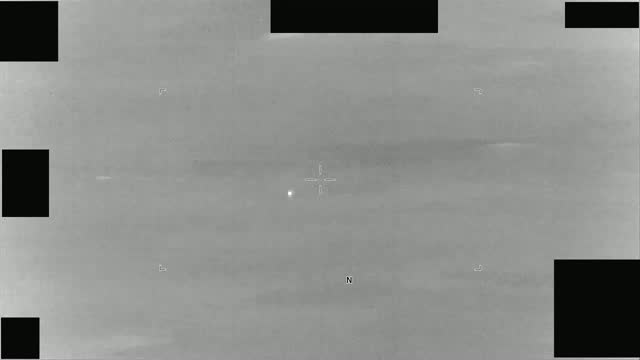
Vídeo de sensor infravermelho · 4 min 58 s · o vídeo só é carregado quando você inicia a reprodução, direto do servidor oficial.
Ficha oficial ↗- Publicação
- Publicação de 18 de setembro de 2026
- Código
- DOW-UAP-PR133
- Duração
- 4 min 58 s
- Órgão
- Comando Central dos EUA / AARO
Título original: DOW-UAP-PR133, Unresolved UAP Report, Middle East, 2025.
DESCRIÇÃO OFICIAL, EM PORTUGUÊS
O Comando Central dos Estados Unidos enviou ao AARO o relato de um fenômeno anômalo não identificado composto por 4 minutos e 58 segundos de vídeo de um sensor infravermelho a bordo de uma plataforma militar dos EUA, em 2024. O relatório de missão que o acompanha, DOW-UAP-D107, descreveu o UAP como “parecendo uma órbita branca redonda… movendo-se a até 500 milhas por hora”.
Descrição do vídeo:
00:00–00:04: o sensor acompanha uma área de contraste, mantendo-a no centro.
00:05–00:50: o sensor reduz a ampliação e continua acompanhando-a no centro.
00:51–01:21: o sensor reduz a ampliação e ajusta a velocidade de movimento para continuar acompanhando-a.
01:22–01:41: o sensor aumenta a ampliação e ajusta a velocidade de movimento, mantendo-a no centro.
01:43–02:05: uma sobreposição digital retangular, a “caixa de foco”, aparece perto do centro. É um elemento gráfico do sistema do sensor e não indica mudança física no ambiente. O sensor acompanha a área de contraste até ela sair pela borda inferior.
02:06–02:21: o sensor percorre a cena e reduz a ampliação. A área de contraste reaparece de vez em quando pela borda esquerda.
02:22–02:28: o sensor reencontra a área de contraste e volta a acompanhá-la no centro. Ele para de se mover por um instante, e ela sai de novo pela direita.
02:29–02:36: o sensor aciona um retículo de rastreamento automático, que não consegue travar. Quando o retículo se desliga, o sensor para, e a área de contraste sai pela borda direita.
02:37–03:22: o sensor se move e reencontra a área de contraste, mantendo-a no campo de visão até ela sair pela borda inferior.
03:23–04:29: o sensor continua se movendo, afasta o zoom e a reencontra, agora bem menor no campo de visão, e continua acompanhando.
04:30–04:58: o sensor aproxima o zoom; a área de contraste atravessa o campo de visão e sai por cima. O sensor alterna a ampliação várias vezes.
Esta descrição do vídeo tem caráter apenas informativo. Nenhuma parte dela deve ser lida como julgamento analítico, conclusão investigativa ou determinação factual sobre a validade, a natureza ou a importância do evento descrito.
Descrição original em inglês
The United States Central Command submitted a report of an unidentified anomalous phenomenon to the All-domain Anomaly Resolution Office (AARO) consisting of 4 minutes and 58 seconds of video footage from an infrared sensor aboard a U.S. military platform in 2024. An accompanying mission report, DOW-UAP-D107, described the UAP as “look[ing] like a white round orbit… moving as fast as 500 miles per hour.”
Video Description:
00:00-00:04: The sensor pans to track an area of contrast, keeping it generally centered within the frame.
00:05-00:50: The sensor decreases its level of magnification and continues to track the area of contrast, keeping it generally within the center of the frame.
00:51-01:21: The sensor decreases its level of magnification and adjusts its panning speed to track the area of contrast, keeping it generally within the center of the frame.
01:22-01:41: The sensor increases its level of magnification and adjusts its panning speed to track the area of contrast, keeping it generally within the center of the frame.
01:43-2:05: A rectangular digital overlay, or “focus box,” appears near the center of the frame. This display element is a graphical component of the sensor system and does indicate a physical change in the environment. The sensor pans to track the area of contrast, keeping it generally within the center of the frame before exiting the sensor field-of-view from the bottom edge.
02:06-02:21: The sensor pans across the scene and decreases its level of magnification. The area of contrast intermittently re-appears from the left edge of the frame.
02:22-02:28: The sensor pans across the scene, reacquiring the area of contrast. After the area of contrast re-enters the scene, the sensor continues to pan to track it, keeping it generally within the center of the frame. The sensor engages briefly stops panning and the area of contrast exits on the right side once again.
02:29-02:36: The sensor activates an auto-tracking reticle, which does not establish a lock on the area of contrast. After the auto-track reticle disengages, the sensor stops panning, causing the area of contrast to exit the frame from the right edge.
02:37-3:22: The sensor pans and requires the area of contrast, keeping it within its field-of-view before it exits the bottom edge of the frame.
3:23-4:29: The sensor continues to pan then zooms out and reacquires the area of contrast, now significantly smaller in the sensor’s field of view. The sensor continuously pans to keep the area of contrast in the field of view.
4:30-4:58: The sensor zooms in, and the area of contrast transits the field-of-view, exiting the top of the frame. The sensor cycles magnification levels multiple times.
This video description is provided for informational purposes only. Readers should not interpret any part of this description as reflecting an analytical judgment, investigative conclusion, or factual determination regarding the described event’s validity, nature, or significance.
DOSSIÊS RELACIONADOS
Arquivo idêntico em duração ao preservado no acervo da pesquisa (identificador DOD_111985772). Fonte: ficha oficial na DVIDS ↗.